fan BUICK ENCLAVE 2018 Owner's Guide
[x] Cancel search | Manufacturer: BUICK, Model Year: 2018, Model line: ENCLAVE, Model: BUICK ENCLAVE 2018Pages: 393, PDF Size: 5.68 MB
Page 181 of 393

Buick Enclave Owner Manual (GMNA-Localizing-U.S./Canada/Mexico-
10999311) - 2018 - crc - 11/20/17
180 Climate Controls
Caution
Do not try to clear frost or other
material from the inside of the
front windshield and rear window
with a razor blade or anything
else that is sharp. This may
damage the rear window
defogger grid and affect the
radio's ability to pick up stations
clearly. The repairs would not be
covered by the vehicle warranty.
Heated and Ventilated Seats
MorL:If equipped, pressMorLto heat the driver or passenger seat.
Cor{:If equipped, pressCor{to ventilate the driver or
passenger seat. See Heated and
Ventilated Seats 014.
Remote Start Climate Control
Operation : The climate control
system may run when the vehicle is
started remotely. If the vehicle has
heated or ventilated seats, they may come on during a remote start.
See
Remote Vehicle Start 036 and
Heated and Ventilated Seats 014.
Sensors
The solar sensor on top of the
instrument panel near the
windshield, monitors the solar heat.
The climate control system uses the
sensor information to adjust the
temperature, fan speed,
recirculation, and air delivery mode
for best comfort.
Do not cover the sensor; otherwise
the automatic climate control system
may not work properly.
Rear Climate Control
System
The rear climate control system is
on the rear of the center console
storage. The settings can be
adjusted with the rear climate
controls and the rear climate
display.
Rear Climate Controls
1. Fan Control
2. AUTO (Automatic Operation)
3. MODE (Air Delivery Mode Control)
4. TEMP (Temperature Control)
5. Heated Rear Seats (If Equipped)
Page 182 of 393
Buick Enclave Owner Manual (GMNA-Localizing-U.S./Canada/Mexico-
10999311) - 2018 - crc - 11/20/17
Climate Controls 181
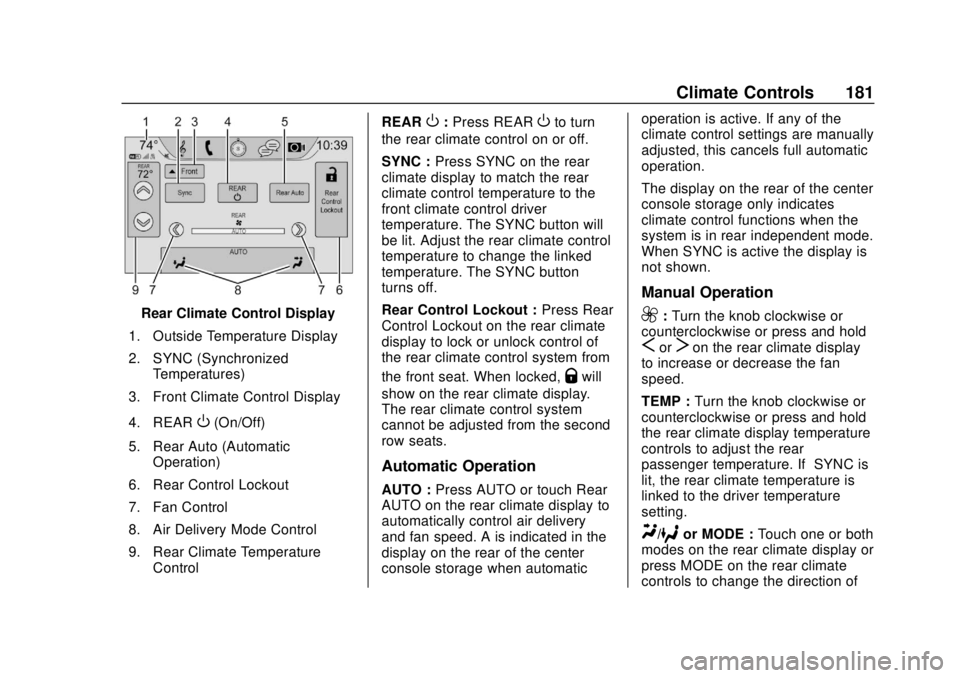
Rear Climate Control Display
1. Outside Temperature Display
2. SYNC (Synchronized Temperatures)
3. Front Climate Control Display
4. REAR
O(On/Off)
5. Rear Auto (Automatic Operation)
6. Rear Control Lockout
7. Fan Control
8. Air Delivery Mode Control
9. Rear Climate Temperature Control REAR
O:
Press REAROto turn
the rear climate control on or off.
SYNC : Press SYNC on the rear
climate display to match the rear
climate control temperature to the
front climate control driver
temperature. The SYNC button will
be lit. Adjust the rear climate control
temperature to change the linked
temperature. The SYNC button
turns off.
Rear Control Lockout : Press Rear
Control Lockout on the rear climate
display to lock or unlock control of
the rear climate control system from
the front seat. When locked,
Qwill
show on the rear climate display.
The rear climate control system
cannot be adjusted from the second
row seats.
Automatic Operation
AUTO : Press AUTO or touch Rear
AUTO on the rear climate display to
automatically control air delivery
and fan speed. A is indicated in the
display on the rear of the center
console storage when automatic operation is active. If any of the
climate control settings are manually
adjusted, this cancels full automatic
operation.
The display on the rear of the center
console storage only indicates
climate control functions when the
system is in rear independent mode.
When SYNC is active the display is
not shown.
Manual Operation
9:
Turn the knob clockwise or
counterclockwise or press and hold
SorTon the rear climate display
to increase or decrease the fan
speed.
TEMP : Turn the knob clockwise or
counterclockwise or press and hold
the rear climate display temperature
controls to adjust the rear
passenger temperature. If SYNC is
lit, the rear climate temperature is
linked to the driver temperature
setting.
Y/6or MODE : Touch one or both
modes on the rear climate display or
press MODE on the rear climate
controls to change the direction of
Page 196 of 393
Buick Enclave Owner Manual (GMNA-Localizing-U.S./Canada/Mexico-
10999311) - 2018 - crc - 11/20/17
Driving and Operating 195
.Allow greater following distance
and watch for slippery spots. Icy
patches can occur on otherwise
clear roads in shaded areas.
The surface of a curve or an
overpass can remain icy when
the surrounding roads are clear.
Avoid sudden steering
maneuvers and braking while
on ice.
. Turn off cruise control.
. Select All-Wheel Drive (AWD)
Mode for vehicles equipped with
AWD. Select Snow/Ice Mode for
FWD only vehicles.
See Driver Mode Control 0222
and All-Wheel Drive 0216.
Blizzard Conditions
Stop the vehicle in a safe place and
signal for help. Stay with the vehicle
unless there is help nearby.
If possible, use Roadside
Assistance. See Roadside
Assistance Program 0359. To get
help and keep everyone in the
vehicle safe:
. Turn on the hazard warning
flashers. .
Tie a red cloth to an outside
mirror.
{Warning
Snow can trap engine exhaust
under the vehicle. This may
cause exhaust gases to get
inside. Engine exhaust contains
carbon monoxide (CO), which
cannot be seen or smelled. It can
cause unconsciousness and even
death.
If the vehicle is stuck in snow:
. Clear snow from the base of
the vehicle, especially any
blocking the exhaust pipe.
. Open a window about 5 cm
(2 in) on the vehicle side
that is away from the wind,
to bring in fresh air.
. Fully open the air outlets on
or under the instrument
panel.
(Continued)
Warning (Continued)
.Adjust the climate control
system to circulate the air
inside the vehicle and set
the fan speed to the highest
setting. See “Climate
Control Systems.”
For more information about CO,
see Engine Exhaust 0209.
To save fuel, run the engine for
short periods to warm the vehicle
and then shut the engine off and
partially close the window. Moving
about to keep warm also helps.
If it takes time for help to arrive,
when running the engine, push the
accelerator pedal slightly so the
engine runs faster than the idle
speed. This keeps the battery
charged to restart the vehicle and to
signal for help with the headlamps.
Do this as little as possible, to
save fuel.
Page 269 of 393
Buick Enclave Owner Manual (GMNA-Localizing-U.S./Canada/Mexico-
10999311) - 2018 - crc - 11/20/17
268 Vehicle Care
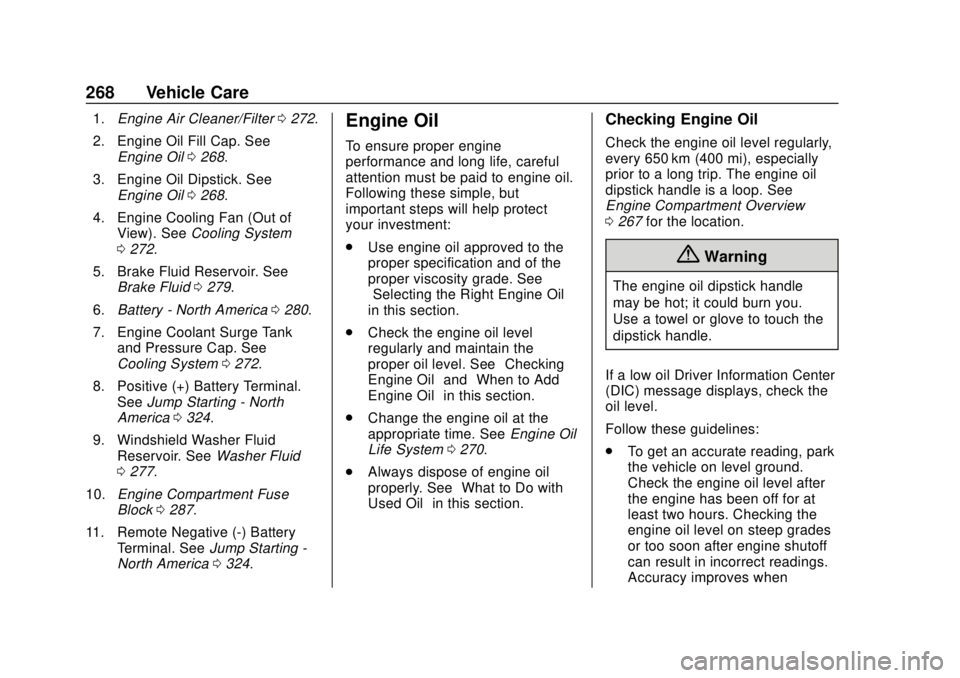
1.Engine Air Cleaner/Filter 0272.
2. Engine Oil Fill Cap. See Engine Oil 0268.
3. Engine Oil Dipstick. See Engine Oil 0268.
4. Engine Cooling Fan (Out of View). See Cooling System
0 272.
5. Brake Fluid Reservoir. See Brake Fluid 0279.
6. Battery - North America 0280.
7. Engine Coolant Surge Tank and Pressure Cap. See
Cooling System 0272.
8. Positive (+) Battery Terminal. See Jump Starting - North
America 0324.
9. Windshield Washer Fluid Reservoir. See Washer Fluid
0 277.
10. Engine Compartment Fuse
Block 0287.
11. Remote Negative (-) Battery Terminal. See Jump Starting -
North America 0324.Engine Oil
To ensure proper engine
performance and long life, careful
attention must be paid to engine oil.
Following these simple, but
important steps will help protect
your investment:
.
Use engine oil approved to the
proper specification and of the
proper viscosity grade. See
“Selecting the Right Engine Oil”
in this section.
. Check the engine oil level
regularly and maintain the
proper oil level. See “Checking
Engine Oil” and“When to Add
Engine Oil” in this section.
. Change the engine oil at the
appropriate time. See Engine Oil
Life System 0270.
. Always dispose of engine oil
properly. See “What to Do with
Used Oil” in this section.
Checking Engine Oil
Check the engine oil level regularly,
every 650 km (400 mi), especially
prior to a long trip. The engine oil
dipstick handle is a loop. See
Engine Compartment Overview
0267 for the location.
{Warning
The engine oil dipstick handle
may be hot; it could burn you.
Use a towel or glove to touch the
dipstick handle.
If a low oil Driver Information Center
(DIC) message displays, check the
oil level.
Follow these guidelines:
. To get an accurate reading, park
the vehicle on level ground.
Check the engine oil level after
the engine has been off for at
least two hours. Checking the
engine oil level on steep grades
or too soon after engine shutoff
can result in incorrect readings.
Accuracy improves when
Page 274 of 393
Buick Enclave Owner Manual (GMNA-Localizing-U.S./Canada/Mexico-
10999311) - 2018 - crc - 11/20/17
Vehicle Care 273
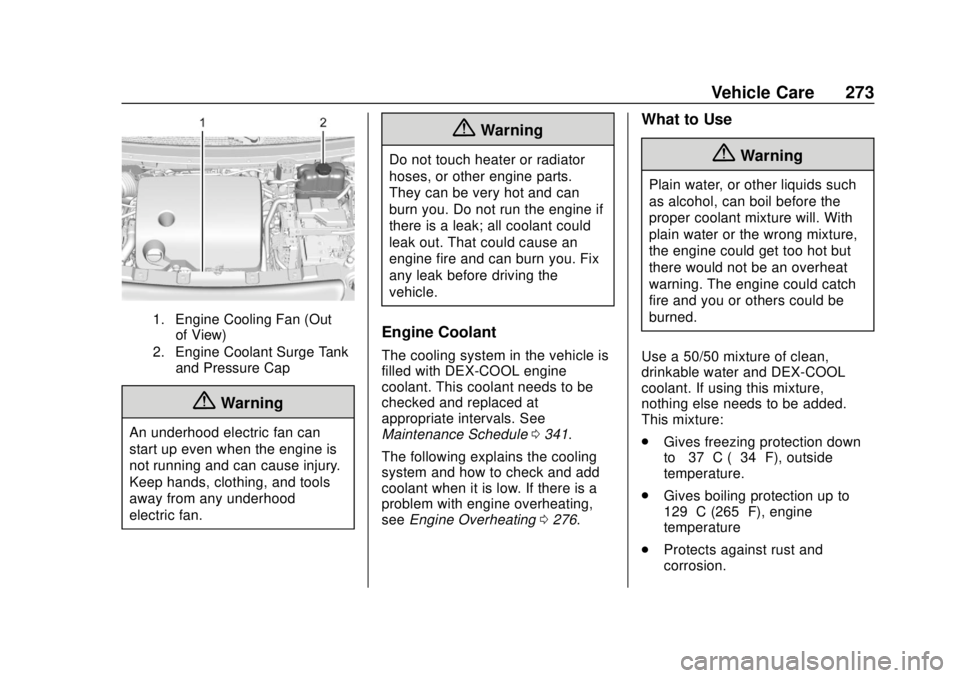
1. Engine Cooling Fan (Outof View)
2. Engine Coolant Surge Tank and Pressure Cap
{Warning
An underhood electric fan can
start up even when the engine is
not running and can cause injury.
Keep hands, clothing, and tools
away from any underhood
electric fan.
{Warning
Do not touch heater or radiator
hoses, or other engine parts.
They can be very hot and can
burn you. Do not run the engine if
there is a leak; all coolant could
leak out. That could cause an
engine fire and can burn you. Fix
any leak before driving the
vehicle.
Engine Coolant
The cooling system in the vehicle is
filled with DEX-COOL engine
coolant. This coolant needs to be
checked and replaced at
appropriate intervals. See
Maintenance Schedule 0341.
The following explains the cooling
system and how to check and add
coolant when it is low. If there is a
problem with engine overheating,
see Engine Overheating 0276.
What to Use
{Warning
Plain water, or other liquids such
as alcohol, can boil before the
proper coolant mixture will. With
plain water or the wrong mixture,
the engine could get too hot but
there would not be an overheat
warning. The engine could catch
fire and you or others could be
burned.
Use a 50/50 mixture of clean,
drinkable water and DEX-COOL
coolant. If using this mixture,
nothing else needs to be added.
This mixture:
. Gives freezing protection down
to−37 °C (−34 °F), outside
temperature.
. Gives boiling protection up to
129 °C (265 °F), engine
temperature
. Protects against rust and
corrosion.
Page 277 of 393
Buick Enclave Owner Manual (GMNA-Localizing-U.S./Canada/Mexico-
10999311) - 2018 - crc - 11/20/17
276 Vehicle Care
3. Fill the coolant surge tank withthe proper mixture to the
indicated level mark.
4. With the coolant surge tank pressure cap off, start the
engine and let it run until you
can feel the upper radiator
hose getting hot. Watch out for
the engine cooling fan.
By this time, the coolant level
inside the coolant surge tank
may be lower. If the level is
lower, add more of the proper
mixture to the coolant surge
tank until the level reaches the
indicated level mark.
5. Replace the pressure cap tightly.
6. Verify coolant level after the engine is shut off and the
coolant is cold. If necessary,
repeat coolant fill procedure
Steps 1–6.
If the coolant still is not at the
proper level when the system
cools down again, see your
dealer.Caution
If the pressure cap is not tightly
installed, coolant loss and engine
damage may occur. Be sure the
cap is properly and tightly
secured.
Engine Overheating
The vehicle has several indicators
to warn of the engine overheating.
There is an engine coolant
temperature gauge on the
instrument cluster. See Engine
Coolant Temperature Gauge 0137.
The vehicle may also display a
message on the Driver Information
Center (DIC).
If the decision is made not to lift the
hood when this warning appears,
get service help right away. See
Roadside Assistance Program
0 359.
If the decision is made to lift the
hood, make sure the vehicle is
parked on a level surface. Then
check to see if the engine cooling fan is running. If the engine is
overheating, the fan should be
running. If it is not, do not continue
to run the engine. Have the vehicle
serviced.
Caution
Do not run the engine if there is a
leak in the engine cooling system.
This can cause a loss of all
coolant and can damage the
system and vehicle. Have any
leaks fixed right away.
If Steam Is Coming from the
Engine Compartment
{Warning
Steam and scalding liquids from a
hot cooling system are under
pressure. Turning the pressure
cap, even a little, can cause them
to come out at high speed and
you could be burned. Never turn
the cap when the cooling system,
(Continued)
Page 278 of 393

Buick Enclave Owner Manual (GMNA-Localizing-U.S./Canada/Mexico-
10999311) - 2018 - crc - 11/20/17
Vehicle Care 277
Warning (Continued)
including the pressure cap, is hot.
Wait for the cooling system and
pressure cap to cool.
If No Steam Is Coming from
the Engine Compartment
If an engine overheat warning is
displayed but no steam can be seen
or heard, the problem may not be
too serious. Sometimes the engine
can get a little too hot when the
vehicle:
.Climbs a long hill on a hot day.
. Stops after high-speed driving.
. Idles for long periods in traffic.
If the overheat warning is displayed
with no sign of steam: 1. Turn the air conditioning off.
2. Turn the heater on to the highest temperature and to the
highest fan speed. Open the
windows as necessary. 3. When it is safe to do so, pull off
the road, shift to P (Park) or
N (Neutral), and let the
engine idle.
If the engine coolant temperature
gauge is no longer in the
overheated area, the vehicle can be
driven. Continue to drive the vehicle
slowly for about 10 minutes. Keep a
safe distance from the vehicle in
front. If the warning does not come
back on, continue to drive normally
and have the cooling system
checked for proper fill and function.
If the warning continues, pull over,
stop, and park the vehicle
right away.
If there is no sign of steam, idle the
engine for three minutes while
parked. If the warning is still
displayed, turn off the engine until it
cools down.
Washer Fluid
What to Use
When windshield washer fluid is
needed, be sure to read the
manufacturer's instructions before
use. If operating the vehicle in an
area where the temperature may fall
below freezing, use a fluid that has
sufficient protection against
freezing.
Adding Washer Fluid
Open the cap with the washer
symbol on it. Add washer fluid until
the tank is full. See Engine
Compartment Overview 0267 for
reservoir location.
Page 327 of 393
Buick Enclave Owner Manual (GMNA-Localizing-U.S./Canada/Mexico-
10999311) - 2018 - crc - 11/20/17
326 Vehicle Care
4. Turn the ignition off. Turn off alllights and accessories in both
vehicles, except the hazard
warning flashers if needed.
{Warning
An electric fan can start up even
when the engine is not running
and can injure you. Keep hands,
clothing, and tools away from any
underhood electric fan.
{Warning
Using a match near a battery can
cause battery gas to explode.
People have been hurt doing this,
and some have been blinded.
Use a flashlight if you need more
light.
Battery fluid contains acid that
can burn you. Do not get it on
you. If you accidentally get it in
your eyes or on your skin, flush
the place with water and get
medical help immediately.
{Warning
Fans or other moving engine
parts can injure you badly. Keep
your hands away from moving
parts once the engine is running.
5. Connect one end of the red positive (+) cable to the
positive (+) terminal on the
discharged battery.
6. Connect the other end of the red positive (+) cable to the
positive (+) terminal of the good
battery.
7. Connect one end of the black negative (–) cable to the
negative (–) terminal of the
good battery.
8. Connect the other end of the black negative (–) cable to the
remote negative (–) terminal for
the discharged battery.
9. Start the engine in the vehicle with the good battery and run
the engine at idle speed for at
least four minutes. 10. Try to start the vehicle that had
the dead battery. If it will not
start after a few tries, it
probably needs service.
Caution
If the jumper cables are
connected or removed in the
wrong order, electrical shorting
may occur and damage the
vehicle. The repairs would not be
covered by the vehicle warranty.
Always connect and remove the
jumper cables in the correct order,
making sure that the cables do
not touch each other or other
metal.
Jumper Cable Removal
Reverse the sequence exactly when
removing the jumper cables.
After starting the disabled vehicle
and removing the jumper cables,
allow it to idle for several minutes.
Page 383 of 393

Buick Enclave Owner Manual (GMNA-Localizing-U.S./Canada/Mexico-
10999311) - 2018 - crc - 11/20/17
382 Index
AutomaticDimming Mirrors . . . . . . . . . . . . . . . . 52
Door Locks . . . . . . . . . . . . . . . . . . . . . 40
Forward Braking . . . . . . . . . . . . . . 241
Headlamp System . . . . . . . . . . . . 169
Transmission . . . . . . . . . . . . . . . . . 210
Transmission Fluid . . . . . . . . . . . 271
Automatic Transmission Manual Mode . . . . . . . . . . . . . . . . . 215
B
BatteryExterior Lighting BatterySaver . . . . . . . . . . . . . . . . . . . . . . . 174
Load Management . . . . . . . . . . . . 173
Power Protection . . . . . . . . . . . . . 173
Battery - North America . . . . 280, 324
Blade Replacement, Wiper . . . . . 281
Brake
Parking, Electric . . . . . . . . . . . . . . 218
System Warning Light . . . . . . . . 142
Brakes . . . . . . . . . . . . . . . . . . . . . . . . . . 278 Antilock . . . . . . . . . . . . . . . . . . . . . . . 217
Assist . . . . . . . . . . . . . . . . . . . . . . . . . 219
Fluid . . . . . . . . . . . . . . . . . . . . . . . . . . 279
Braking . . . . . . . . . . . . . . . . . . . . . . . . . 186
Automatic Forward . . . . . . . . . . . 241 Braking System
Front Pedestrian (FPB) . . . . . . . 243
Break-In, New Vehicle . . . . . . . . . . 200
Bulb Replacement Headlamp Aiming . . . . . . . . . . . . . 284
Headlamps . . . . . . . . . . . . . . . . . . . 285
License Plate Lamps . . . . . . . . . 285
Buying New Tires . . . . . . . . . . . . . . . 310
C
Calibration . . . . . . . . . . . . . . . . . . . . . . 126
California Fuel Requirements . . . . . . . . . . . 250
Perchlorate MaterialsRequirements . . . . . . . . . . . . . . . 265
California Proposition
65 Warning . . . . . . . . . .264, 280, 324,
Back Cover
Canadian Vehicle Owners . . . . . . . . 2
Capacities and Specifications . . . . . . . . . . . . . . . . . 353
Carbon Monoxide Engine Exhaust . . . . . . . . . . . . . . . 209
Liftgate . . . . . . . . . . . . . . . . . . . . . . . . . 42
Winter Driving . . . . . . . . . . . . . . . . 194
Cargo Management System . . . . . . . . . .118 Caution, Danger, and Warning . . . . 2
Center Console Storage . . . . . . . . 118
Chains, Tire . . . . . . . . . . . . . . . . . . . . 315
Charging
Wireless . . . . . . . . . . . . . . . . . . . . . . 129
Charging System Light . . . . . . . . . 139
Check Engine Light (MalfunctionIndicator) . . . . . . . . . . . . . . . . . . . . 140
Child Restraints Infants and Young Children . . . . . 97
Lower Anchors and Tethers
for Children . . . . . . . . . . . . . . . . . 103
Older Children . . . . . . . . . . . . . . . . . . 96
Securing . . . . . . . . . . . . . . . . . . 111, 113
Systems . . . . . . . . . . . . . . . . . . . . . . 100
Circuit Breakers . . . . . . . . . . . . . . . . 286
Cleaning Exterior Care . . . . . . . . . . . . . . . . . 330
Interior Care . . . . . . . . . . . . . . . . . . 334
Climate Control Systems
Dual Automatic . . . . . . . . . . . . . . . 176
Rear . . . . . . . . . . . . . . . . . . . . . . . . . . 180
Clock . . . . . . . . . . . . . . . . . . . . . . . . . . . 126
Cluster, Instrument . . . . . . . . . . . . . 132
Collision Damage Repair . . . . . . . 362
Compact Spare Tire . . . . . . . . . . . . 323
Page 386 of 393

Buick Enclave Owner Manual (GMNA-Localizing-U.S./Canada/Mexico-
10999311) - 2018 - crc - 11/20/17
Index 385
G
Garage Door Opener . . . . . . . . . . . 162Programming . . . . . . . . . . . . . . . . . 162
Gas Strut(s) . . . . . . . . . . . . . . . . . . . . 283
Gauges Engine CoolantTemperature . . . . . . . . . . . . . . . . 137
Fuel . . . . . . . . . . . . . . . . . . . . . . . . . . 136
Odometer . . . . . . . . . . . . . . . . . . . . . 135
Speedometer . . . . . . . . . . . . . . . . . 135
Tachometer . . . . . . . . . . . . . . . . . . . 135
Trip Odometer . . . . . . . . . . . . . . . . 135
Warning Lights and Indicators . . . . . . . . . . . . . . . . . . . 131
General Information Service and Maintenance . . . . . 339
Towing . . . . . . . . . . . . . . . . . . . . . . . . 253
Vehicle Care . . . . . . . . . . . . . . . . . . 264
Glove Box . . . . . . . . . . . . . . . . . . . . . . 117
GM Mobility Reimbursement
Program . . . . . . . . . . . . . . . . . . . . . . . 359
H
Hazard Warning Flashers . . . . . . . 170
Head Restraints . . . . . . . . . . . . . . . . . 61
HeadlampsAiming . . . . . . . . . . . . . . . . . . . . . . . . 284
Automatic . . . . . . . . . . . . . . . . . . . . . 169 Headlamps (cont'd)
Bulb Replacement . . . . . . . . . . . . 285
Daytime Running
Lamps (DRL) . . . . . . . . . . . . . . . . 169
Flash-to-Pass . . . . . . . . . . . . . . . . . 168
High-Beam On Light . . . . . . . . . . 146
High/Low Beam Changer . . . . . 168
Lamps On Reminder . . . . . . . . . 147
Heated
Rear Seats . . . . . . . . . . . . . . . . . . . . . 72
Steering Wheel . . . . . . . . . . . . . . . 123
Heated and Ventilated Front Seats . . . . . . . . . . . . . . . . . . . . . . . . . . 68
Heated Mirrors . . . . . . . . . . . . . . . . . . . 52
Heater
Engine . . . . . . . . . . . . . . . . . . . . . . . . 204
Heating . . . . . . . . . . . . . . . . . . . . 176, 180
High-Beam On Light . . . . . . . . . . . . 146
High-Speed Operation . . . . . . . . . . 303
Hill and Mountain Roads . . . . . . . . 194
Hill Start Assist (HSA) . . . . . . . . . . 219
Hood . . . . . . . . . . . . . . . . . . . . . . . . . . . 266
Horn . . . . . . . . . . . . . . . . . . . . . . . . . . . . 124
How to Wear Seat Belts Properly . . . . . . . . . . . . . . . . . . . . . . . . 76
HVAC . . . . . . . . . . . . . . . . . . . . . . 176, 180
I
Ignition Positions . . . . . . . . . . . . . . . 200
Immobilizer . . . . . . . . . . . . . . . . . . . . . . 50
Indicator Pedestrian Ahead . . . . . . . . . . . . 144
Vehicle Ahead . . . . . . . . . . . . . . . . 144
Infants and Young Children, Restraints . . . . . . . . . . . . . . . . . . . . . . 97
Infotainment . . . . . . . . . . . . . . . . . . . . 175
Infotainment System . . . . . . . . . . . . 368
Instrument Cluster . . . . . . . . . . . . . . 132
Interior Rearview Mirrors . . . . . . . . . 53
Introduction . . . . . . . . . . . . . . . . . . . . . . . 2
J
Jump Starting - North America . . . . . . . . . . . . . . . . . . . . . . . 324
K
Keyless EntryRemote (RKE) System . . . . . . . . . 30
Keys . . . . . . . . . . . . . . . . . . . . . . . . . . . . . 29
L
Labeling, Tire Sidewall . . . . . . . . . . 296
Lamps Courtesy . . . . . . . . . . . . . . . . . . . . . . 171
Daytime Running (DRL) . . . . . . 169
Dome . . . . . . . . . . . . . . . . . . . . . . . . . 171