tire size BUICK ENCORE 2016 User Guide
[x] Cancel search | Manufacturer: BUICK, Model Year: 2016, Model line: ENCORE, Model: BUICK ENCORE 2016Pages: 320, PDF Size: 4.75 MB
Page 229 of 320
Buick Encore Owner Manual (GMNA-Localizing-U.S./Canada/Mexico-
9234779) - 2016 - CRC - 1/5/16
228 Vehicle Care
Sidewall:The portion of a tire
between the tread and the bead.
Speed Rating
:An
alphanumeric code assigned to
a tire indicating the maximum
speed at which a tire can
operate.
Traction
:The friction between
the tire and the road surface.
The amount of grip provided.
Tread
:The portion of a tire that
comes into contact with
the road.
Treadwear Indicators
:Narrow
bands, sometimes called wear
bars, that show across the tread
of a tire when only 1.6 mm
(1/16 in) of tread remains. See
When It Is Time for New
Tires 0235.
UTQGS (Uniform Tire Quality
Grading Standards)
:A tire
information system that provides
consumers with ratings for a
tire's traction, temperature, and
treadwear. Ratings are determined by tire
manufacturers using
government testing procedures.
The ratings are molded into the
sidewall of the tire. See
Uniform
Tire Quality Grading 0237.
Vehicle Capacity Weight
:The
number of designated seating
positions multiplied by
68 kg (150 lb) plus the rated
cargo load. See Vehicle Load
Limits 0151.
Vehicle Maximum Load on the
Tire
:Load on an individual tire
due to curb weight, accessory
weight, occupant weight, and
cargo weight.
Vehicle Placard
:A label
permanently attached to a
vehicle showing the vehicle
capacity weight and the original
equipment tire size and
recommended inflation pressure.
See “Tire and Loading
Information Label” underVehicle
Load Limits 0151.
Tire Pressure
Tires need the correct amount of
air pressure to operate
effectively.
Caution
Neither tire underinflation nor
overinflation is good.
Underinflated tires, or tires
that do not have enough air,
can result in:
.Tire overloading and
overheating which could
lead to a blowout.
.Premature or
irregular wear.
.Poor handling.
.Reduced fuel economy.
Overinflated tires, or tires that
have too much air, can
result in:
.Unusual wear.
(Continued)
Page 231 of 320
Buick Encore Owner Manual (GMNA-Localizing-U.S./Canada/Mexico-
9234779) - 2016 - CRC - 1/5/16
230 Vehicle Care
Each tire, including the spare (if
provided), should be checked
monthly when cold and inflated to
the inflation pressure recommended
by the vehicle manufacturer on the
vehicle placard or tire inflation
pressure label. (If your vehicle has
tires of a different size than the size
indicated on the vehicle placard or
tire inflation pressure label, you
should determine the proper tire
inflation pressure for those tires.)
As an added safety feature, your
vehicle has been equipped with a
tire pressure monitoring system
(TPMS) that illuminates a low tire
pressure telltale when one or more
of your tires is significantly
under-inflated.
Accordingly, when the low tire
pressure telltale illuminates, you
should stop and check your tires as
soon as possible, and inflate them
to the proper pressure. Driving on a
significantly under-inflated tire
causes the tire to overheat and can
lead to tire failure. Under-inflation
also reduces fuel efficiency and tiretread life, and may affect the
vehicle's handling and stopping
ability.
Please note that the TPMS is not a
substitute for proper tire
maintenance, and it is the driver's
responsibility to maintain correct tire
pressure, even if under-inflation has
not reached the level to trigger
illumination of the TPMS low tire
pressure telltale.
Your vehicle has also been
equipped with a TPMS malfunction
indicator to indicate when the
system is not operating properly.
The TPMS malfunction indicator is
combined with the low tire pressure
telltale. When the system detects a
malfunction, the telltale will flash for
approximately one minute and then
remain continuously illuminated.
This sequence will continue upon
subsequent vehicle start-ups as
long as the malfunction exists.
When the malfunction indicator is
illuminated, the system may not be
able to detect or signal low tire
pressure as intended. TPMS
malfunctions may occur for a varietyof reasons, including the installation
of replacement or alternate tires or
wheels on the vehicle that prevent
the TPMS from functioning properly.
Always check the TPMS malfunction
telltale after replacing one or more
tires or wheels on your vehicle to
ensure that the replacement or
alternate tires and wheels allow the
TPMS to continue to function
properly.
See
Tire Pressure Monitor
Operation 0230.
See Radio Frequency
Statement 0288.
Tire Pressure Monitor
Operation
This vehicle may have a Tire
Pressure Monitor System (TPMS).
The TPMS is designed to warn the
driver when a low tire pressure
condition exists. TPMS sensors are
mounted onto each tire and wheel
assembly, excluding the spare tire
and wheel assembly. The TPMS
sensors monitor the air pressure in
Page 232 of 320
Buick Encore Owner Manual (GMNA-Localizing-U.S./Canada/Mexico-
9234779) - 2016 - CRC - 1/5/16
Vehicle Care 231
the tires and transmit the tire
pressure readings to a receiver
located in the vehicle.
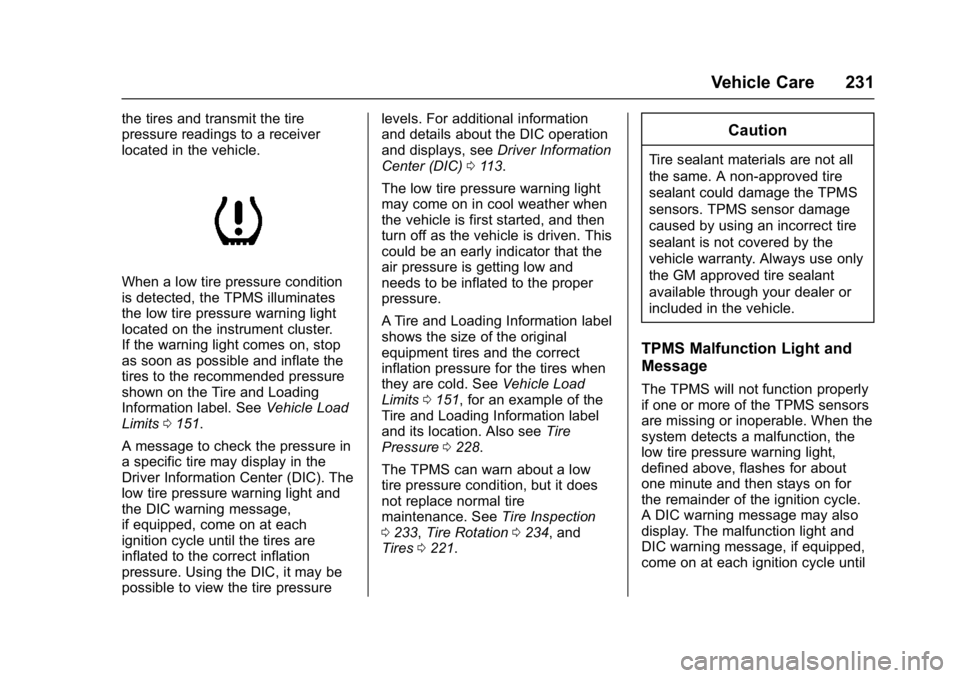
When a low tire pressure condition
is detected, the TPMS illuminates
the low tire pressure warning light
located on the instrument cluster.
If the warning light comes on, stop
as soon as possible and inflate the
tires to the recommended pressure
shown on the Tire and Loading
Information label. SeeVehicle Load
Limits 0151.
A message to check the pressure in
a specific tire may display in the
Driver Information Center (DIC). The
low tire pressure warning light and
the DIC warning message,
if equipped, come on at each
ignition cycle until the tires are
inflated to the correct inflation
pressure. Using the DIC, it may be
possible to view the tire pressure levels. For additional information
and details about the DIC operation
and displays, see
Driver Information
Center (DIC) 0113.
The low tire pressure warning light
may come on in cool weather when
the vehicle is first started, and then
turn off as the vehicle is driven. This
could be an early indicator that the
air pressure is getting low and
needs to be inflated to the proper
pressure.
A Tire and Loading Information label
shows the size of the original
equipment tires and the correct
inflation pressure for the tires when
they are cold. See Vehicle Load
Limits 0151, for an example of the
Tire and Loading Information label
and its location. Also see Tire
Pressure 0228.
The TPMS can warn about a low
tire pressure condition, but it does
not replace normal tire
maintenance. See Tire Inspection
0 233, Tire Rotation 0234, and
Tires 0221.
Caution
Tire sealant materials are not all
the same. A non-approved tire
sealant could damage the TPMS
sensors. TPMS sensor damage
caused by using an incorrect tire
sealant is not covered by the
vehicle warranty. Always use only
the GM approved tire sealant
available through your dealer or
included in the vehicle.
TPMS Malfunction Light and
Message
The TPMS will not function properly
if one or more of the TPMS sensors
are missing or inoperable. When the
system detects a malfunction, the
low tire pressure warning light,
defined above, flashes for about
one minute and then stays on for
the remainder of the ignition cycle.
A DIC warning message may also
display. The malfunction light and
DIC warning message, if equipped,
come on at each ignition cycle until
Page 235 of 320
Buick Encore Owner Manual (GMNA-Localizing-U.S./Canada/Mexico-
9234779) - 2016 - CRC - 1/5/16
234 Vehicle Care
.The tire has a bump, bulge,
or split.
.The tire has a puncture, cut,
or other damage that cannot
be repaired well because of
the size or location of the
damage.
Tire Rotation
Tires should be rotated every
12 000 km (7,500 mi). See
Maintenance Schedule0263.
Tires are rotated to achieve a
more uniform wear for all tires.
The first rotation is the most
important.
Anytime unusual wear is
noticed, rotate the tires as soon
as possible, check for proper tire
inflation pressure, and check for
damaged tires or wheels. If the
unusual wear continues after the
rotation, check the wheel
alignment. See When It Is Time
for New Tires 0235 andWheel
Replacement 0239.
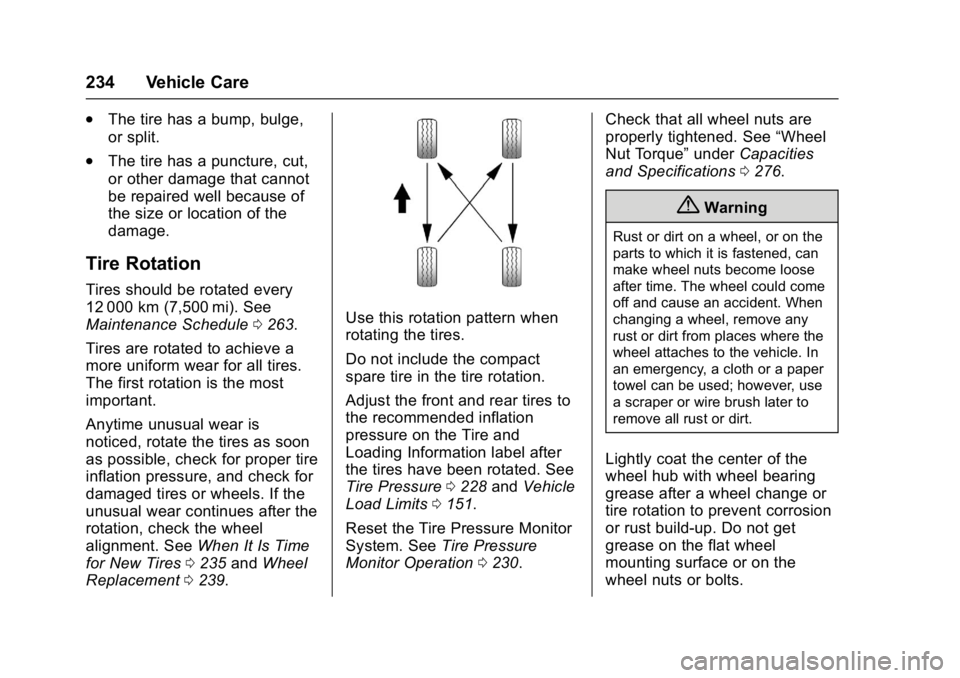
Use this rotation pattern when
rotating the tires.
Do not include the compact
spare tire in the tire rotation.
Adjust the front and rear tires to
the recommended inflation
pressure on the Tire and
Loading Information label after
the tires have been rotated. See
Tire Pressure 0228 and Vehicle
Load Limits 0151.
Reset the Tire Pressure Monitor
System. See Tire Pressure
Monitor Operation 0230. Check that all wheel nuts are
properly tightened. See
“Wheel
Nut Torque” underCapacities
and Specifications 0276.
{Warning
Rust or dirt on a wheel, or on the
parts to which it is fastened, can
make wheel nuts become loose
after time. The wheel could come
off and cause an accident. When
changing a wheel, remove any
rust or dirt from places where the
wheel attaches to the vehicle. In
an emergency, a cloth or a paper
towel can be used; however, use
a scraper or wire brush later to
remove all rust or dirt.
Lightly coat the center of the
wheel hub with wheel bearing
grease after a wheel change or
tire rotation to prevent corrosion
or rust build-up. Do not get
grease on the flat wheel
mounting surface or on the
wheel nuts or bolts.
Page 237 of 320
Buick Encore Owner Manual (GMNA-Localizing-U.S./Canada/Mexico-
9234779) - 2016 - CRC - 1/5/16
236 Vehicle Care
vehicle, including brake system
performance, ride and handling,
traction control, and tire
pressure monitoring
performance. GM's TPC Spec
number is molded onto the tire's
sidewall near the tire size. If the
tires have an all-season tread
design, the TPC Spec number
will be followed by MS for mud
and snow. SeeTire Sidewall
Labeling 0223.
GM recommends replacing worn
tires in complete sets of four.
Uniform tread depth on all tires
will help to maintain the
performance of the vehicle.
Braking and handling
performance may be adversely
affected if all the tires are not
replaced at the same time.
If proper rotation and
maintenance have been done,
all four tires should wear out at
about the same time. See Tire
Rotation 0234. However, if it is necessary to replace only one
axle set of worn tires, place the
new tires on the rear axle.
Winter tires with the same speed
rating as the original equipment
tires may not be available for H,
V, W, Y and ZR speed rated
tires. Never exceed the winter
tires’
maximum speed capability
when using winter tires with a
lower speed rating.
{Warning
Tires could explode during
improper service. Attempting
to mount or dismount a tire
could cause injury or death.
Only your dealer or authorized
tire service center should
mount or dismount the tires.
{Warning
Mixing tires of different sizes,
brands, or types may cause
loss of control of the vehicle,
resulting in a crash or other
vehicle damage. Use the
correct size, brand, and type
of tires on all wheels.
{Warning
Using bias-ply tires on the
vehicle may cause the wheel
rim flanges to develop cracks
after many miles of driving.
A tire and/or wheel could fail
suddenly and cause a crash.
Use only radial-ply tires with
the wheels on the vehicle.
If the vehicle tires must be
replaced with a tire that does not
have a TPC Spec number, make
sure they are the same size,
Page 238 of 320

Buick Encore Owner Manual (GMNA-Localizing-U.S./Canada/Mexico-
9234779) - 2016 - CRC - 1/5/16
Vehicle Care 237
load range, speed rating, and
construction (radial) as the
original tires.
Vehicles that have a tire
pressure monitoring system
could give an inaccurate
low-pressure warning if non-TPC
Spec rated tires are installed.
SeeTire Pressure Monitor
System 0229.
The Tire and Loading
Information label indicates the
original equipment tires on the
vehicle. See Vehicle Load
Limits 0151.
Different Size Tires and
Wheels
If wheels or tires are installed that
are a different size than the original
equipment wheels and tires, vehicle
performance, including its braking,
ride and handling characteristics,
stability, and resistance to rollover
may be affected. If the vehicle has
electronic systems such as antilock
brakes, rollover airbags, roll bars, traction control, electronic stability
control, or All-Wheel Drive, the
performance of these systems can
also be affected.
{Warning
If different sized wheels are used,
there may not be an acceptable
level of performance and safety if
tires not recommended for those
wheels are selected. This
increases the chance of a crash
and serious injury. Only use GM
specific wheel and tire systems
developed for the vehicle, and
have them properly installed by a
GM certified technician.
See Buying New Tires 0235 and
Accessories and
Modifications 0189.
Uniform Tire Quality
Grading
The following information relates
to the system developed by the
United States National Highway Traffic Safety Administration
(NHTSA), which grades tires by
treadwear, traction, and
temperature performance. This
applies only to vehicles sold in
the United States. The grades
are molded on the sidewalls of
most passenger car tires. The
Uniform Tire Quality Grading
(UTQG) system does not apply
to deep tread, winter tires,
compact spare tires, tires with
nominal rim diameters of
10 to 12 inches (25 to 30 cm),
or to some limited-production
tires.
While the tires available on
General Motors passenger cars
and light trucks may vary with
respect to these grades, they
must also conform to federal
safety requirements and
additional General Motors Tire
Performance Criteria (TPC)
standards.
Page 241 of 320
Buick Encore Owner Manual (GMNA-Localizing-U.S./Canada/Mexico-
9234779) - 2016 - CRC - 1/5/16
240 Vehicle Care
Tire Chains
{Warning
Do not use tire chains. There is
not enough clearance. Tire chains
used on a vehicle without the
proper amount of clearance can
cause damage to the brakes,
suspension, or other vehicle
parts. The area damaged by the
tire chains could cause loss of
control and a crash.
Use another type of traction
device only if its manufacturer
recommends it for the vehicle's
tire size combination and road
conditions. Follow that
manufacturer's instructions. To
avoid vehicle damage, drive slow
and readjust or remove the
traction device if it contacts the
vehicle. Do not spin the wheels.
If traction devices are used, install
them on the front tires.
If a Tire Goes Flat
It is unusual for a tire to blow out
while driving, especially if the tires
are maintained properly. SeeTires
0 221. If air goes out of a tire, it is
much more likely to leak out slowly.
But if there ever is a blowout, here
are a few tips about what to expect
and what to do:
If a front tire fails, the flat tire
creates a drag that pulls the vehicle
toward that side. Take your foot off
the accelerator pedal and grip the
steering wheel firmly. Steer to
maintain lane position, and then
gently brake to a stop, well off the
road, if possible.
A rear blowout, particularly on a
curve, acts much like a skid and
may require the same correction as
used in a skid. Stop pressing the
accelerator pedal and steer to
straighten the vehicle. It may be
very bumpy and noisy. Gently brake
to a stop, well off the road,
if possible.{Warning
Driving on a flat tire will cause
permanent damage to the tire.
Re-inflating a tire after it has been
driven on while severely
underinflated or flat may cause a
blowout and a serious crash.
Never attempt to re-inflate a tire
that has been driven on while
severely underinflated or flat.
Have your dealer or an authorized
tire service center repair or
replace the flat tire as soon as
possible.
{Warning
Lifting a vehicle and getting under
it to do maintenance or repairs is
dangerous without the
appropriate safety equipment and
training. If a jack is provided with
the vehicle, it is designed only for
changing a flat tire. If it is used for
anything else, you or others could
(Continued)
Page 246 of 320
Buick Encore Owner Manual (GMNA-Localizing-U.S./Canada/Mexico-
9234779) - 2016 - CRC - 1/5/16
Vehicle Care 245
13. Tighten the wheel nuts firmlywith the wheel wrench in a
crisscross sequence, as
shown.
Caution
Wheel covers will not fit on the
vehicle's compact spare. If you try
to put a wheel cover on the
compact spare, the cover or the
spare could be damaged.
Storing a Flat or Spare Tire
and Tools
{Warning
Storing a jack, a tire, or other
equipment in the passenger
compartment of the vehicle could
cause injury. In a sudden stop or
collision, loose equipment could
strike someone. Store all these in
the proper place. Storing the Flat Tire and Tools
1. Return the jack and tools to their original storage location.
2. Replace the trim cover.
3. Place the flat tire, lying flat, in the rear storage compartment.
4. Attach one end of the strap to a cargo tie-down in the rear of
the vehicle.
5. Route the strap through the
wheel, as shown.
6. Attach the other end of the strap to the other cargo
tie-down in the rear of the
vehicle.
7. Tighten the strap. Storing the Compact Spare Tire
and Tools
Reverse the instructions for
removing the spare tire and tools to
store the spare tire.
The compact spare tire is for
temporary use only. Replace the
compact spare tire with a full-size
tire as soon as you can. See
Compact Spare Tire
0245.
Compact Spare Tire
{Warning
Driving with more than one
compact spare tire at a time could
result in loss of braking and
handling. This could lead to a
crash and you or others could be
injured. Use only one compact
spare tire at a time.
If this vehicle has a compact spare
tire, it was fully inflated when new;
however, it can lose air over time.
Check the inflation pressure
regularly. It should be 420 kPa
(60 psi).
Page 318 of 320

Buick Encore Owner Manual (GMNA-Localizing-U.S./Canada/Mexico-
9234779) - 2016 - CRC - 1/5/16
Index 317
Securing Child Restraints . . . . 83, 85
SecurityOnStar
®. . . . . . . . . . . . . . . . . . . . . . 293
Vehicle . . . . . . . . . . . . . . . . . . . . . . . . . 33
Vehicle Alarm . . . . . . . . . . . . . . . . . . . 33
Service Accessories and
Modifications . . . . . . . . . . . . . . . . 189
Climate Control System . . . . . . . 134
Doing Your Own Work . . . . . . . . 189
Engine Soon Light . . . . . . . . . . . . 106
Maintenance Records . . . . . . . . 274
Maintenance, General Information . . . . . . . . . . . . . . . . . . 262
Parts Identification Label . . . . . 275
Publications Ordering Information . . . . . . . . . . . . . . . . . . 287
Scheduling Appointments . . . . . 284
Services Special Application . . . . . . . . . . . 269
Servicing the Airbag . . . . . . . . . . . . . 69
Shift Lock Control Function
Check, Automatic
Transmission . . . . . . . . . . . . . . . . . . 208
Shifting
Into Park . . . . . . . . . . . . . . . . . . . . . . 160
Out of Park . . . . . . . . . . . . . . . . . . . 161
Side Blind Zone Alert (SBZA) . . . 178 Signals, Turn and
Lane-Change . . . . . . . . . . . . . . . . . 129
Spare Tire Compact . . . . . . . . . . . . . . . . . . . . . . 245
Special Application Services . . . . 269
Specifications and Capacities . . . . . . . . . . . . . . . . . . . . . 276
Speedometer . . . . . . . . . . . . . . . . . . . 102
StabiliTrak OFF Light . . . . . . . . . . . . . . . . . . . . . .110
Start Vehicle, Remote . . . . . . . . . . . 29
Starter Switch Check . . . . . . . . . . . 208
Starting the Engine . . . . . . . . . . . . . 157
Steering . . . . . . . . . . . . . . . . . . . . . . . . 146
Heated Wheel . . . . . . . . . . . . . . . . . . 95
Power, Warning Lights . . . . . . . . 109
Wheel Adjustment . . . . . . . . . . . . . . 95
Wheel Controls . . . . . . . . . . . . . . . . . 95
Storage Areas Cargo Cover . . . . . . . . . . . . . . . . . . . . 91
Cargo Management System . . . . 91
Center Console . . . . . . . . . . . . . . . . . 91
Convenience Net . . . . . . . . . . . . . . . 92
Glove Box . . . . . . . . . . . . . . . . . . . . . . 89
Instrument Panel . . . . . . . . . . . . . . . 89
Roof Rack System . . . . . . . . . . . . . . 93
Sunglasses . . . . . . . . . . . . . . . . . . . . . 90
Underseat . . . . . . . . . . . . . . . . . . . . . . 90 Storage Compartments . . . . . . . . . . 89
Stuck Vehicle . . . . . . . . . . . . . . . . . . . 150
Summer Tires . . . . . . . . . . . . . . . . . . 223
Sun Visors . . . . . . . . . . . . . . . . . . . . . . . 39
Sunglass Storage . . . . . . . . . . . . . . . . 90
Sunroof . . . . . . . . . . . . . . . . . . . . . . . . . . 39
Symbols . . . . . . . . . . . . . . . . . . . . . . . . . . 3
System
Forward CollisionAlert (FCA) . . . . . . . . . . . . . . . . . . 177
Infotainment . . . . . . . . . . . . . 133, 291
Roof Rack . . . . . . . . . . . . . . . . . . . . . . 93
T
Tachometer . . . . . . . . . . . . . . . . . . . . . 102
Text Telephone (TTY) Users . . . . 280
Theft-Deterrent Systems . . . . . . . . . 35
Immobilizer . . . . . . . . . . . . . . . . . . . . . 34
Time . . . . . . . . . . . . . . . . . . . . . . . . . . . . . 98
Tires . . . . . . . . . . . . . . . . . . . . . . . . . . . . 221 All-Season . . . . . . . . . . . . . . . . . . . . 222
Buying New Tires . . . . . . . . . . . . . 235
Chains . . . . . . . . . . . . . . . . . . . . . . . . 240
Changing . . . . . . . . . . . . . . . . . . . . . 241
Compact Spare . . . . . . . . . . . . . . . 245
Designations . . . . . . . . . . . . . . . . . 225
Different Size . . . . . . . . . . . . . . . . . 237
If a Tire Goes Flat . . . . . . . . . . . . 240
Inspection . . . . . . . . . . . . . . . . . . . . 233
Page 319 of 320

Buick Encore Owner Manual (GMNA-Localizing-U.S./Canada/Mexico-
9234779) - 2016 - CRC - 1/5/16
318 Index
Tires (cont'd)Messages . . . . . . . . . . . . . . . . . . . . 120
Pressure Light . . . . . . . . . . . . . . . . . 111
Pressure Monitor Operation . . 230
Pressure Monitor System . . . . . 229
Rotation . . . . . . . . . . . . . . . . . . . . . . 234
Sidewall Labeling . . . . . . . . . . . . . 223
Terminology and Definitions . . 226
Uniform Tire Quality
Grading . . . . . . . . . . . . . . . . . . . . . 237
Wheel Alignment and Tire Balance . . . . . . . . . . . . . . . . . . . . . 239
Wheel Replacement . . . . . . . . . . 239
When It Is Time for New Tires . . . . . . . . . . . . . . . . . . . . . . . . 235
Winter . . . . . . . . . . . . . . . . . . . . . . . . 222
Towing General Information . . . . . . . . . . 185
Recreational Vehicle . . . . . . . . . . 250
Vehicle . . . . . . . . . . . . . . . . . . . . . . . 249
Traction Control System (TCS)/StabiliTrak
®Light . . . . . . . . . . . . .110
Off Light . . . . . . . . . . . . . . . . . . . . . . .110
Traction Control/Electronic Stability Control . . . . . . . . . . . . . . . 168
Transmission Automatic . . . . . . . . . . . . . . . . . . . . . 164 Transmission (cont'd)
Fluid, Automatic . . . . . . . . . . . . . . 198
Messages . . . . . . . . . . . . . . . . . . . . 120
Transportation Program,
Courtesy . . . . . . . . . . . . . . . . . . . . . . 284
Triangle, Warning . . . . . . . . . . . . . . . . 92
Trip Odometer . . . . . . . . . . . . . . . . . . 102
Turn and Lane-Change Signals . . . . . . . . . . . . . . . . . . . . . . . . 129
U
Underseat Storage . . . . . . . . . . . . . . 90
Uniform Tire Quality Grading . . . 237
Using This Manual . . . . . . . . . . . . . . . . 2
V
Vehicle
Alarm System . . . . . . . . . . . . . . . . . . 33
Canadian Owners . . . . . . . . . . . . . . . 2
Control . . . . . . . . . . . . . . . . . . . . . . . 145
Design . . . . . . . . . . . . . . . . . . . . . . . . 144
Identification Number (VIN) . . . 275
Load Limits . . . . . . . . . . . . . . . . . . . 151
Messages . . . . . . . . . . . . . . . . . . . . .116
Personalization . . . . . . . . . . . . . . . 121
Remote Start . . . . . . . . . . . . . . . . . . . 29
Security . . . . . . . . . . . . . . . . . . . . . . . . 33
Towing . . . . . . . . . . . . . . . . . . . . . . . . 249
Vehicle Ahead Indicator . . . . . . . . 110 Vehicle Care
Tire Pressure . . . . . . . . . . . . . . . . . 228
Vehicle Data Recording and Privacy . . . . . . . . . . . . . . . . . . . . . . . . 289
Ventilation, Air . . . . . . . . . . . . . . . . . . 141
Visors . . . . . . . . . . . . . . . . . . . . . . . . . . . 39
W
Warning Brake System Light . . . . . . . . . . . 108
Caution and Danger . . . . . . . . . . . . . 3
Lane Departure (LDW) . . . . . . . 180
Warning Lights, Gauges, and Indicators . . . . . . . . . . . . . . . . . . . . . 100
Warning Triangle . . . . . . . . . . . . . . . . 92
Warnings Hazard Flashers . . . . . . . . . . . . . . 128
Washer Fluid . . . . . . . . . . . . . . . . . . . 204
Wheels Alignment and Tire Balance . . 239
Different Size . . . . . . . . . . . . . . . . . 237
Replacement . . . . . . . . . . . . . . . . . 239
When It Is Time for New Tires . . . . . . . . . . . . . . . . . . . . . . . . . . 235
Where to Put the Restraint . . . . . . 76
Windows . . . . . . . . . . . . . . . . . . . . . . . . 37 Power . . . . . . . . . . . . . . . . . . . . . . . . . . 38
Windshield Replacement . . . . . . . . . . . . . . . . . .211