instrument panel BUICK LACROSSE 2006 Workshop Manual
[x] Cancel search | Manufacturer: BUICK, Model Year: 2006, Model line: LACROSSE, Model: BUICK LACROSSE 2006Pages: 444, PDF Size: 2.66 MB
Page 302 of 444
Wheel Alignment and Tire Balance..................5-70
Wheel Replacement......................................5-70
Tire Chains..................................................5-72
If a Tire Goes Flat........................................5-72
Changing a Flat Tire.....................................5-73
Removing the Spare Tire and Tools................5-74
Removing the Flat Tire and Installing
the Spare Tire..........................................5-76
Storing a Flat or Spare Tire and Tools............5-82
Compact Spare Tire......................................5-83
Appearance Care............................................5-84
Cleaning the Inside of Your Vehicle.................5-84
Fabric/Carpet...............................................5-85
Leather.......................................................5-86
Instrument Panel, Vinyl, and Other
Plastic Surfaces........................................5-86
Care of Safety Belts......................................5-87
Weatherstrips...............................................5-87
Washing Your Vehicle...................................5-87
Cleaning Exterior Lamps/Lenses.....................5-87
Finish Care..................................................5-88Windshield and Wiper Blades.........................5-88
Aluminum or Chrome-Plated Wheels................5-89
Tires...........................................................5-89
Sheet Metal Damage.....................................5-90
Finish Damage.............................................5-90
Underbody Maintenance................................5-90
Chemical Paint Spotting.................................5-90
Vehicle Care/Appearance Materials..................5-91
Vehicle Identication......................................5-92
Vehicle Identication Number (VIN).................5-92
Service Parts Identication Label.....................5-92
Electrical System............................................5-93
Add-On Electrical Equipment..........................5-93
Headlamp Wiring..........................................5-93
Windshield Wiper Fuses................................5-93
Power Windows and Other Power Options.......5-93
Fuses and Circuit Breakers............................5-93
Instrument Panel Fuse Block..........................5-94
Underhood Fuse Block..................................5-95
Capacities and Specications..........................5-98
Section 5 Service and Appearance Care
5-2
Page 305 of 444
Your vehicle has an airbag system. Before attempting
to do your own service work, seeServicing Your
Airbag-Equipped Vehicle on page 1-69.
You should keep a record with all parts receipts and
list the mileage and the date of any service work
you perform. SeeMaintenance Record on page 6-14.
Adding Equipment to the Outside
of Your Vehicle
Things you might add to the outside of your vehicle can
affect the airow around it. This may cause wind noise
and affect windshield washer performance. Check with
your dealer before adding equipment to the outside of
your vehicle.
Fuel
The 8th digit of your vehicle identication number (VIN)
shows the code letter or number that identies your
engine. You will nd the VIN at the top left of the
instrument panel. SeeVehicle Identication Number
(VIN) on page 5-92.
Gasoline Octane
If your vehicle has the 3.8L V6 engine (VIN Code 2),
use regular unleaded gasoline with a posted octane
rating of 87 or higher. If the octane rating is less than 87,
you may notice an audible knocking noise when you
drive, commonly referred to as spark knock. If this
occurs, use a gasoline rated at 87 octane or higher as
soon as possible. If you are using gasoline rated at
87 octane or higher and you hear heavy knocking, your
engine needs service.
If your vehicle has the 3.6L V6 engine (VIN Code 7),
use regular unleaded gasoline with a posted octane
rating of 87 or higher. For best performance or trailer
towing, you may choose to use middle grade 89 octane
unleaded gasoline. If the octane rating is less than
87, you may notice an audible knocking noise when you
drive, commonly referred to as spark knock. If this
occurs, use a gasoline rated at 87 octane or higher as
soon as possible. If you are using gasoline rated at
87 octane or higher and you hear heavy knocking, your
engine needs service.
5-5
Page 309 of 444
{CAUTION:
If you spill fuel and then something ignites it,
you could be badly burned. Fuel can spray out
on you if you open the fuel cap too quickly.
This spray can happen if your tank is nearly
full, and is more likely in hot weather. Open
the fuel cap slowly and wait for any hiss noise
to stop. Then unscrew the cap all the way.
Be careful not to spill fuel. Do not top off or overll the
tank and wait a few seconds after you have nished
pumping before removing the nozzle. Clean fuel
from painted surfaces as soon as possible. See
Washing Your Vehicle on page 5-87.
When replacing the fuel cap, turn it clockwise until
it clicks. Make sure the cap is fully installed. The
diagnostic system can determine if the fuel cap has
been left off or improperly installed. This would allow
fuel to evaporate into the atmosphere. SeeMalfunction
Indicator Lamp on page 3-41.Your vehicle may also be equipped with a check gas
cap warning light, which will be displayed on the
instrument panel cluster if the fuel cap is not properly
installed. SeeCheck Gas Cap Light on page 3-49
for more information.
If your vehicle has a Driver Information Center (DIC),
the CHECK GAS CAP message will be displayed if the
fuel cap is not properly installed. SeeDIC Warnings
and Messages on page 3-59for more information.
{CAUTION:
If a re starts while you are refueling, do not
remove the nozzle. Shut off the ow of fuel
by shutting off the pump or by notifying the
station attendant. Leave the area immediately.
Notice:If you need a new fuel cap, be sure to get
the right type. Your dealer can get one for you.
If you get the wrong type, it may not t properly.
This may cause your malfunction indicator lamp
to light and may damage your fuel tank and
emissions system. SeeMalfunction Indicator
Lamp on page 3-41.
5-9
Page 311 of 444
Hood Release
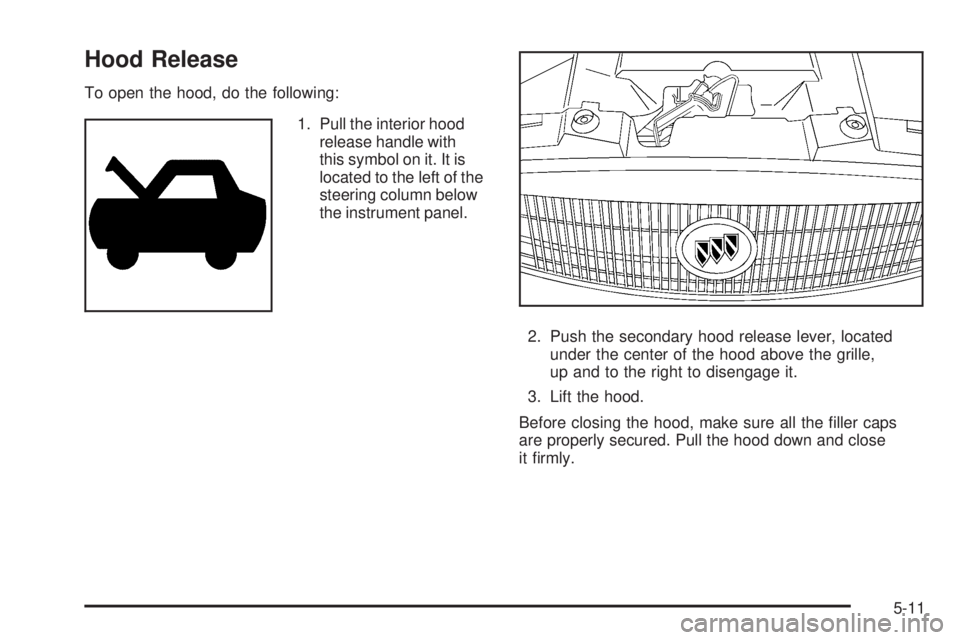
To open the hood, do the following:
1. Pull the interior hood
release handle with
this symbol on it. It is
located to the left of the
steering column below
the instrument panel.
2. Push the secondary hood release lever, located
under the center of the hood above the grille,
up and to the right to disengage it.
3. Lift the hood.
Before closing the hood, make sure all the ller caps
are properly secured. Pull the hood down and close
it rmly.
5-11
Page 327 of 444
{CAUTION:
You can be burned if you spill coolant on hot
engine parts. Coolant contains ethylene glycol,
and it will burn if the engine parts are hot
enough. Do not spill coolant on a hot engine.
Occasionally check the coolant level in the radiator.
For information on how to add coolant to the radiator,
seeCooling System on page 5-30.
Radiator Pressure Cap
Notice:If the pressure cap is not tightly installed,
coolant loss and possible engine damage may
occur. Be sure the cap is properly and tightly
secured.
The radiator pressure cap is located in the front of the
engine compartment on the passenger’s side of the
vehicle. SeeEngine Compartment Overview on
page 5-12for more information on location.
Engine Overheating
There is a coolant temperature gage and a warning
light on the instrument panel cluster that indicate
an overheated engine condition. SeeEngine Coolant
Temperature Gage on page 3-41andEngine Coolant
Temperature Warning Light on page 3-40for more
information.
In addition, if your vehicle is equipped with a Driver
Information Center (DIC), you will nd an ENGINE
COOLANT HOT and a REDUCED POWER STOP
WHEN SAFE message displayed on the DIC.
SeeDIC Warnings and Messages on page 3-59
for more information.
5-27
Page 329 of 444
If you get the overheat warning with no sign of steam,
try this for a minute or so:
1. In heavy traffic, let the engine idle in NEUTRAL (N)
while stopped. If it is safe to do so, pull off the road,
shift to PARK (P) or NEUTRAL (N) and let the
engine idle.
2. Set the climate controls to the highest heat setting
and fan speed and open the windows as necessary.
If you no longer have the overheat warning, you
can drive. Just to be safe, drive slower for about
10 minutes. If the warning does not come back on,
you can drive normally.
If the warning continues and you have not stopped,
pull over, stop, and park your vehicle right away.
If there is still no sign of steam, you can idle the
engine for three minutes while you are parked. If you
still have the warning, turn off the engine and get
everyone out of the vehicle until it cools down.
Also, see “Overheated Engine Protection Operating
Mode” later in this section.
You may decide not to lift the hood but to get service
help right away.Overheated Engine Protection
Operating Mode
This emergency operating mode allows your vehicle to
be driven to a safe place in an emergency situation.
If an overheated engine condition exists, an overheat
protection mode which alternates ring groups of
cylinders helps prevent engine damage. In this mode,
you will notice a signicant loss in power and engine
performance. The REDUCED POWER STOP WHEN
SAFE message will come on in the Driver Information
Center (DIC), along with the engine coolant temperature
warning light on the instrument panel, to indicate the
vehicle has entered overheated engine protection
operating mode. The temperature gage will also indicate
an overheat condition exists. Driving extended miles
(km) and/or towing a trailer in the overheat protection
mode should be avoided.
Notice:After driving in the overheated engine
protection operating mode, to avoid engine damage,
allow the engine to cool before attempting any
repair. The engine oil will be severely degraded.
Repair the cause of coolant loss, change the oil
and reset the oil life system. SeeEngine Oil
on page 5-15.
5-29
Page 338 of 444
How to Check Power Steering Fluid
To check the power steering uid, do the following:
1. Turn the key off and let the engine compartment
cool down.
2. Wipe the cap and the top of the reservoir clean.
3. Unscrew the cap and wipe the dipstick with a
clean rag.
4. Replace the cap and completely tighten it.
5. Remove the cap again and look at the uid level
on the dipstick.
If your vehicle has the 3.8L V6 engine, the uid level
should be between the ADD and HOT marks when the
engine is cold, and at the HOT mark when the engine
is hot. If the uid is at the ADD mark when the engine
is cold or hot, power steering uid should be added.
If your vehicle has the 3.6L V6 engine, the uid
level should be between the Min (Minimum) and
Max (Maximum) marks when the engine is cold, and
at the Max mark when the engine is hot. If the uid
is at the Min mark when the engine is cold or hot,
power steering uid should be added.
What to Use
To determine what kind of uid to use, see
Recommended Fluids and Lubricants on page 6-12.
Always use the proper uid. Failure to use the proper
uid can cause leaks and damage hoses and seals.
Windshield Washer Fluid
What to Use
When you need windshield washer uid, be sure to
read the manufacturer’s instructions before use. If you
will be operating your vehicle in an area where the
temperature may fall below freezing, use a uid that
has sufficient protection against freezing.
Adding Washer Fluid
When the windshield washer uid is low, a low washer
uid light may appear on the instrument panel cluster.
SeeLow Washer Fluid Warning Light on page 3-47
for more information.
In addition, if your vehicle is equipped with a Driver
Information Center (DIC), the LOW WASHER FLUID
message will appear when the uid level is low.
SeeDIC Warnings and Messages on page 3-59for
more information.
5-38
Page 386 of 444
If any of the soil remains, a commercial fabric cleaner
or spot lifter may be necessary. When a commercial
upholstery cleaner or spot lifter is to be used, test
a small hidden area for colorfastness rst. If the
locally cleaned area gives any impression that a
ring formation may result, clean the entire surface.
After the cleaning process has been completed,
a paper towel can be used to blot excess moisture
from the fabric or carpet.
Leather
A soft cloth dampened with water may be used to
remove dust. If a more thorough cleaning is necessary,
a soft cloth dampened with a mild soap solution can
be used. Allow the leather to dry naturally. Do not use
heat to dry. Never use steam to clean leather. Never
use spot lifters or spot removers on leather. Many
commercial leather cleaners and coatings that are
sold to preserve and protect leather may permanently
change the appearance and feel of your leather and are
not recommended. Do not use silicone or wax-based
products, or those containing organic solvents to clean
your vehicle’s interior because they can alter the
appearance by increasing the gloss in a non-uniform
manner. Never use shoe polish on your leather.
Instrument Panel, Vinyl, and Other
Plastic Surfaces
A soft cloth dampened with water may be used to
remove dust. If a more thorough cleaning is necessary,
a clean soft cloth dampened with a mild soap solution
can be used to gently remove dust and dirt. Never
use spot lifters or removers on plastic surfaces. Many
commercial cleaners and coatings that are sold
to preserve and protect soft plastic surfaces may
permanently change the appearance and feel of your
interior and are not recommended. Do not use silicone
or wax-based products, or those containing organic
solvents to clean your vehicle’s interior because
they can alter the appearance by increasing the gloss
in a non-uniform manner.
Some commercial products may increase gloss on your
instrument panel. The increase in gloss may cause
annoying reections in the windshield and even make
it difficult to see through the windshield under certain
conditions.
5-86
Page 392 of 444
Vehicle Identication
Vehicle Identication Number (VIN)
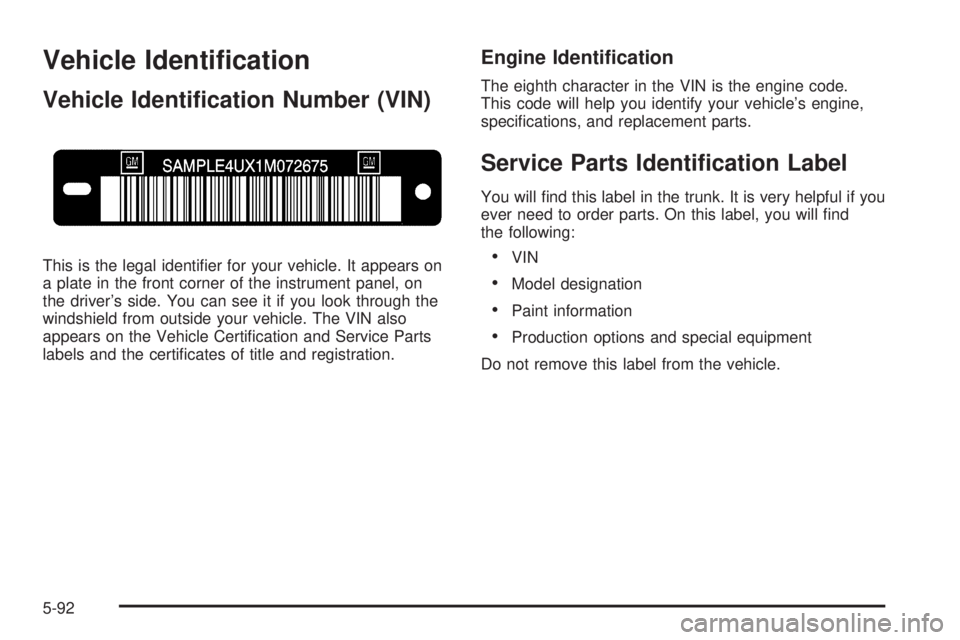
This is the legal identier for your vehicle. It appears on
a plate in the front corner of the instrument panel, on
the driver’s side. You can see it if you look through the
windshield from outside your vehicle. The VIN also
appears on the Vehicle Certication and Service Parts
labels and the certicates of title and registration.
Engine Identication
The eighth character in the VIN is the engine code.
This code will help you identify your vehicle’s engine,
specications, and replacement parts.
Service Parts Identication Label
You will nd this label in the trunk. It is very helpful if you
ever need to order parts. On this label, you will nd
the following:
VIN
Model designation
Paint information
Production options and special equipment
Do not remove this label from the vehicle.
5-92
Page 393 of 444
Electrical System
Add-On Electrical Equipment
Notice:Don’t add anything electrical to your
vehicle unless you check with your dealer rst.
Some electrical equipment can damage your vehicle
and the damage wouldn’t be covered by your
warranty. Some add-on electrical equipment can
keep other components from working as they should.
Your vehicle has an airbag system. Before attempting
to add anything electrical to your vehicle, seeServicing
Your Airbag-Equipped Vehicle on page 1-69.
Headlamp Wiring
The headlamp wiring is protected by a circuit breaker
in the underhood fuse block. An electrical overload
will cause the headlamps to go on and off, or in some
cases to remain off. If this happens, have the headlamp
system checked right away.
Windshield Wiper Fuses
The windshield wiper motor is protected by a circuit
breaker and a fuse. If the motor overheats due to heavy
snow, etc., the wiper will stop until the motor cools.
If the overload is caused by some electrical problem,
have it xed.
Power Windows and Other
Power Options
Circuit breakers in the instrument panel fuse block
protect the power windows and other power accessories.
When the current load is too heavy, the circuit breaker
opens and closes, protecting the circuit until the
problem is xed.
Fuses and Circuit Breakers
The wiring circuits in the vehicle are protected from
short circuits by a combination of fuses, circuit breakers
and in the fuse block wiring itself. This greatly reduces
the chance of res caused by electrical problems.
Look at the silver-colored band inside the fuse. If the
band is broken or melted, replace the fuse. Make sure
a bad fuse is replaced with a new one of the identical
size and rating.
5-93