ignition BUICK LACROSSE 2007 Owner's Manual
[x] Cancel search | Manufacturer: BUICK, Model Year: 2007, Model line: LACROSSE, Model: BUICK LACROSSE 2007Pages: 512
Page 415 of 512
6. Proceed to the passenger side front tire,
and repeat the procedure in Step 5.
7. Proceed to the passenger side rear tire,
and repeat the procedure in Step 5.
8. Proceed to the driver side rear tire, and
repeat the procedure in Step 5.
9. After hearing the conrming horn chirp for the
driver side rear tire, the horn chirps two more
times to signal the tire learning process
has ended. Turn the ignition switch to OFF.
10. Set all four tires to the recommended air
pressure level as indicated on the tire and
loading information label.
11. Put the valve caps back on the valve stems.Federal Communications Commission
(FCC) and Industry and Science Canada
The Tire Pressure Monitor System (TPMS)
operates on a radio frequency and complies with
Part 15 of the FCC Rules. Operation is subject
to the following two conditions:
1. This device may not cause harmful
interference.
2. This device must accept any interference
received, including interference that may
cause undesired operation.
The Tire Pressure Monitor System (TPMS)
operates on a radio frequency and complies with
RSS-210 of Industry and Science Canada.
Operation is subject to the following two conditions:
1. This device may not cause interference.
2. This device must accept any interference
received, including interference that may
cause undesired operation of the device.
Changes or modications to this system by other
than an authorized service facility could void
authorization to use this equipment.
415
Page 451 of 512
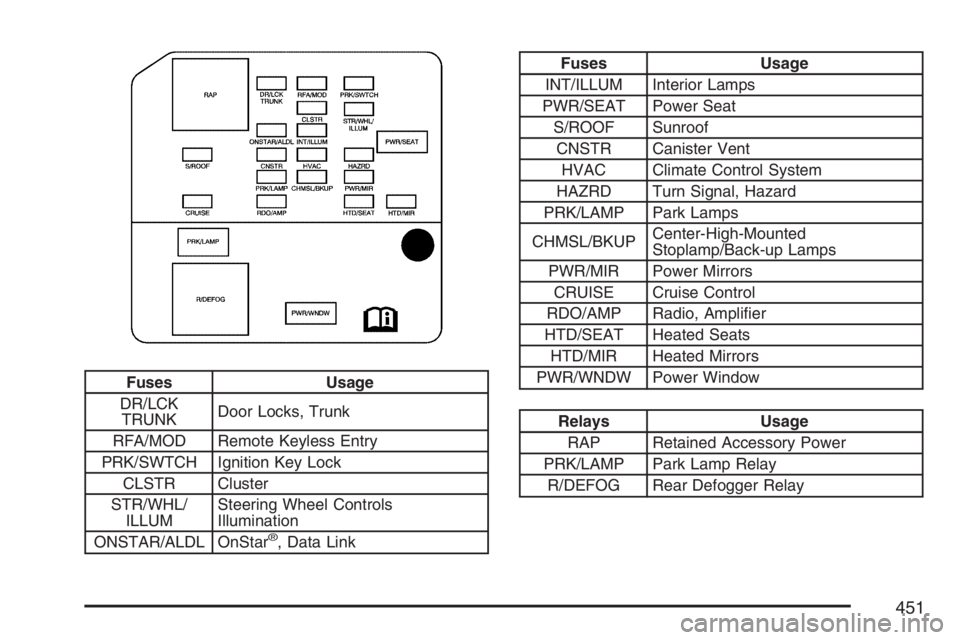
Fuses Usage
DR/LCK
TRUNKDoor Locks, Trunk
RFA/MOD Remote Keyless Entry
PRK/SWTCH Ignition Key Lock
CLSTR Cluster
STR/WHL/
ILLUMSteering Wheel Controls
Illumination
ONSTAR/ALDL OnStar
®, Data Link
Fuses Usage
INT/ILLUM Interior Lamps
PWR/SEAT Power Seat
S/ROOF Sunroof
CNSTR Canister Vent
HVAC Climate Control System
HAZRD Turn Signal, Hazard
PRK/LAMP Park Lamps
CHMSL/BKUPCenter-High-Mounted
Stoplamp/Back-up Lamps
PWR/MIR Power Mirrors
CRUISE Cruise Control
RDO/AMP Radio, Amplier
HTD/SEAT Heated Seats
HTD/MIR Heated Mirrors
PWR/WNDW Power Window
Relays Usage
RAP Retained Accessory Power
PRK/LAMP Park Lamp Relay
R/DEFOG Rear Defogger Relay
451
Page 452 of 512
Underhood Fuse Block
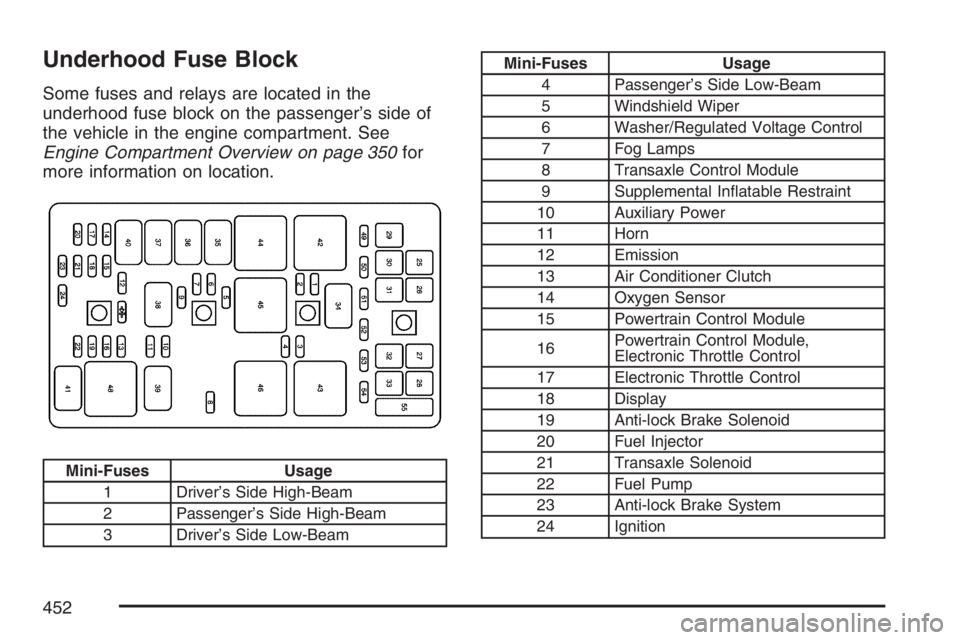
Some fuses and relays are located in the
underhood fuse block on the passenger’s side of
the vehicle in the engine compartment. See
Engine Compartment Overview on page 350for
more information on location.
Mini-Fuses Usage
1 Driver’s Side High-Beam
2 Passenger’s Side High-Beam
3 Driver’s Side Low-Beam
Mini-Fuses Usage
4 Passenger’s Side Low-Beam
5 Windshield Wiper
6 Washer/Regulated Voltage Control
7 Fog Lamps
8 Transaxle Control Module
9 Supplemental Inatable Restraint
10 Auxiliary Power
11 Horn
12 Emission
13 Air Conditioner Clutch
14 Oxygen Sensor
15 Powertrain Control Module
16Powertrain Control Module,
Electronic Throttle Control
17 Electronic Throttle Control
18 Display
19 Anti-lock Brake Solenoid
20 Fuel Injector
21 Transaxle Solenoid
22 Fuel Pump
23 Anti-lock Brake System
24 Ignition
452
Page 453 of 512
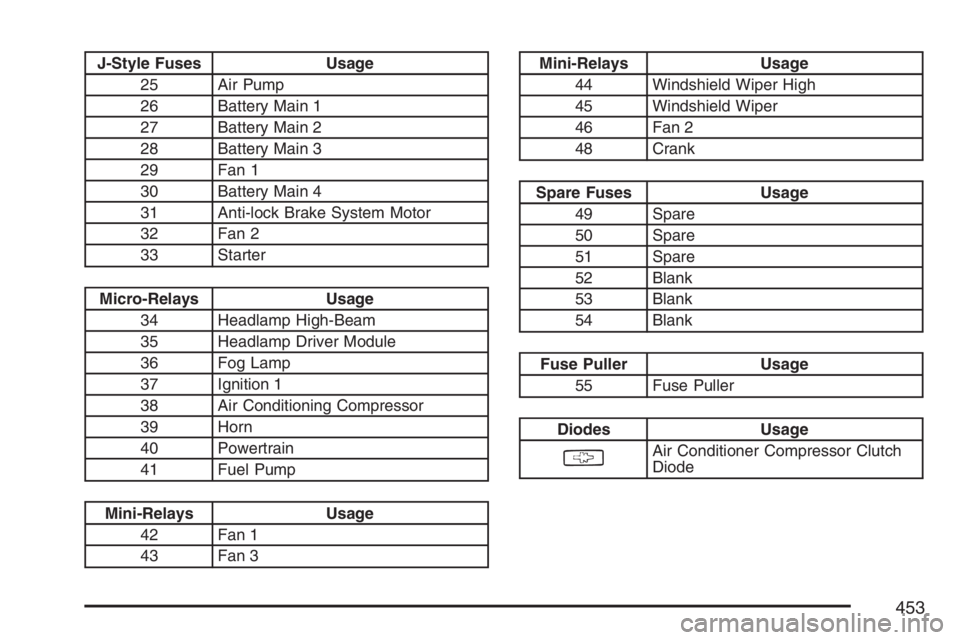
J-Style Fuses Usage
25 Air Pump
26 Battery Main 1
27 Battery Main 2
28 Battery Main 3
29 Fan 1
30 Battery Main 4
31 Anti-lock Brake System Motor
32 Fan 2
33 Starter
Micro-Relays Usage
34 Headlamp High-Beam
35 Headlamp Driver Module
36 Fog Lamp
37 Ignition 1
38 Air Conditioning Compressor
39 Horn
40 Powertrain
41 Fuel Pump
Mini-Relays Usage
42 Fan 1
43 Fan 3
Mini-Relays Usage
44 Windshield Wiper High
45 Windshield Wiper
46 Fan 2
48 Crank
Spare Fuses Usage
49 Spare
50 Spare
51 Spare
52 Blank
53 Blank
54 Blank
Fuse Puller Usage
55 Fuse Puller
Diodes Usage
§Air Conditioner Compressor Clutch
Diode
453
Page 468 of 512
At Least Once a Year
Starter Switch Check
{CAUTION:
When you are doing this inspection, the
vehicle could move suddenly. If the vehicle
moves, you or others could be injured.
1. Before you start, be sure you have enough
room around the vehicle.
2. Firmly apply both the parking brake and the
regular brake. SeeParking Brake on
page 117.
Do not use the accelerator pedal, and be
ready to turn off the engine immediately if it
starts.
3. Try to start the engine in each gear. The
vehicle should start only in PARK (P) or
NEUTRAL (N). If the vehicle starts in any
other position, contact your GM Goodwrench
®
dealer for service.
Automatic Transaxle Shift Lock Control
System Check
{CAUTION:
When you are doing this inspection, the
vehicle could move suddenly. If the vehicle
moves, you or others could be injured.
1. Before you start, be sure you have enough
room around the vehicle. It should be parked
on a level surface.
2. Firmly apply the parking brake. SeeParking
Brake on page 117.
Be ready to apply the regular brake
immediately if the vehicle begins to move.
3. With the engine off, turn the ignition to RUN,
but do not start the engine. Without applying
the regular brake, try to move the shift
lever out of PARK (P) with normal effort. If the
shift lever moves out of PARK (P), contact
your GM Goodwrench
®dealer for service.
468
Page 469 of 512
Ignition Transaxle Lock Check
While parked, and with the parking brake set, try
to turn the ignition to OFF in each shift lever
position.
The ignition should turn to OFF only when the
shift lever is in PARK (P).
The ignition key should come out only in OFF.
Contact your GM Goodwrench
®dealer if service
is required.
Parking Brake and Automatic Transaxle
Park (P) Mechanism Check
{CAUTION:
When you are doing this check, your
vehicle could begin to move. You or
others could be injured and property
could be damaged. Make sure there is
room in front of your vehicle in case it
begins to roll. Be ready to apply the
regular brake at once should the vehicle
begin to move.Park on a fairly steep hill, with the vehicle facing
downhill. Keeping your foot on the regular
brake, set the parking brake.
To check the parking brake’s holding ability:
With the engine running and transaxle in
NEUTRAL (N), slowly remove foot pressure
from the regular brake pedal. Do this until the
vehicle is held by the parking brake only.
To check the PARK (P) mechanism’s holding
ability: With the engine running, shift to
PARK (P). Then release the parking brake
followed by the regular brake.
Contact your GM Goodwrench
®dealer if service
is required.
Underbody Flushing Service
At least every spring, use plain water to ush any
corrosive materials from the underbody. Take
care to clean thoroughly any areas where mud and
other debris can collect.
469
Page 504 of 512
I
Ignition Positions......................................... 109
Infants and Young Children, Restraints.......... 42
Ination - Tire Pressure............................... 409
Instrument Panel
Overview.................................................. 148
Instrument Panel (I/P)
Brightness................................................ 161
Cluster..................................................... 180
Interior Lamps............................................. 161
J
Jump Starting.............................................. 385
K
Keyless Entry System................................... 89
Keys............................................................. 87
L
Labeling, Tire Sidewall................................. 403
Lamps
Battery Run-Down Protection................... 164
Courtesy.................................................. 161
Electric Power Management..................... 163
Exterior.................................................... 158
Exterior Lighting Battery Saver................. 160
Fog .......................................................... 160
Interior..................................................... 161
Overhead Console Reading..................... 163
Rear Assist Handle Reading.................... 163
LATCH System
Child Restraints......................................... 51
License Plate Lamps................................... 400
Light
Airbag Readiness..................................... 182
Anti-Lock Brake System Warning............. 187
Brake System Warning............................. 186
Change Engine Oil................................... 195
Charging System..................................... 185
Check Gas Cap....................................... 199
Cruise Control.......................................... 195
504