change wheel BUICK LACROSSE 2007 User Guide
[x] Cancel search | Manufacturer: BUICK, Model Year: 2007, Model line: LACROSSE, Model: BUICK LACROSSE 2007Pages: 512
Page 333 of 512
Following Distance
Stay at least twice as far behind the vehicle ahead
as when driving the vehicle without a trailer.
This can help avoid situations that require heavy
braking and sudden turns.
Passing
More passing distance is needed up ahead when
towing a trailer. And, because the vehicle is a
good deal longer with the trailer, you will need to
go much farther beyond the vehicle you have
passed before you can return to the proper lane.
Backing Up
Hold the bottom of the steering wheel with one
hand. Then, to move the trailer to the left,
move that hand to the left. To move the trailer to
the right, move your hand to the right. Always
back up slowly and, if possible, have someone
guide you.
Making Turns
Notice:Making very sharp turns while
trailering could cause the trailer to come in
contact with the vehicle. Your vehicle could be
damaged. Avoid making very sharp turns while
trailering.
When turning with a trailer, make wider turns than
normal. Do this so the trailer will not strike soft
shoulders, curbs, road signs, trees, or other
objects. Avoid jerky or sudden maneuvers. Signal
well in advance.
Turn Signals When Towing a Trailer
When towing a trailer, the vehicle may need a
different turn signal asher and/or extra wiring.
Check with your dealer. The arrows on the
instrument panel will ash whenever signaling a
turn or lane change. Properly hooked up, the trailer
lamps will also ash, telling other drivers you are
about to turn, change lanes or stop.
When towing a trailer, the arrows on the instrument
panel will ash for turns even if the bulbs on the
trailer are burned out. You may think drivers behind
you are seeing your signal when they are not. It is
important to check occasionally to be sure the
trailer bulbs are still working.
333
Page 383 of 512
{CAUTION:
The brake wear warning sound means that
soon the brakes will not work well. That
could lead to an accident. When you hear
the brake wear warning sound, have your
vehicle serviced.
Notice:Continuing to drive with worn-out
brake pads could result in costly brake repair.
Some driving conditions or climates may cause
a brake squeal when the brakes are rst applied or
lightly applied. This does not mean something is
wrong with your brakes.
Properly torqued wheel nuts are necessary to help
prevent brake pulsation. When tires are rotated,
inspect brake pads for wear and evenly tighten
wheel nuts in the proper sequence to GM torque
specications.
Brake linings should always be replaced as
complete axle sets.
Brake Pedal Travel
See your dealer if the brake pedal does not return
to normal height, or if there is a rapid increase in
pedal travel. This could be a sign of brake trouble.
Brake Adjustment
Every time you apply the brakes, with or without
the vehicle moving, your brakes adjust for wear.
Replacing Brake System Parts
The braking system on a vehicle is complex. Its
many parts have to be of top quality and work
well together if the vehicle is to have really good
braking. Your vehicle was designed and tested
with top-quality GM brake parts. When you replace
parts of your braking system — for example, when
your brake linings wear down and you need new
ones put in — be sure you get new approved
GM replacement parts. If you do not, your brakes
may no longer work properly. For example, if
someone puts in brake linings that are wrong for
your vehicle, the balance between your front
and rear brakes can change — for the worse.
The braking performance you have come to expect
can change in many other ways if someone puts
in the wrong replacement brake parts.
383
Page 417 of 512
{CAUTION:
Rust or dirt on a wheel, or on the parts to
which it is fastened, can make wheel nuts
become loose after time. The wheel could
come off and cause an accident. When
you change a wheel, remove any rust or
dirt from places where the wheel attaches
to the vehicle. In an emergency, you can
use a cloth or a paper towel to do this;
but be sure to use a scraper or wire brush
later, if needed, to get all the rust or dirt
off. SeeChanging a Flat Tire on page 426.
When It Is Time for New Tires
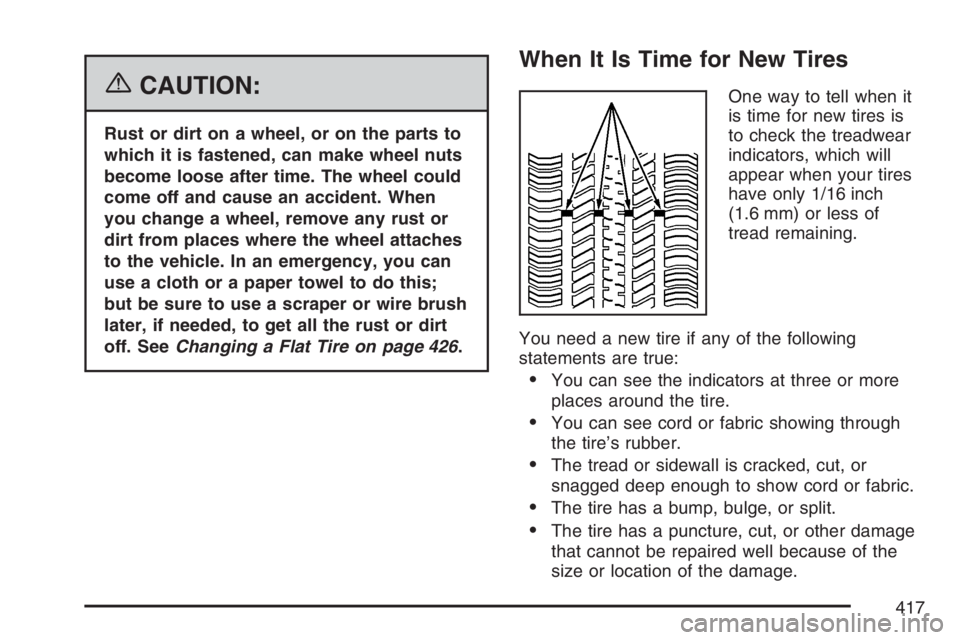
One way to tell when it
is time for new tires is
to check the treadwear
indicators, which will
appear when your tires
have only 1/16 inch
(1.6 mm) or less of
tread remaining.
You need a new tire if any of the following
statements are true:
You can see the indicators at three or more
places around the tire.
You can see cord or fabric showing through
the tire’s rubber.
The tread or sidewall is cracked, cut, or
snagged deep enough to show cord or fabric.
The tire has a bump, bulge, or split.
The tire has a puncture, cut, or other damage
that cannot be repaired well because of the
size or location of the damage.
417
Page 425 of 512
If a Tire Goes Flat
It is unusual for a tire to blowout while you are
driving, especially if you maintain your vehicle’s
tires properly. If air goes out of a tire, it is
much more likely to leak out slowly. But if you
should ever have a blowout, here are a few tips
about what to expect and what to do:
If a front tire fails, the at tire will create a drag
that pulls the vehicle toward that side. Take your
foot off the accelerator pedal and grip the
steering wheel rmly. Steer to maintain lane
position, and then gently brake to a stop well out
of the traffic lane.
A rear blowout, particularly on a curve, acts much
like a skid and may require the same correction
you would use in a skid. In any rear blowout
remove your foot from the accelerator pedal. Get
the vehicle under control by steering the way
you want the vehicle to go. It may be very bumpy
and noisy, but you can still steer. Gently brake
to a stop, well off the road if possible.{CAUTION:
Lifting a vehicle and getting under it to
do maintenance or repairs is dangerous
without the appropriate safety equipment
and training. The jack provided with your
vehicle is designed only for changing a
at tire. If it is used for anything else, you
or others could be badly injured or killed
if the vehicle slips off the jack. Use the
jack provided with your vehicle only for
changing a at tire.
If a tire goes at, the next part shows how to
use the jacking equipment to change a at
tire safely.
425
Page 426 of 512
Changing a Flat Tire
If a tire goes at, avoid further tire and wheel
damage by driving slowly to a level place. Turn on
your vehicle’s hazard warning ashers. SeeHazard
Warning Flashers on page 150for more
information.
{CAUTION:
Changing a tire can be dangerous. The
vehicle can slip off the jack and roll over
or fall on you or other people. You and
they could be badly injured or even killed.
Find a level place to change your tire.
To help prevent the vehicle from moving:
1. Set the parking brake rmly.
2. Put the shift lever in PARK (P).
CAUTION: (Continued)
CAUTION: (Continued)
3. Turn off the engine and do not restart
while the vehicle is raised.
4. Do not allow passengers to remain
in the vehicle.
To be even more certain the vehicle will
not move, you should put blocks at the
front and rear of the tire farthest away
from the one being changed. That would
be the tire, on the other side, at the
opposite end of the vehicle.
When your vehicle has a at tire, use the following
example as a guide to assist you in the placement
of wheel blocks.
426
Page 429 of 512
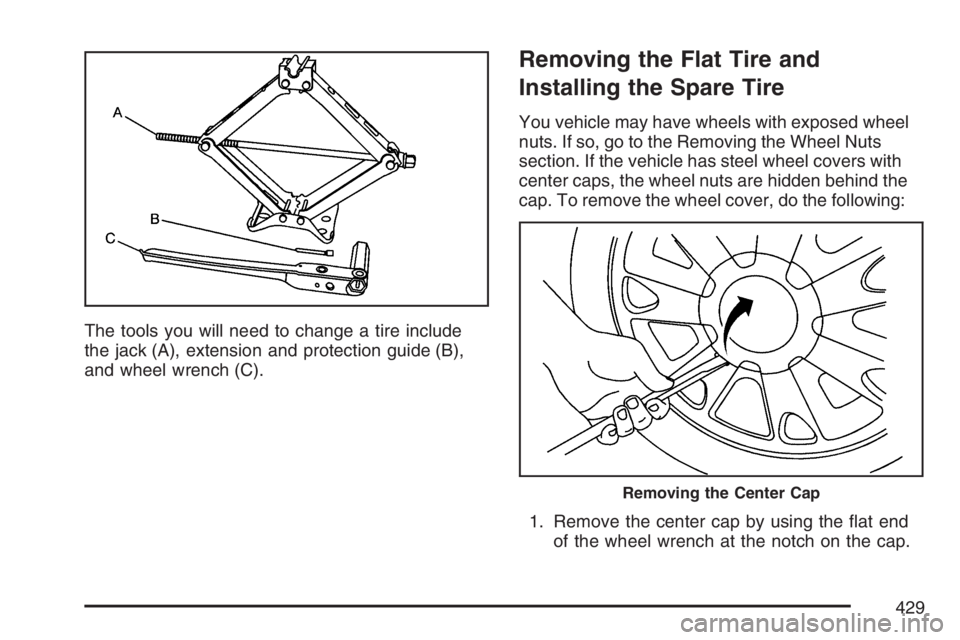
The tools you will need to change a tire include
the jack (A), extension and protection guide (B),
and wheel wrench (C).
Removing the Flat Tire and
Installing the Spare Tire
You vehicle may have wheels with exposed wheel
nuts. If so, go to the Removing the Wheel Nuts
section. If the vehicle has steel wheel covers with
center caps, the wheel nuts are hidden behind the
cap. To remove the wheel cover, do the following:
1. Remove the center cap by using the at end
of the wheel wrench at the notch on the cap.
Removing the Center Cap
429
Page 433 of 512
{CAUTION:
Rust or dirt on the wheel, or on the parts
to which it is fastened, can make the
wheel nuts become loose after time.
The wheel could come off and cause an
accident. When you change a wheel,
remove any rust or dirt from the places
where the wheel attaches to the vehicle.
In an emergency, you can use a cloth or
a paper towel to do this; but be sure to
use a scraper or wire brush later, if
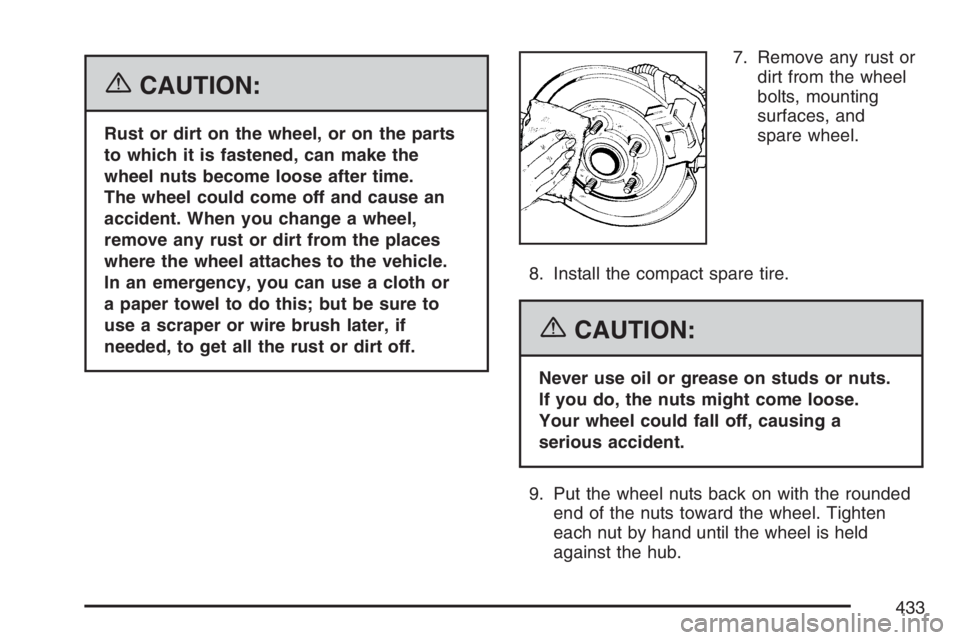
needed, to get all the rust or dirt off.7. Remove any rust or
dirt from the wheel
bolts, mounting
surfaces, and
spare wheel.
8. Install the compact spare tire.
{CAUTION:
Never use oil or grease on studs or nuts.
If you do, the nuts might come loose.
Your wheel could fall off, causing a
serious accident.
9. Put the wheel nuts back on with the rounded
end of the nuts toward the wheel. Tighten
each nut by hand until the wheel is held
against the hub.
433
Page 489 of 512
Additional Program Information
All program options, such as shuttle service, may
not be available at every dealer. Please contact
your dealer for specic information about
availability. All Courtesy Transportation
arrangements will be administered by appropriate
dealer personnel.
General Motors reserves the right to unilaterally
modify, change or discontinue Courtesy
Transportation at any time and to resolve all
questions of claim eligibility pursuant to the terms
and conditions described herein at its sole
discretion.
Vehicle Data Collection and Event
Data Recorders
Your vehicle, like other modern motor vehicles, has
a number of sophisticated computer systems that
monitor and control several aspects of the vehicle’s
performance. Your vehicle uses on-board vehicle
computers to monitor emission control components
to optimize fuel economy, to monitor conditions for
airbag deployment and, if so equipped, to provide
anti-lock braking and to help the driver control the
vehicle in difficult driving situations.Some information may be stored during regular
operations to facilitate repair of detected
malfunctions; other information is stored only in a
crash event by computer systems, such as those
commonly called Event Data Recorders (EDR).
In a crash event, computer systems, such as the
airbag Sensing and Diagnostic Module (SDM)
in your vehicle may record information about the
condition of the vehicle and how it was operated,
such as data related to engine speed, brake
application, throttle position, vehicle speed, safety
belt usage, airbag readiness, airbag performance,
and the severity of a collision. If your vehicle is
equipped with StabiliTrak
®, steering performance,
including yaw rate, steering wheel angle, and
lateral acceleration, is also recorded. This
information has been used to improve vehicle
crash performance and may be used to improve
crash performance of future vehicles and
driving safety. Unlike the data recorders on many
airplanes, these on-board systems do not
record sounds, such as conversation of vehicle
occupants.
489