radio BUICK LACROSSE 2007 Workshop Manual
[x] Cancel search | Manufacturer: BUICK, Model Year: 2007, Model line: LACROSSE, Model: BUICK LACROSSE 2007Pages: 512
Page 282 of 512
FM Stereo
FM stereo will give the best sound, but FM signals
will reach only about 10 to 40 miles (16 to 65 km).
Tall buildings or hills can interfere with FM
signals, causing the sound to fade in and out.
XM™ Satellite Radio Service
XM™ Satellite Radio Service gives digital radio
reception from coast-to-coast in the 48 contiguous
United States, and in Canada. Just as with FM,
tall buildings or hills can interfere with satellite
radio signals, causing the sound to fade in and out.
In addition, traveling or standing under heavy
foliage, bridges, garages, or tunnels may cause
loss of the XM™ signal for a period of time.
The radio may display NO SIGNAL to indicate
interference.
Care of Your CDs
Handle CDs carefully. Store them in their original
cases or other protective cases and away from
direct sunlight and dust. The CD player scans the
bottom surface of the disc. If the surface of a
CD is damaged, such as cracked, broken,
or scratched, the CD will not play properly or not
at all. If the surface of a CD is soiled, take a
soft, lint free cloth or dampen a clean, soft cloth in
a mild, neutral detergent solution mixed with
water, and clean it. Make sure the wiping process
starts from the center to the edge.
Do not touch the bottom side of a CD while
handling it; this could damage the surface. Pick up
CDs by grasping the outer edges or the edge of
the hole and the outer edge.
Care of the CD Player
Do not use CD lens cleaners for CD players
because the lens of the CD optics can become
contaminated by lubricants.
282
Page 283 of 512
Backglass Antenna
The AM-FM antenna is integrated with the rear
window defogger, located in the rear window.
Make sure that the inside surface of the rear
window is not scratched and that the lines on the
glass are not damaged. If the inside surface is
damaged, it could interfere with radio reception.
Also, for proper radio reception, the antenna
connector at the top-center of the rear window
needs to be properly attached to the post on the
glass.
Notice:Do not apply aftermarket glass tinting
with metallic lm. The metallic lm in some
tinting materials will interfere with or distort the
incoming radio reception. Any damage
caused to your backglass antenna due to
metallic tinting materials will not be covered
by your warranty.Notice:Using a razor blade or sharp object to
clear the inside rear window may damage
the rear window antenna and/or the rear
window defogger. Repairs would not be
covered by your warranty. Do not clear the
inside rear window with sharp objects.
Because this antenna is built into your rear
window, there is a reduced risk of damage caused
by car washes and vandals.
If static is heard on the radio, when the rear
window defogger is turned on, it could mean that
a defogger grid line has been damaged. If this
is true, the grid line must be repaired.
If you choose to add a cellular telephone to your
vehicle, and the antenna needs to be attached
to the glass, make sure that you do not damage
the grid lines for the AM-FM antenna. There
is enough space between the lines to attach a
cellular telephone antenna without interfering with
radio reception.
283
Page 284 of 512
XM™ Satellite Radio
Antenna System
The XM™ Satellite Radio antenna is located on
the roof of your vehicle. Keep this antenna clear of
snow and ice build up for clear radio reception.
If your vehicle has a sunroof, the performance of
the XM™ system may be affected if the sunroof
is open.
Loading items onto the roof of your vehicle can
interfere with the performance of the XM™ system.
Make sure the XM™ Satellite Radio antenna is
not obstructed.
Chime Level Adjustment
The radio is used to adjust the vehicle’s chime
level. To change the volume level of the chime,
press and hold pushbutton 6 with the ignition
on and the radio power off. The volume level
will change from the normal level to loud,
and LOUD will appear on the radio display.
To change back to the default or normal setting,
press and hold pushbutton 6 again. The volume
level will change from the loud level to normal,
and NORMAL will appear on the radio display.
Removing the radio and not replacing it with
a factory radio or chime module will disable
vehicle chimes.
284
Page 295 of 512
To limit wheel spin, especially in slippery road
conditions, you should always leave the TCS on.
But you can turn the system off if you ever
need to. The TCS should be turned off if the
vehicle ever gets stuck in sand, mud or snow and
rocking the vehicle is required. SeeRocking
Your Vehicle to Get It Out on page 319andIf Your
Vehicle is Stuck in Sand, Mud, Ice, or Snow on
page 318.
To turn the TCS on or off, press the TCS button
located above the radio.
When the TCS is turned off, the TCS warning light
will come on along with the TRACTION CONTROL
OFF message on the DIC. It will disappear when
the TCS is turned back on. If the TCS is limiting
wheel spin when the TCS button is pressed, the
TCS warning light will come on and the TCS will
turn off right away.
Adding non-GM accessories can affect your
vehicle’s performance. SeeAccessories and
Modications on page 341for more information.Enhanced Traction System (ETS)
Your vehicle may have an Enhanced Traction
System (ETS) that limits wheel spin. This is
especially useful in slippery road conditions. The
system operates only if it senses that one or
both of the front wheels are spinning or beginning
to lose traction. When this happens, the system
reduces engine power and may also upshift
the transaxle to limit wheel spin. You may feel or
hear the system working, but this is normal.
The TRACTION CONTROL ACTIVE message on
the Driver Information Center (DIC) will be
displayed when the system is limiting wheel spin.
If the vehicle is in cruise control when ETS
begins to limit wheel spin, the cruise control will
automatically disengage. When road conditions
allow safe use of it, the cruise control can be used
again. SeeCruise Control on page 154.
295
Page 296 of 512
The ETS operates in all transaxle shift lever
positions. But the system can upshift the transaxle
only as high as the chosen shift lever position,
so use the lower gears only when necessary. See
Automatic Transaxle Operation on page 114.
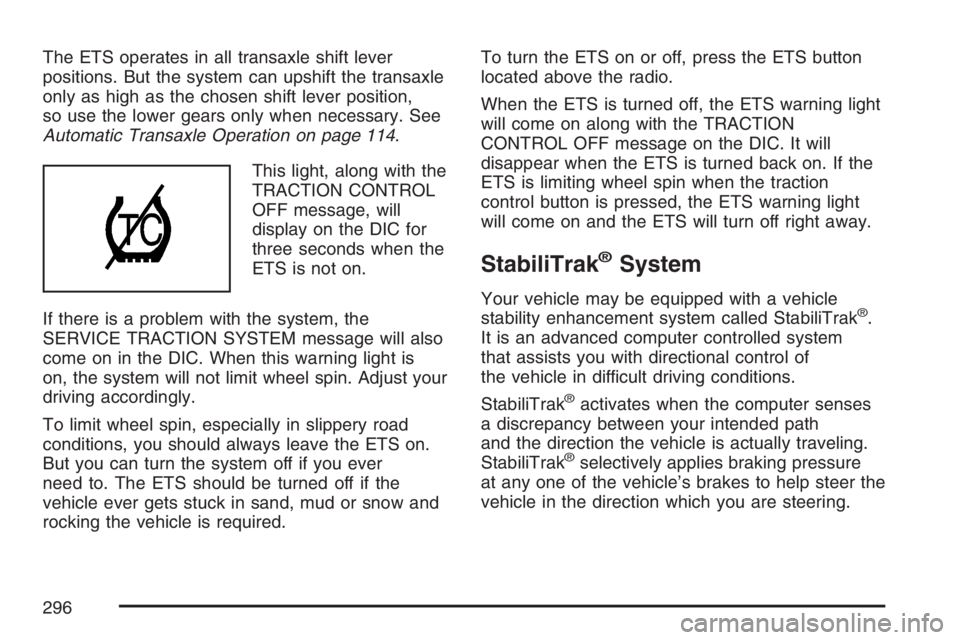
This light, along with the
TRACTION CONTROL
OFF message, will
display on the DIC for
three seconds when the
ETS is not on.
If there is a problem with the system, the
SERVICE TRACTION SYSTEM message will also
come on in the DIC. When this warning light is
on, the system will not limit wheel spin. Adjust your
driving accordingly.
To limit wheel spin, especially in slippery road
conditions, you should always leave the ETS on.
But you can turn the system off if you ever
need to. The ETS should be turned off if the
vehicle ever gets stuck in sand, mud or snow and
rocking the vehicle is required.To turn the ETS on or off, press the ETS button
located above the radio.
When the ETS is turned off, the ETS warning light
will come on along with the TRACTION
CONTROL OFF message on the DIC. It will
disappear when the ETS is turned back on. If the
ETS is limiting wheel spin when the traction
control button is pressed, the ETS warning light
will come on and the ETS will turn off right away.
StabiliTrak®System
Your vehicle may be equipped with a vehicle
stability enhancement system called StabiliTrak®.
It is an advanced computer controlled system
that assists you with directional control of
the vehicle in difficult driving conditions.
StabiliTrak
®activates when the computer senses
a discrepancy between your intended path
and the direction the vehicle is actually traveling.
StabiliTrak
®selectively applies braking pressure
at any one of the vehicle’s brakes to help steer the
vehicle in the direction which you are steering.
296
Page 386 of 512
Notice:If you leave your radio or other
accessories on during the jump starting
procedure, they could be damaged. The repairs
would not be covered by your warranty.
Always turn off your radio and other
accessories when jump starting your vehicle.
3. Turn off the ignition on both vehicles.
Unplug unnecessary accessories plugged into
the cigarette lighter or the accessory power
outlets. Turn off the radio and all lamps
that are not needed. This will avoid sparks
and help save both batteries. And it could
save the radio!
4. Open the hood on the other vehicle and
locate the positive (+) and negative (−)
terminal locations on that vehicle.
You will not use your vehicle’s battery for jump
starting. It has a remote positive (+) jump
starting terminal, located on the underhood
fuse block, for that purpose. SeeEngine
Compartment Overview on page 350for more
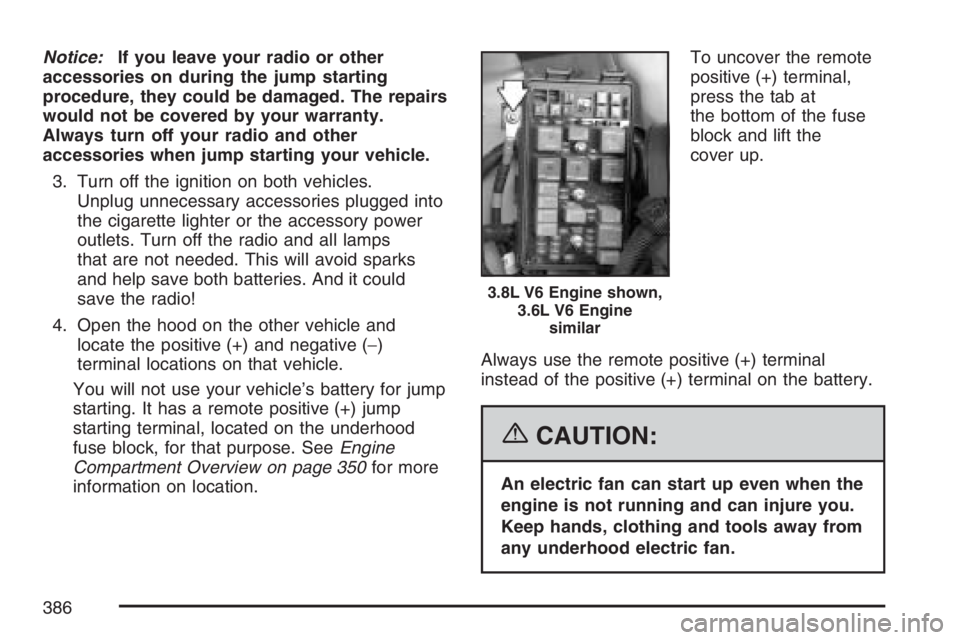
information on location.To uncover the remote
positive (+) terminal,
press the tab at
the bottom of the fuse
block and lift the
cover up.
Always use the remote positive (+) terminal
instead of the positive (+) terminal on the battery.
{CAUTION:
An electric fan can start up even when the
engine is not running and can injure you.
Keep hands, clothing and tools away from
any underhood electric fan.
3.8L V6 Engine shown,
3.6L V6 Engine
similar
386
Page 411 of 512
Tire Pressure Monitor System
The Tire Pressure Monitor System (TPMS) uses
radio and sensor technology to check tire pressure
levels. TPMS sensors are mounted onto each
tire and wheel assembly, except for the spare tire.
The TPMS sensors monitor the air pressure in
your vehicle’s tires and transmit tire pressure
readings to a receiver located in the vehicle.
When a low tire pressure condition is detected,
the TPMS illuminates the low tire pressure
warning light, located in the instrument panel
cluster. If your vehicle has the uplevel Driver
Information Center (DIC), a warning message to
check the pressure in a specic tire displays at
the same time the low tire pressure warning light
comes on. The low tire pressure warning light
and the DIC warning message CHECK TIRE
PRESSURE come on at each ignition cycle
until the tires are inated to the correct
ination pressure. Vehicles that have the
uplevel DIC buttons can also check tire
pressure levels by pressing the gages button.For additional information and details about the
DIC operation and displays seeDIC Operation and
Displays on page 200andDIC Warnings and
Messages on page 208.
During cooler weather conditions, the low tire
pressure warning light and the DIC warning
message, if your vehicle has this feature, may
come on when the vehicle is rst started, and then
turn off as you start to drive. This could be an
early indicator that the air pressure in the tire(s)
are getting low and need to be inated to the
proper pressure.
Each tire, including the spare (if provided), should
be checked monthly when cold and inated
to the ination pressure recommended by the
vehicle manufacturer on the vehicle placard or tire
ination pressure label. (If your vehicle has tires
of a different size than the size indicated on
the vehicle placard or tire ination pressure label,
you should determine the proper tire ination
pressure for those tires.)
411
Page 415 of 512
6. Proceed to the passenger side front tire,
and repeat the procedure in Step 5.
7. Proceed to the passenger side rear tire,
and repeat the procedure in Step 5.
8. Proceed to the driver side rear tire, and
repeat the procedure in Step 5.
9. After hearing the conrming horn chirp for the
driver side rear tire, the horn chirps two more
times to signal the tire learning process
has ended. Turn the ignition switch to OFF.
10. Set all four tires to the recommended air
pressure level as indicated on the tire and
loading information label.
11. Put the valve caps back on the valve stems.Federal Communications Commission
(FCC) and Industry and Science Canada
The Tire Pressure Monitor System (TPMS)
operates on a radio frequency and complies with
Part 15 of the FCC Rules. Operation is subject
to the following two conditions:
1. This device may not cause harmful
interference.
2. This device must accept any interference
received, including interference that may
cause undesired operation.
The Tire Pressure Monitor System (TPMS)
operates on a radio frequency and complies with
RSS-210 of Industry and Science Canada.
Operation is subject to the following two conditions:
1. This device may not cause interference.
2. This device must accept any interference
received, including interference that may
cause undesired operation of the device.
Changes or modications to this system by other
than an authorized service facility could void
authorization to use this equipment.
415
Page 438 of 512
And do not mix the compact spare tire or wheel
with other wheels or tires. They will not t.
Keep the spare tire and its wheel together.
Notice:Tire chains will not t your compact
spare. Using them can damage your vehicle
and can damage the chains too. Do not use
tire chains on your compact spare.
Appearance Care
Cleaning the Inside of Your Vehicle
Your vehicle’s interior will continue to look its
best if it is cleaned often. Although not always
visible, dust and dirt can accumulate on your
upholstery. Dirt can damage carpet, fabric, leather,
and plastic surfaces. Regular vacuuming is
recommended to remove particles from your
upholstery. It is important to keep your upholstery
from becoming and remaining heavily soiled.
Soils should be removed as quickly as possible.
Your vehicle’s interior may experience extremes
of heat that could cause stains to set rapidly.Lighter colored interiors may require more
frequent cleaning. Use care because newspapers
and garments that transfer color to your home
furnishings may also transfer color to your
vehicle’s interior.
When cleaning your vehicle’s interior, only use
cleaners specically designed for the surfaces
being cleaned. Permanent damage may result
from using cleaners on surfaces for which
they were not intended. Use glass cleaner only on
glass. Remove any accidental over-spray from
other surfaces immediately. To prevent over-spray,
apply cleaner directly to the cleaning cloth.
Notice:If you use abrasive cleaners when
cleaning glass surfaces on your vehicle, you
could scratch the glass and/or cause damage
to the integrated radio antenna and the rear
window defogger. When cleaning the glass on
your vehicle, use only a soft cloth and glass
cleaner.
438
Page 451 of 512
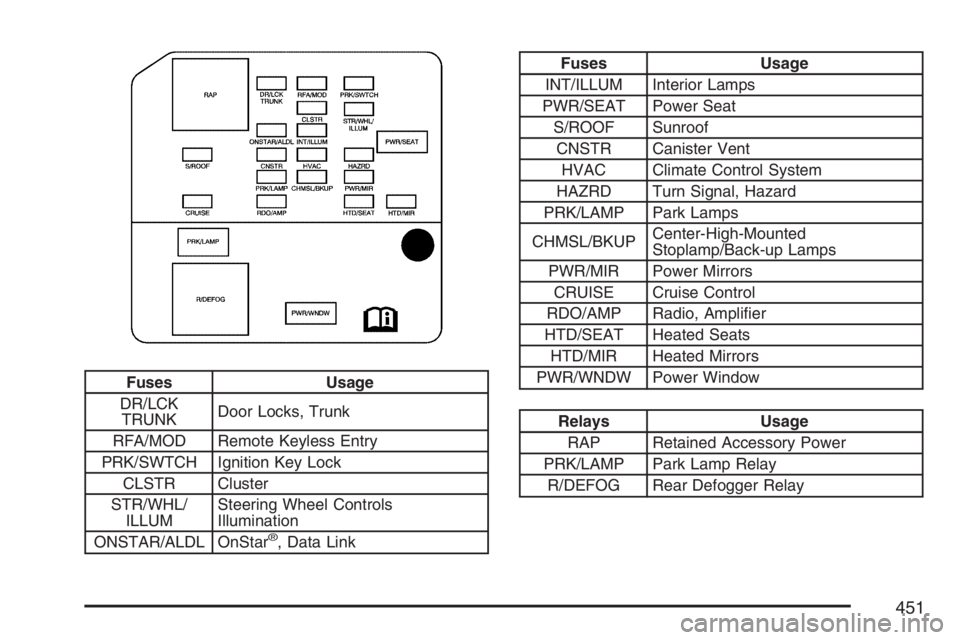
Fuses Usage
DR/LCK
TRUNKDoor Locks, Trunk
RFA/MOD Remote Keyless Entry
PRK/SWTCH Ignition Key Lock
CLSTR Cluster
STR/WHL/
ILLUMSteering Wheel Controls
Illumination
ONSTAR/ALDL OnStar
®, Data Link
Fuses Usage
INT/ILLUM Interior Lamps
PWR/SEAT Power Seat
S/ROOF Sunroof
CNSTR Canister Vent
HVAC Climate Control System
HAZRD Turn Signal, Hazard
PRK/LAMP Park Lamps
CHMSL/BKUPCenter-High-Mounted
Stoplamp/Back-up Lamps
PWR/MIR Power Mirrors
CRUISE Cruise Control
RDO/AMP Radio, Amplier
HTD/SEAT Heated Seats
HTD/MIR Heated Mirrors
PWR/WNDW Power Window
Relays Usage
RAP Retained Accessory Power
PRK/LAMP Park Lamp Relay
R/DEFOG Rear Defogger Relay
451