lbs BUICK LACROSSE 2007 Owner's Manual
[x] Cancel search | Manufacturer: BUICK, Model Year: 2007, Model line: LACROSSE, Model: BUICK LACROSSE 2007Pages: 512
Page 321 of 512
Steps for Determining Correct Load Limit
1. Locate the statement “The combined
weight of occupants and cargo should never
exceed XXX kg or XXX lbs” on your
vehicle’s placard.
2. Determine the combined weight of the driver
and passengers that will be riding in your
vehicle.
3. Subtract the combined weight of the driver
and passengers from XXX kg or XXX lbs.
4. The resulting gure equals the available
amount of cargo and luggage load capacity.
For example, if the “XXX” amount equals
1400 lbs and there will be ve 150 lb
passengers in your vehicle, the amount of
available cargo and luggage load capacity is
650 lbs (1400−750 (5 x 150) = 650 lbs).5. Determine the combined weight of luggage
and cargo being loaded on the vehicle. That
weight may not safely exceed the available
cargo and luggage load capacity calculated in
Step 4.
6. If your vehicle will be towing a trailer, the load
from your trailer will be transferred to your
vehicle. Consult this manual to determine how
this reduces the available cargo and luggage
load capacity for your vehicle.
If your vehicle can tow a trailer, seeTowing a
Trailer on page 327for important information
on towing a trailer, towing safety rules, and
trailering tips.
321
Page 322 of 512
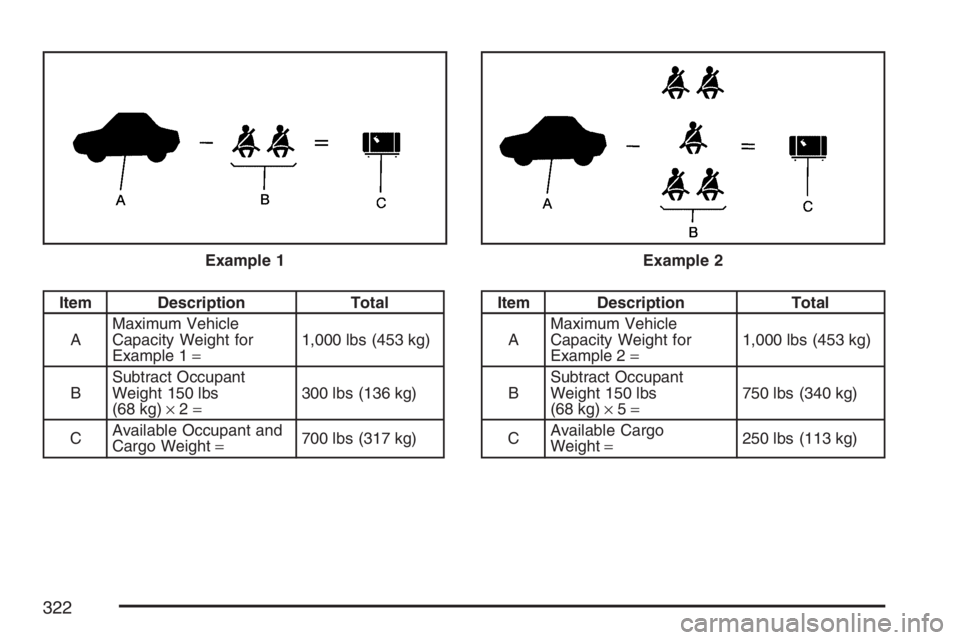
Item Description Total
AMaximum Vehicle
Capacity Weight for
Example 1=1,000 lbs (453 kg)
BSubtract Occupant
Weight 150 lbs
(68 kg)×2=300 lbs (136 kg)
CAvailable Occupant and
Cargo Weight=700 lbs (317 kg)Item Description Total
AMaximum Vehicle
Capacity Weight for
Example 2=1,000 lbs (453 kg)
BSubtract Occupant
Weight 150 lbs
(68 kg)×5=750 lbs (340 kg)
CAvailable Cargo
Weight=250 lbs (113 kg) Example 1
Example 2
322
Page 323 of 512
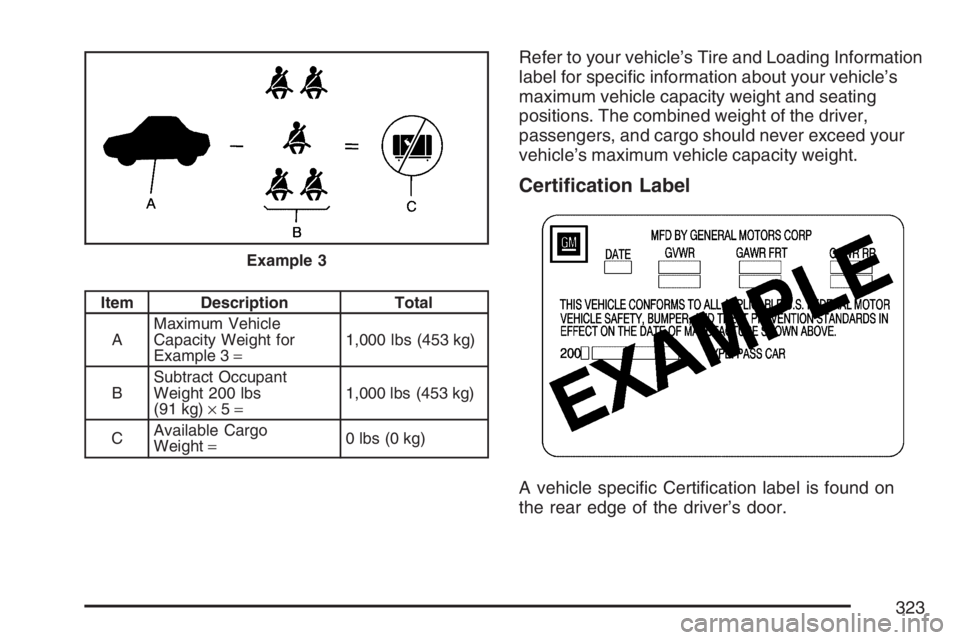
Item Description Total
AMaximum Vehicle
Capacity Weight for
Example 3=1,000 lbs (453 kg)
BSubtract Occupant
Weight 200 lbs
(91 kg)×5=1,000 lbs (453 kg)
CAvailable Cargo
Weight=0 lbs (0 kg)
Refer to your vehicle’s Tire and Loading Information
label for specic information about your vehicle’s
maximum vehicle capacity weight and seating
positions. The combined weight of the driver,
passengers, and cargo should never exceed your
vehicle’s maximum vehicle capacity weight.
Certication Label
A vehicle specic Certication label is found on
the rear edge of the driver’s door.
Example 3
323
Page 329 of 512
There are three important considerations have to
do with weight:
The weight of the trailer
The weight of the trailer tongue
The total weight on the vehicle’s tires
Weight of the Trailer
How heavy can a trailer safely be?
It should never weigh more than 1,000 lbs
(450 kg). But even that can be too heavy.
It depends on how you plan to use your rig. For
example, speed, altitude, road grades, outside
temperature and how much the vehicle is used to
pull a trailer are all important. It can also depend
on any special equipment that is on the vehicle,
and the amount of tongue weight the vehicle can
carry. See “Weight of the Trailer Tongue” later
in this section for more information.Maximum trailer weight is calculated assuming
only the driver is in the tow vehicle and it has all
the required trailering equipment. The weight
of additional optional equipment, passengers and
cargo must be subtracted from the maximum
trailer weight.
Ask your dealer for our trailering information or
advice, or you can write us at:
Buick Customer Assistance Center
P.O. Box 33136
Detroit, MI 48232-5136
In Canada, write to:
General Motors of Canada Limited
Customer Communication Centre, 163-005
1908 Colonel Sam Drive
Oshawa, Ontario L1H 8P7
329
Page 333 of 512
Following Distance
Stay at least twice as far behind the vehicle ahead
as when driving the vehicle without a trailer.
This can help avoid situations that require heavy
braking and sudden turns.
Passing
More passing distance is needed up ahead when
towing a trailer. And, because the vehicle is a
good deal longer with the trailer, you will need to
go much farther beyond the vehicle you have
passed before you can return to the proper lane.
Backing Up
Hold the bottom of the steering wheel with one
hand. Then, to move the trailer to the left,
move that hand to the left. To move the trailer to
the right, move your hand to the right. Always
back up slowly and, if possible, have someone
guide you.
Making Turns
Notice:Making very sharp turns while
trailering could cause the trailer to come in
contact with the vehicle. Your vehicle could be
damaged. Avoid making very sharp turns while
trailering.
When turning with a trailer, make wider turns than
normal. Do this so the trailer will not strike soft
shoulders, curbs, road signs, trees, or other
objects. Avoid jerky or sudden maneuvers. Signal
well in advance.
Turn Signals When Towing a Trailer
When towing a trailer, the vehicle may need a
different turn signal asher and/or extra wiring.
Check with your dealer. The arrows on the
instrument panel will ash whenever signaling a
turn or lane change. Properly hooked up, the trailer
lamps will also ash, telling other drivers you are
about to turn, change lanes or stop.
When towing a trailer, the arrows on the instrument
panel will ash for turns even if the bulbs on the
trailer are burned out. You may think drivers behind
you are seeing your signal when they are not. It is
important to check occasionally to be sure the
trailer bulbs are still working.
333
Page 337 of 512
Service........................................................ 340
Accessories and Modications................... 341
California Proposition 65 Warning.............. 341
Doing Your Own Service Work.................. 342
Adding Equipment to the Outside
of Your Vehicle...................................... 343
Fuel............................................................. 343
Gasoline Octane........................................ 343
Gasoline Specications.............................. 344
California Fuel........................................... 344
Additives................................................... 344
Fuels in Foreign Countries........................ 345
Filling the Tank......................................... 346
Filling a Portable Fuel Container............... 348
Checking Things Under the Hood.............. 348
Hood Release........................................... 349
Engine Compartment Overview.................. 350
Engine Oil................................................. 353
Engine Oil Life System.............................. 356
Engine Air Cleaner/Filter............................ 358
Automatic Transaxle Fluid......................... 360Engine Coolant.......................................... 363
Radiator Pressure Cap.............................. 367
Engine Overheating................................... 367
Overheated Engine Protection
Operating Mode..................................... 370
Cooling System......................................... 370
Power Steering Fluid ................................. 378
Windshield Washer Fluid........................... 380
Brakes...................................................... 381
Battery...................................................... 384
Jump Starting............................................ 385
Headlamp Aiming........................................ 391
Bulb Replacement....................................... 394
Halogen Bulbs........................................... 394
Headlamps and Sidemarker Lamps........... 395
Front Turn Signal and Parking Lamps....... 397
Taillamps, Turn Signal, Sidemarker,
Stoplamps and Back-up Lamps.............. 398
License Plate Lamp................................... 400
Replacement Bulbs................................... 400
Windshield Replacement............................ 401
Section 5 Service and Appearance Care
337
Page 391 of 512
To disconnect the jumper cables from both
vehicles, do the following:
1. Disconnect the black negative (−) cable from
the vehicle that had the dead battery.
2. Disconnect the black negative (−) cable from
the vehicle with the good battery.
3. Disconnect the red positive (+) cable from the
vehicle with the good battery.
4. Disconnect the red positive (+) cable from the
other vehicle.
5. Return the fuse block cover to its original
position.
Headlamp Aiming
The vehicle has a visual optical headlamp aiming
system. The aim has been preset at the factory
and should need no further adjustment
However, If the vehicle is damaged in an accident,
the headlamp aim may be affected and adjustment
may be necessary.
If oncoming vehicles ash their high beams at
you, this may also mean the vertical aim needs to
be adjusted.It is recommended that the vehicle is taken to your
dealer for service if the headlamps need to be
re-aimed. It is possible however, to re-aim
the headlamps as described in the following
procedure.
The vehicle should be properly prepared as follows:
The vehicle should be placed so the headlamps
are 25 ft. (7.6 m) from a light colored wall.
The vehicle must have all four tires on a
perfectly level surface which is level all the way
to the wall.
The vehicle should be placed so it is
perpendicular to the wall.
The vehicle should not have any snow, ice or
mud on it.
The vehicle should be fully assembled and all
other work stopped while headlamp aiming is
being done.
The vehicle should be normally loaded with a
full tank of fuel and one person or 160 lbs
(75 kg) on the driver’s seat.
Tires should be properly inated.
391
Page 394 of 512
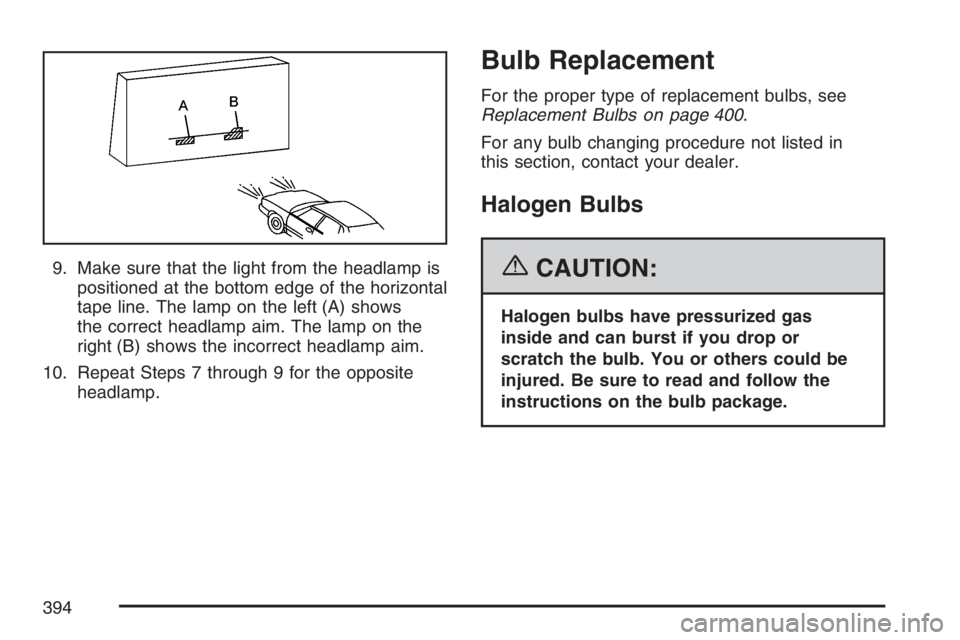
9. Make sure that the light from the headlamp is
positioned at the bottom edge of the horizontal
tape line. The lamp on the left (A) shows
the correct headlamp aim. The lamp on the
right (B) shows the incorrect headlamp aim.
10. Repeat Steps 7 through 9 for the opposite
headlamp.
Bulb Replacement
For the proper type of replacement bulbs, see
Replacement Bulbs on page 400.
For any bulb changing procedure not listed in
this section, contact your dealer.
Halogen Bulbs
{CAUTION:
Halogen bulbs have pressurized gas
inside and can burst if you drop or
scratch the bulb. You or others could be
injured. Be sure to read and follow the
instructions on the bulb package.
394
Page 395 of 512
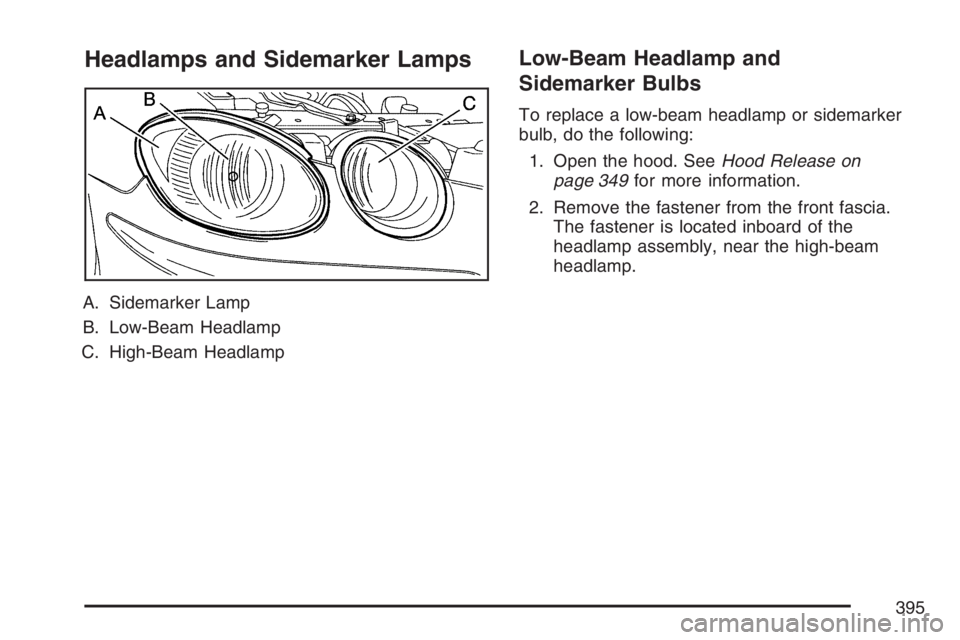
Headlamps and Sidemarker Lamps
A. Sidemarker Lamp
B. Low-Beam Headlamp
C. High-Beam Headlamp
Low-Beam Headlamp and
Sidemarker Bulbs
To replace a low-beam headlamp or sidemarker
bulb, do the following:
1. Open the hood. SeeHood Release on
page 349for more information.
2. Remove the fastener from the front fascia.
The fastener is located inboard of the
headlamp assembly, near the high-beam
headlamp.
395
Page 397 of 512
High-Beam Headlamp Bulbs
To replace the high-beam headlamp bulb, do the
following:
1. Open the hood. SeeHood Release on
page 349for more information.
2. Locate the high-beam headlamp bulb socket.
3. Remove the access cover from behind the
bulb being replaced.
4. Turn the bulb socket counterclockwise and
pull it from the headlamp assembly.
5. Holding the base of the socket, pull the old
bulb from the socket.
6. Replace with a new bulb.
7. Reverse Steps 2 through 4 to reinstall.
Front Turn Signal and Parking
Lamps
To replace a front turn signal/parking lamp bulb in
the front fascia, do the following:
1. Locate the front turn signal/parking bulb
socket by reaching behind the front bumper.
2. Turn the bulb socket counterclockwise and
pull it out of the assembly.
3. Holding the base of the socket, pull the old
bulb from the socket.
4. Push the new bulb into the socket.
5. Reverse Steps 1 through 3 to reinstall.
397