brakes BUICK LACROSSE 2007 Owner's Manual
[x] Cancel search | Manufacturer: BUICK, Model Year: 2007, Model line: LACROSSE, Model: BUICK LACROSSE 2007Pages: 512
Page 115 of 512
Make sure the shift lever is fully in PARK (P)
before starting the engine. The vehicle has
an electronic shift lock release system. You must
fully apply the regular brakes before shifting
from PARK (P) when the ignition is in RUN. If you
cannot shift out of PARK (P), ease pressure on
the shift lever by pushing it all the way into
PARK (P) as you maintain brake application.
Then move the shift lever into another gear.
SeeShifting Out of Park (P) on page 120
Notice:Shifting to REVERSE (R) while your
vehicle is moving forward could damage the
transaxle. The repairs would not be covered by
your warranty. Shift to REVERSE (R) only after
your vehicle is stopped.
REVERSE (R): Use this gear to back up.
To rock the vehicle back and forth in order to get
it out of snow, ice, or sand without damaging
the transaxle, seeIf Your Vehicle is Stuck in Sand,
Mud, Ice, or Snow on page 318.
NEUTRAL (N):In this position, the engine does
not connect with the wheels. To restart when
you are already moving, use NEUTRAL (N) only.
Also, use NEUTRAL (N) when the vehicle is
being towed.
{CAUTION:
Shifting into a drive gear while your engine
is running at high speed is dangerous.
Unless your foot is rmly on the brake
pedal, your vehicle could move very
rapidly. You could lose control and hit
people or objects. Do not shift into a
drive gear while your engine is running
at high speed.
Notice:Shifting out of PARK (P) or
NEUTRAL (N) while the engine is running at
high speed may damage the transaxle.
The repairs would not be covered by your
warranty. Be sure the engine is not running at
high speeds when shifting your vehicle.
Notice:Driving your vehicle if you notice that
it is moving slowly or not shifting gears as
you increase speed may damage the transaxle.
Have your vehicle serviced right away. You
can drive in SECOND (2) when you are driving
less than 35 mph (55 km/h) and DRIVE (D)
for higher speeds until then.
115
Page 116 of 512
DRIVE (D): This position is for normal driving.
It provides the best fuel economy for your vehicle.
If more power is needed for passing, and the
vehicle is:
Going less than 35 mph (55 km/h), push the
accelerator pedal about halfway down.
Going about 35 mph (55 km/h) or more, push
the accelerator pedal all the way down.
By doing this the vehicle will automatically
shift down to the next gear and have
more power.
Downshifting the transaxle in slippery road
conditions could result in skidding, see Skidding
underLoss of Control on page 302.
THIRD (3):This position is also used for normal
driving. However it reduces vehicle speed
more than DRIVE (D) without using your brakes.
You might choose THIRD (3) instead of DRIVE (D)
when driving on hilly, winding roads, when
towing a trailer, so there is less shifting between
gears and when going down a steep hill.Notice:Driving in SECOND (2) for more than
25 miles (40 km) or at speeds over 55 mph
(90 km/h) may damage the transaxle. Also,
shifting into SECOND (2) at speeds above
65 mph (105 km/h) can cause damage. Drive in
THIRD (3) or DRIVE (D) instead of SECOND (2).
SECOND (2): This position reduces vehicle
speed even more than THIRD (3) without using
your brakes. You can use SECOND (2) on hills.
It can help control your speed as you go down
steep mountain roads, but then you would
also want to use your brakes off and on.
FIRST (1): This position reduces vehicle speed
even more than SECOND (2) without using
your brakes. You can use it on very steep hills, or
in deep snow or mud. If the shift lever is put in
FIRST (1) while the vehicle is moving forward, the
transmission will not shift into rst gear until the
vehicle is going slowly enough.
Notice:Spinning the tires or holding the
vehicle in one place on a hill using only the
accelerator pedal may damage the transaxle.
If you are stuck, do not spin the tires. When
stopping on a hill, use the brakes, or parking
brake to hold the vehicle in place.
116
Page 120 of 512
Shifting Out of Park (P)
Automatic Transaxle Shift Lock
This vehicle has an electronic shift lock release
system. The shift lock release is designed to:
Prevent ignition key removal unless the
shift lever is in PARK (P)
Prevent movement of the shift lever out of
PARK (P) unless the ignition is in a position
other than OFF.
The shift lock is always functional except in
the case of a an uncharged or low voltage
(less than 9 volt) battery.
If your vehicle has an uncharged battery or a
battery with low voltage, try charging or jump
starting the battery. SeeJump Starting on
page 385.
Console Shift
If your console shift cannot be moved out of
PARK (P)
1. Apply and maintain the regular brakes.
2. Turn the ignition to the ACESSORY or RUN
position. SeeIgnition Positions on page 109
for more information.3. Let up on the shift lever and make sure the shift
lever is pushed all the way into PARK (P).
4. Then, move the shift into the desired gear.
If you still cannot move the shift lever from
PARK (P), consult your dealer or a professional
towing service.
Column Shift
If your park lock cable cannot be moved out of
PARK (P)
1. Apply and maintain the regular brakes.
2. Turn the ignition key to the ACCESSORY or
RUN position. SeeIgnition Positions on
page 109for more information.
3. Shift out of the PARK (P) position to the
NEUTRAL (N) position.
4. Move the vehicle to a safe location.
If you still cannot move the shift lever from
PARK (P), consult your dealer or a professional
towing service.
120
Page 166 of 512
The rst time an object is detected while in
REVERSE (R), a chime will sound and the
following will occur in sequence, depending on the
distance from the object:
At 5 feet (1.5 m) a chime will sound and
one amber light will be lit.
At 40 inches (1.0 m) both amber lights will
be lit.
At 20 inches (0.5 m) a continuous chime will
sound and all three lights (amber/amber/red)
will be lit.
At 1 foot (0.3 m) a continuous chime will
sound and all three lights (amber/amber/red)
will ash.
URPA can detect objects 3 inches (7.6 cm) and
wider, and at least 10 inches (25.4 cm) tall,
but it cannot detect objects that are above trunk
level. In order for the rear sensors to recognize an
object, it must be within operating range.
If the URPA system is not functioning properly, the
display will ash red, indicating that there is a
problem. The light will also ash red while driving if
a trailer is attached to your vehicle, or a bicycle or
object is on the back of, or hanging out of yourtrunk. The light will continue to ash until the trailer
or the object is removed and your vehicle is driven
forward at least 15 mph (25 km/h).
It may also ash red if the ultrasonic sensors are
not kept clean. So be sure to keep your rear
bumper free of mud, dirt, snow, ice and slush or
materials such as paint or the system may
not work properly. If after cleaning the rear bumper
and driving forward at least 15 mph (25 km/h),
the display continues to ash red, see your
GM dealer. For cleaning instructions, seeWashing
Your Vehicle on page 442.
It may also ash red if your vehicle is moving in
REVERSE (R) at a speed greater than 3 mph
(5 km/h). Other conditions that may affect system
performance include things like the vibrations
from a jackhammer or the compression of
airbrakes on a very large truck.
As always, drivers should use care when backing
up a vehicle. Always look behind you, being
sure to check for other vehicles, obstructions and
blind spots.
166
Page 187 of 512
Anti-Lock Brake System
Warning Light
Your vehicle may have
the Anti-Lock Brake
System (ABS).
This light will come on when your engine is
started and may stay on for several seconds.
That is normal.
If the ABS warning light comes on and stays on,
there may be a problem with the anti-lock
portion of the brake system. If the brake system
warning light is not on, you still have brakes,
but you do not have anti-lock brakes. SeeBrake
System Warning Light on page 186.
If the light stays on, turn the ignition to OFF. If the
light comes on when you are driving, stop as
soon as possible and turn the ignition off. Then
start the engine again to reset the system. If
the light still stays on, or comes on again whileyou are driving, your vehicle needs service. If the
regular brake system warning light is not on,
you still have brakes, but you do not have anti-lock
brakes. If the regular brake system warning light
is also on, you do not have anti-lock brakes
and there is a problem with your regular brakes.
SeeBrake System Warning Light on page 186.
The ABS warning light should come on briey
when you turn the ignition key to RUN. If the light
does not come on then, have it xed so it will
be ready to warn you if there is a problem.
Traction Control System (TCS)
Warning Light
Your vehicle may
have a Traction
Control System (TCS)
warning light.
If this warning light comes on and stays on, there
may be a problem with the TCS and, if your
vehicle has this feature, the StabiliTrak
®system.
187
Page 216 of 512
LEFT REAR TURN LAMP OUT
This message displays when the left rear turn
signal bulb needs to be replaced. SeeTaillamps,
Turn Signal, Sidemarker, Stoplamps and
Back-up Lamps on page 398.
This message displays while the ignition is in RUN.
Press any of the DIC buttons to acknowledge this
message and to clear it from the screen.
This message continues to display for two seconds
if it has not been acknowledged when the engine is
turned off. It also re-displays for two seconds if the
message has been acknowledged, but the
condition still exists when the engine is turned off.
If the condition still exists, the message re-appears
when the engine is turned on.
LOW BRAKE FLUID
This message displays when the brake uid level
is low. Have the brake system serviced by
your dealer as soon as possible. SeeBrakes on
page 381for proper uid level.
The brake system warning light also appears on
the instrument panel cluster when this message
appears on the DIC. SeeBrake System Warning
Light on page 186.This message displays and a chime sounds only
while the ignition is in RUN. Press any of the
DIC buttons to acknowledge this message and to
clear it from the screen.
This message continues to display for two seconds
if it has not been acknowledged when the engine is
turned off. It also re-displays for two seconds if the
message has been acknowledged, but the
condition still exists when the engine is turned off.
If the condition still exists, the message re-appears
when the engine is turned on.
LOW FUEL
This message displays when your vehicle is low
on fuel. Rell the fuel tank as soon as possible.
SeeFuel Gage on page 198andFilling the Tank
on page 346for more information.
The message displays and a chime sounds while
the ignition is in RUN. Press any of the DIC
buttons to acknowledge this message and to clear
it from the screen.
If the condition still exists, the message re-appears
when the engine is turned on.
216
Page 290 of 512
Control of a Vehicle
You have three systems that make your vehicle go
where you want it to go. They are the brakes, the
steering, and the accelerator. All three systems
have to do their work at the places where the tires
meet the road.
Sometimes, as when you are driving on snow or
ice, it is easy to ask more of those control systems
than the tires and road can provide. That means
you can lose control of your vehicle. SeeTraction
Control System (TCS) on page 294.
Adding non-GM accessories can affect your
vehicle’s performance. SeeAccessories and
Modications on page 341.
Braking
SeeBrake System Warning Light on page 186.
Braking action involves perception time and
reaction time.
First, you have to decide to push on the brake
pedal. That is perception time. Then you have to
bring up your foot and do it. That is reaction time.Average reaction time is about three-fourths of a
second. But that is only an average. It might be less
with one driver and as long as two or three seconds
or more with another. Age, physical condition,
alertness, coordination, and eyesight all play a part.
So do alcohol, drugs, and frustration. But even in
three-fourths of a second, a vehicle moving at
60 mph (100 km/h) travels 66 feet (20 m). That
could be a lot of distance in an emergency, so
keeping enough space between your vehicle and
others is important.
And, of course, actual stopping distances vary
greatly with the surface of the road, whether it is
pavement or gravel; the condition of the road,
whether it is wet, dry, or icy; tire tread; the
condition of the brakes; the weight of the vehicle;
and the amount of brake force applied.
Avoid needless heavy braking. Some people drive
in spurts — heavy acceleration followed by heavy
braking — rather than keeping pace with traffic.
This is a mistake. The brakes may not have time to
cool between hard stops. The brakes will wear out
much faster if you do a lot of heavy braking.
290
Page 291 of 512
If you keep pace with the traffic and allow realistic
following distances, you will eliminate a lot of
unnecessary braking. That means better braking
and longer brake life.
If your vehicle’s engine ever stops while you are
driving, brake normally but do not pump the
brakes. If you do, the pedal may get harder to
push down. If the engine stops, you will still have
some power brake assist. But you will use it
when you brake. Once the power assist is used
up, it may take longer to stop and the brake pedal
will be harder to push.
Adding non-GM accessories can affect your
vehicle’s performance. SeeAccessories and
Modications on page 341.Anti-Lock Brake System (ABS)
Your vehicle may have the Anti-Lock Brake
System (ABS), an advanced electronic braking
system that will help prevent a braking skid.
If your vehicle has ABS,
this warning light on the
instrument panel will
come on briey
when you start your
vehicle.
When you start your engine, or when you begin to
drive away, your ABS will check itself. You may
hear a momentary motor or clicking noise
while this test is going on, and you may even
notice that your brake pedal moves or pulses a
little. This is normal.
291
Page 292 of 512
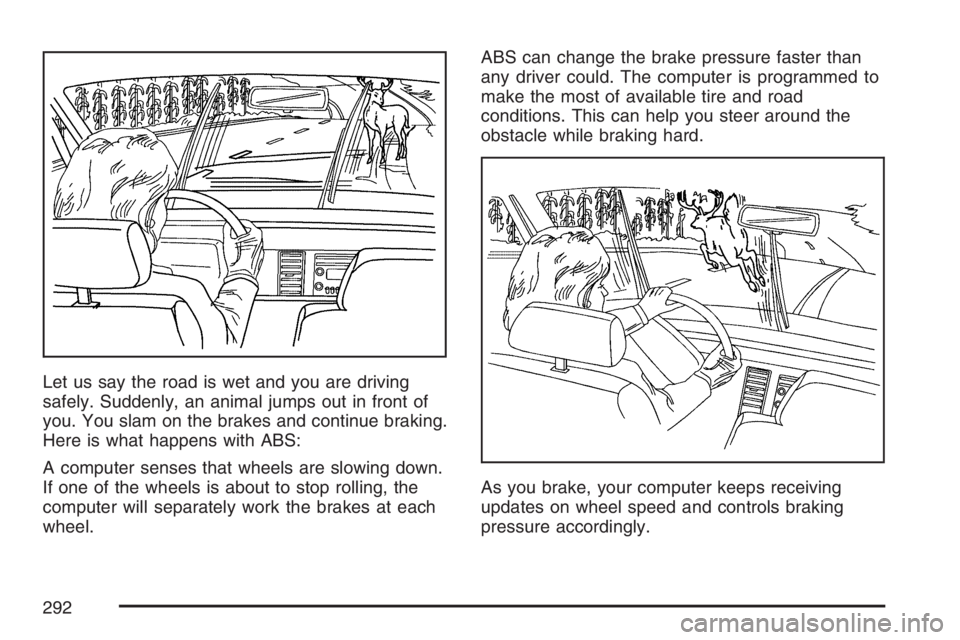
Let us say the road is wet and you are driving
safely. Suddenly, an animal jumps out in front of
you. You slam on the brakes and continue braking.
Here is what happens with ABS:
A computer senses that wheels are slowing down.
If one of the wheels is about to stop rolling, the
computer will separately work the brakes at each
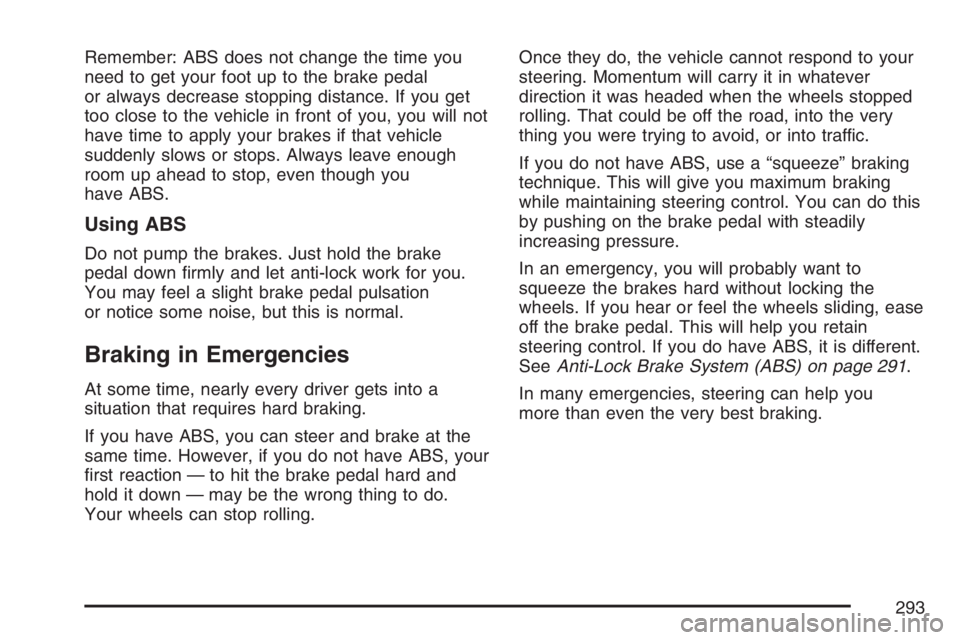
wheel.ABS can change the brake pressure faster than
any driver could. The computer is programmed to
make the most of available tire and road
conditions. This can help you steer around the
obstacle while braking hard.
As you brake, your computer keeps receiving
updates on wheel speed and controls braking
pressure accordingly.
292
Page 293 of 512
Remember: ABS does not change the time you
need to get your foot up to the brake pedal
or always decrease stopping distance. If you get
too close to the vehicle in front of you, you will not
have time to apply your brakes if that vehicle
suddenly slows or stops. Always leave enough
room up ahead to stop, even though you
have ABS.
Using ABS
Do not pump the brakes. Just hold the brake
pedal down rmly and let anti-lock work for you.
You may feel a slight brake pedal pulsation
or notice some noise, but this is normal.
Braking in Emergencies
At some time, nearly every driver gets into a
situation that requires hard braking.
If you have ABS, you can steer and brake at the
same time. However, if you do not have ABS, your
rst reaction — to hit the brake pedal hard and
hold it down — may be the wrong thing to do.
Your wheels can stop rolling.Once they do, the vehicle cannot respond to your
steering. Momentum will carry it in whatever
direction it was headed when the wheels stopped
rolling. That could be off the road, into the very
thing you were trying to avoid, or into traffic.
If you do not have ABS, use a “squeeze” braking
technique. This will give you maximum braking
while maintaining steering control. You can do this
by pushing on the brake pedal with steadily
increasing pressure.
In an emergency, you will probably want to
squeeze the brakes hard without locking the
wheels. If you hear or feel the wheels sliding, ease
off the brake pedal. This will help you retain
steering control. If you do have ABS, it is different.
SeeAnti-Lock Brake System (ABS) on page 291.
In many emergencies, steering can help you
more than even the very best braking.
293