light BUICK LACROSSE 2008 User Guide
[x] Cancel search | Manufacturer: BUICK, Model Year: 2008, Model line: LACROSSE, Model: BUICK LACROSSE 2008Pages: 440
Page 72 of 440
Restraint System Check
Checking the Restraint Systems
Safety Belts
Now and then, make sure the safety belt reminder light
and all your belts, buckles, latch plates, retractors
and anchorages are working properly.
Look for any other loose or damaged safety belt system
parts. If you see anything that might keep a safety belt
system from doing its job, have it repaired. Torn or frayed
safety belts may not protect you in a crash. They can rip
apart under impact forces. If a belt is torn or frayed, get a
new one right away.
Make sure the safety belt reminder light is working.
SeeSafety Belt Reminders on page 3-32for more
information.
Keep safety belts clean and dry. SeeCare of Safety
Belts on page 5-102.
Airbags
The airbag system does not need regularly scheduled
maintenance or replacement. Make sure the airbag
readiness light is working. SeeAirbag Readiness Light
on page 3-33for more information.
Notice:If an airbag covering is damaged, opened,
or broken, the airbag may not work properly. Do not
open or break the airbag coverings. If there are any
opened or broken airbag covers, have the airbag
covering and/or airbag module replaced. For the
location of the airbag modules, seeWhat Makes an
Airbag Inflate? on page 1-60. See your dealer/retailer
for service.
1-68
Page 73 of 440
Replacing Restraint System Parts
After a Crash
{CAUTION:
A crash can damage the restraint systems
in your vehicle. A damaged restraint system
may not properly protect the person using it,
resulting in serious injury or even death in a
crash. To help make sure your restraint systems
are working properly after a crash, have them
inspected and any necessary replacements
made as soon as possible.If you have had a crash, do you need new belts or
LATCH system (if equipped) parts?
After a very minor crash, nothing may be necessary. But
the belt assemblies that were used during any crash may
have been stressed or damaged. See your dealer/retailer
to have your safety belt assemblies inspected or
replaced.
If your vehicle has the LATCH system and it was being
used during a crash, you may need new LATCH
system parts.
New parts and repairs may be necessary even if the
belt or LATCH system (if equipped), was not being used
at the time of the crash.
If an airbag inates, you will need to replace airbag
system parts. See the part on the airbag system earlier
in this section.
Have your safety belt pretensioners checked if your
vehicle has been in a crash, if your airbag readiness
light stays on after you start your vehicle, or while you
are driving. SeeAirbag Readiness Light on page 3-33.
1-69
Page 79 of 440
Remote Keyless Entry (RKE)
System Operation
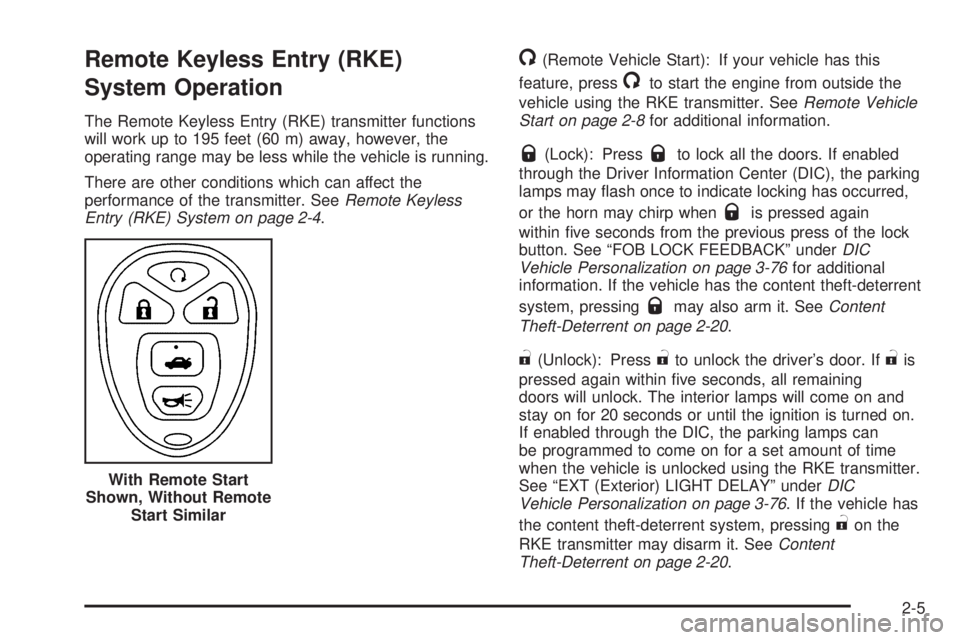
The Remote Keyless Entry (RKE) transmitter functions
will work up to 195 feet (60 m) away, however, the
operating range may be less while the vehicle is running.
There are other conditions which can affect the
performance of the transmitter. SeeRemote Keyless
Entry (RKE) System on page 2-4.
/(Remote Vehicle Start): If your vehicle has this
feature, press
/to start the engine from outside the
vehicle using the RKE transmitter. SeeRemote Vehicle
Start on page 2-8for additional information.
Q(Lock): PressQto lock all the doors. If enabled
through the Driver Information Center (DIC), the parking
lamps may ash once to indicate locking has occurred,
or the horn may chirp when
Qis pressed again
within ve seconds from the previous press of the lock
button. See “FOB LOCK FEEDBACK” underDIC
Vehicle Personalization on page 3-76for additional
information. If the vehicle has the content theft-deterrent
system, pressing
Qmay also arm it. SeeContent
Theft-Deterrent on page 2-20.
"(Unlock): Press"to unlock the driver’s door. If"is
pressed again within ve seconds, all remaining
doors will unlock. The interior lamps will come on and
stay on for 20 seconds or until the ignition is turned on.
If enabled through the DIC, the parking lamps can
be programmed to come on for a set amount of time
when the vehicle is unlocked using the RKE transmitter.
See “EXT (Exterior) LIGHT DELAY” underDIC
Vehicle Personalization on page 3-76. If the vehicle has
the content theft-deterrent system, pressing
"on the
RKE transmitter may disarm it. SeeContent
Theft-Deterrent on page 2-20. With Remote Start
Shown, Without Remote
Start Similar
2-5
Page 83 of 440
After entering the vehicle during a remote start, insert
and turn the key to ON/RUN to drive the vehicle.
The engine will shut off automatically after 10 minutes,
unless a time extension has been done or the
vehicle’s key is inserted into the ignition switch and
turned to ON/RUN.
To manually shut off a remote start, do any of the
following.
Aim the RKE transmitter at the vehicle and press
and release the remote start button.
Turn on the hazard warning ashers.
Turn the ignition switch out of LOCK/OFF position
and then back to LOCK/OFF.
The parking lamps turn off to indicate the engine is off.After the engine has been started two times, or one
time with a time extension, the vehicle’s ignition must be
turned to ON/RUN using the key before the remote
start procedure can be used again. SeeIgnition
Positions on page 2-24for information regarding the
ignition positions on your vehicle.
The remote vehicle start feature will not operate if any
of the follow occur:
The remote start system is disabled through the DIC.
The vehicle’s key is in the ignition.
A door on the vehicle is open.
The vehicle’s hood is open.
The hazard warning ashers are on.
The check engine light is on. SeeMalfunction
Indicator Lamp on page 3-42
2-9
Page 89 of 440
Remote Trunk Release
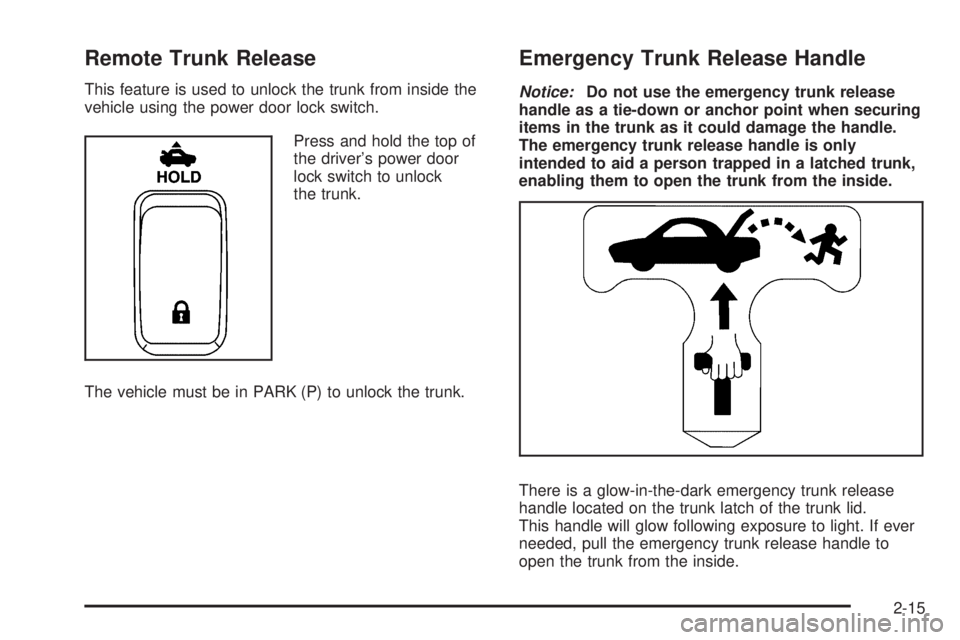
This feature is used to unlock the trunk from inside the
vehicle using the power door lock switch.
Press and hold the top of
the driver’s power door
lock switch to unlock
the trunk.
The vehicle must be in PARK (P) to unlock the trunk.
Emergency Trunk Release Handle
Notice:Do not use the emergency trunk release
handle as a tie-down or anchor point when securing
items in the trunk as it could damage the handle.
The emergency trunk release handle is only
intended to aid a person trapped in a latched trunk,
enabling them to open the trunk from the inside.
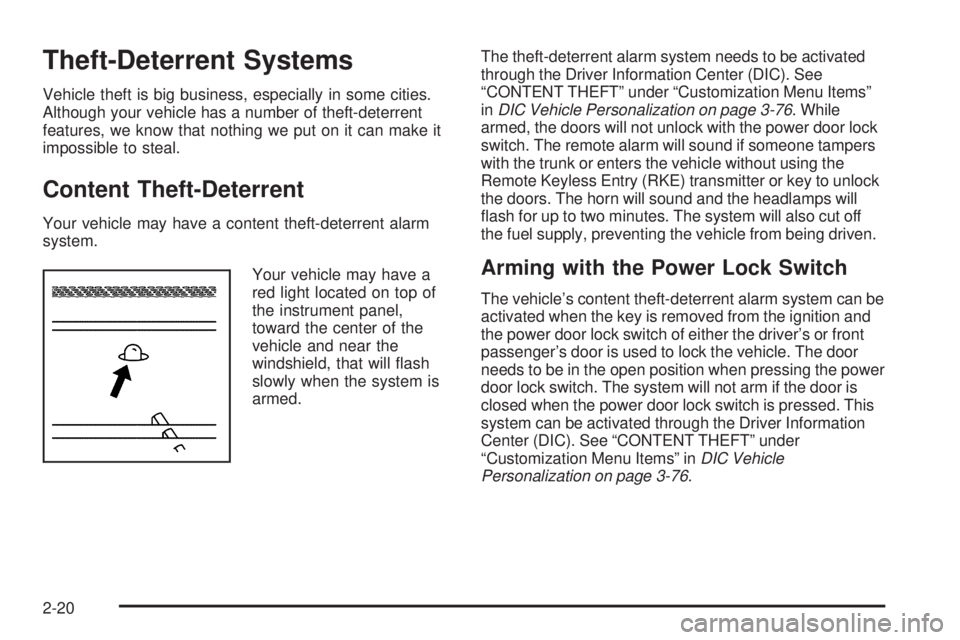
There is a glow-in-the-dark emergency trunk release
handle located on the trunk latch of the trunk lid.
This handle will glow following exposure to light. If ever
needed, pull the emergency trunk release handle to
open the trunk from the inside.
2-15
Page 94 of 440
Theft-Deterrent Systems
Vehicle theft is big business, especially in some cities.
Although your vehicle has a number of theft-deterrent
features, we know that nothing we put on it can make it
impossible to steal.
Content Theft-Deterrent
Your vehicle may have a content theft-deterrent alarm
system.
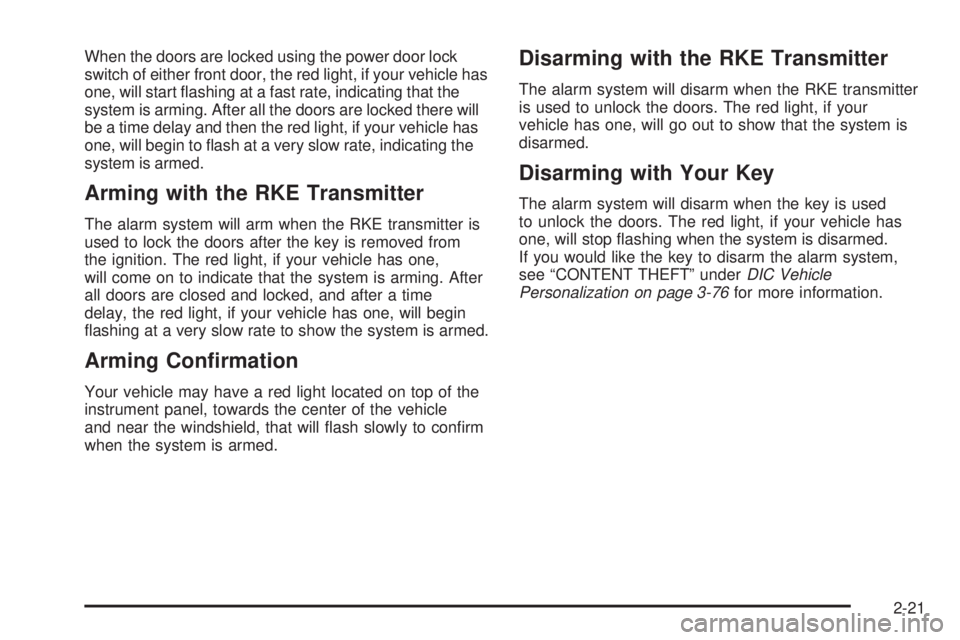
Your vehicle may have a
red light located on top of
the instrument panel,
toward the center of the
vehicle and near the
windshield, that will ash
slowly when the system is
armed.The theft-deterrent alarm system needs to be activated
through the Driver Information Center (DIC). See
“CONTENT THEFT” under “Customization Menu Items”
inDIC Vehicle Personalization on page 3-76. While
armed, the doors will not unlock with the power door lock
switch. The remote alarm will sound if someone tampers
with the trunk or enters the vehicle without using the
Remote Keyless Entry (RKE) transmitter or key to unlock
the doors. The horn will sound and the headlamps will
ash for up to two minutes. The system will also cut off
the fuel supply, preventing the vehicle from being driven.
Arming with the Power Lock Switch
The vehicle’s content theft-deterrent alarm system can be
activated when the key is removed from the ignition and
the power door lock switch of either the driver’s or front
passenger’s door is used to lock the vehicle. The door
needs to be in the open position when pressing the power
door lock switch. The system will not arm if the door is
closed when the power door lock switch is pressed. This
system can be activated through the Driver Information
Center (DIC). See “CONTENT THEFT” under
“Customization Menu Items” inDIC Vehicle
Personalization on page 3-76.
2-20
Page 95 of 440
When the doors are locked using the power door lock
switch of either front door, the red light, if your vehicle has
one, will start ashing at a fast rate, indicating that the
system is arming. After all the doors are locked there will
be a time delay and then the red light, if your vehicle has
one, will begin to ash at a very slow rate, indicating the
system is armed.
Arming with the RKE Transmitter
The alarm system will arm when the RKE transmitter is
used to lock the doors after the key is removed from
the ignition. The red light, if your vehicle has one,
will come on to indicate that the system is arming. After
all doors are closed and locked, and after a time
delay, the red light, if your vehicle has one, will begin
ashing at a very slow rate to show the system is armed.
Arming Conrmation
Your vehicle may have a red light located on top of the
instrument panel, towards the center of the vehicle
and near the windshield, that will ash slowly to conrm
when the system is armed.
Disarming with the RKE Transmitter
The alarm system will disarm when the RKE transmitter
is used to unlock the doors. The red light, if your
vehicle has one, will go out to show that the system is
disarmed.
Disarming with Your Key
The alarm system will disarm when the key is used
to unlock the doors. The red light, if your vehicle has
one, will stop ashing when the system is disarmed.
If you would like the key to disarm the alarm system,
see “CONTENT THEFT” underDIC Vehicle
Personalization on page 3-76for more information.
2-21
Page 96 of 440
PASS-Key®III
Your PASS-Key®III system operates on a radio
frequency subject to Federal Communications
Commission (FCC) Rules and with Industry Canada.
This device complies with Part 15 of the FCC Rules.
Operation is subject to the following two conditions:
1. This device may not cause harmful interference.
2. This device must accept any interference received,
including interference that may cause undesired
operation.
This device complies with RSS-210 of Industry Canada.
Operation is subject to the following two conditions:
1. This device may not cause interference.
2. This device must accept any interference received,
including interference that may cause undesired
operation of the device.
Changes or modications to this system by other than
an authorized service facility could void authorization to
use this equipment.
PASS-Key
®III uses a radio frequency transponder in
the key that matches a decoder in your vehicle.
PASS-Key®III Operation
Your vehicle is equipped with PASS-Key®III
(Personalized Automotive Security System)
theft-deterrent system. PASS-Key
®III is a passive
theft-deterrent system.
The system is automatically armed when the key is
removed from the ignition.
You do not have to manually arm or disarm the system.
The security light will come on if there is a problem
with arming or disarming the theft-deterrent system.
PASS-Key III
®uses a transponder in the ignition
key that matches a decoder in the vehicle.
When the PASS-Key
®III system senses that the wrong
key has been inserted into the ignition, it shuts down the
vehicle’s starter and fuel systems. The starter will not
work and fuel will stop owing to the engine. If someone
tries to start the vehicle again with the wrong key, the
vehicle will not start. Anyone using a trial-and-error
method to start the vehicle will be discouraged to do so
because of the high number of electrical key codes.
When trying to start the vehicle, if the engine does not
start and the STARTING DISABLED warning message
on the Driver Information Center (DIC) comes on, there
may be a problem with your theft-deterrent system. Turn
the ignition off and try again.
2-22
Page 99 of 440
If the steering wheel is locked, move it from right to left
and turn the key to ACC/ACCESSORY. If none of
this works, then your vehicle needs service.
B (ACC/ACCESSORY):This position lets the radio and
windshield wipers operate while the engine is off. To
use ACC/ACCESSORY, turn the key clockwise.
C (ON/RUN):This position is where the key returns to
after the vehicle is started. This position displays
some of the warning and indicator lights.
The battery could be drained if you leave the key in the
ACC/ACCESSORY or ON/RUN position with the
engine off. You may not be able to start your vehicle if
the battery is allowed to drain for an extended period
of time.
D (START):This position starts the engine.
A warning chime will sound and the Driver Information
Center (DIC) will display DRIVER’S DOOR AJAR
when the driver’s door is opened if the ignition is in
LOCK/OFF, ACC/ACCESSORY and the key is in
the ignition. SeeDIC Warnings and Messages on
page 3-58for more information.Key In the Ignition
Never leave your vehicle with the keys inside, as it is an
easy target for joy riders or thieves. If you leave the key in
the ignition and park your vehicle, a chime will sound,
when you open the driver’s door. Always remember to
remove your key from the ignition and take it with you.
This will lock your ignition and transmission. Also, always
remember to lock the doors.
The battery could be drained if you leave the key in the
ignition while your vehicle is parked. You may not be
able to start your vehicle after it has been parked for an
extended period of time.
Retained Accessory Power (RAP)
These vehicle accessories can be used for up to
10 minutes after the engine is turned off:
Audio System
Power Windows
Power to these accessories continues to work for
10 minutes or until a door is opened.
2-25
Page 106 of 440
Notice:Driving in SECOND (2) for more than
25 miles (40 km) or at speeds over 55 mph (90 km/h)
may damage the transmission. Also, shifting into
SECOND (2) at speeds above 65 mph (105 km/h) can
cause damage. Drive in THIRD (3) or DRIVE (D)
instead of SECOND (2).
SECOND (2): This position reduces vehicle speed even
more than THIRD (3) without using your brakes. You can
use SECOND (2) on hills. It can help control your speed
as you go down steep mountain roads, but then you
would also want to use your brakes off and on.
FIRST (1): This position reduces vehicle speed even
more than SECOND (2) without using your brakes. You
can use it on very steep hills, or in deep snow or
mud. If the shift lever is put in FIRST (1) while the
vehicle is moving forward, the transmission will not shift
into rst gear until the vehicle is going slowly enough.
Notice:Spinning the tires or holding the vehicle in
one place on a hill using only the accelerator
pedal may damage the transmission. The repair will
not be covered by your warranty. If you are stuck,
do not spin the tires. When stopping on a hill,
use the brakes to hold the vehicle in place.Parking Brake
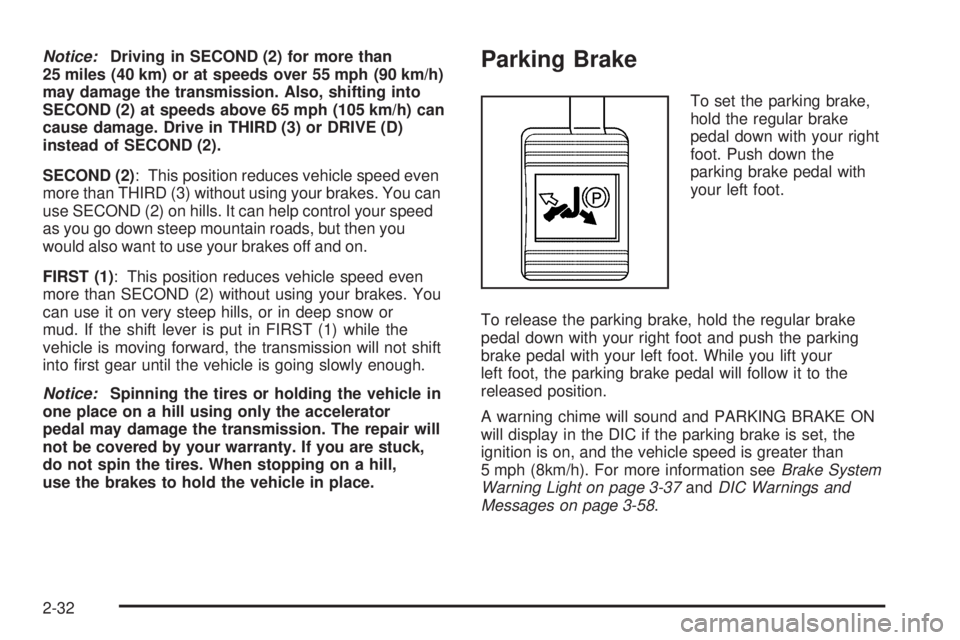
To set the parking brake,
hold the regular brake
pedal down with your right
foot. Push down the
parking brake pedal with
your left foot.
To release the parking brake, hold the regular brake
pedal down with your right foot and push the parking
brake pedal with your left foot. While you lift your
left foot, the parking brake pedal will follow it to the
released position.
A warning chime will sound and PARKING BRAKE ON
will display in the DIC if the parking brake is set, the
ignition is on, and the vehicle speed is greater than
5 mph (8km/h). For more information seeBrake System
Warning Light on page 3-37andDIC Warnings and
Messages on page 3-58.
2-32