Driver info BUICK LACROSSE 2008 Service Manual
[x] Cancel search | Manufacturer: BUICK, Model Year: 2008, Model line: LACROSSE, Model: BUICK LACROSSE 2008Pages: 440
Page 257 of 440
Steps for Determining Correct Load Limit
1.Locate the statement “The combined weight of
occupants and cargo should never exceed
XXX kg or XXX lbs” on your vehicle’s placard.
2.Determine the combined weight of the driver
and passengers that will be riding in your
vehicle.
3.Subtract the combined weight of the driver
and passengers from XXX kg or XXX lbs.
4.The resulting gure equals the available
amount of cargo and luggage load capacity.
For example, if the “XXX” amount equals
1400 lbs and there will be ve 150 lb
passengers in your vehicle, the amount of
available cargo and luggage load capacity is
650 lbs (1400−750 (5 x 150) = 650 lbs).
5.Determine the combined weight of luggage and
cargo being loaded on the vehicle. That weight
may not safely exceed the available cargo and
luggage load capacity calculated in Step 4.
6.If your vehicle will be towing a trailer, the load
from your trailer will be transferred to your
vehicle. Consult this manual to determine how
this reduces the available cargo and luggage
load capacity for your vehicle.
If your vehicle can tow a trailer, seeTowing a
Trailer on page 4-28for important information
on towing a trailer, towing safety rules, and
trailering tips.
4-23
Page 259 of 440
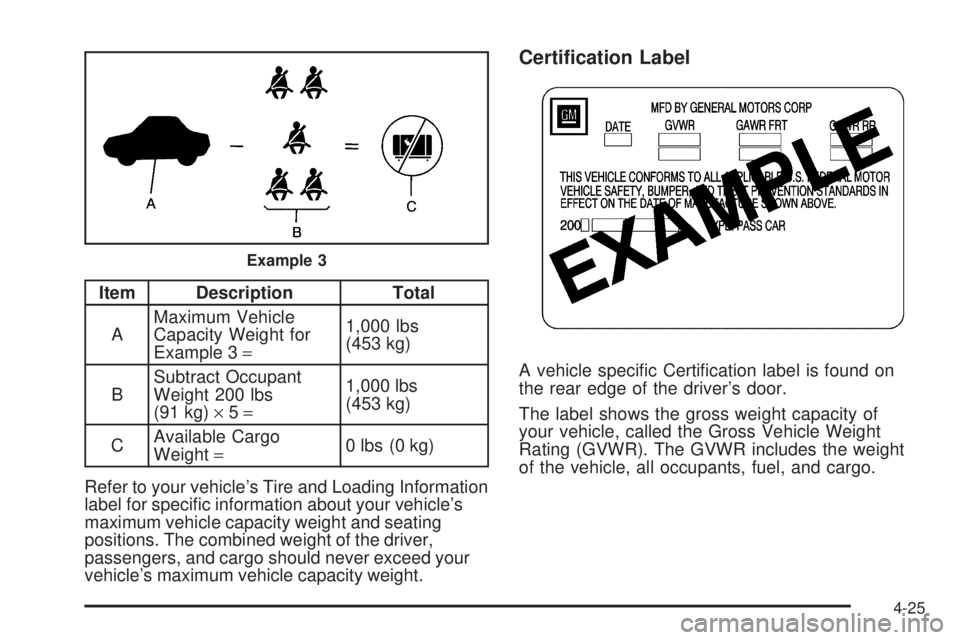
Item Description Total
AMaximum Vehicle
Capacity Weight for
Example 3=1,000 lbs
(453 kg)
BSubtract Occupant
Weight 200 lbs
(91 kg)×5=1,000 lbs
(453 kg)
CAvailable Cargo
Weight=0 lbs (0 kg)
Refer to your vehicle’s Tire and Loading Information
label for specic information about your vehicle’s
maximum vehicle capacity weight and seating
positions. The combined weight of the driver,
passengers, and cargo should never exceed your
vehicle’s maximum vehicle capacity weight.
Certication Label
A vehicle specic Certication label is found on
the rear edge of the driver’s door.
The label shows the gross weight capacity of
your vehicle, called the Gross Vehicle Weight
Rating (GVWR). The GVWR includes the weight
of the vehicle, all occupants, fuel, and cargo.
Example 3
4-25
Page 264 of 440
Weight of the Trailer
How heavy can a trailer safely be?
It should never weigh more than 1,000 lbs (450 kg). But
even that can be too heavy.
It depends on how you plan to use your rig. For
example, speed, altitude, road grades, outside
temperature and how much the vehicle is used to pull a
trailer are all important. It can also depend on any
special equipment that is on the vehicle, and the amount
of tongue weight the vehicle can carry. See “Weight
of the Trailer Tongue” later in this section for more
information.
Maximum trailer weight is calculated assuming only the
driver is in the tow vehicle and it has all the required
trailering equipment. The weight of additional optional
equipment, passengers and cargo must be subtracted
from the maximum trailer weight.
Ask your dealer/retailer for our trailering information or
advice, or write us at our Customer Assistance
Offices. SeeCustomer Assistance Offices on page 7-6
for more information.
Weight of the Trailer Tongue
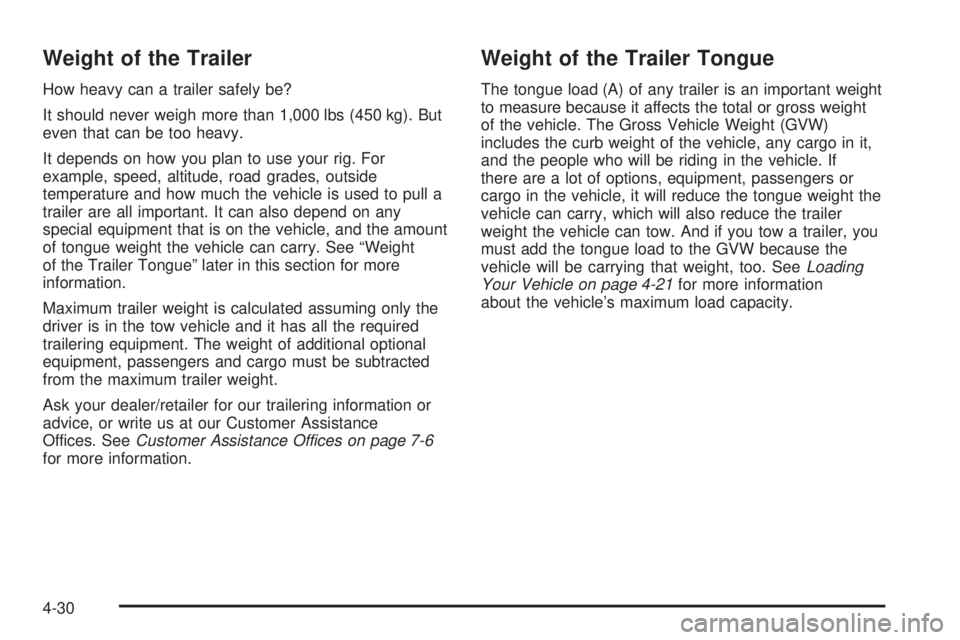
The tongue load (A) of any trailer is an important weight
to measure because it affects the total or gross weight
of the vehicle. The Gross Vehicle Weight (GVW)
includes the curb weight of the vehicle, any cargo in it,
and the people who will be riding in the vehicle. If
there are a lot of options, equipment, passengers or
cargo in the vehicle, it will reduce the tongue weight the
vehicle can carry, which will also reduce the trailer
weight the vehicle can tow. And if you tow a trailer, you
must add the tongue load to the GVW because the
vehicle will be carrying that weight, too. SeeLoading
Your Vehicle on page 4-21for more information
about the vehicle’s maximum load capacity.
4-30
Page 279 of 440
{CAUTION:
Fuel can spray out on you if you open the fuel
cap too quickly. If you spill fuel and then
something ignites it, you could be badly
burned. This spray can happen if your tank is
nearly full, and is more likely in hot weather.
Open the fuel cap slowly and wait for any hiss
noise to stop. Then unscrew the cap all the way.
Be careful not to spill fuel. Do not top off or overll the
tank and wait a few seconds after you have nished
pumping before removing the nozzle. Clean fuel from
painted surfaces as soon as possible. SeeWashing Your
Vehicle on page 5-102.
When replacing the fuel cap, turn it clockwise until it
clicks. Make sure the cap is fully installed. The
diagnostic system can determine if the fuel cap has
been left off or improperly installed. This would allow fuel
to evaporate into the atmosphere. SeeMalfunction
Indicator Lamp on page 3-42.
Your vehicle may also have a check gas cap warning
light, which will be displayed on the instrument panel
cluster if the fuel cap is not properly installed. SeeCheck
Gas Cap Light on page 3-49for more information.If your vehicle has a Driver Information Center (DIC),
the CHECK GAS CAP message will be displayed if the
fuel cap is not properly installed. SeeDIC Warnings
and Messages on page 3-58for more information.
{CAUTION:
If a re starts while you are refueling, do not
remove the nozzle. Shut off the ow of fuel by
shutting off the pump or by notifying the
station attendant. Leave the area immediately.
Notice:If you need a new fuel cap, be sure to get
the right type. Your dealer/retailer can get one for
you. If you get the wrong type, it may not t properly.
This may cause your malfunction indicator lamp to
light and may damage your fuel tank and emissions
system. SeeMalfunction Indicator Lamp
on page 3-42.
5-9
Page 291 of 440
Engine Oil Additives
Do not add anything to the oil. The recommended oils
with the starburst symbol that meet
GM Standard GM6094M are all you need for good
performance and engine protection.
Engine Oil Life System
When to Change Engine Oil
Your vehicle has a computer system that lets you know
when to change the engine oil and lter. This is based
on engine revolutions and engine temperature, and not
on mileage. Based on driving conditions, the mileage at
which an oil change will be indicated can vary
considerably. For the oil life system to work properly, you
must reset the system every time the oil is changed.When the system has calculated that oil life has been
diminished, it will indicate that an oil change is
necessary. A change engine oil light or, if your vehicle
has the Driver Information Center (DIC), a CHANGE OIL
SOON message will come on. SeeChange Engine Oil
Light on page 3-45orDIC Warnings and Messages on
page 3-58. Change the oil as soon as possible within the
next 600 miles (1 000 km). It is possible that, if you are
driving under the best conditions, the oil life system might
not indicate that an oil change is necessary for over a
year. However, the engine oil and lter must be changed
at least once a year and at this time the system must be
reset. Your dealer/retailer has trained service people who
will perform this work using genuine parts and reset the
system. It is also important to check the oil regularly and
keep it at the proper level.
If the system is ever reset accidentally, you must
change the oil at 3,000 miles (5 000 km) since the last
oil change. Remember to reset the oil life system
whenever the oil is changed.
5-21
Page 292 of 440
How to Reset the Engine Oil Life
System
The Engine Oil Life System calculates when to change
the engine oil and lter based on vehicle use.
Whenever the oil is changed, reset the system so it can
calculate when the next oil change is required. If a
situation occurs where you change the oil prior to a
change engine oil light or CHANGE OIL SOON message
being turned on, reset the system.
After changing the engine oil, reset the system:
Vehicles with Driver Information Center (DIC)
1. Press the option button on the DIC until
ENGINE OIL MONITOR appears on the
DIC screen.
2. Press the set/reset button to reset the system.
The next screen indicates that the CHANGE
OIL SOON message has been reset.
If the vehicle has the uplevel DIC, when the
gages button is pressed and the OIL
LIFE REMAINING mode appears, it should
read 100 percent OIL LIFE REMAINING.
3. Turn the key to LOCK/OFF.
Vehicles without Driver Information Center (DIC)
1. With the engine off, turn the ignition key to
ON/RUN.
2. Fully press and release the accelerator pedal
slowly three times within ve seconds.
3. Turn the key to LOCK/OFF, then start the
vehicle.
If the light or message comes back on when you start
your vehicle, the oil life system has not reset. Repeat the
procedure.
What to Do with Used Oil
Used engine oil contains certain elements that can be
unhealthy for your skin and could even cause cancer.
Do not let used oil stay on your skin for very long. Clean
your skin and nails with soap and water, or a good hand
cleaner. Wash or properly dispose of clothing or rags
containing used engine oil. See the manufacturer’s
warnings about the use and disposal of oil products.
Used oil can be a threat to the environment. If you
change your own oil, be sure to drain all the oil from the
lter before disposal. Never dispose of oil by putting it
in the trash, pouring it on the ground, into sewers, or into
streams or bodies of water. Instead, recycle it by taking
it to a place that collects used oil. If you have a problem
properly disposing of used oil, ask your dealer/retailer, a
service station, or a local recycling center for help.
5-22
Page 293 of 440
Engine Air Cleaner/Filter
The engine air cleaner/lter is located in the engine
compartment on the driver’s side of the vehicle.
SeeEngine Compartment Overview on page 5-12for
more information on location.
When to Inspect the Engine Air
Cleaner/Filter
Inspect the air cleaner/lter at the MaintenanceII
intervals and replace it at the rst oil change after each
50,000 mile (80 000 km) interval. SeeScheduled
Maintenance on page 6-4for more information. If you
are driving in dusty/dirty conditions, inspect the lter
at each engine oil change.
How to Inspect the Engine Air
Cleaner/Filter
To inspect the air cleaner/lter, remove the lter from
the vehicle and lightly shake the lter to release loose
dust and dirt. If the lter remains caked with dirt, a new
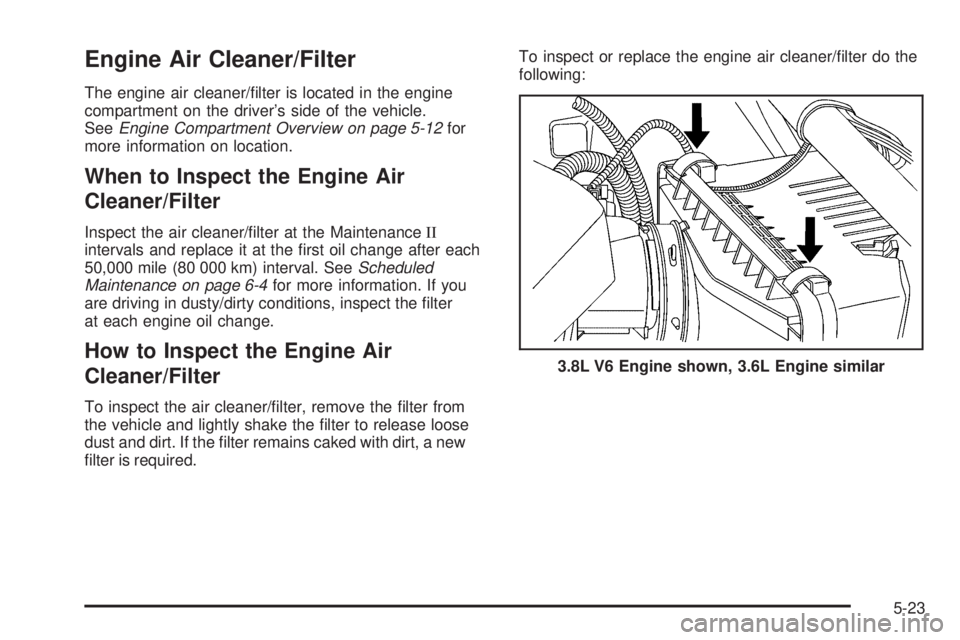
lter is required.To inspect or replace the engine air cleaner/lter do the
following:
3.8L V6 Engine shown, 3.6L Engine similar
5-23
Page 298 of 440
What to Use
Use a mixture of one-half clean, drinkable water and
one-half DEX-COOL®engine coolant which will not
damage aluminum parts. If this coolant mixture is used,
nothing else needs to be added.
{CAUTION:
Adding only plain water to your cooling system
can be dangerous. Plain water, or some other
liquid such as alcohol, can boil before the
proper coolant mixture will. Your vehicle’s
coolant warning system is set for the proper
coolant mixture. With plain water or the wrong
mixture, your engine could get too hot but you
would not get the overheat warning. Your
engine could catch re and you or others could
be burned. Use a 50/50 mixture of clean,
drinkable water and DEX-COOL
®coolant.
Notice:If you use an improper coolant mixture,
your engine could overheat and be badly damaged.
The repair cost would not be covered by your
warranty. Too much water in the mixture can freeze
and crack the engine, radiator, heater core, and
other parts.If coolant needs to be added more than four times a
year, have your dealer/retailer check the cooling system.
Notice:If you use extra inhibitors and/or additives
in your vehicle’s cooling system, you could damage
your vehicle. Use only the proper mixture of the
engine coolant listed in this manual for the cooling
system. SeeRecommended Fluids and Lubricants on
page 6-12for more information.
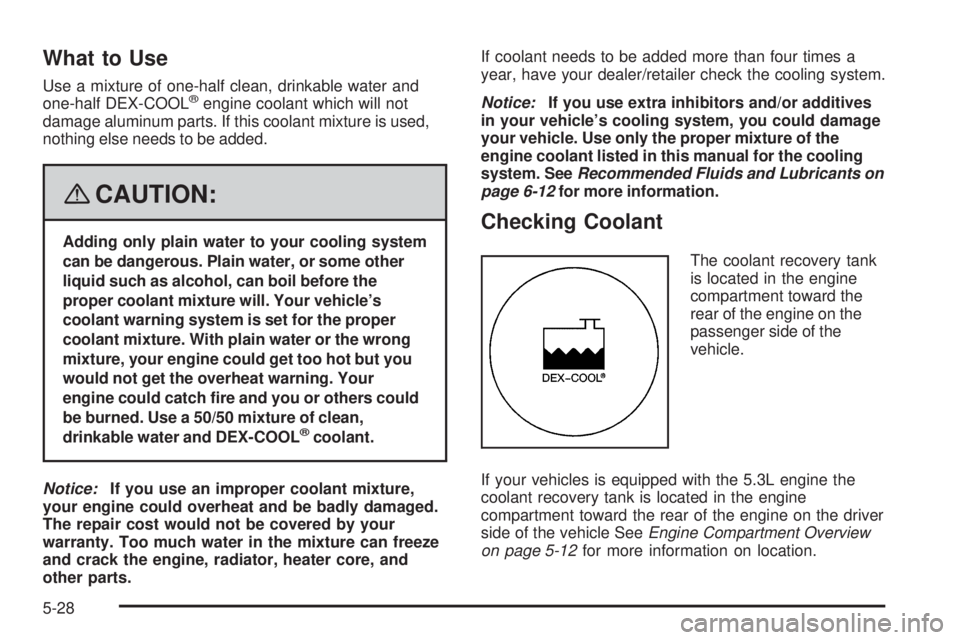
Checking Coolant
The coolant recovery tank
is located in the engine
compartment toward the
rear of the engine on the
passenger side of the
vehicle.
If your vehicles is equipped with the 5.3L engine the
coolant recovery tank is located in the engine
compartment toward the rear of the engine on the driver
side of the vehicle SeeEngine Compartment Overview
on page 5-12for more information on location.
5-28
Page 300 of 440
Pressure Cap
Notice:If the pressure cap is not tightly installed,
coolant loss and possible engine damage may
occur. Be sure the cap is properly and tightly
secured.
SeeEngine Compartment Overview on page 5-12for
more information on location.
Engine Overheating
There is a coolant temperature gage and a warning light
on the instrument panel cluster that indicate an
overheated engine condition. SeeEngine Coolant
Temperature Gage on page 3-40andEngine Coolant
Temperature Warning Light on page 3-40for more
information.
In addition, if your vehicle is equipped with a Driver
Information Center (DIC), you will nd an ENGINE
COOLANT HOT and a REDUCED POWER STOP
WHEN SAFE message displayed on the DIC. SeeDIC
Warnings and Messages on page 3-58for more
information.
5-30
Page 302 of 440
If you no longer have the overheat warning, you can
drive. Just to be safe, drive slower for about 10 minutes.
If the warning does not come back on, you can drive
normally.
If the warning continues and you have not stopped, pull
over, stop, and park your vehicle right away.
If there is still no sign of steam, you can idle the engine
for three minutes while you are parked. If you still
have the warning, turn off the engine and get everyone
out of the vehicle until it cools down. Also, see
“Overheated Engine Protection Operating Mode” later in
this section.
You may decide not to lift the hood but to get service
help right away.Overheated Engine Protection
Operating Mode
This emergency operating mode allows your vehicle to
be driven to a safe place in an emergency situation.
If an overheated engine condition exists, an overheat
protection mode which alternates ring groups of
cylinders helps prevent engine damage. In this mode,
you will notice a signicant loss in power and engine
performance. The REDUCED POWER STOP WHEN
SAFE message will come on in the Driver Information
Center (DIC), if the vehicle has one, along with the
engine coolant temperature warning light on the
instrument panel, to indicate the vehicle has entered
overheated engine protection operating mode. The
temperature gage will also indicate an overheat condition
exists. Driving extended miles (km) and/or towing a trailer
in the overheat protection mode should be avoided.
Notice:After driving in the overheated engine
protection operating mode, to avoid engine damage,
allow the engine to cool before attempting any
repair. The engine oil will be severely degraded.
Repair the cause of coolant loss, change the oil and
reset the oil life system. SeeEngine Oil on page 5-18.
5-32