steering wheel BUICK LACROSSE 2009 Owner's Guide
[x] Cancel search | Manufacturer: BUICK, Model Year: 2009, Model line: LACROSSE, Model: BUICK LACROSSE 2009Pages: 428
Page 247 of 428
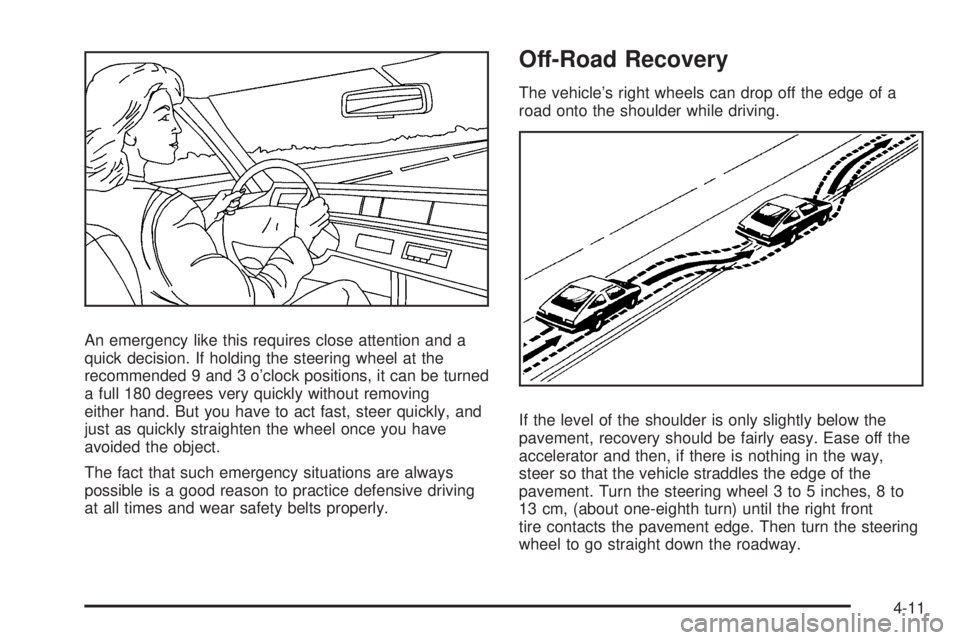
An emergency like this requires close attention and a
quick decision. If holding the steering wheel at the
recommended 9 and 3 o’clock positions, it can be turned
a full 180 degrees very quickly without removing
either hand. But you have to act fast, steer quickly, and
just as quickly straighten the wheel once you have
avoided the object.
The fact that such emergency situations are always
possible is a good reason to practice defensive driving
at all times and wear safety belts properly.
Off-Road Recovery
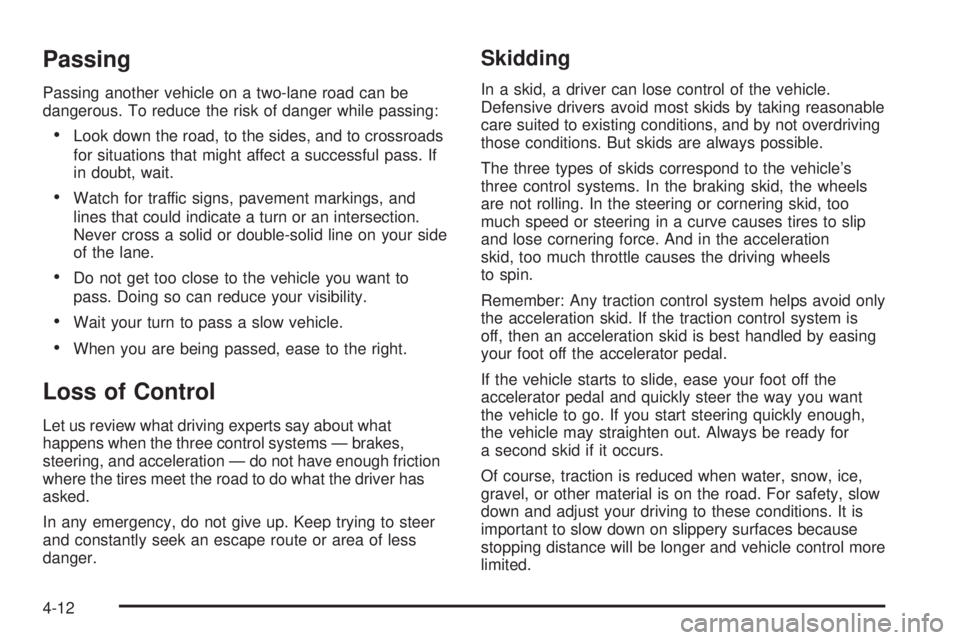
The vehicle’s right wheels can drop off the edge of a
road onto the shoulder while driving.
If the level of the shoulder is only slightly below the
pavement, recovery should be fairly easy. Ease off the
accelerator and then, if there is nothing in the way,
steer so that the vehicle straddles the edge of the
pavement. Turn the steering wheel 3 to 5 inches, 8 to
13 cm, (about one-eighth turn) until the right front
tire contacts the pavement edge. Then turn the steering
wheel to go straight down the roadway.
4-11
Page 248 of 428
Passing
Passing another vehicle on a two-lane road can be
dangerous. To reduce the risk of danger while passing:
Look down the road, to the sides, and to crossroads
for situations that might affect a successful pass. If
in doubt, wait.
Watch for traffic signs, pavement markings, and
lines that could indicate a turn or an intersection.
Never cross a solid or double-solid line on your side
of the lane.
Do not get too close to the vehicle you want to
pass. Doing so can reduce your visibility.
Wait your turn to pass a slow vehicle.
When you are being passed, ease to the right.
Loss of Control
Let us review what driving experts say about what
happens when the three control systems — brakes,
steering, and acceleration — do not have enough friction
where the tires meet the road to do what the driver has
asked.
In any emergency, do not give up. Keep trying to steer
and constantly seek an escape route or area of less
danger.
Skidding
In a skid, a driver can lose control of the vehicle.
Defensive drivers avoid most skids by taking reasonable
care suited to existing conditions, and by not overdriving
those conditions. But skids are always possible.
The three types of skids correspond to the vehicle’s
three control systems. In the braking skid, the wheels
are not rolling. In the steering or cornering skid, too
much speed or steering in a curve causes tires to slip
and lose cornering force. And in the acceleration
skid, too much throttle causes the driving wheels
to spin.
Remember: Any traction control system helps avoid only
the acceleration skid. If the traction control system is
off, then an acceleration skid is best handled by easing
your foot off the accelerator pedal.
If the vehicle starts to slide, ease your foot off the
accelerator pedal and quickly steer the way you want
the vehicle to go. If you start steering quickly enough,
the vehicle may straighten out. Always be ready for
a second skid if it occurs.
Of course, traction is reduced when water, snow, ice,
gravel, or other material is on the road. For safety, slow
down and adjust your driving to these conditions. It is
important to slow down on slippery surfaces because
stopping distance will be longer and vehicle control more
limited.
4-12
Page 253 of 428
Winter Driving
Driving on Snow or Ice
Drive carefully when there is snow or ice between the
tires and the road, creating less traction or grip. Wet ice
can occur at about 32°F (0°C) when freezing rain
begins to fall, resulting in even less traction. Avoid
driving on wet ice or in freezing rain until roads can be
treated with salt or sand.
Drive with caution, whatever the condition. Accelerate
gently so traction is not lost. Accelerating too quickly
causes the wheels to spin and makes the surface under
the tires slick, so there is even less traction.
Try not to break the fragile traction. If you accelerate too
fast, the drive wheels will spin and polish the surface
under the tires even more.If the vehicle has theTraction Control System (TCS) on
page 4-7orEnhanced Traction System (ETS) on
page 4-8, it improves the ability to accelerate on slippery
roads, but slow down and adjust your driving to the
road conditions. When driving through deep snow, turn
off the traction system to help maintain vehicle motion
at lower speeds.
TheAntilock Brake System (ABS) on page 4-5improves
vehicle stability during hard stops on a slippery roads, but
apply the brakes sooner than when on dry pavement.
Allow greater following distance on any slippery road
and watch for slippery spots. Icy patches can occur on
otherwise clear roads in shaded areas. The surface
of a curve or an overpass can remain icy when
the surrounding roads are clear. Avoid sudden steering
maneuvers and braking while on ice.
Turn off cruise control, if equipped, on slippery surfaces.
4-17
Page 256 of 428
Rocking Your Vehicle to Get It Out
Turn the steering wheel left and right to clear the
area around the front wheels. Turn off any traction or
stability system. Shift back and forth between
R (Reverse) and a forward gear, spinning the wheels as
little as possible. To prevent transmission wear, wait
until the wheels stop spinning before shifting gears.
Release the accelerator pedal while shifting, and press
lightly on the accelerator pedal when the transmission
is in gear. Slowly spinning the wheels in the forward and
reverse directions causes a rocking motion that could
free the vehicle. If that does not get the vehicle out after
a few tries, it might need to be towed out. If the
vehicle does need to be towed out, seeTowing Your
Vehicle on page 4-26.
Loading the Vehicle
It is very important to know how much weight your
vehicle can carry. Two labels on your vehicle
show how much weight it may properly carry, the
Tire and Loading Information label and the
Vehicle Certication label.
{CAUTION:
Do not load the vehicle any heavier than
the Gross Vehicle Weight Rating (GVWR),
or either the maximum front or rear Gross
Axle Weight Rating (GAWR). If you do, parts
on the vehicle can break, and it can change
the way your vehicle handles. These could
cause you to lose control and crash. Also,
overloading can shorten the life of the
vehicle.
4-20
Page 263 of 428
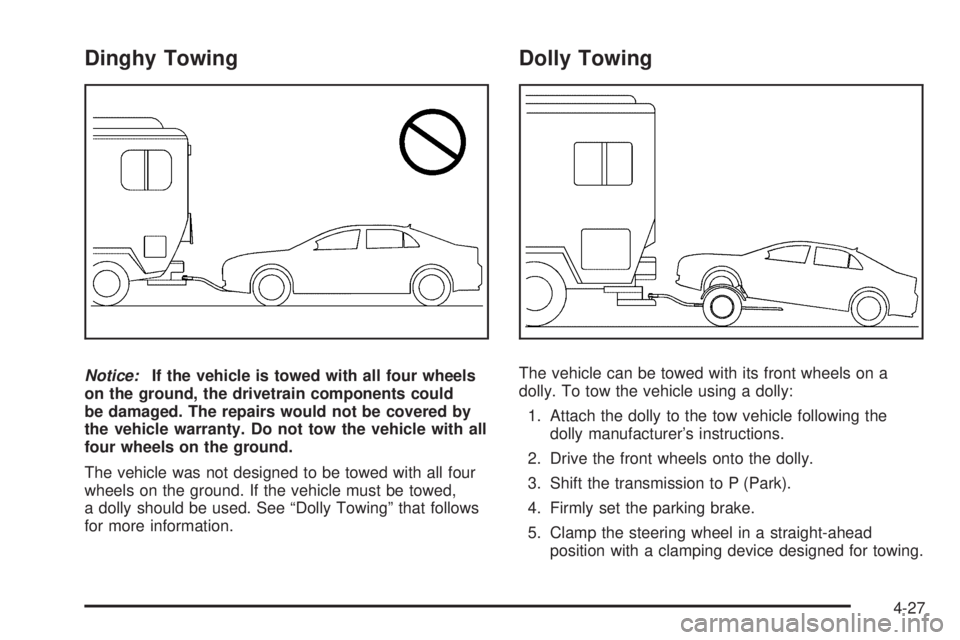
Dinghy Towing
Notice:If the vehicle is towed with all four wheels
on the ground, the drivetrain components could
be damaged. The repairs would not be covered by
the vehicle warranty. Do not tow the vehicle with all
four wheels on the ground.
The vehicle was not designed to be towed with all four
wheels on the ground. If the vehicle must be towed,
a dolly should be used. See “Dolly Towing” that follows
for more information.
Dolly Towing
The vehicle can be towed with its front wheels on a
dolly. To tow the vehicle using a dolly:
1. Attach the dolly to the tow vehicle following the
dolly manufacturer’s instructions.
2. Drive the front wheels onto the dolly.
3. Shift the transmission to P (Park).
4. Firmly set the parking brake.
5. Clamp the steering wheel in a straight-ahead
position with a clamping device designed for towing.
4-27
Page 268 of 428
Driving with a Trailer
Towing a trailer requires a certain amount of experience.
Get to know the rig before setting out for the open
road. Get acquainted with the feel of handling and
braking with the added weight of the trailer. And always
keep in mind that the vehicle you are driving is now
longer and not as responsive as the vehicle is by itself.
Before starting, check all trailer hitch parts and
attachments, safety chains, electrical connectors, lamps,
tires and mirror adjustments. If the trailer has electric
brakes, start the vehicle and trailer moving and
then apply the trailer brake controller by hand to be sure
the brakes are working. This checks the electrical
connection at the same time.
During the trip, check occasionally to be sure that the
load is secure, and that the lamps and any trailer brakes
are still working.
Following Distance
Stay at least twice as far behind the vehicle ahead as
you would when driving the vehicle without a trailer. This
can help to avoid situations that require heavy braking
and sudden turns.
Passing
More passing distance is needed when towing a trailer.
Because the rig is longer, it is necessary to go much
farther beyond the passed vehicle before returning to
the lane.
Backing Up
Hold the bottom of the steering wheel with one hand.
Then, to move the trailer to the left, move that hand
to the left. To move the trailer to the right, move your
hand to the right. Always back up slowly and, if possible,
have someone guide you.
Making Turns
Notice:Making very sharp turns while trailering
could cause the trailer to come in contact with the
vehicle. The vehicle could be damaged. Avoid
making very sharp turns while trailering.
When turning with a trailer, make wider turns than
normal. Do this so the trailer will not strike soft
shoulders, curbs, road signs, trees or other objects.
Avoid jerky or sudden maneuvers. Signal well in
advance.
4-32
Page 346 of 428
If a Tire Goes Flat
It is unusual for a tire to blowout while you are driving,
especially if you maintain your vehicle’s tires properly.
If air goes out of a tire, it is much more likely to leak
out slowly. But if you should ever have a blowout, here
are a few tips about what to expect and what to do:
If a front tire fails, the at tire creates a drag that pulls
the vehicle toward that side. Take your foot off the
accelerator pedal and grip the steering wheel rmly.
Steer to maintain lane position, and then gently brake
to a stop well out of the traffic lane.
A rear blowout, particularly on a curve, acts much like
a skid and may require the same correction you would
use in a skid. In any rear blowout remove your foot from
the accelerator pedal. Get the vehicle under control by
steering the way you want the vehicle to go. It may be
very bumpy and noisy, but you can still steer. Gently
brake to a stop, well off the road if possible.{CAUTION:
Lifting a vehicle and getting under it to do
maintenance or repairs is dangerous without the
appropriate safety equipment and training. If a jack
is provided with the vehicle, it is designed only for
changing a at tire. If it is used for anything else,
you or others could be badly injured or killed if the
vehicle slips off the jack. If a jack is provided with
the vehicle, only use it for changing a at tire.
If a tire goes at, the next part shows how to use the
jacking equipment to change a at tire safely.
Changing a Flat Tire
If a tire goes at, avoid further tire and wheel damage
by driving slowly to a level place. Turn on the hazard
warning ashers. SeeHazard Warning Flashers
on page 3-6.
5-76
Page 371 of 428
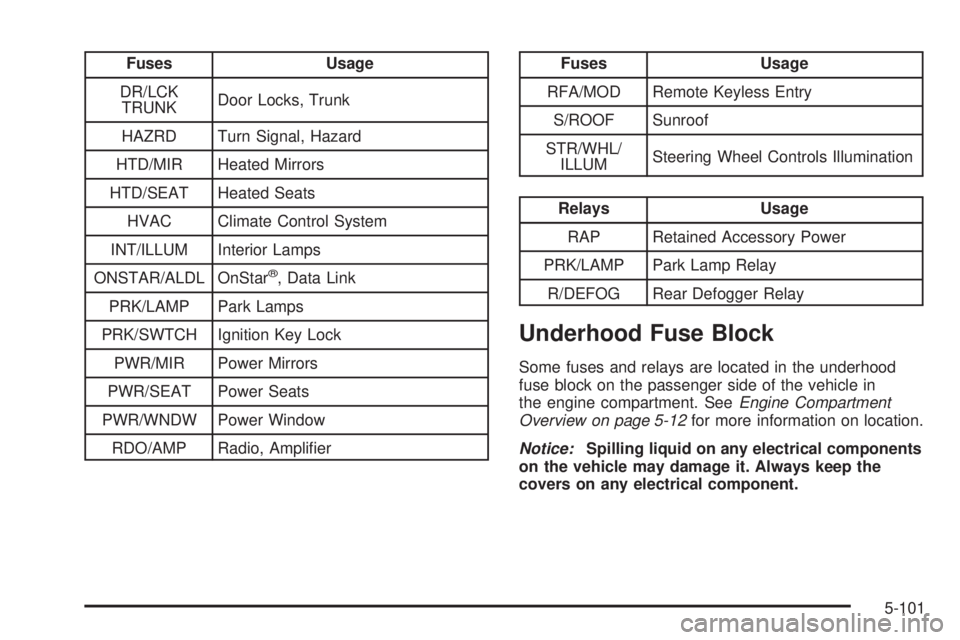
Fuses Usage
DR/LCK
TRUNKDoor Locks, Trunk
HAZRD Turn Signal, Hazard
HTD/MIR Heated Mirrors
HTD/SEAT Heated Seats
HVAC Climate Control System
INT/ILLUM Interior Lamps
ONSTAR/ALDL OnStar
®, Data Link
PRK/LAMP Park Lamps
PRK/SWTCH Ignition Key Lock
PWR/MIR Power Mirrors
PWR/SEAT Power Seats
PWR/WNDW Power Window
RDO/AMP Radio, Amplier
Fuses Usage
RFA/MOD Remote Keyless Entry
S/ROOF Sunroof
STR/WHL/
ILLUMSteering Wheel Controls Illumination
Relays Usage
RAP Retained Accessory Power
PRK/LAMP Park Lamp Relay
R/DEFOG Rear Defogger Relay
Underhood Fuse Block
Some fuses and relays are located in the underhood
fuse block on the passenger side of the vehicle in
the engine compartment. SeeEngine Compartment
Overview on page 5-12for more information on location.
Notice:Spilling liquid on any electrical components
on the vehicle may damage it. Always keep the
covers on any electrical component.
5-101
Page 415 of 428
A
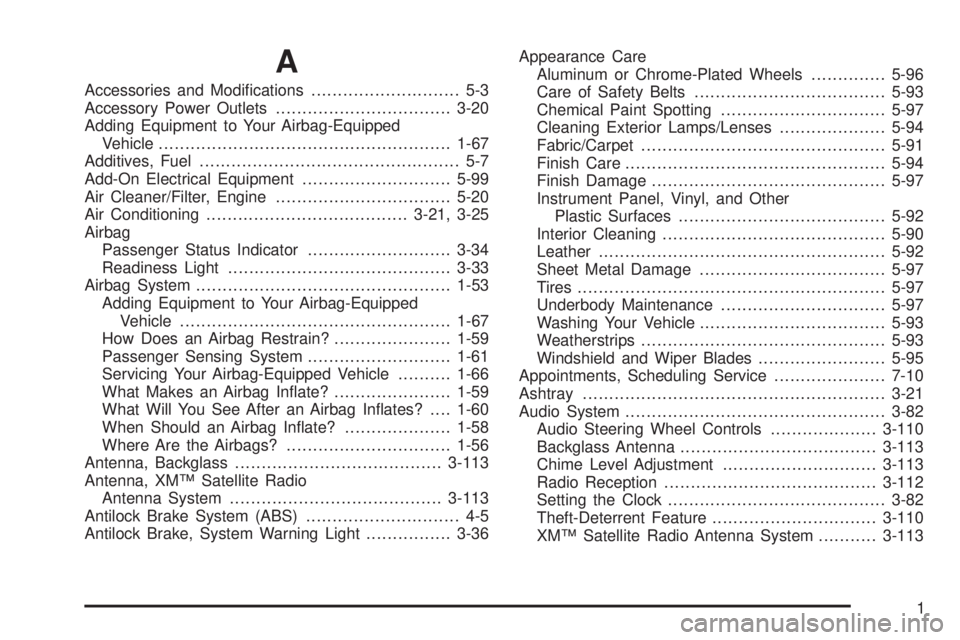
Accessories and Modications............................ 5-3
Accessory Power Outlets.................................3-20
Adding Equipment to Your Airbag-Equipped
Vehicle.......................................................1-67
Additives, Fuel................................................. 5-7
Add-On Electrical Equipment............................5-99
Air Cleaner/Filter, Engine.................................5-20
Air Conditioning......................................3-21, 3-25
Airbag
Passenger Status Indicator...........................3-34
Readiness Light..........................................3-33
Airbag System................................................1-53
Adding Equipment to Your Airbag-Equipped
Vehicle...................................................1-67
How Does an Airbag Restrain?......................1-59
Passenger Sensing System...........................1-61
Servicing Your Airbag-Equipped Vehicle..........1-66
What Makes an Airbag Inate?......................1-59
What Will You See After an Airbag Inates?....1-60
When Should an Airbag Inate?....................1-58
Where Are the Airbags?...............................1-56
Antenna, Backglass.......................................3-113
Antenna, XM™ Satellite Radio
Antenna System........................................3-113
Antilock Brake System (ABS)............................. 4-5
Antilock Brake, System Warning Light................3-36Appearance Care
Aluminum or Chrome-Plated Wheels..............5-96
Care of Safety Belts....................................5-93
Chemical Paint Spotting...............................5-97
Cleaning Exterior Lamps/Lenses....................5-94
Fabric/Carpet..............................................5-91
Finish Care.................................................5-94
Finish Damage............................................5-97
Instrument Panel, Vinyl, and Other
Plastic Surfaces.......................................5-92
Interior Cleaning..........................................5-90
Leather......................................................5-92
Sheet Metal Damage...................................
5-97
Tires..........................................................5-97
Underbody Maintenance...............................5-97
Washing Your Vehicle...................................5-93
Weatherstrips..............................................5-93
Windshield and Wiper Blades........................5-95
Appointments, Scheduling Service.....................7-10
Ashtray.........................................................3-21
Audio System.................................................3-82
Audio Steering Wheel Controls....................3-110
Backglass Antenna.....................................3-113
Chime Level Adjustment.............................3-113
Radio Reception........................................3-112
Setting the Clock.........................................3-82
Theft-Deterrent Feature...............................3-110
XM™ Satellite Radio Antenna System...........3-113
1
Page 426 of 428
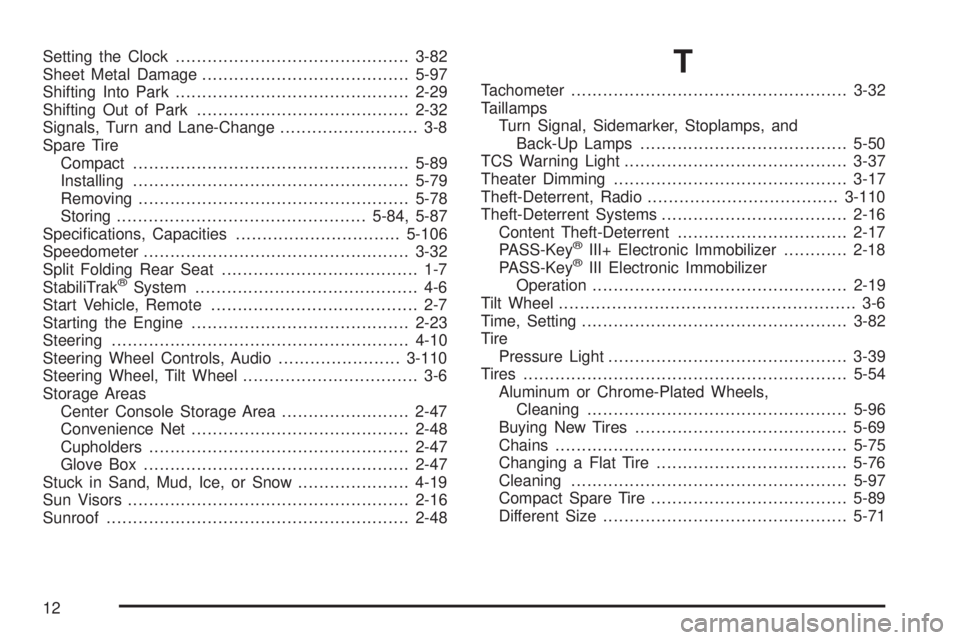
Setting the Clock............................................3-82
Sheet Metal Damage.......................................5-97
Shifting Into Park............................................2-29
Shifting Out of Park........................................2-32
Signals, Turn and Lane-Change.......................... 3-8
Spare Tire
Compact....................................................5-89
Installing....................................................5-79
Removing...................................................5-78
Storing...............................................5-84, 5-87
Specications, Capacities...............................5-106
Speedometer..................................................3-32
Split Folding Rear Seat..................................... 1-7
StabiliTrak
®System.......................................... 4-6
Start Vehicle, Remote....................................... 2-7
Starting the Engine.........................................2-23
Steering........................................................4-10
Steering Wheel Controls, Audio.......................3-110
Steering Wheel, Tilt Wheel................................. 3-6
Storage Areas
Center Console Storage Area........................2-47
Convenience Net.........................................2-48
Cupholders.................................................2-47
Glove Box..................................................2-47
Stuck in Sand, Mud, Ice, or Snow.....................4-19
Sun Visors.....................................................2-16
Sunroof.........................................................2-48
T
Tachometer....................................................3-32
Taillamps
Turn Signal, Sidemarker, Stoplamps, and
Back-Up Lamps.......................................5-50
TCS Warning Light..........................................3-37
Theater Dimming............................................3-17
Theft-Deterrent, Radio....................................3-110
Theft-Deterrent Systems...................................2-16
Content Theft-Deterrent................................2-17
PASS-Key
®III+ Electronic Immobilizer............2-18
PASS-Key®III Electronic Immobilizer
Operation................................................2-19
Tilt Wheel........................................................ 3-6
Time, Setting..................................................3-82
Tire
Pressure Light.............................................3-39
Tires.............................................................5-54
Aluminum or Chrome-Plated Wheels,
Cleaning.................................................5-96
Buying New Tires........................................5-69
Chains.......................................................5-75
Changing a Flat Tire....................................5-76
Cleaning....................................................5-97
Compact Spare Tire.....................................5-89
Different Size..............................................5-71
12