stop start BUICK LACROSSE 2009 Owner's Guide
[x] Cancel search | Manufacturer: BUICK, Model Year: 2009, Model line: LACROSSE, Model: BUICK LACROSSE 2009Pages: 428
Page 213 of 428
To use repeat:
To repeat playing a track, press and release this
button. RPT # displays. Press this button again
to turn off repeat play.
To repeat playing a CD, press and hold this button
for two seconds. REPEAT CD # displays. Press
this button again to turn off repeat play.
4 RDM (Random):Depending on the radio, press
to hear the tracks in random, rather than sequential,
order. RANDOM ON displays. Press again to turn off
random play.
For the radio with a Six-Disc CD player, press to listen to
the tracks in random, on one CD or on all of the CDs.
To use random on a Six-Disc CD player:
To play the tracks on a CD in random order, press
and release the random button. RANDOM ONE
displays. Press again to turn off random play.
To play the tracks on all of the CDs that are loaded
in random order, press and hold this button for more
than two seconds. A beep sounds and RANDOM
ALL displays. Press again to turn off random play.
oSEEKp:Press the left arrow to go to the start of
the current or the previous track. Press the right arrow
to go to the start of the next track.
To scan tracks, press and hold either arrow for more
than two seconds. SCAN displays. The radio goes to the
next track, plays 10 seconds, then goes to the next track.
To scan one CD on a Six-Disc CD player, press and
hold either SEEK arrow for more than two seconds until
TRACK SCAN displays and a beep sounds. The radio
goes to the next track, plays for 10 seconds, then goes
to the next track.
Press either arrow again, to stop scanning.
To scan all loaded CDs, press and hold either arrow for
more than four seconds until ALL CD SCAN displays and
a beep sounds. Use this feature to listen to 10 seconds of
the rst track of each loaded CD.
Press either arrow again, to stop scanning.
DISP (Display):Press to see how long the current track
has been playing. The elapsed time of the track displays.
To change the default on the display, track, or elapsed
time, press until the desired display appears, then hold
the button for two seconds. The radio produces one beep
and the selected display becomes the default.
3-91
Page 238 of 428
Your Driving, the Road, and
the Vehicle
Driving for Better Fuel Economy
Driving habits can affect fuel mileage. Here are some
driving tips to get the best fuel economy possible.
Avoid fast starts and accelerate smoothly.
Brake gradually and avoid abrupt stops.
Avoid idling the engine for long periods of time.
When road and weather conditions are appropriate,
use cruise control, if equipped.
Always follow posted speed limits or drive more
slowly when conditions require.
Keep vehicle tires properly inated.
Combine several trips into a single trip.
Replace the vehicle’s tires with the same TPC Spec
number molded into the tire’s sidewall near the size.
Follow recommended scheduled maintenance.
Defensive Driving
Defensive driving means “always expect the
unexpected.” The rst step in driving defensively is to
wear your safety belt — SeeSafety Belts: They Are for
Everyone on page 1-8.
{CAUTION:
Assume that other road users (pedestrians,
bicyclists, and other drivers) are going to be
careless and make mistakes. Anticipate what they
might do and be ready. In addition:
Allow enough following distance between you
and the driver in front of you.
Focus on the task of driving.
Driver distraction can cause collisions resulting in
injury or possible death. These simple defensive
driving techniques could save your life.
4-2
Page 241 of 428
Antilock Brake System (ABS)
This vehicle has the Antilock Brake System (ABS), an
advanced electronic braking system that will help
prevent a braking skid.
When the engine is started and the vehicle begins to
drive away, ABS checks itself. A momentary motor
or clicking noise might be heard while this test is going
on, and it might even be noticed that the brake pedal
moves a little. This is normal.
If there is a problem with
ABS, this warning light
stays on. SeeAntilock
Brake System (ABS)
Warning Light on
page 3-36.
Let us say the road is wet and you are driving safely.
Suddenly, an animal jumps out in front of you. You slam
on the brakes and continue braking. Here is what
happens with ABS:
A computer senses that the wheels are slowing down. If
one of the wheels is about to stop rolling, the computer
will separately work the brakes at each wheel.ABS can change the brake pressure to each wheel, as
required, faster than any driver could. This can help
the driver steer around the obstacle while braking hard.
As the brakes are applied, the computer keeps receiving
updates on wheel speed and controls braking pressure
accordingly.
Remember: ABS does not change the time needed to get
a foot up to the brake pedal or always decrease stopping
distance. If you get too close to the vehicle in front of you,
there will not be enough time to apply the brakes if that
vehicle suddenly slows or stops. Always leave enough
room up ahead to stop, even with ABS.
Using ABS
Do not pump the brakes. Just hold the brake pedal
down rmly and let antilock work. The antilock pump or
motor might be heard operating and the brake pedal
might be felt to pulsate, but this is normal.
Braking in Emergencies
ABS allows the driver to steer and brake at the same
time. In many emergencies, steering can help more than
even the very best braking.
4-5
Page 248 of 428
Passing
Passing another vehicle on a two-lane road can be
dangerous. To reduce the risk of danger while passing:
Look down the road, to the sides, and to crossroads
for situations that might affect a successful pass. If
in doubt, wait.
Watch for traffic signs, pavement markings, and
lines that could indicate a turn or an intersection.
Never cross a solid or double-solid line on your side
of the lane.
Do not get too close to the vehicle you want to
pass. Doing so can reduce your visibility.
Wait your turn to pass a slow vehicle.
When you are being passed, ease to the right.
Loss of Control
Let us review what driving experts say about what
happens when the three control systems — brakes,
steering, and acceleration — do not have enough friction
where the tires meet the road to do what the driver has
asked.
In any emergency, do not give up. Keep trying to steer
and constantly seek an escape route or area of less
danger.
Skidding
In a skid, a driver can lose control of the vehicle.
Defensive drivers avoid most skids by taking reasonable
care suited to existing conditions, and by not overdriving
those conditions. But skids are always possible.
The three types of skids correspond to the vehicle’s
three control systems. In the braking skid, the wheels
are not rolling. In the steering or cornering skid, too
much speed or steering in a curve causes tires to slip
and lose cornering force. And in the acceleration
skid, too much throttle causes the driving wheels
to spin.
Remember: Any traction control system helps avoid only
the acceleration skid. If the traction control system is
off, then an acceleration skid is best handled by easing
your foot off the accelerator pedal.
If the vehicle starts to slide, ease your foot off the
accelerator pedal and quickly steer the way you want
the vehicle to go. If you start steering quickly enough,
the vehicle may straighten out. Always be ready for
a second skid if it occurs.
Of course, traction is reduced when water, snow, ice,
gravel, or other material is on the road. For safety, slow
down and adjust your driving to these conditions. It is
important to slow down on slippery surfaces because
stopping distance will be longer and vehicle control more
limited.
4-12
Page 269 of 428
Turn Signals When Towing a Trailer
The arrows on the instrument panel ash whenever
signaling a turn or lane change. Properly hooked up, the
trailer lamps also ash, telling other drivers the vehicle
is turning, changing lanes or stopping.
When towing a trailer, the arrows on the instrument
panel ash for turns even if the bulbs on the trailer are
burned out. For this reason you may think other
drivers are seeing the signal when they are not. It is
important to check occasionally to be sure the
trailer bulbs are still working.
Driving on Grades
Notice:Do not tow on steep continuous grades
exceeding 6 miles (9.6 km). Extended, higher than
normal engine and transmission temperatures may
result and damage the vehicle. Frequent stops are
very important to allow the engine and transmission
to cool.
Reduce speed and shift to a lower gearbeforestarting
down a long or steep downgrade. If the transmission is
not shifted down, the brakes might have to be used so
much that they would get hot and no longer work well.
On a long uphill grade, shift down and reduce the
vehicle’s speed to around 45 mph (70 km/h) to reduce
the possibility of the engine and the transmission
overheating. If the engine does overheat, seeEngine
Overheating on page 5-31.
Parking on Hills
{CAUTION:
Parking the vehicle on a hill with the trailer
attached can be dangerous. If something goes
wrong, the rig could start to move. People can be
injured, and both the vehicle and the trailer can be
damaged. When possible, always park the rig on a
at surface.
If parking the rig on a hill:
1. Press the brake pedal, but do not shift into P (Park)
yet. Turn the wheels into the curb if facing downhill
or into traffic if facing uphill.
2. Have someone place chocks under the trailer
wheels.
3. When the wheel chocks are in place, release the
brake pedal until the chocks absorb the load.
4. Reapply the brake pedal. Then apply the parking
brake and shift the transmission into P (Park).
5. Release the brake pedal.
4-33
Page 270 of 428
Leaving After Parking on a Hill
1. Apply and hold the brake pedal while you:
start the engine,
shift into a gear, and
release the parking brake.
2. Let up on the brake pedal.
3. Drive slowly until the trailer is clear of the chocks.
4. Stop and have someone pick up and store the
chocks.
Maintenance When Trailer Towing
The vehicle needs service more often when pulling a
trailer. SeeScheduled Maintenance on page 6-4
for more information. Things that are especially
important in trailer operation are automatic transmission
uid, engine oil, belts, cooling system and brake
system. It is a good idea to inspect these before and
during the trip.
Check periodically to see that all hitch nuts and bolts
are tight.
Engine Cooling When Trailer Towing
The cooling system may temporarily overheat during
severe operating conditions. SeeEngine Overheating on
page 5-31.
Changing a Tire When Trailer Towing
If the vehicle gets a at tire while towing a trailer,
be sure to secure the trailer and disconnect it from the
vehicle before changing the tire.
4-34
Page 271 of 428
Service............................................................5-3
Accessories and Modications..........................5-3
California Proposition 65 Warning.....................5-4
California Perchlorate Materials
Requirements.............................................5-4
Doing Your Own Service Work.........................5-4
Adding Equipment to the Outside of
the Vehicle.................................................5-5
Fuel................................................................5-5
Gasoline Octane............................................5-6
Gasoline Specications....................................5-6
California Fuel...............................................5-6
Additives.......................................................5-7
Fuels in Foreign Countries...............................5-7
Filling the Tank..............................................5-8
Filling a Portable Fuel Container.....................5-10
Checking Things Under the Hood....................5-10
Hood Release..............................................5-11
Engine Compartment Overview.......................5-12
Engine Oil...................................................5-15
Engine Oil Life System..................................5-18
Engine Air Cleaner/Filter................................5-20
Automatic Transmission Fluid.........................5-22
Cooling System............................................5-24
Engine Coolant.............................................5-25
Radiator Pressure Cap..................................5-31Pressure Cap...............................................5-31
Engine Overheating.......................................5-31
Overheated Engine Protection
Operating Mode........................................5-34
Power Steering Fluid.....................................5-34
Windshield Washer Fluid................................5-35
Brakes........................................................5-37
Battery........................................................5-40
Jump Starting...............................................5-41
Headlamp Aiming..........................................
.5-46
Bulb Replacement..........................................5-49
Halogen Bulbs..............................................5-49
Taillamps, Turn Signal, Sidemarker,
Stoplamps and Back-up Lamps...................5-50
License Plate Lamp......................................5-52
Replacement Bulbs.......................................5-52
Windshield Replacement.................................5-53
Windshield Wiper Blade Replacement..............5-53
Tires..............................................................5-54
Tire Sidewall Labeling...................................5-55
Tire Terminology and Denitions.....................5-58
Ination - Tire Pressure.................................5-61
Tire Pressure Monitor System.........................5-62
Tire Pressure Monitor Operation.....................5-64
Tire Inspection and Rotation...........................5-67
Section 5 Service and Appearance Care
5-1
Page 279 of 428
{CAUTION:
Fuel can spray out on you if you open the fuel cap
too quickly. If you spill fuel and then something
ignites it, you could be badly burned. This spray
can happen if the tank is nearly full, and is more
likely in hot weather. Open the fuel cap slowly and
wait for any hiss noise to stop. Then unscrew the
cap all the way.
Be careful not to spill fuel. Do not top off or overll the
tank and wait a few seconds after you have nished
pumping before removing the nozzle. Clean fuel from
painted surfaces as soon as possible. SeeWashing
Your Vehicle on page 5-93.
When replacing the fuel cap, turn it clockwise until it
clicks. Make sure the cap is fully installed. The diagnostic
system can determine if the fuel cap has been left off or
improperly installed. This would allow fuel to evaporate
into the atmosphere. SeeMalfunction Indicator Lamp on
page 3-40.The vehicle may also have a check gas cap warning
light, which displays on the instrument panel cluster
if the fuel cap is not properly installed. SeeCheck
Gas Cap Light on page 3-47for more information.
If the vehicle has a Driver Information Center (DIC),
the CHECK GAS CAP message displays if the fuel
cap is not properly installed. SeeDIC Warnings
and Messages on page 3-56for more information.
{CAUTION:
If a re starts while you are refueling, do not
remove the nozzle. Shut off the ow of fuel by
shutting off the pump or by notifying the station
attendant. Leave the area immediately.
Notice:If you need a new fuel cap, be sure to get
the right type. Your dealer/retailer can get one
for you. If you get the wrong type, it may not t
properly. This may cause the malfunction indicator
lamp to light and may damage the fuel tank and
emissions system. SeeMalfunction Indicator Lamp
on page 3-40.
5-9
Page 336 of 428
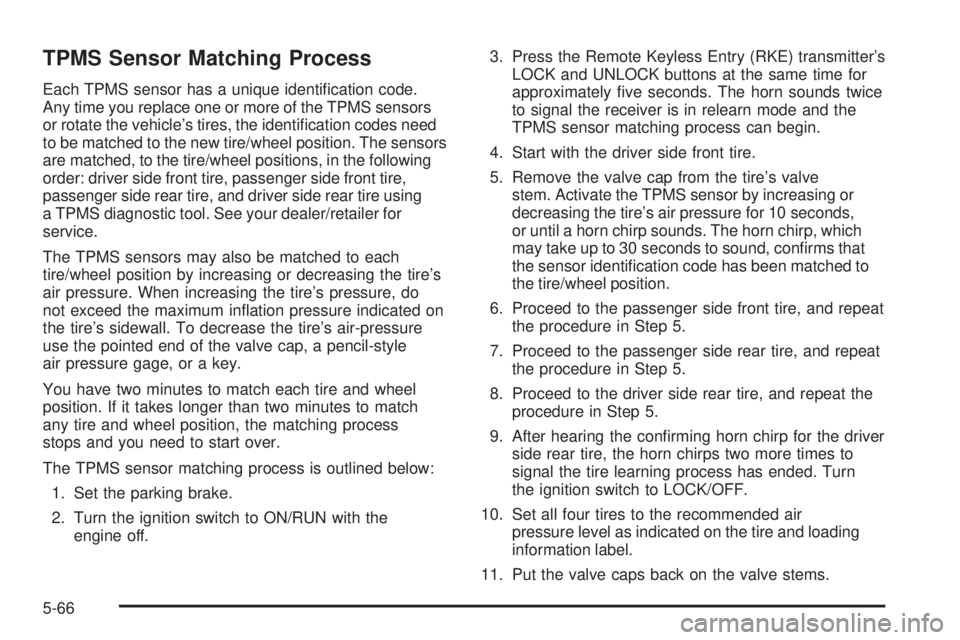
TPMS Sensor Matching Process
Each TPMS sensor has a unique identication code.
Any time you replace one or more of the TPMS sensors
or rotate the vehicle’s tires, the identication codes need
to be matched to the new tire/wheel position. The sensors
are matched, to the tire/wheel positions, in the following
order: driver side front tire, passenger side front tire,
passenger side rear tire, and driver side rear tire using
a TPMS diagnostic tool. See your dealer/retailer for
service.
The TPMS sensors may also be matched to each
tire/wheel position by increasing or decreasing the tire’s
air pressure. When increasing the tire’s pressure, do
not exceed the maximum ination pressure indicated on
the tire’s sidewall. To decrease the tire’s air-pressure
use the pointed end of the valve cap, a pencil-style
air pressure gage, or a key.
You have two minutes to match each tire and wheel
position. If it takes longer than two minutes to match
any tire and wheel position, the matching process
stops and you need to start over.
The TPMS sensor matching process is outlined below:
1. Set the parking brake.
2. Turn the ignition switch to ON/RUN with the
engine off.3. Press the Remote Keyless Entry (RKE) transmitter’s
LOCK and UNLOCK buttons at the same time for
approximately ve seconds. The horn sounds twice
to signal the receiver is in relearn mode and the
TPMS sensor matching process can begin.
4. Start with the driver side front tire.
5. Remove the valve cap from the tire’s valve
stem. Activate the TPMS sensor by increasing or
decreasing the tire’s air pressure for 10 seconds,
or until a horn chirp sounds. The horn chirp, which
may take up to 30 seconds to sound, conrms that
the sensor identication code has been matched to
the tire/wheel position.
6. Proceed to the passenger side front tire, and repeat
the procedure in Step 5.
7. Proceed to the passenger side rear tire, and repeat
the procedure in Step 5.
8. Proceed to the driver side rear tire, and repeat the
procedure in Step 5.
9. After hearing the conrming horn chirp for the driver
side rear tire, the horn chirps two more times to
signal the tire learning process has ended. Turn
the ignition switch to LOCK/OFF.
10. Set all four tires to the recommended air
pressure level as indicated on the tire and loading
information label.
11. Put the valve caps back on the valve stems.
5-66
Page 426 of 428
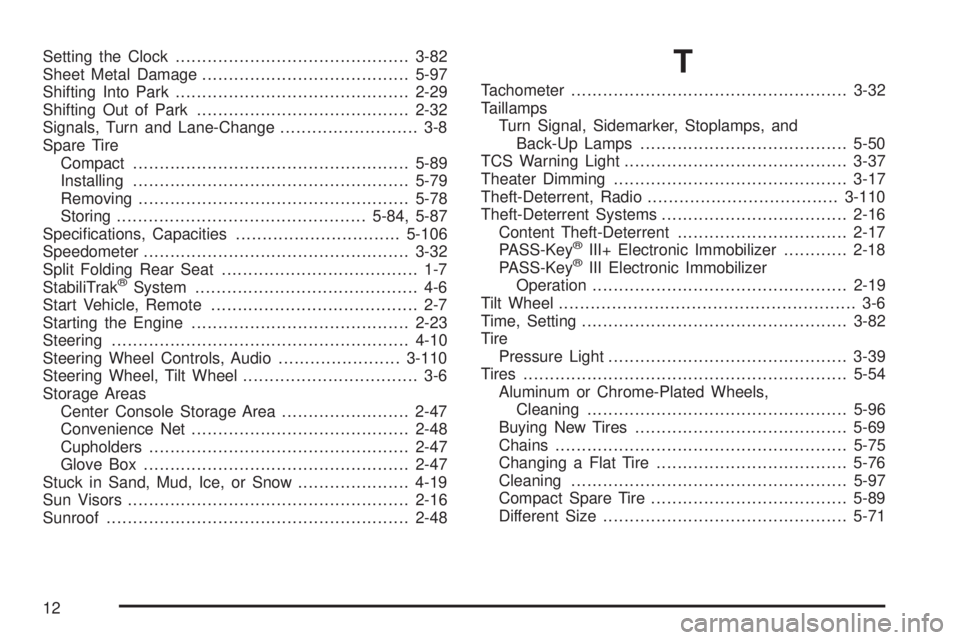
Setting the Clock............................................3-82
Sheet Metal Damage.......................................5-97
Shifting Into Park............................................2-29
Shifting Out of Park........................................2-32
Signals, Turn and Lane-Change.......................... 3-8
Spare Tire
Compact....................................................5-89
Installing....................................................5-79
Removing...................................................5-78
Storing...............................................5-84, 5-87
Specications, Capacities...............................5-106
Speedometer..................................................3-32
Split Folding Rear Seat..................................... 1-7
StabiliTrak
®System.......................................... 4-6
Start Vehicle, Remote....................................... 2-7
Starting the Engine.........................................2-23
Steering........................................................4-10
Steering Wheel Controls, Audio.......................3-110
Steering Wheel, Tilt Wheel................................. 3-6
Storage Areas
Center Console Storage Area........................2-47
Convenience Net.........................................2-48
Cupholders.................................................2-47
Glove Box..................................................2-47
Stuck in Sand, Mud, Ice, or Snow.....................4-19
Sun Visors.....................................................2-16
Sunroof.........................................................2-48
T
Tachometer....................................................3-32
Taillamps
Turn Signal, Sidemarker, Stoplamps, and
Back-Up Lamps.......................................5-50
TCS Warning Light..........................................3-37
Theater Dimming............................................3-17
Theft-Deterrent, Radio....................................3-110
Theft-Deterrent Systems...................................2-16
Content Theft-Deterrent................................2-17
PASS-Key
®III+ Electronic Immobilizer............2-18
PASS-Key®III Electronic Immobilizer
Operation................................................2-19
Tilt Wheel........................................................ 3-6
Time, Setting..................................................3-82
Tire
Pressure Light.............................................3-39
Tires.............................................................5-54
Aluminum or Chrome-Plated Wheels,
Cleaning.................................................5-96
Buying New Tires........................................5-69
Chains.......................................................5-75
Changing a Flat Tire....................................5-76
Cleaning....................................................5-97
Compact Spare Tire.....................................5-89
Different Size..............................................5-71
12