trailer BUICK LACROSSE 2009 Owner's Guide
[x] Cancel search | Manufacturer: BUICK, Model Year: 2009, Model line: LACROSSE, Model: BUICK LACROSSE 2009Pages: 428
Page 304 of 428
Overheated Engine Protection
Operating Mode
This emergency operating mode allows your vehicle
to be driven to a safe place in an emergency situation.
If an overheated engine condition exists, an overheat
protection mode which alternates ring groups of
cylinders helps prevent engine damage. In this mode,
you will notice a signicant loss in power and engine
performance. The REDUCED POWER STOP WHEN
SAFE message will come on in the Driver Information
Center (DIC), if the vehicle has one, along with the engine
coolant temperature warning light on the instrument
panel, to indicate the vehicle has entered overheated
engine protection operating mode. The temperature
gage will also indicate an overheat condition exists.
Driving extended miles (km) and/or towing a trailer in
the overheat protection mode should be avoided.
Notice:After driving in the overheated engine
protection operating mode, to avoid engine damage,
allow the engine to cool before attempting any
repair. The engine oil will be severely degraded.
Repair the cause of coolant loss, change the oil
and reset the oil life system. SeeEngine Oil
on page 5-15.
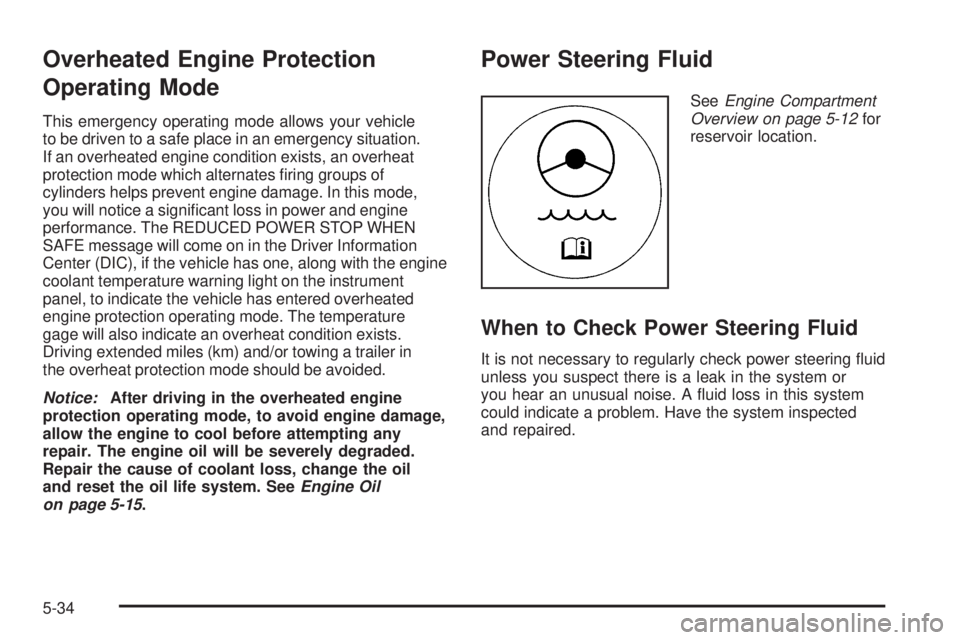
Power Steering Fluid
SeeEngine Compartment
Overview on page 5-12for
reservoir location.
When to Check Power Steering Fluid
It is not necessary to regularly check power steering uid
unless you suspect there is a leak in the system or
you hear an unusual noise. A uid loss in this system
could indicate a problem. Have the system inspected
and repaired.
5-34
Page 385 of 428
Maintenance Footnotes
(a)Visually inspect brake lines and hoses for proper
hook-up, binding, leaks, cracks, chafing, etc. Inspect
disc brake pads for wear and rotors for surface
condition. Inspect other brake parts, including calipers,
parking brake, etc.
(b)Visually inspect front and rear suspension and
steering system for damaged, loose, or missing parts or
signs of wear. Inspect power steering lines and hoses
for proper hook-up, binding, leaks, cracks, chafing, etc.
(c)Visually inspect hoses and have them replaced if
they are cracked, swollen, or deteriorated. Inspect all
pipes, fittings and clamps; replace with genuine parts as
needed. To help ensure proper operation, a pressure
test of the cooling system and pressure cap and
cleaning the outside of the radiator and air conditioning
condenser is recommended at least once a year.
(d)Inspect wiper blades for wear, cracking, or
contamination. Clean the windshield and wiper blades,
if contaminated. Replace wiper blades that are worn
or damaged. See Windshield Wiper Blade Replacement
on page 5-53 and Windshield and Wiper Blades on
page 5-95 for more information.(e)Make sure the safety belt reminder light and safety
belt assemblies are working properly. Look for any
other loose or damaged safety belt system parts. If you
see anything that might keep a safety belt system
from doing its job, have it repaired. Have any torn or
frayed safety belts replaced. Also see Checking
the Restraint Systems on page 1-68.
(f)Lubricate all key lock cylinders. Lubricate all hinges
and latches, including those for the body doors, hood,
secondary latch, pivots, spring anchor, release pawl,
rear compartment, glove box door, and console door.
More frequent lubrication may be required when
exposed to a corrosive environment. Applying silicone
grease on weatherstrips with a clean cloth will make
them last longer, seal better, and not stick or squeak.
(g)If driving regularly under dusty conditions, the
filter may require replacement more often.
(h)Change automatic transmission fluid and filter if the
vehicle is mainly driven under one or more of these
conditions:
In heavy city traffic where the outside temperature
regularly reaches 90°F (32°C) or higher.
In hilly or mountainous terrain.
When doing frequent trailer towing.
Uses such as found in taxi, police, or delivery
service.
6-7
Page 427 of 428
Tires (cont.)
If a Tire Goes Flat.......................................5-76
Ination - Tire Pressure................................5-61
Inspection and Rotation................................5-67
Installing the Spare Tire................................5-79
Pressure Monitor Operation...........................5-64
Pressure Monitor System..............................5-62
Removing the Flat Tire.................................5-79
Removing the Spare Tire and Tools...............5-78
Storing a Flat or Spare Tire
and Tools........................................5-84, 5-87
Tire Sidewall Labeling..................................5-55
Tire Terminology and Denitions....................5-58
Uniform Tire Quality Grading.........................5-72
Wheel Alignment and Tire Balance.................5-74
Wheel Replacement.....................................5-74
When It Is Time for New Tires......................5-68
Towing
Recreational Vehicle.....................................4-26
Towing a Trailer..........................................4-28
Your Vehicle...............................................4-26
Traction
Control System (TCS).................................... 4-7
Control System Warning Light.......................3-37
Enhanced Traction System (ETS).................... 4-8
Enhanced Traction System (ETS)
Warning Light..........................................3-37
StabiliTrak
®System....................................... 4-6Transmission
Fluid, Automatic...........................................5-22
Transmission Operation, Automatic....................2-26
Trunk............................................................2-12
Trunk Ajar Light..............................................3-45
Turn and Lane-Change Signals.......................... 3-8
Turn Signal/Multifunction Lever........................... 3-7
U
Ultrasonic Rear Parking Assist (URPA)...............2-37
Uniform Tire Quality Grading............................5-72
Universal Home Remote System.......................2-43
Operation...................................................2-43
V
Vehicle
Control........................................................ 4-3
Loading......................................................4-20
Running While Parked..................................2-34
Service Soon Light......................................3-45
Symbols......................................................... iii
Vehicle Data Recording and Privacy..................7-17
Vehicle Identication
Number (VIN).............................................5-98
Service Parts Identication Label...................5-98
13