buttons BUICK LACROSSE 2009 Owner's Guide
[x] Cancel search | Manufacturer: BUICK, Model Year: 2009, Model line: LACROSSE, Model: BUICK LACROSSE 2009Pages: 428
Page 195 of 428
TRACTION CONTROL ACTIVE
This message displays when the traction system
is on. Slippery road conditions may exist if this message
is displayed, so adjust your driving accordingly. See
Traction Control System (TCS) on page 4-7orEnhanced
Traction System (ETS) on page 4-8for more information.
This message only displays while the ignition is in
ON/RUN and will not disappear until driving conditions
change and the system is no longer active.
This message cannot be acknowledged or cleared from
the screen.
TRACTION CONTROL OFF
This message displays when the traction system turns
off. SeeTraction Control System (TCS) on page 4-7
orEnhanced Traction System (ETS) on page 4-8
for more information.
This message only displays while the ignition is in
ON/RUN and disappears after two seconds.Any of the following conditions may cause the system to
turn off:
The system is turned off by pressing the traction
control button located on the center of the instrument
panel. SeeTraction Control System (TCS) on
page 4-7orEnhanced Traction System (ETS)
on page 4-8.
The battery is low.
There is a system failure. See your dealer/retailer for
service.
TRUNK AJAR
This message displays when the trunk is not closed
completely. Make sure that the trunk is closed
completely. SeeTrunk on page 2-12.
This message displays while the ignition is in ON/RUN.
A chime sounds when the gear position is shifted out of
P (Park). Press any of the DIC buttons to acknowledge
this message and to clear it from the screen.
This message continues to display for two seconds
if it has not been acknowledged when the engine
is turned off. It also re-displays for two seconds if the
message has been acknowledged, but the condition
still exists when the engine is turned off.
If the condition still exists, the message re-appears
when the engine is turned on.
3-73
Page 207 of 428
Finding a Station
BAND:Press to choose between FM1, FM2, AM, or
XM1orXM2.
e(Tune):Turn to select radio stations.
oSEEKp:Press and release to go to the previous or
the next station and stay there.
To scan stations, press and hold either arrow for more
than two seconds. SCAN or SCN displays and the radio
beeps once. The radio goes to a station, plays for a few
seconds, and then goes to the next station. Press either
arrow again or one of the pushbuttons to stop scanning
presets.
To scan preset stations, press and hold either arrow for
more than four seconds. PSCAN or PSC displays and the
radio beeps twice. The radio goes to a preset station,
plays for a few seconds, then goes to the next preset
station. Press either arrow again or one of the
pushbuttons to stop scanning presets.The radio seeks and scans stations only with a strong
signal that are in the selected band.
SCAN:On the radio with six-disc CD, press until
SC displays. The radio goes to a station, plays for
a few seconds, and then goes to the next station.
Press again to stop scanning stations.
The radio scans stations only with a strong signal that
are in the selected band.
INFO (Information) (XM Satellite Radio Service Only):
The vehicle’s radio may have an INFO button. If the
current station on the radio has a message, the
information symbol displays. Press to see the message.
If the entire message is not displayed, parts of the
message appears every three seconds. To manually
scroll through the message, press and release the
INFO button.
When a message is not available from a station,
NO INFO displays.
3-85
Page 208 of 428
Setting Preset Stations
Up to 30 stations (six FM1, six FM2, six AM, six XM1
and six XM2) can be programmed on the six numbered
pushbuttons.
To program either radio:
1. Turn the radio on.
2. Press BAND to select FM1, FM2, AM, or XM1™ or
XM2™ (if equipped).
3. Tune to the desired station.
4. Press EQ to select the equalization.
5. Press and hold one of the six numbered
pushbuttons until the radio beeps once. When
that numbered pushbutton is pressed again, the
station and equalization that were stored, returns.
6. Repeat the steps for each pushbutton.
Setting the Tone (Bass/Treble)
e
(Bass/Treble):Press and release until BASS or
TREBLE displays. Turn
eto increase or to decrease
the bass or treble.
Press and hold
eto adjust the bass and treble to the
middle position. The radio beeps once.
To adjust all tone and speaker controls to the middle
position, press and hold
ewhen no tone or speaker
control displays. ALL CENTERED displays and the
radio beeps once.
EQ (Equalization):Press to select customized
equalization settings.
To return the bass and treble to the manual mode,
press and release until BASS or TREBLE displays.
3-86
Page 222 of 428
Audio System
When using the in-vehicle Bluetooth system, sound
comes through the vehicle’s front audio system speakers
and overrides the audio system. Use the audio system
volume knob, during a call, to change the volume level.
The adjusted volume level remains in memory for later
calls. To prevent missed calls, a minimum volume level
is used if the volume is turned down too low.
Bluetooth Controls
Use the buttons located on the steering wheel to
operate the in-vehicle Bluetooth system. SeeAudio
Steering Wheel Controls on page 3-110for more
information.
b>(Push To Talk):Press to answer incoming calls,
to conrm system information, and to start speech
recognition.
cx(Phone On Hook):Press to end a call, reject a
call, or to cancel an operation.
Pairing
A Bluetooth enabled cell phone must be paired to the
in-vehicle Bluetooth system rst and then connected to
the vehicle before it can be used. See the cell phone
manufacturers user guide for Bluetooth functions before
pairing the cell phone. If a Bluetooth phone is not
connected, calls will be made using OnStar
®Hands-Free
Calling, if available. Refer to the OnStar owner’s guide
for more information.
Pairing Information:
Up to ve cell phones can be paired to the in-vehicle
Bluetooth system.
The pairing process is disabled when the vehicle is
moving.
The in-vehicle Bluetooth system automatically links
with the rst available paired cell phone in the order
the phone was paired.
Only one paired cell phone can be connected to the
in-vehicle Bluetooth system at a time.
Pairing should only need to be completed once,
unless changes to the pairing information have
been made or the phone is deleted.
To link to a different paired phone, see Linking to a
Different Phone later in this section.
3-100
Page 233 of 428
x(Previous):Press to go to the previous radio
station. The radio seeks stations only with a strong
signal that are in the selected band.
To scan stations, press and hold
cxfor
two seconds until a beep sounds. The radio goes
to a station, play for a few seconds, then goes to the
next station. Press
cxagain to stop scanning.
While a CD is playing, press
cxto go to the previous
track.
c(Phone on Hook):Press to reject an incoming call,
or end a current call.
b>(Push to Talk/Mute):Press to silence the vehicle
speakers only. Press again or any other radio button,
to turn the sound on.For vehicles with OnStar
®or Bluetooth systems press
and hold
b>for longer than two seconds to interact
with those systems. SeeOnStar®System on page 2-39
andBluetooth®on page 3-99in this manual for more
information.
BAND:Press to switch between FM1, FM2, AM, or
XM1orXM2.
1–6 (Preset Pushbuttons):Press to play stations
that are programmed on the radio preset pushbuttons.
The radio seeks preset stations only with a strong signal
that are in the selected band.
When a CD is playing in the six-disc CD changer, press
this button to go to the next available CD, if multiple
CDs are loaded.
+
x/−x(Volume):Press to increase or to decrease
the volume.
3-111
Page 334 of 428
Tire Pressure Monitor Operation
This vehicle may have a Tire Pressure Monitor System
(TPMS). The TPMS is designed to warn the driver when
a low tire pressure condition exists. TPMS sensors are
mounted onto each tire and wheel assembly, excluding
the spare tire and wheel assembly. The TPMS sensors
monitor the air pressure in the vehicle’s tires and
transmits the tire pressure readings to a receiver
located in the vehicle.
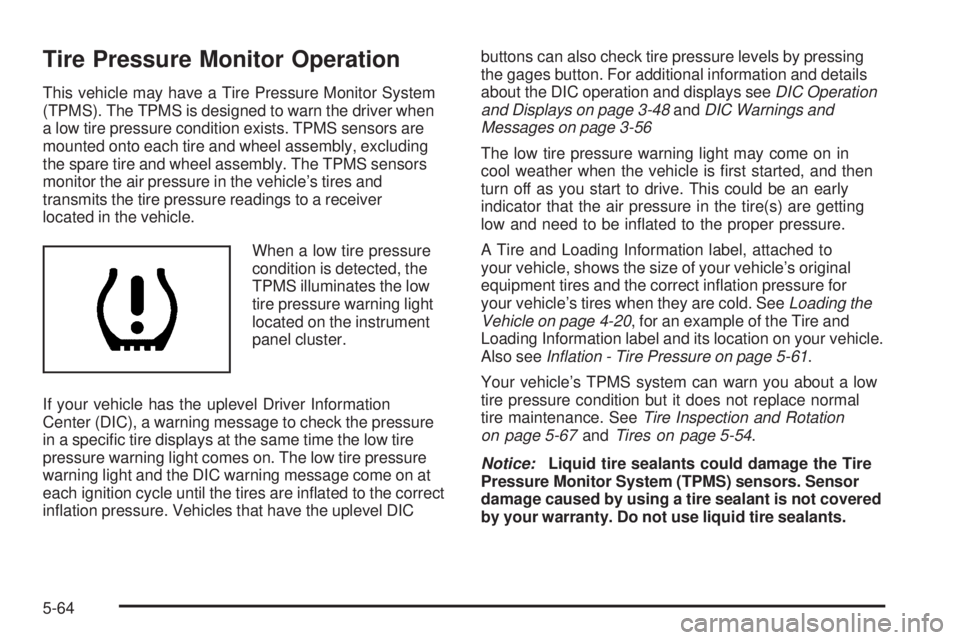
When a low tire pressure
condition is detected, the
TPMS illuminates the low
tire pressure warning light
located on the instrument
panel cluster.
If your vehicle has the uplevel Driver Information
Center (DIC), a warning message to check the pressure
in a specic tire displays at the same time the low tire
pressure warning light comes on. The low tire pressure
warning light and the DIC warning message come on at
each ignition cycle until the tires are inated to the correct
ination pressure. Vehicles that have the uplevel DICbuttons can also check tire pressure levels by pressing
the gages button. For additional information and details
about the DIC operation and displays seeDIC Operation
and Displays on page 3-48andDIC Warnings and
Messages on page 3-56
The low tire pressure warning light may come on in
cool weather when the vehicle is rst started, and then
turn off as you start to drive. This could be an early
indicator that the air pressure in the tire(s) are getting
low and need to be inated to the proper pressure.
A Tire and Loading Information label, attached to
your vehicle, shows the size of your vehicle’s original
equipment tires and the correct ination pressure for
your vehicle’s tires when they are cold. SeeLoading the
Vehicle on page 4-20, for an example of the Tire and
Loading Information label and its location on your vehicle.
Also seeInflation - Tire Pressure on page 5-61.
Your vehicle’s TPMS system can warn you about a low
tire pressure condition but it does not replace normal
tire maintenance. SeeTire Inspection and Rotation
on page 5-67andTires on page 5-54.
Notice:Liquid tire sealants could damage the Tire
Pressure Monitor System (TPMS) sensors. Sensor
damage caused by using a tire sealant is not covered
by your warranty. Do not use liquid tire sealants.
5-64
Page 336 of 428
TPMS Sensor Matching Process
Each TPMS sensor has a unique identication code.
Any time you replace one or more of the TPMS sensors
or rotate the vehicle’s tires, the identication codes need
to be matched to the new tire/wheel position. The sensors
are matched, to the tire/wheel positions, in the following
order: driver side front tire, passenger side front tire,
passenger side rear tire, and driver side rear tire using
a TPMS diagnostic tool. See your dealer/retailer for
service.
The TPMS sensors may also be matched to each
tire/wheel position by increasing or decreasing the tire’s
air pressure. When increasing the tire’s pressure, do
not exceed the maximum ination pressure indicated on
the tire’s sidewall. To decrease the tire’s air-pressure
use the pointed end of the valve cap, a pencil-style
air pressure gage, or a key.
You have two minutes to match each tire and wheel
position. If it takes longer than two minutes to match
any tire and wheel position, the matching process
stops and you need to start over.
The TPMS sensor matching process is outlined below:
1. Set the parking brake.
2. Turn the ignition switch to ON/RUN with the
engine off.3. Press the Remote Keyless Entry (RKE) transmitter’s
LOCK and UNLOCK buttons at the same time for
approximately ve seconds. The horn sounds twice
to signal the receiver is in relearn mode and the
TPMS sensor matching process can begin.
4. Start with the driver side front tire.
5. Remove the valve cap from the tire’s valve
stem. Activate the TPMS sensor by increasing or
decreasing the tire’s air pressure for 10 seconds,
or until a horn chirp sounds. The horn chirp, which
may take up to 30 seconds to sound, conrms that
the sensor identication code has been matched to
the tire/wheel position.
6. Proceed to the passenger side front tire, and repeat
the procedure in Step 5.
7. Proceed to the passenger side rear tire, and repeat
the procedure in Step 5.
8. Proceed to the driver side rear tire, and repeat the
procedure in Step 5.
9. After hearing the conrming horn chirp for the driver
side rear tire, the horn chirps two more times to
signal the tire learning process has ended. Turn
the ignition switch to LOCK/OFF.
10. Set all four tires to the recommended air
pressure level as indicated on the tire and loading
information label.
11. Put the valve caps back on the valve stems.
5-66
Page 360 of 428
Appearance Care
Interior Cleaning
The vehicle’s interior will continue to look its best if it is
cleaned often. Although not always visible, dust and dirt
can accumulate on the upholstery. Dirt can damage
carpet, fabric, leather, and plastic surfaces. Regular
vacuuming is recommended to remove particles from
the upholstery. It is important to keep the upholstery from
becoming and remaining heavily soiled. Soils should be
removed as quickly as possible. The vehicle’s interior
may experience extremes of heat that could cause
stains to set rapidly.
Lighter colored interiors may require more frequent
cleaning. Use care because newspapers and garments
that transfer color to home furnishings may also transfer
color to the vehicle’s interior.
When cleaning the vehicle’s interior, only use cleaners
specically designed for the surfaces being cleaned.
Permanent damage may result from using cleaners onsurfaces for which they were not intended. Use glass
cleaner only on glass. Remove any accidental over-spray
from other surfaces immediately. To prevent over-spray,
apply cleaner directly to the cleaning cloth.
Notice:Using abrasive cleaners when cleaning
glass surfaces on the vehicle, could scratch
the glass and/or cause damage to the rear window
defogger. When cleaning the glass on the vehicle,
use only a soft cloth and glass cleaner.
Many cleaners contain solvents that may become
concentrated in the vehicle’s breathing space. Before
using cleaners, read and adhere to all safety instructions
on the label. While cleaning the vehicle’s interior,
maintain adequate ventilation by opening the vehicle’s
doors and windows.
Dust may be removed from small buttons and knobs
using a small brush with soft bristles.
Products that remove odors from the vehicle’s
upholstery and clean the vehicle’s glass can be
obtained from your dealer/retailer.
5-90