lock BUICK LACROSSE 2010 Owner's Manual
[x] Cancel search | Manufacturer: BUICK, Model Year: 2010, Model line: LACROSSE, Model: BUICK LACROSSE 2010Pages: 414
Page 354 of 414
9-72 Vehicle Care
{WARNING
Rust or dirt on a wheel, or on the
parts to which it is fastened, can
make wheel nuts become loose
after time. The wheel could come
off and cause an accident. When
changing a wheel, remove any
rust or dirt from places where the
wheel attaches to the vehicle. In
an emergency, use a cloth or a
paper towel to do this; but be sure
to use a scraper or wire brush
later, if needed, to get all the rust
or dirt off. SeeIf a Tire Goes Flat
on page 9‑67.
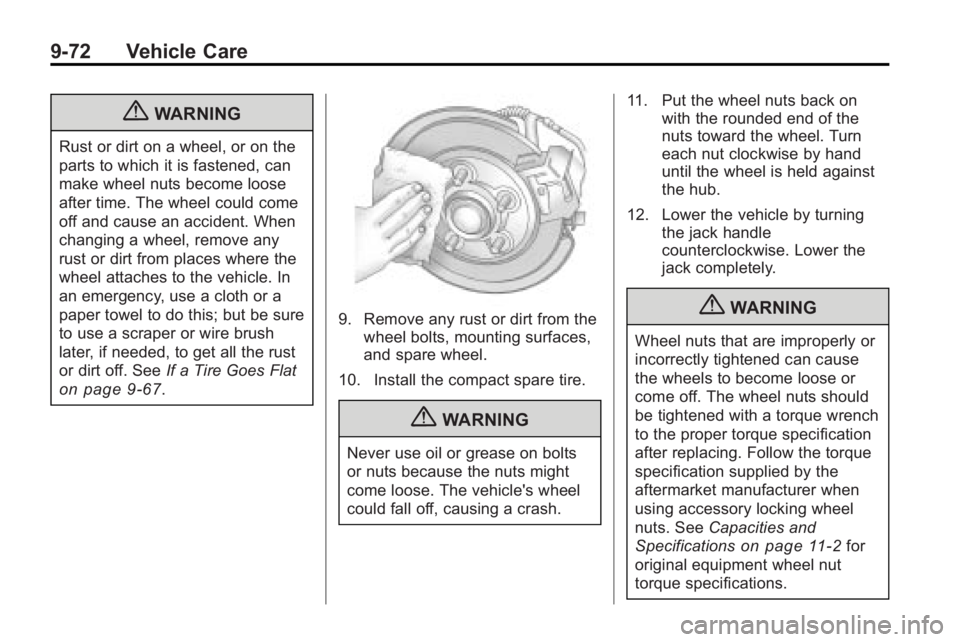
9. Remove any rust or dirt from the
wheel bolts, mounting surfaces,
and spare wheel.
10. Install the compact spare tire.
{WARNING
Never use oil or grease on bolts
or nuts because the nuts might
come loose. The vehicle's wheel
could fall off, causing a crash. 11. Put the wheel nuts back on
with the rounded end of the
nuts toward the wheel. Turn
each nut clockwise by hand
until the wheel is held against
the hub.
12. Lower the vehicle by turning the jack handle
counterclockwise. Lower the
jack completely.
{WARNING
Wheel nuts that are improperly or
incorrectly tightened can cause
the wheels to become loose or
come off. The wheel nuts should
be tightened with a torque wrench
to the proper torque specification
after replacing. Follow the torque
specification supplied by the
aftermarket manufacturer when
using accessory locking wheel
nuts. See Capacities and
Specifications
on page 11‑2for
original equipment wheel nut
torque specifications.
Page 358 of 414
9-76 Vehicle Care
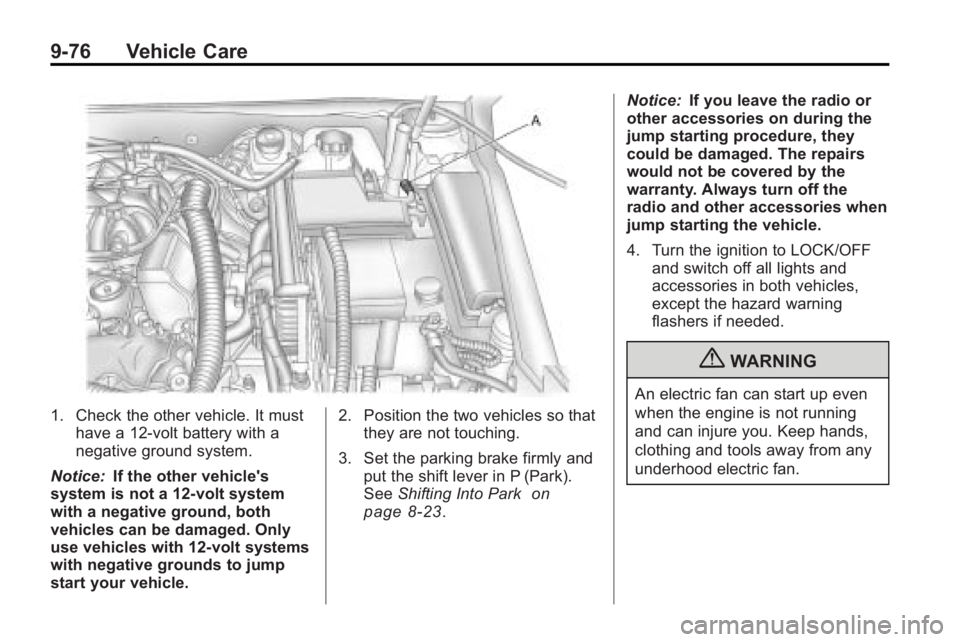
1. Check the other vehicle. It musthave a 12-volt battery with a
negative ground system.
Notice: If the other vehicle's
system is not a 12-volt system
with a negative ground, both
vehicles can be damaged. Only
use vehicles with 12-volt systems
with negative grounds to jump
start your vehicle. 2. Position the two vehicles so that
they are not touching.
3. Set the parking brake firmly and put the shift lever in P (Park).
See Shifting Into Park
on
page 8‑23. Notice:
If you leave the radio or
other accessories on during the
jump starting procedure, they
could be damaged. The repairs
would not be covered by the
warranty. Always turn off the
radio and other accessories when
jump starting the vehicle.
4. Turn the ignition to LOCK/OFF
and switch off all lights and
accessories in both vehicles,
except the hazard warning
flashers if needed.
{WARNING
An electric fan can start up even
when the engine is not running
and can injure you. Keep hands,
clothing and tools away from any
underhood electric fan.
Page 363 of 414
Vehicle Care 9-81
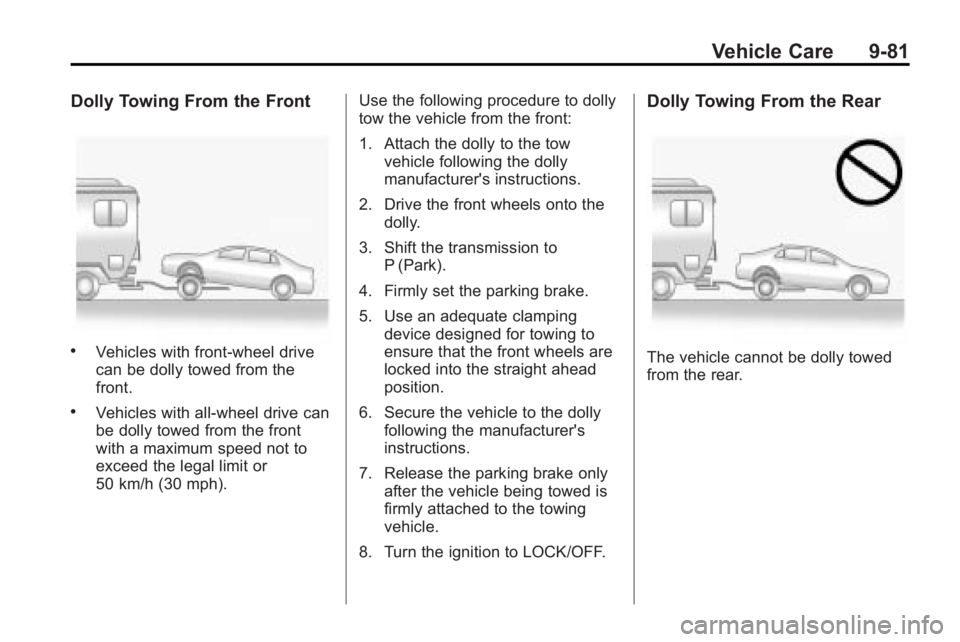
Dolly Towing From the Front
.Vehicles with front-wheel drive
can be dolly towed from the
front.
.Vehicles with all-wheel drive can
be dolly towed from the front
with a maximum speed not to
exceed the legal limit or
50 km/h (30 mph).Use the following procedure to dolly
tow the vehicle from the front:
1. Attach the dolly to the tow
vehicle following the dolly
manufacturer's instructions.
2. Drive the front wheels onto the dolly.
3. Shift the transmission to P (Park).
4. Firmly set the parking brake.
5. Use an adequate clamping device designed for towing to
ensure that the front wheels are
locked into the straight ahead
position.
6. Secure the vehicle to the dolly following the manufacturer's
instructions.
7. Release the parking brake only after the vehicle being towed is
firmly attached to the towing
vehicle.
8. Turn the ignition to LOCK/OFF.
Dolly Towing From the Rear
The vehicle cannot be dolly towed
from the rear.
Page 374 of 414
10-4 Service and Maintenance
.Windshield wiper blade
inspection for wear, cracking,
or contamination and windshield
and wiper blade cleaning,
if contaminated. SeeExterior
Care
on page 9‑82. Worn or
damaged wiper blade
replacement. See Wiper Blade
Replacement on page 9‑29.
.Body hinges and latches, key
lock cylinders, folding seat
hardware, and sunroof
(if equipped) lubrication.
See Recommended Fluids and
Lubricants
on page 10‑7.
More frequent lubrication may
be required when vehicle is
exposed to a corrosive
environment. Applying silicone
grease on weatherstrips with a
clean cloth makes them last
longer, seal better, and not stick
or squeak.
.Restraint system component
check. See Safety System
Check on page 2‑23.
.Automatic transmission fluid
level check and adding fluid,
if needed. See Automatic
Transmission Fluid
on
page 9‑15.
.Engine air cleaner filter
inspection. See Engine Air
Cleaner/Filter on page 9‑15.
.Passenger compartment air
filter replacement (or every
12 months, whichever occurs
first). More frequent replacement
may be required if vehicle is
driven regularly under dusty
conditions.
Additional Required Services
At Each Fuel Stop
.Engine oil level check. See
Engine Oil on page 9‑11.
.Engine coolant level check. See
Engine Coolant on page 9‑18.
.Windshield washer fluid level
check. See Washer Fluidon
page 9‑23.
Once a Month
.Tire inflation check. See Tire
Pressure on page 9‑53.
.Tire wear inspection. See Tire
Inspection on page 9‑59.
Once a Year
.See Starter Switch Checkon
page 9‑27.
.See Automatic Transmission
Shift Lock Control System
Check on page 9‑27.
Page 375 of 414
Service and Maintenance 10-5
.SeeIgnition Transmission Lock
Check on page 9‑28.
.See Park Brake and P (Park)
Mechanism Checkon
page 9‑28.
.Engine cooling system and
pressure cap pressure check.
Radiator and air conditioning
condenser outside cleaning.
See Cooling System
on
page 9‑17.
.Exhaust system and nearby heat
shields inspection for loose or
damaged components.
.Accelerator pedal check for
damage, high effort, or binding.
Replace if needed.
First Engine Oil Change After
Every 40 000 km/25,000 Miles
.Fuel system inspection for
damage or leaks. First Engine Oil Change After
Every 80 000 km/50,000 Miles
.Engine air cleaner filter
replacement. See
Engine Air
Cleaner/Filter on page 9‑15.
.Automatic transmission fluid
change (severe service) for
vehicles mainly driven in heavy
city traffic in hot weather,
in hilly or mountainous terrain,
when frequently towing a
trailer, or used for taxi,
police, or delivery service.
See Automatic Transmission
Fluid on page 9‑15.
First Engine Oil Change After
Every 160 000 km/100,000 Miles
.Automatic transmission fluid
change (normal service).
See Automatic Transmission
Fluid on page 9‑15.
.Spark plug replacement and
spark plug wires inspection.
An Emission Control Service. First Engine Oil Change After
Every 240 000 km/150,000 Miles
.Engine cooling system drain,
flush, and refill, cooling system
and cap pressure check, and
cleaning of outside of radiator
and air conditioning condenser
(or every 5 years, whichever
occurs first). See
Cooling
System
on page 9‑17.
An Emission Control Service.
.Engine accessory drive belt
inspection for fraying, excessive
cracks, or obvious damage
and replacement, if needed.
An Emission Control Service.
Page 378 of 414
10-8 Service and Maintenance
UsageFluid/Lubricant
Automatic Transmission DEXRON
®-VI Automatic Transmission Fluid.
Key Lock Cylinders Multi-Purpose Lubricant, Superlube (GM Part No. U.S. 12346241,
in Canada 10953474).
Hood Latch Assembly, Secondary Latch, Pivots, Spring Anchor, and
Release Pawl Lubriplate Lubricant Aerosol (GM Part No. U.S. 12346293,
in Canada 992723) or lubricant meeting requirements of NLGI #2,
Category LB or GC-LB.
Hood and Door Hinges Multi-Purpose Lubricant, Superlube (GM Part No. U.S. 12346241,
in Canada 10953474).
Weatherstrip Conditioning Weatherstrip Lubricant (GM Part No. U.S. 3634770, in Canada 10953518)
or Dielectric Silicone Grease (GM Part No. U.S. 12345579,
in Canada 992887).
Page 393 of 414
Customer Information 12-7
Services Provided
.Emergency Fuel Delivery:
Delivery of enough fuel for the
vehicle to get to the nearest
service station.
.Lock-Out Service:Service is
provided to unlock the vehicle if
you are locked out. A remote
unlock may be available if you
have OnStar
®. For security
reasons, the driver must present
identification before this service
is given.
.Emergency Tow From a Public
Road or Highway: Tow to
the nearest Buick dealer for
warranty service, or if the vehicle
was in a crash and cannot be
driven. Assistance is also given
when the vehicle is stuck in
sand, mud, or snow.
.Flat Tire Change: Service is
provided to change a flat tire
with the spare tire. The spare
tire, if equipped, must be in good
condition and properly inflated.
It is the owner's responsibility for
the repair or replacement of the
tire if it is not covered by the
warranty.
.Battery Jump Start: Service is
provided to jump start a dead
battery.
Services Not Included in
Roadside Assistance
.Impound towing caused by
violation of any laws.
.Legal fines.
.Mounting, dismounting or
changing of snow tires, chains,
or other traction devices.
.Towing or services for vehicles
driven on a non-public road or
highway.
Services Specific to Canadian
Purchased Vehicles
.Fuel delivery: Reimbursement
is approximately $5 Canadian.
Diesel fuel delivery may be
restricted. Propane and other
fuels are not provided through
this service.
.Lock-Out Service: Vehicle
registration is required.
.Trip Routing Service: Detailed
maps of North America are
provided when requested either
with the most direct route or the
most scenic route. There is a
six request limit per year.
Additional travel information
is also available. Allow
three weeks for delivery.
Page 401 of 414
Customer Information 12-15
Vehicle Data
Recording and
Privacy
Your GM vehicle has a number of
sophisticated computers that record
information about the vehicle’s
performance and how it is driven.
For example, your vehicle uses
computer modules to monitor and
control engine and transmission
performance, to monitor the
conditions for airbag deployment
and deploy airbags in a crash and,
if so equipped, to provide antilock
braking to help the driver control the
vehicle. These modules may store
data to help your dealer/retailer
technician service your vehicle.
Some modules may also store data
about how you operate the vehicle,
such as rate of fuel consumption or
average speed. These modules may
also retain the owner’s personal
preferences, such as radio pre-sets,
seat positions, and temperature
settings.
Event Data Recorders
This vehicle has an Event Data
Recorder (EDR). The main purpose
of an EDR is to record, in certain
crash or near crash-like situations,
such as an airbag deployment or
hitting a road obstacle, data that will
assist in understanding how a
vehicle's systems performed. The
EDR is designed to record data
related to vehicle dynamics and
safety systems for a short period of
time, typically 30 seconds or less.
The EDR in this vehicle is designed
to record such data as:
.How various systems in your
vehicle were operating
.Whether or not the driver and
passenger safety belts were
buckled/fastened
.How far, if at all, the driver was
pressing the accelerator and/or
brake pedal
.How fast the vehicle was
traveling This data can help provide a better
understanding of the circumstances
in which crashes and injuries occur.
Important:
EDR data is recorded
by your vehicle only if a non-trivial
crash situation occurs; no data is
recorded by the EDR under normal
driving conditions and no personal
data (e.g., name, gender, age, and
crash location) is recorded.
However, other parties, such as law
enforcement, could combine the
EDR data with the type of
personally identifying data routinely
acquired during a crash
investigation.
To read data recorded by an EDR,
special equipment is required, and
access to the vehicle or the EDR is
needed. In addition to the vehicle
manufacturer, other parties, such as
law enforcement, that have the
special equipment, can read the
information if they have access to
the vehicle or the EDR.
Page 402 of 414
12-16 Customer Information
GM will not access this data or
share it with others except: with the
consent of the vehicle owner or,
if the vehicle is leased, with the
consent of the lessee; in response
to an official request of police or
similar government office; as part of
GM's defense of litigation through
the discovery process; or, as
required by law. Data that GM
collects or receives may also be
used for GM research needs or may
be made available to others for
research purposes, where a need is
shown and the data is not tied to a
specific vehicle or vehicle owner.
OnStar®
If your vehicle has OnStar and you
subscribe to the OnStar services,
please refer to the OnStar Terms
and Conditions for information on
data collection and use. See also
OnStar
®Systemon page 4‑43in
this manual for more information.
Navigation System
If your vehicle has a navigation
system, use of the system may
result in the storage of destinations,
addresses, telephone numbers, and
other trip information. Refer to the
navigation system operating manual
for information on stored data and
for deletion instructions.
Radio Frequency
Identification (RFID)
RFID technology is used in some
vehicles for functions such as tire
pressure monitoring and ignition
system security, as well as in
connection with conveniences such
as key fobs for remote door locking/
unlocking and starting, and
in-vehicle transmitters for garage
door openers. RFID technology in
GM vehicles does not use or record
personal information or link with any
other GM system containing
personal information.
Radio Frequency
Statement
This vehicle has systems that
operate on a radio frequency that
comply with Part 15 of the Federal
Communications Commission (FCC)
Rules and with RSS-210/211 of
Industry and Science Canada.
Operation is subject to the following
two conditions:
1. The device may not cause interference.
2. The device must accept any interference received, including
interference that may cause
undesired operation of the
device.
Changes or modifications to any of
these systems by other than an
authorized service facility could void
authorization to use this equipment.
Page 403 of 414
INDEX i-1
A
Accessories andModifications . . . . . . . . . . . . . . . . . . 9-3
Accessory Power . . . . . . . . . . . . . . 8-20
Adaptive Forward Lighting (AFL) . . . . . . . . . . . . . . . . . 5-3
Add-On Electrical
Equipment . . . . . . . . . . . . . . . . . . . 8-60
Adding Equipment to the Airbag-Equipped Vehicle . . . . . 2-38
Adjustments
Lumbar, Front Seats . . . . . . . . . . . 2-5
Air Cleaner/Filter, Engine . . . . . . 9-15
Air Filter, Passenger Compartment . . . . . . . . . . . . . . . . . 7-8
Air Intake . . . . . . . . . . . . . . . . . . . . . . . 7-8
Air Vents . . . . . . . . . . . . . . . . . . . . . . . 7-8
Airbag System
Check . . . . . . . . . . . . . . . . . . . . . . . . 2-39
How Does an AirbagRestrain? . . . . . . . . . . . . . . . . . . . 2-30
Passenger Sensing System . . . . . . . . . . . . . . . . . . . . . . 2-32 Airbag System (cont.)
What Makes an Airbag
Inflate? . . . . . . . . . . . . . . . . . . . . . . 2-30
What Will You See After
an Airbag Inflates? . . . . . . . . . . 2-30
When Should an Airbag Inflate? . . . . . . . . . . . . . . . . . . . . . . 2-28
Where Are the Airbags? . . . . . . 2-27
Airbags
Adding Equipment to theVehicle . . . . . . . . . . . . . . . . . . . . . . 2-38
Passenger Status Indicator . . . 4-16
Readiness Light . . . . . . . . . . . . . . 4-16
Servicing Airbag-Equipped Vehicles . . . . . . . . . . . . . . . . . . . . . 2-37
System Check . . . . . . . . . . . . . . . . 2-24
Alarm System Anti-Theft . . . . . . . . . . . . . . . . . . . . . 1-13
All-Wheel Drive . . . . . . . . . . . . . . . . 8-30
AM-FM Radio . . . . . . . . . . . . . . . . . . 6-12
Antenna Satellite Radio . . . . . . . . . . . . . . . . 6-19
Anti-Theft
Alarm System . . . . . . . . . . . . . . . . 1-13
Alarm System Messages . . . . . 4-37 Antilock Brake
System (ABS) . . . . . . . . . . . . . . . . 8-31
Warning Light . . . . . . . . . . . . . . . . . 4-21
Appearance Care Exterior . . . . . . . . . . . . . . . . . . . . . . . 9-82
Interior . . . . . . . . . . . . . . . . . . . . . . . . 9-86
Assistance Program,
Roadside . . . . . . . . . . . . . . . . . . . . . 12-6
Audio Players . . . . . . . . . . . . . . . . . 6-20 CD . . . . . . . . . . . . . . . . . . . . . . . . . . . 6-20
Audio System
Backglass Antenna . . . . . . . . . . . 6-19
Radio Reception . . . . . . . . . . . . . . 6-18
Theft-Deterrent Feature . . . . . . . . 6-2
Automatic Headlamp System . . . . . . . . . . . . . 5-3
Automatic Climate Control System . . . . . . . . . . . . . . . . . . . . . . . . 7-1
Automatic Transmission . . . . . . . 8-27 Fluid . . . . . . . . . . . . . . . . . . . . . . . . . . 9-15
Manual Mode . . . . . . . . . . . . . . . . . 8-29
Shiftlock Control SystemCheck . . . . . . . . . . . . . . . . . . . . . . . 9-27
Auxiliary Devices . . . . . . . . 6-28, 6-31