adjust light BUICK LACROSSE 2011 Owner's Guide
[x] Cancel search | Manufacturer: BUICK, Model Year: 2011, Model line: LACROSSE, Model: BUICK LACROSSE 2011Pages: 462, PDF Size: 5.73 MB
Page 245 of 462
Black plate (5,1)Buick LaCrosse Owner Manual - 2011
Climate Controls 8-5
Automatic Operation
The system automatically controls
the fan speed, air delivery, air
conditioning, and recirculation in
order to heat or cool the vehicle
to the desired temperature.
When the AUTO indicator light is
on, the system is in full automatic
operation. If the air delivery mode,
fan speed, recirculation, or air
conditioning setting is adjusted,
the AUTO indicator turns off and
the selected settings will appear
on the display.
To place the system in automatic
mode do the following:
1. Press AUTO.
2. Set the temperature. Allow thesystem time to stabilize. Adjust
the temperature as needed for
best comfort.QTEMPR(Driver and
Passenger Temperature
Control): The temperature
can be adjusted separately for
the driver and the passenger.
Press to increase or decrease
the temperature.
ZONE: Press to link all climate
zone settings to the driver's
settings. The ZONE indicator light
will turn off. When the passenger
settings are adjusted, the ZONE
indicator light is on.
Manual Operation
O(Power): Press to turn the fan off
or on.
D C(Fan Control): Press to
increase or decrease the fan speed.
The fan speed setting appears on
the main display. Pressing either
button cancels automatic fan control
and the fan is controlled manually.
Press AUTO to return to automatic
operation.
e *(Air Delivery Mode
Control): Press to change
the direction of the airflow.
The current mode appears in
the display screen. Pressing
either button cancels automatic air
delivery control and the direction
of the airflow is controlled manually.
Press AUTO to return to automatic
operation.
To change the current mode, select
one of the following:
Y(Vent): Air is directed to the
instrument panel outlets.
\(Bi-Level): Air is divided
between the instrument panel
outlets and the floor outlets.
C(Tri‐Level): Air is divided
between the windshield, instrument
panel, and floor outlets.
[(Floor): Air is directed to the
floor outlets.
-(Defog): Clears the windows of
fog or moisture. Air is directed to the
windshield and floor outlets.
Page 246 of 462
Black plate (6,1)Buick LaCrosse Owner Manual - 2011
8-6 Climate Controls
0(Defrost):Clears the
windshield of fog or frost more
quickly. Air is directed to the
windshield.
For best results, clear all snow and
ice from the windshield before
defrosting.
#(Air Conditioning): Press to
turn the air conditioning system on
or off. If the fan is turned off or the
outside temperature falls below
freezing, the air conditioner will
not run.
Pressing this button cancels
automatic air conditioning and
turns off the air conditioner.
Press AUTO to return to automatic
operation and the air conditioner
runs automatically as needed.
When the indicator light is on, the
air conditioner runs automatically
to cool the air inside the vehicle or
to dry the air needed to defog the
windshield faster.
>//(Recirculation/Auto
Recirculation): Press to change to
automatic control of air recirculation
inside the vehicle. When the auto
recirculation indicator light is on,
the air is automatically recirculated
as needed to help quickly cool the
air inside the vehicle.
In auto recirculation control, the
Air Quality Control system may
operate when pollution is detected.
To adjust the sensitivity of the
Air Quality Control, see “Climate
and Air Quality” underVehicle
Personalization on page 5‑39.
When the
>indicator light is on,
air is recirculated inside the vehicle.
If both indicator lights are off,
outside air will flow into the vehicle.
Press AUTO or
/to return to
automatic operation. Auto Defog:
The climate control
system may have a sensor to
automatically detect high humidity
inside the vehicle. When high
humidity is detected, the climate
control system may adjust to
outside air supply and turn on
the air conditioner. The fan speed
may slightly increase to help
prevent fogging. If the climate
control system does not detect
possible window fogging, it returns
to normal operation. To turn Auto
Defog off or on, see “Climate
and Air Quality” underVehicle
Personalization on page 5‑39.
Page 257 of 462
Black plate (7,1)Buick LaCrosse Owner Manual - 2011
Driving and Operating 9-7
Of course, traction is reduced when
water, snow, ice, gravel, or other
material is on the road. For safety,
slow down and adjust your driving
to these conditions. It is important
to slow down on slippery surfaces
because stopping distance is longer
and vehicle control more limited.
While driving on a surface with
reduced traction, try to avoid
sudden steering, acceleration,
or braking, including reducing
vehicle speed by shifting to a lower
gear. Any sudden changes could
cause the tires to slide. You might
not realize the surface is slippery
until the vehicle is skidding. Learn to
recognize warning clues—such as
enough water, ice, or packed snow
on the road to make a mirrored
surface —and slow down when
you have any doubt.
Remember: Antilock brakes help
avoid only the braking skid.Driving on Wet Roads
Rain and wet roads can reduce
vehicle traction and affect your
ability to stop and accelerate.
Always drive slower in these types
of driving conditions and avoid
driving through large puddles and
deep‐standing or flowing water.
{WARNING
Wet brakes can cause crashes.
They might not work as well in
a quick stop and could cause
pulling to one side. You could
lose control of the vehicle.
After driving through a large
puddle of water or a car/vehicle
wash, lightly apply the brake
pedal until the brakes work
normally.
(Continued)
WARNING (Continued)
Flowing or rushing water creates
strong forces. Driving through
flowing water could cause the
vehicle to be carried away. If this
happens, you and other vehicle
occupants could drown. Do not
ignore police warnings and be
very cautious about trying to
drive through flowing water.
Hydroplaning
Hydroplaning is dangerous. Water
can build up under the vehicle's
tires so they actually ride on the
water. This can happen if the road
is wet enough and you are going
fast enough. When the vehicle is
hydroplaning, it has little or no
contact with the road.
There is no hard and fast rule about
hydroplaning. The best advice is to
slow down when the road is wet.
Page 286 of 462
Black plate (36,1)Buick LaCrosse Owner Manual - 2011
9-36 Driving and Operating
Ride Control Systems
Traction Control
System (TCS)
The vehicle has a traction
control system that limits wheel
spin. This is especially useful in
slippery road conditions. On a
front-wheel-drive vehicle, the
system operates if it senses that
one or both of the front wheels
are spinning or beginning to lose
traction. On an All-Wheel-Drive
(AWD) vehicle, the system will
operate if it senses that any of the
wheels are spinning or beginning
to lose traction. When this happens,
the system brakes the spinning
wheel(s) and/or reduces engine
power to limit wheel spin.
The system may be heard or felt
while it is working, but this is
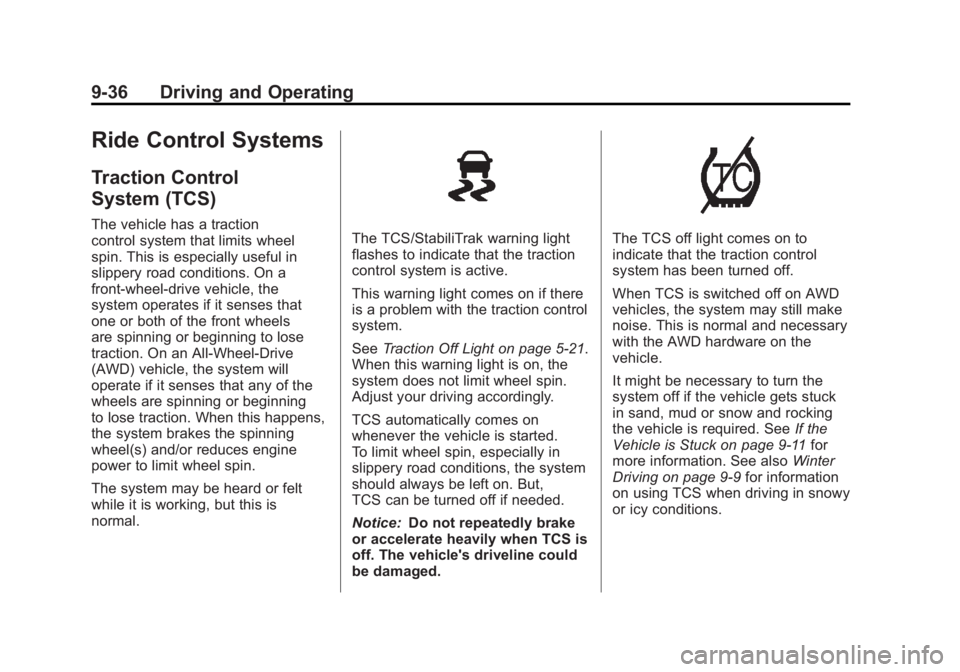
normal.The TCS/StabiliTrak warning light
flashes to indicate that the traction
control system is active.
This warning light comes on if there
is a problem with the traction control
system.
SeeTraction Off Light on page 5‑21.
When this warning light is on, the
system does not limit wheel spin.
Adjust your driving accordingly.
TCS automatically comes on
whenever the vehicle is started.
To limit wheel spin, especially in
slippery road conditions, the system
should always be left on. But,
TCS can be turned off if needed.
Notice: Do not repeatedly brake
or accelerate heavily when TCS is
off. The vehicle's driveline could
be damaged.The TCS off light comes on to
indicate that the traction control
system has been turned off.
When TCS is switched off on AWD
vehicles, the system may still make
noise. This is normal and necessary
with the AWD hardware on the
vehicle.
It might be necessary to turn the
system off if the vehicle gets stuck
in sand, mud or snow and rocking
the vehicle is required. See If the
Vehicle is Stuck on page 9‑11 for
more information. See also Winter
Driving on page 9‑9 for information
on using TCS when driving in snowy
or icy conditions.
Page 287 of 462
Black plate (37,1)Buick LaCrosse Owner Manual - 2011
Driving and Operating 9-37
To turn the system off, pressg
located on the console to the right
of the shifter.
Press and release
gand the traction
control system turns off and the
traction control system warning light
comes on. Press
gagain to turn the
system back on. For information on
turning StabiliTrak off and on, see
Electronic Stability Control (ESC) on
page 9‑37.
Adding non‐GM accessories can
affect the vehicle's performance.
See Accessories and Modifications
on page 10‑3 for more information.
Electronic Stability
Control (ESC)
The vehicle has a vehicle
stability enhancement system
called StabiliTrak. It is an advanced
computer controlled system that
assists with directional control of the
vehicle in difficult driving conditions.
StabiliTrak activates when the
computer senses a difference
between the intended path and
the direction the vehicle is actually
traveling. StabiliTrak selectively
applies braking pressure at any one
of the vehicle's brakes to help steer
the vehicle in the intended direction.
When the stability control system
activates, the Traction Control
System (TCS)/StabiliTrak light
flashes on the instrument panel.
This also occurs when traction
control is activated. A noise might
be heard or vibration might be felt
in the brake pedal. This is normal.
Continue to steer the vehicle in the
intended direction.
If there is a problem detected with
StabiliTrak, the TCS/StabiliTrak light
comes on and the system is not
operational. See Electronic Stability
Control (ESC)/Traction Control
System (TCS) Indicator/Warning
Light on page 5‑22. Driving should
be adjusted accordingly.
Page 288 of 462
Black plate (38,1)Buick LaCrosse Owner Manual - 2011
9-38 Driving and Operating
StabiliTrak comes on automatically
whenever the vehicle is started.
To assist with directional control
of the vehicle, the system should
always be left on.
StabiliTrak can be turned off
if needed by pressing and
holding
guntil the StabiliTrak
Off light comes on the instrument
panel. For information on turning
TCS off and on, see Traction
Control System (TCS) on
page 9‑36.
If cruise control is being used when
StabiliTrak activates, the cruise
control automatically disengages.
Press the cruise control button to
reengage when road conditions
allow. See Cruise Control on
page 9‑39 for more information.
Limited-Slip Differential
Vehicles with a limited-slip
differential can give more traction
on snow, mud, ice, sand, or gravel.
It works like a standard differential
most of the time, but when traction
is low, this feature allows the drive
wheel with the most traction to
move the vehicle.
Selective Ride Control
The vehicle may have a ride control
system called Selective Ride
Control. The system provides the
following performance benefits:
.Reduced Impact Harshness
.Improved Road Isolation
.Improved High-Speed Stability
.Improved Handling Response
.Better Control of Body Ride
Motions To switch from TOUR to SPORT
mode, move the shift lever to
the left while the transmission
is in D (Drive).
TOUR:
Use for normal city and
highway driving. This setting
provides a smooth, soft ride.
SPORT: Use where road conditions
or personal preference demand
more control. This setting provides
more “feel,” or response to road
conditions through increased
steering effort and suspension
tuning.
The setting can be changed at any
time. Based on road conditions,
steering wheel angle, and vehicle
speed, the system automatically
adjusts to provide the best handling
while providing a smooth ride.
The TOUR and SPORT modes
will feel similar on a smooth road.
Page 337 of 462
Black plate (25,1)Buick LaCrosse Owner Manual - 2011
Vehicle Care 10-25
Some driving conditions or climates
can cause a brake squeal when
the brakes are first applied or
lightly applied. This does not mean
something is wrong with the brakes.
Properly torqued wheel nuts are
necessary to help prevent brake
pulsation. When tires are rotated,
inspect brake pads for wear
and evenly tighten wheel nuts
in the proper sequence to torque
specifications inCapacities and
Specifications on page 12‑2.
Brake linings should always be
replaced as complete axle sets.
Brake Pedal Travel
See your dealer if the brake
pedal does not return to normal
height, or if there is a rapid increase
in pedal travel. This could be a
sign that brake service might be
required.
Brake Adjustment
Every time the brakes are applied,
with or without the vehicle moving,
the brakes adjust for wear.
Replacing Brake System Parts
The braking system on a vehicle is
complex. Its many parts have to be
of top quality and work well together
if the vehicle is to have really good
braking. The vehicle was designed
and tested with top-quality brake
parts. When parts of the braking
system are replaced, be sure to get
new, approved replacement parts.
If this is not done, the brakes might
not work properly. For example,
installing disc brake pads that are
wrong for the vehicle, can change
the balance between the front
and rear brakes —for the worse.
The braking performance expected
can change in many other ways if
the wrong replacement brake parts
are installed.
Brake Fluid
The brake master cylinder reservoir
is filled with DOT 3 brake fluid
as indicated on the reservoir cap.
See Engine Compartment Overview
on page 10‑6 for the location of the
reservoir.
There are only two reasons why
the brake fluid level in the reservoir
might go down:
.The brake fluid level goes down
because of normal brake lining
wear. When new linings are
installed, the fluid level goes
back up.
.A fluid leak in the brake
hydraulic system can also cause
a low fluid level. Have the brake
hydraulic system fixed, since a
leak means that sooner or later
the brakes will not work well.
Page 342 of 462
Black plate (30,1)Buick LaCrosse Owner Manual - 2011
10-30 Vehicle Care
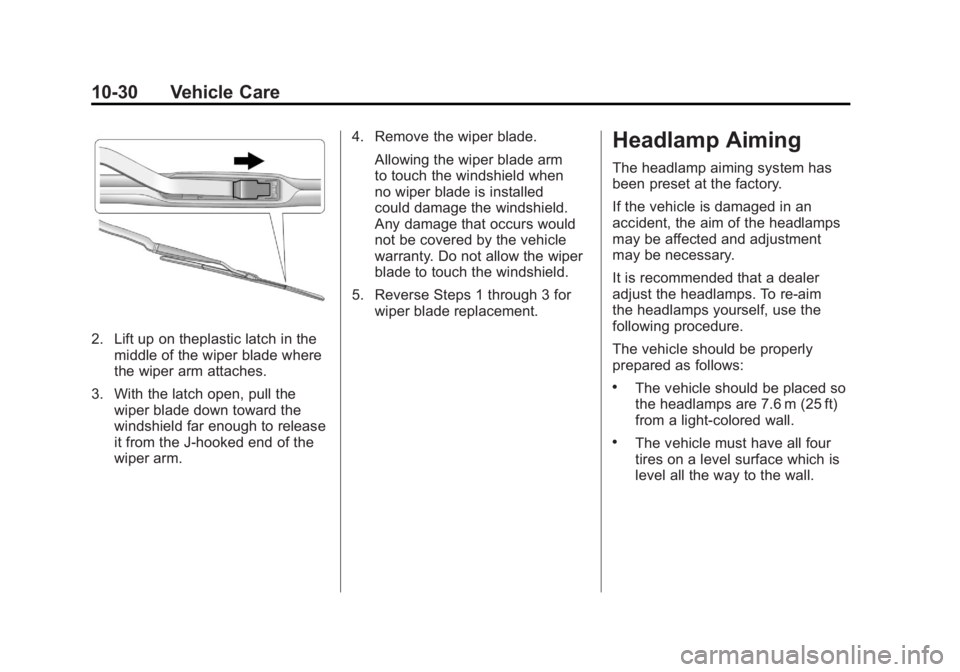
2. Lift up on theplastic latch in themiddle of the wiper blade where
the wiper arm attaches.
3. With the latch open, pull the wiper blade down toward the
windshield far enough to release
it from the J-hooked end of the
wiper arm. 4. Remove the wiper blade.
Allowing the wiper blade arm
to touch the windshield when
no wiper blade is installed
could damage the windshield.
Any damage that occurs would
not be covered by the vehicle
warranty. Do not allow the wiper
blade to touch the windshield.
5. Reverse Steps 1 through 3 for wiper blade replacement.
Headlamp Aiming
The headlamp aiming system has
been preset at the factory.
If the vehicle is damaged in an
accident, the aim of the headlamps
may be affected and adjustment
may be necessary.
It is recommended that a dealer
adjust the headlamps. To re-aim
the headlamps yourself, use the
following procedure.
The vehicle should be properly
prepared as follows:
.The vehicle should be placed so
the headlamps are 7.6 m (25 ft)
from a light‐colored wall.
.The vehicle must have all four
tires on a level surface which is
level all the way to the wall.
Page 344 of 462
Black plate (32,1)Buick LaCrosse Owner Manual - 2011
10-32 Vehicle Care
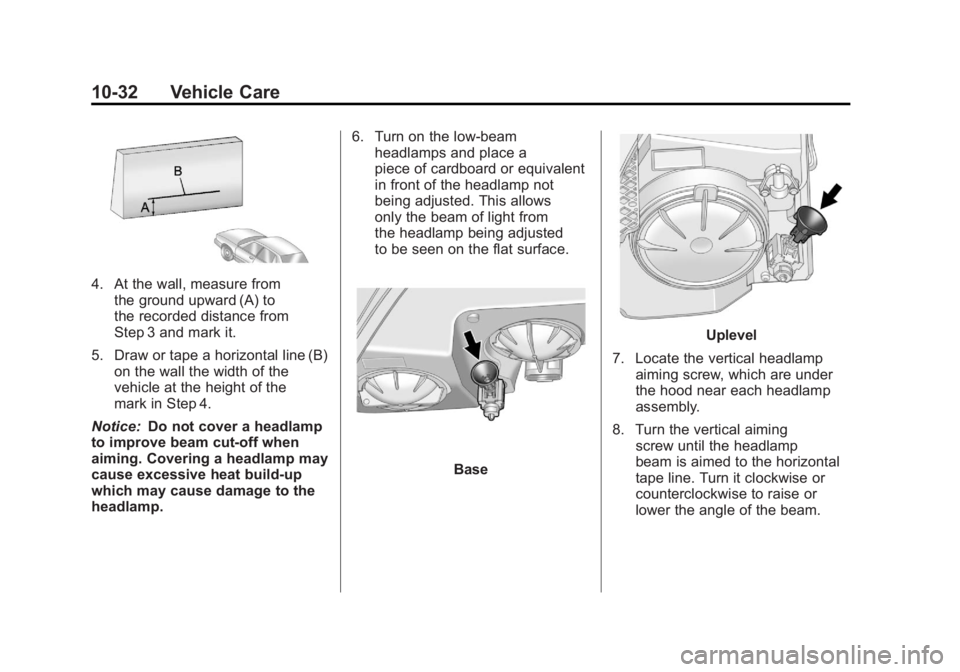
4. At the wall, measure fromthe ground upward (A) to
the recorded distance from
Step 3 and mark it.
5. Draw or tape a horizontal line (B) on the wall the width of the
vehicle at the height of the
mark in Step 4.
Notice: Do not cover a headlamp
to improve beam cut-off when
aiming. Covering a headlamp may
cause excessive heat build-up
which may cause damage to the
headlamp. 6. Turn on the low-beam
headlamps and place a
piece of cardboard or equivalent
in front of the headlamp not
being adjusted. This allows
only the beam of light from
the headlamp being adjusted
to be seen on the flat surface.
Base
Uplevel
7. Locate the vertical headlamp aiming screw, which are under
the hood near each headlamp
assembly.
8. Turn the vertical aiming screw until the headlamp
beam is aimed to the horizontal
tape line. Turn it clockwise or
counterclockwise to raise or
lower the angle of the beam.
Page 374 of 462
Black plate (62,1)Buick LaCrosse Owner Manual - 2011
10-62 Vehicle Care
Do not include the compact
spare tire in the tire rotation.
After the tires have been
rotated, adjust the front and
rear inflation pressures as
shown on the Tire and Loading
Information label. SeeTire
Pressure on page 10‑54
and Vehicle Load Limits on
page 9‑12.
Reset the Tire Pressure Monitor
System. See Tire Pressure
Monitor Operation on
page 10‑57. Make certain that all wheel
nuts are properly tightened.
See
“Wheel Nut Torque” under
Capacities and Specifications on
page 12‑2.
{WARNING
Rust or dirt on a wheel, or on the
parts to which it is fastened, can
make wheel nuts become loose
after time. The wheel could come
off and cause an accident. When
changing a wheel, remove any
rust or dirt from places where the
wheel attaches to the vehicle.
In an emergency, use a cloth or
a paper towel to do this; but be
sure to use a scraper or wire
brush later, if needed, to get all
the rust or dirt off. See If a Tire
Goes Flat on page 10‑70.
Lightly coat the center of the
wheel hub with wheel bearing
grease after a wheel change
or tire rotation to prevent
corrosion or rust build-up.
Do not get grease on the flat
wheel mounting surface or
on the wheel nuts or bolts.