lock BUICK LACROSSE 2014 Owners Manual
[x] Cancel search | Manufacturer: BUICK, Model Year: 2014, Model line: LACROSSE, Model: BUICK LACROSSE 2014Pages: 402, PDF Size: 4.37 MB
Page 269 of 402
Black plate (21,1)Buick LaCrosse Owner Manual (GMNA-Localizing-U.S./Canada/Mexico-
6043609) - 2014 - 2nd Edition - 10/17/13
Vehicle Care 10-21
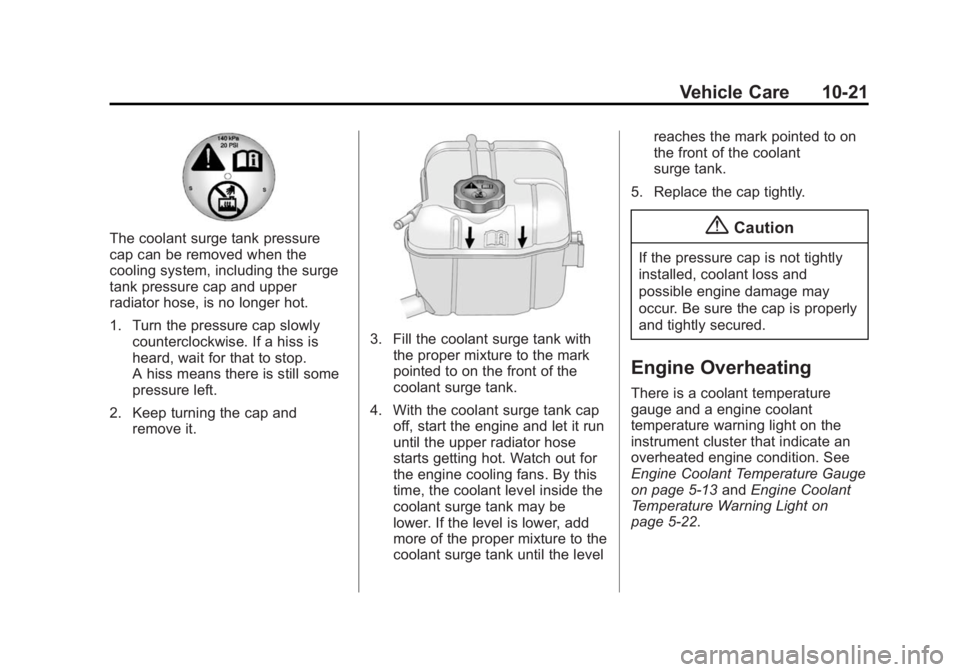
The coolant surge tank pressure
cap can be removed when the
cooling system, including the surge
tank pressure cap and upper
radiator hose, is no longer hot.
1. Turn the pressure cap slowlycounterclockwise. If a hiss is
heard, wait for that to stop.
A hiss means there is still some
pressure left.
2. Keep turning the cap and remove it.
3. Fill the coolant surge tank withthe proper mixture to the mark
pointed to on the front of the
coolant surge tank.
4. With the coolant surge tank cap off, start the engine and let it run
until the upper radiator hose
starts getting hot. Watch out for
the engine cooling fans. By this
time, the coolant level inside the
coolant surge tank may be
lower. If the level is lower, add
more of the proper mixture to the
coolant surge tank until the level reaches the mark pointed to on
the front of the coolant
surge tank.
5. Replace the cap tightly.
{Caution
If the pressure cap is not tightly
installed, coolant loss and
possible engine damage may
occur. Be sure the cap is properly
and tightly secured.
Engine Overheating
There is a coolant temperature
gauge and a engine coolant
temperature warning light on the
instrument cluster that indicate an
overheated engine condition. See
Engine Coolant Temperature Gauge
on page 5-13 andEngine Coolant
Temperature Warning Light on
page 5-22.
Page 276 of 402
Black plate (28,1)Buick LaCrosse Owner Manual (GMNA-Localizing-U.S./Canada/Mexico-
6043609) - 2014 - 2nd Edition - 10/17/13
10-28 Vehicle Care
Infrequent Usage: Remove the
12-volt battery black, negative (−)
cable from the battery to keep the
battery from running down.
Extended Storage: Remove the
12-volt battery black, negative (−)
cable from the battery or use a
battery trickle charger.
Remember to reconnect the battery
when ready to drive the vehicle.
All-Wheel Drive
Transfer Case
Under normal driving conditions,
transfer case fluid does not require
changing or checking unless there
is a fluid leak or unusual noise.
If required, have the transfer case
serviced by your dealer.
Starter Switch Check
{Warning
When you are doing this
inspection, the vehicle could
move suddenly. If the vehicle
moves, you or others could be
injured.
1. Before starting this check, be sure there is enough room
around the vehicle.
2. Apply both the parking brake and the regular brake.
Do not use the accelerator
pedal, and be ready to turn off
the engine immediately if it
starts.
3. Try to start the engine in each gear. The vehicle should start
only in P (Park) or N (Neutral).
If the vehicle starts in any other
position, contact your dealer for
service.
Automatic Transmission
Shift Lock Control
Function Check
{Warning
When you are doing this
inspection, the vehicle could
move suddenly. If the vehicle
moves, you or others could be
injured.
1. Before starting this check, be sure there is enough room
around the vehicle. It should be
parked on a level surface.
2. Apply the parking brake. Be ready to apply the regular brake
immediately if the vehicle begins
to move.
3. With the engine off, turn the ignition on, but do not start the
engine. Without applying the
regular brake, try to move the
shift lever out of P (Park) with
Page 277 of 402
Black plate (29,1)Buick LaCrosse Owner Manual (GMNA-Localizing-U.S./Canada/Mexico-
6043609) - 2014 - 2nd Edition - 10/17/13
Vehicle Care 10-29
normal effort. If the shift lever
moves out of P (Park), contact
your dealer for service.
Ignition Transmission
Lock Check
While parked, and with the parking
brake set, try to turn the ignition to
LOCK/OFF in each shift lever
position.
.The ignition should turn to
LOCK/OFF only when the shift
lever is in P (Park).
.With the key access ignition
system, the ignition key should
come out only in LOCK/OFF.
SeeIgnition Positions (Key
Access) on page 9-15 orIgnition
Positions (Keyless Access) on
page 9-16.
Contact your dealer if service is
required.
Park Brake and P (Park)
Mechanism Check
{Warning
When you are doing this check,
the vehicle could begin to move.
You or others could be injured
and property could be damaged.
Make sure there is room in front
of the vehicle in case it begins to
roll. Be ready to apply the regular
brake at once should the vehicle
begin to move.
Park on a fairly steep hill, with the
vehicle facing downhill. Keeping
your foot on the regular brake, set
the parking brake.
.To check the parking brake's
holding ability: With the engine
running and the transmission in
N (Neutral), slowly remove foot
pressure from the regular brake
pedal. Do this until the vehicle is
held by the parking brake only.
.To check the P (Park)
mechanism's holding ability:
With the engine running, shift to
P (Park). Then release the
parking brake followed by the
regular brake.
Contact your dealer if service is
required.
Wiper Blade Replacement
Windshield wiper blades should be
inspected for wear and cracking.
See Maintenance Schedule on
page 11-2 for more information.
Replacement blades come in
different types and are removed in
different ways. For proper type and
length, see Maintenance
Replacement Parts on page 11-13.
To replace the windshield wiper
blade:
1. Pull the windshield wiper
assembly away from the
windshield.
Page 280 of 402
Black plate (32,1)Buick LaCrosse Owner Manual (GMNA-Localizing-U.S./Canada/Mexico-
6043609) - 2014 - 2nd Edition - 10/17/13
10-32 Vehicle Care
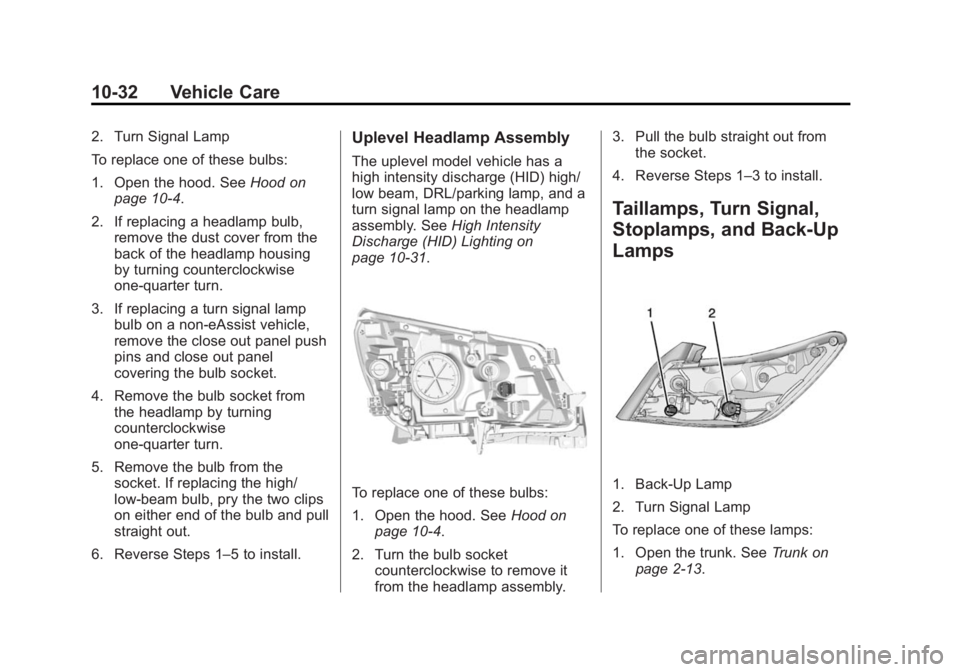
2. Turn Signal Lamp
To replace one of these bulbs:
1. Open the hood. SeeHood on
page 10-4.
2. If replacing a headlamp bulb, remove the dust cover from the
back of the headlamp housing
by turning counterclockwise
one-quarter turn.
3. If replacing a turn signal lamp bulb on a non-eAssist vehicle,
remove the close out panel push
pins and close out panel
covering the bulb socket.
4. Remove the bulb socket from the headlamp by turning
counterclockwise
one-quarter turn.
5. Remove the bulb from the socket. If replacing the high/
low-beam bulb, pry the two clips
on either end of the bulb and pull
straight out.
6. Reverse Steps 1–5 to install.Uplevel Headlamp Assembly
The uplevel model vehicle has a
high intensity discharge (HID) high/
low beam, DRL/parking lamp, and a
turn signal lamp on the headlamp
assembly. See High Intensity
Discharge (HID) Lighting on
page 10-31.
To replace one of these bulbs:
1. Open the hood. See Hood on
page 10-4.
2. Turn the bulb socket counterclockwise to remove it
from the headlamp assembly. 3. Pull the bulb straight out from
the socket.
4. Reverse Steps 1–3 to install.
Taillamps, Turn Signal,
Stoplamps, and Back-Up
Lamps
1. Back-Up Lamp
2. Turn Signal Lamp
To replace one of these lamps:
1. Open the trunk. See Trunk on
page 2-13.
Page 281 of 402
Black plate (33,1)Buick LaCrosse Owner Manual (GMNA-Localizing-U.S./Canada/Mexico-
6043609) - 2014 - 2nd Edition - 10/17/13
Vehicle Care 10-33
2. Remove the fasteners and pullback the trunk trim.
3. Remove the four plastic wing nuts holding the taillamp
assembly in place.
4. Pull out the taillamp assembly and disconnect the wiring
harness.
5. Turn the bulb socket counterclockwise to remove it.
6. Pull the old bulb straight out of the bulb socket.
7. Reverse Steps 1–6 to install.
License Plate Lamp
The license plate lamps for this
vehicle are on the trunk lid.
To replace one of these bulbs:
1. Open the trunk. See Trunk on
page 2-13.
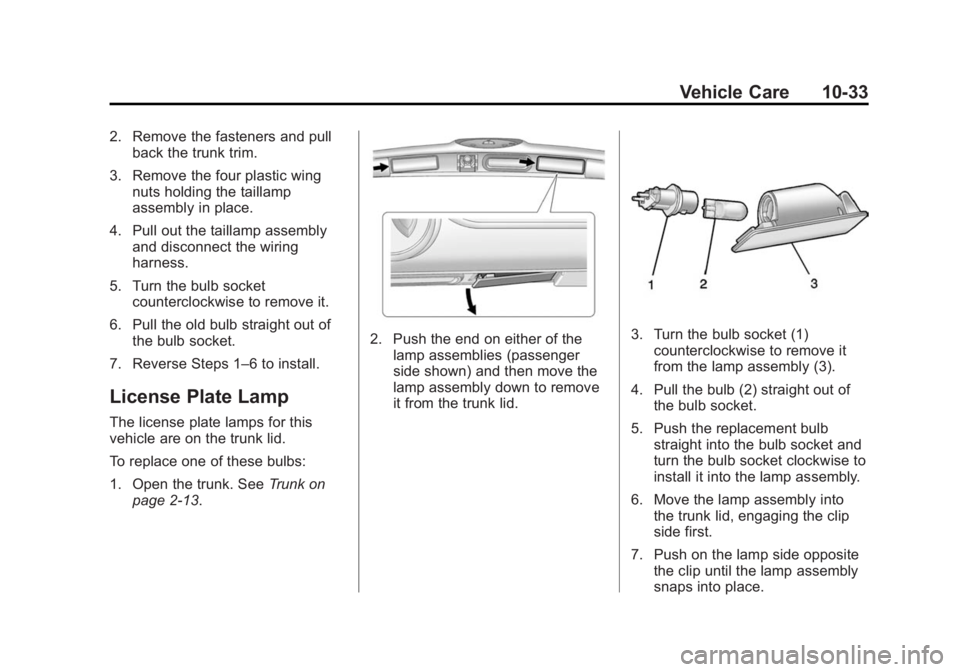
2. Push the end on either of the
lamp assemblies (passenger
side shown) and then move the
lamp assembly down to remove
it from the trunk lid.3. Turn the bulb socket (1)counterclockwise to remove it
from the lamp assembly (3).
4. Pull the bulb (2) straight out of the bulb socket.
5. Push the replacement bulb straight into the bulb socket and
turn the bulb socket clockwise to
install it into the lamp assembly.
6. Move the lamp assembly into the trunk lid, engaging the clip
side first.
7. Push on the lamp side opposite the clip until the lamp assembly
snaps into place.
Page 283 of 402
Black plate (35,1)Buick LaCrosse Owner Manual (GMNA-Localizing-U.S./Canada/Mexico-
6043609) - 2014 - 2nd Edition - 10/17/13
Vehicle Care 10-35
Headlamp Wiring
An electrical overload may cause
the lamps to go on and off, or in
some cases to remain off. Have the
headlamp wiring checked right away
if the lamps go on and off or
remain off.
Windshield Wipers
If the wiper motor overheats due to
heavy snow or ice, the windshield
wipers will stop until the motor cools
and will then restart.
Although the circuit is protected
from electrical overload, overload
due to heavy snow or ice may
cause wiper linkage damage.
Always clear ice and heavy snow
from the windshield before using the
windshield wipers.
If the overload is caused by an
electrical problem and not snow or
ice, be sure to get it fixed.
Fuses and Circuit
Breakers
The wiring circuits in the vehicle are
protected from short circuits by a
combination of fuses and circuit
breakers. This greatly reduces the
chance of damage caused by
electrical problems.
To check a fuse, look at the
silver-colored band inside the fuse.
If the band is broken or melted,
replace the fuse. Be sure to replace
a bad fuse with a new one of the
identical size and rating.
Fuses of the same amperage can
be temporarily borrowed from
another fuse location, if a fuse goes
out. Replace the fuse as soon as
possible.
To identify and check fuses, circuit
breakers, and relays, seeEngine
Compartment Fuse Block on
page 10-35 andInstrument Panel
Fuse Block on page 10-39.
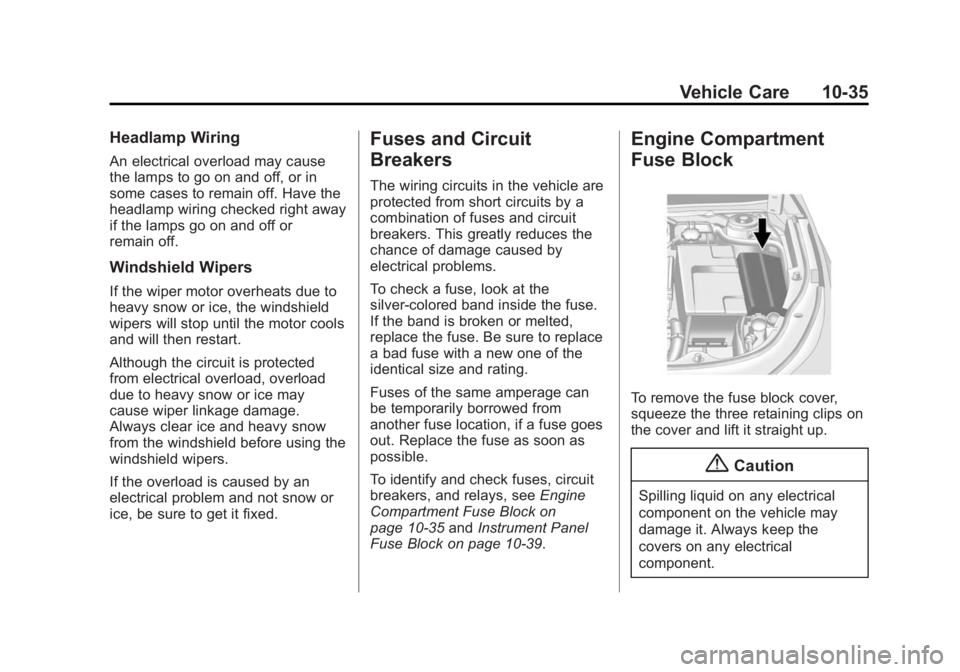
Engine Compartment
Fuse Block
To remove the fuse block cover,
squeeze the three retaining clips on
the cover and lift it straight up.
{Caution
Spilling liquid on any electrical
component on the vehicle may
damage it. Always keep the
covers on any electrical
component.
Page 284 of 402
Black plate (36,1)Buick LaCrosse Owner Manual (GMNA-Localizing-U.S./Canada/Mexico-
6043609) - 2014 - 2nd Edition - 10/17/13
10-36 Vehicle Care
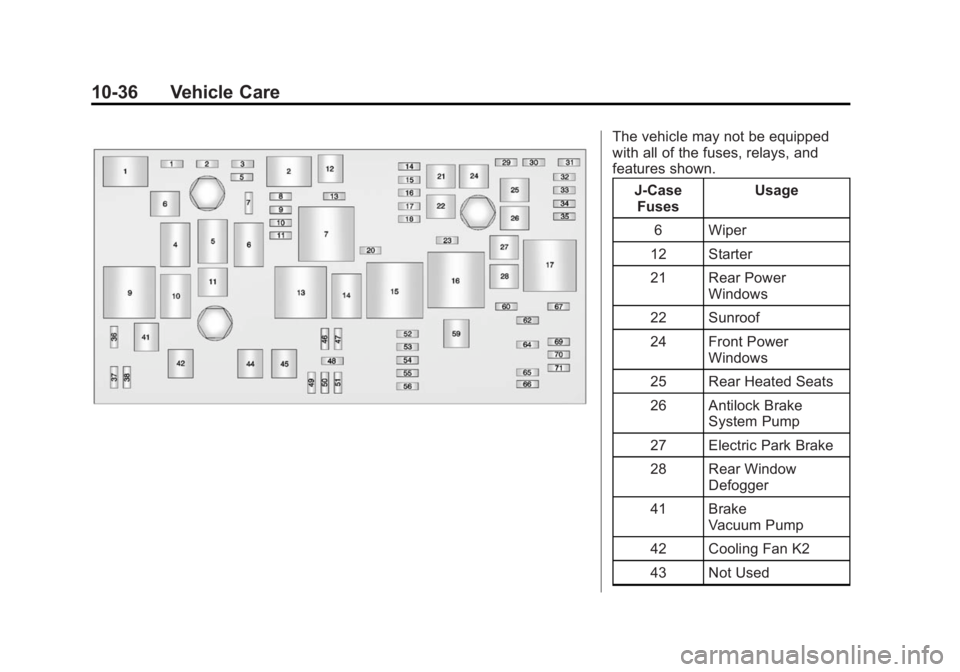
The vehicle may not be equipped
with all of the fuses, relays, and
features shown.J-CaseFuses Usage
6 Wiper
12 Starter
21 Rear Power Windows
22 Sunroof
24 Front Power Windows
25 Rear Heated Seats
26 Antilock Brake System Pump
27 Electric Park Brake
28 Rear Window Defogger
41 Brake Vacuum Pump
42 Cooling Fan K2
43 Not Used
Page 286 of 402
Black plate (38,1)Buick LaCrosse Owner Manual (GMNA-Localizing-U.S./Canada/Mexico-
6043609) - 2014 - 2nd Edition - 10/17/13
10-38 Vehicle Care
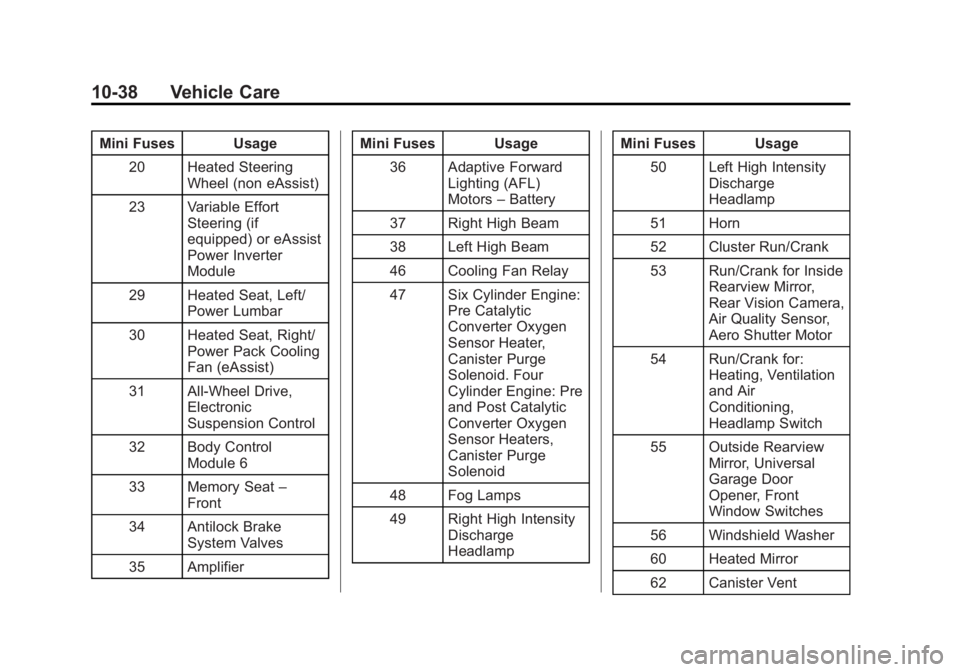
Mini Fuses Usage20 Heated Steering Wheel (non eAssist)
23 Variable Effort Steering (if
equipped) or eAssist
Power Inverter
Module
29 Heated Seat, Left/ Power Lumbar
30 Heated Seat, Right/ Power Pack Cooling
Fan (eAssist)
31 All-Wheel Drive, Electronic
Suspension Control
32 Body Control Module 6
33 Memory Seat –
Front
34 Antilock Brake System Valves
35 Amplifier Mini Fuses Usage
36 Adaptive Forward Lighting (AFL)
Motors–Battery
37 Right High Beam
38 Left High Beam
46 Cooling Fan Relay
47 Six Cylinder Engine: Pre Catalytic
Converter Oxygen
Sensor Heater,
Canister Purge
Solenoid. Four
Cylinder Engine: Pre
and Post Catalytic
Converter Oxygen
Sensor Heaters,
Canister Purge
Solenoid
48 Fog Lamps
49 Right High Intensity Discharge
Headlamp Mini Fuses Usage
50 Left High Intensity Discharge
Headlamp
51 Horn
52 Cluster Run/Crank
53 Run/Crank for Inside Rearview Mirror,
Rear Vision Camera,
Air Quality Sensor,
Aero Shutter Motor
54 Run/Crank for: Heating, Ventilation
and Air
Conditioning,
Headlamp Switch
55 Outside Rearview Mirror, Universal
Garage Door
Opener, Front
Window Switches
56 Windshield Washer
60 Heated Mirror
62 Canister Vent
Page 287 of 402
Black plate (39,1)Buick LaCrosse Owner Manual (GMNA-Localizing-U.S./Canada/Mexico-
6043609) - 2014 - 2nd Edition - 10/17/13
Vehicle Care 10-39
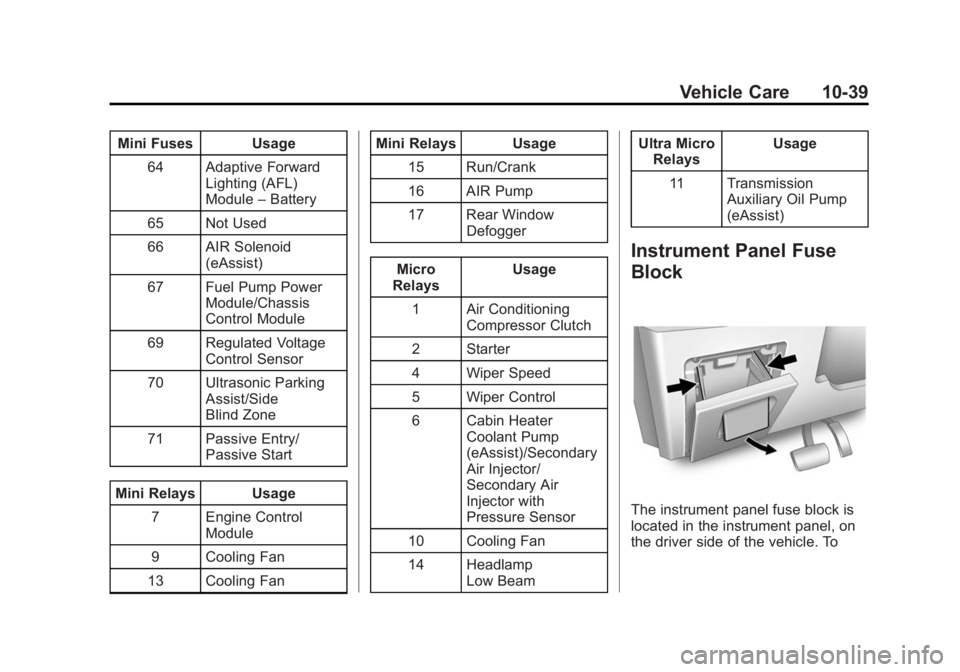
Mini Fuses Usage64 Adaptive Forward Lighting (AFL)
Module–Battery
65 Not Used
66 AIR Solenoid (eAssist)
67 Fuel Pump Power Module/Chassis
Control Module
69 Regulated Voltage Control Sensor
70 Ultrasonic Parking Assist/Side
Blind Zone
71 Passive Entry/ Passive Start
Mini Relays Usage 7 Engine Control Module
9 Cooling Fan
13 Cooling Fan Mini Relays Usage
15 Run/Crank
16 AIR Pump
17 Rear Window Defogger
Micro
Relays Usage
1 Air Conditioning Compressor Clutch
2 Starter
4 Wiper Speed
5 Wiper Control
6 Cabin Heater Coolant Pump
(eAssist)/Secondary
Air Injector/
Secondary Air
Injector with
Pressure Sensor
10 Cooling Fan
14 Headlamp Low Beam Ultra Micro
Relays Usage
11 Transmission Auxiliary Oil Pump
(eAssist)
Instrument Panel Fuse
Block
The instrument panel fuse block is
located in the instrument panel, on
the driver side of the vehicle. To
Page 303 of 402
Black plate (55,1)Buick LaCrosse Owner Manual (GMNA-Localizing-U.S./Canada/Mexico-
6043609) - 2014 - 2nd Edition - 10/17/13
Vehicle Care 10-55
7. Place the relearn tool againstthe tire sidewall, near the valve
stem. Then press the button to
activate the TPMS sensor.
A horn chirp confirms that the
sensor identification code has
been matched to this tire and
wheel position.
8. Proceed to the passenger side front tire, and repeat the
procedure in Step 7.
9. Proceed to the passenger side rear tire, and repeat the
procedure in Step 7.
10. Proceed to the driver side rear tire, and repeat the procedure
in Step 7. The horn sounds two
times to indicate the sensor
identification code has been
matched to the driver side rear
tire, and the TPMS sensor
matching process is no longer
active. The TIRE LEARNING
ACTIVE message on the DIC
display screen goes off. 11. Turn the ignition to LOCK/OFF
or press STOP to turn the
ignition off.
12. Set all four tires to the recommended air pressure
level as indicated on the Tire
and Loading Information label.
Tire Inspection
We recommend that the tires,
including the spare tire, if the
vehicle has one, be inspected
for signs of wear or damage at
least once a month.
Replace the tire if:
.The indicators at three or
more places around the tire
can be seen.
.There is cord or fabric
showing through the tire's
rubber.
.The tread or sidewall is
cracked, cut, or snagged
deep enough to show cord or
fabric.
.The tire has a bump, bulge,
or split.
.The tire has a puncture, cut,
or other damage that cannot
be repaired well because of
the size or location of the
damage.
Tire Rotation
Tires should be rotated every
12 000 km (7,500 mi). See
Maintenance Schedule on
page 11-2.
Tires are rotated to achieve a
uniform wear for all tires. The
first rotation is the most
important.
Anytime unusual wear is
noticed, rotate the tires as soon
as possible, check for proper tire