ECU BUICK LESABRE 1993 User Guide
[x] Cancel search | Manufacturer: BUICK, Model Year: 1993, Model line: LESABRE, Model: BUICK LESABRE 1993Pages: 324, PDF Size: 17.02 MB
Page 69 of 324
e Put your valuables in a storage area, like your trunk
0 Lock the glove box.
Lock all the doors except the driver’s.
Then take the door key with you.
or glove box.
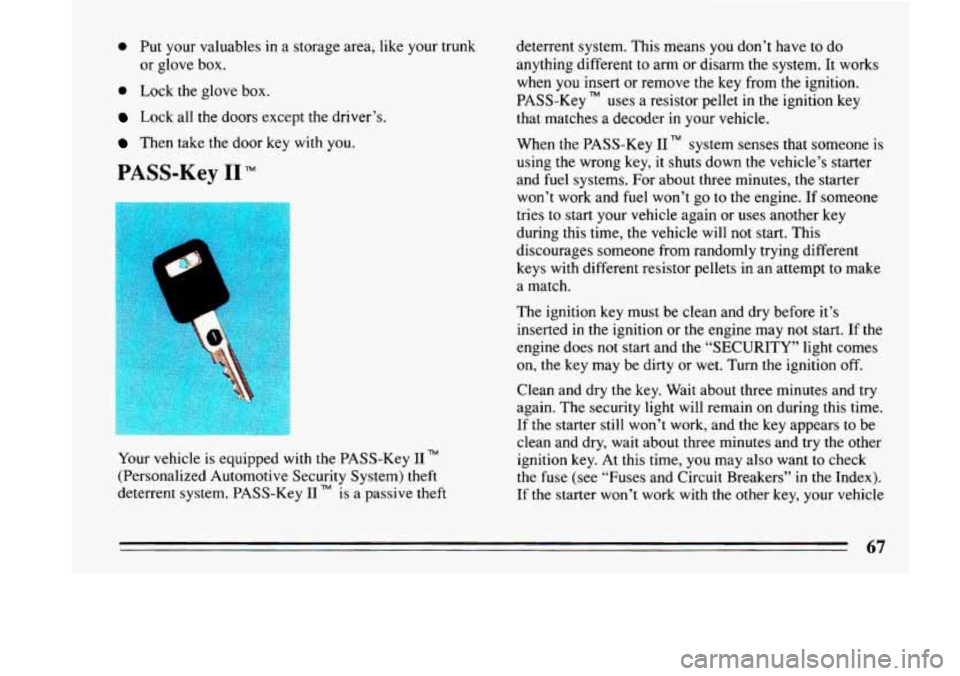
PASS-Key I1 TM
Your vehicle is equipped with the PASS-Key I1 TM
(Personalized Automotive Security System) theft
deterrent system. PASS-Key I1
TM is a passive theft deterrent system.
This means you don’t have to do
anything different
to arm or disarm the system. It works
when you insert or remove the key from the ignition.
PASS-Key uses a resistor pellet in the ignition key
that matches
a decoder in your vehicle.
When the PASS-Key I1
TM system senses that someone is
using the wrong key, it
shuts down the vehicle’s starter
and fuel systems. For about three minutes, the starter
won’t work and
fuel won’t go to the engine. If someone
tries to start your vehicle again or uses another key
during this time, the vehicle will not start. This
discourages someone from randomly trying different
keys with different resistor pellets in an attempt to make
a match.
The ignition key must be clean and dry before it’s
inserted in the ignition or the engine may not start.
If the
engine does not start and the “SECURITY” light comes
on, the key may be dirty or wet. Turn the ignition off.
Clean and dry the key. Wait about three minutes and try
again. The security light will remain on during this time.
If the starter still won’t work, and the key appears to be
clean and dry, wait about three minutes and try the other
ignition key. At this time, you may also want to check
the
fuse (see “Fuses and Circuit Breakers” in the Index).
If the starter won’t work with the other key, your vehicle
67
Page 70 of 324
needs service. If your vehicle does start, the first ignition
key may be faulty. See
your Buick dealer or a locksmith
who can service the PASS-Key
I1 .
If you accidentally use a key that has a damaged or
missing resistor pellet, the starter won’t work and the
security light will flash. But
you don’t have to wait three
minutes before trying one
of the other ignition keys.
See your Buick dealer or a locksmith who can service
the Pass-Key
I1 TM to have a new key made.
If you’re ever driving and
the “SECURITY” light comes
on and stays on,
you will be able to restart your engine if
you
turn it off. Your PASS-Key I1 system, however, is
not working properly and must be serviced by your
Buick dealer. Your vehicle is not protected by the
PASS-Key I1 system.
If you lose or damage a PASS-Key I1 TM ignition key, see
your Buick dealer or
a locksmith who can service
PASS-Key I1
TM to have a new key made.
New Vehicle CLBreak-InSS
Your modern
Don’t drive at any one speed -- f
-- for the first 500 miles i804 km). Don’
make full-throttle starts.
fee
Avoid making hard stops for the first ~UU
miles (322 km) or so. During this time your
I new brake linings aren’t yet broken in. Hard
stops with new linings can mean prematl
wear and earlier replacement. Follow
this
I “breaking-in” guidel’
Page 85 of 324
You may also have a lock out button. Push LOCK to
disable the power window switches. This will prevent
passengers from opening and closing the windows. Push
UNLOCK to allow your passengers to be able to use
their window switches again.
Horn
To sound the horn, press a pad with the horn symbol on
either side
of the steering wheel.
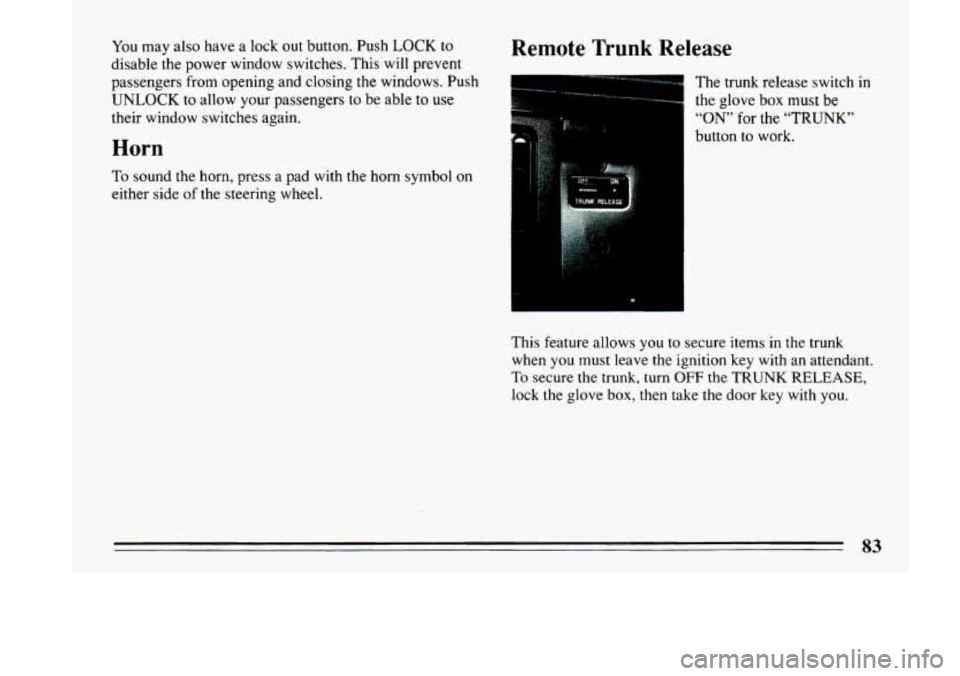
Remote Trunk Release
I! The trunk release switch in
the glove
box must be
“ON” for the “TRUNK”
button to work.
This feature allows
you to secure items in the trunk
when you must leave the ignition key with an attendant.
To secure the trunk, turn OFF the TRUNK RELEASE,
lock the glove box, then take the door key with you.
83
Page 141 of 324
FWD
Press and hold FWD to advance quickly within a track.
Release it to resume playing. Watch
the graphic display
to stop at a specific passage.
PREV
Press PREV to hear the previous track. Press it again to
move back one more track.
NEXT
Press NEXT to hear the next track instead of waiting
until the present track is finished. If you hold this
button, or press
it more than once, the disc will advance
further.
STFL
Press ST/PL (Stop/Play) and the disc will stop hd the
radio will play. Press
STPL again to restart the disc at
the point where it stopped.
Press the PWR button or
turn the ignition key off to stop
the disc player. The disc stays
in the player and will
resahe playing at the point where it stopped.
EJECT
Press EJCT, the disc will eject and the radio will play.
The disc will start at track
1 when you reinsert it.
As a feature to protect the disc, if you turn off the
ignition with the disc partway out of the slot (after
eject), it will be drawn back into the player
in about 30
seconds.
The disc will play at track
1 when the radio system is
turned on again.
Anti-Theft Feature
Delco-Loc I1 is a security feature for the compact disc
player. It can be used or ignored. If ignored, the system
plays normally. If it is used, your player won’t be usable
if it’s ever stolen, because it won’t turn on.
The instructions below
tell you how to enter your
personal secret code into the system.
If your car loses
battery power for any reason, you must unlock the
system with the secret code again before the system will
turn on.
Be sure to read through the entire procedure and become
familiar with the appropriate buttons and knobs before
itarting.
k.
139
Page 142 of 324
Step 1. Write down any 6-digit number and keep it in a
safe place.
Step
2. Turn the ignition to the ACC or RUN position.
Step
3. Press PWR to turn the radio off.
Step 4. Press presets 1 and 4 buttons together. Hold
them until
“- - -” shows on the display (at least 5
seconds).
You are now ready to enter your secret code. If you
pause more than
15 seconds between steps you may
have to start over.
Step
5. Press SET and “000” will appear on the display.
Step
6. Press SEEK or 4 and hold it until the first
digit of your code appears.
Step
7. Rotate the tune knob right or left to make the
next two numbers agree with your code.
Step
8. Press AM-FM knob and “000” will appear. Now
you are ready to enter the second three digits of the code
according to Step
6 and 7.
Step 9. Press the AM-FM knob. The display will show
“rEF’”
, and then “000” will appear indicating that some
steps are to be repeated for verification. Step
10. Repeat steps 6, 7, and 8.
Step 11. Press the AM-FM knob. If the display shows
“SEC” , the verification process was successful and the
system is SECURE. If the display shows
“- - -”, the
verification steps were not successful and the entire sequence must be started again.
To Unlock The System After a Power Loss
When battery power is reapplied to a secured radio, the
radio won’t turn
on and “LOC” will appear in the
display.
Enter your secret code as follows; pause
no more than
15 seconds between steps.
1.
2.
3.
4.
Turn the ignition on (Radio off.)
Press the SET button. The display will show
“000”.
Enter the six digits of the code following steps 6 thru
9 above. The display will show the number as
entered.
Press the
AM/FM button and the time appears -
indicating that the disabling sequence was
successful. If the display indicates “SEC”, the
number did not match and the unit is still secured.
140
Page 143 of 324
Disabling The Theft System
Step 1. Press preset buttons 1 and 4 for 5 seconds with
ignition “On” and radio power “Off’. The display will
show “SEC”, indicating the unit is in the secure mode.
Step
2. Press the SET button. The display will show
‘600097.
Step 3. Enter the first three digits of the code following
step
6 and 7 of the preceding paragraphs. The display
will show the numbers as entered.
Step
4. Press the AM-FM button. The radio will display
“000”.
Step 5. Enter the second three digits of the code. The
display shows the number as entered.
Step
6. Press the AM-FM button. If the display shows
- - -” , the disabling sequence was successful. (The
numbers matched the user-selected code or the factory
back-up code, and the unit is
in the UNSECURED
mode.) If
the display shows “SEC”, the disabling
sequence was unsuccessful and
the numbers did not
match either of the codes, the unit will remain in the
SECURED mode.
66
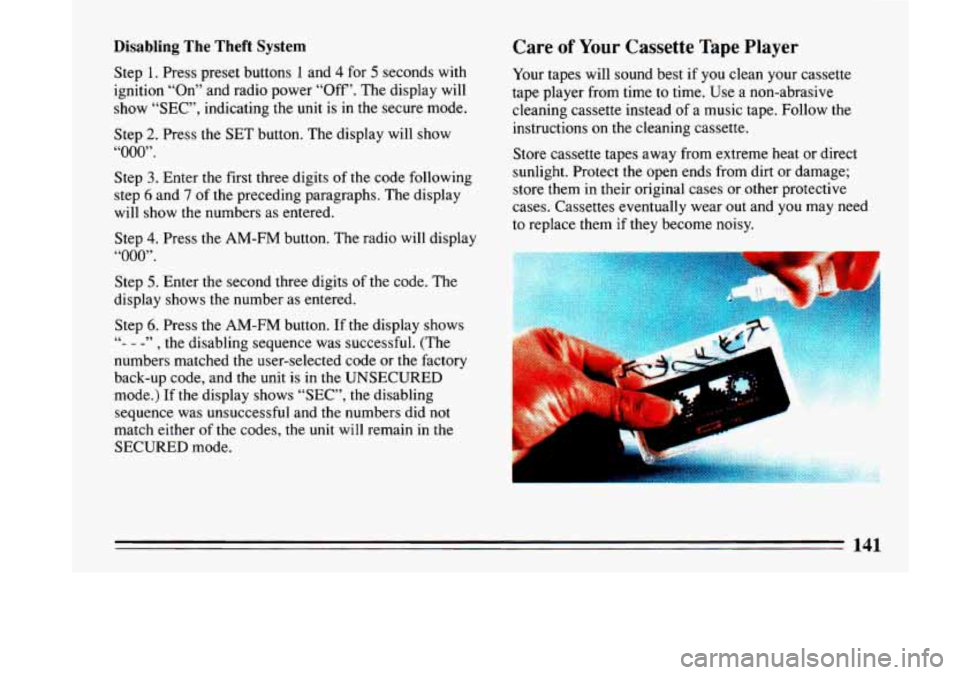
Care of Your Cassette Tape Player
Your tapes will sound best if you clean your cassette
tape player from time to time. Use a non-abrasive
cleaning cassette instead of a music tape. Follow the
instructions on the cleaning cassette.
Store cassette tapes away from extreme heat or direct
sunlight. Protect the open ends from dirt or damage;
store them in their original cases or other protective
cases. Cassettes eventually wear out and you may need
to replace them
if they become noisy.
141
Page 187 of 324
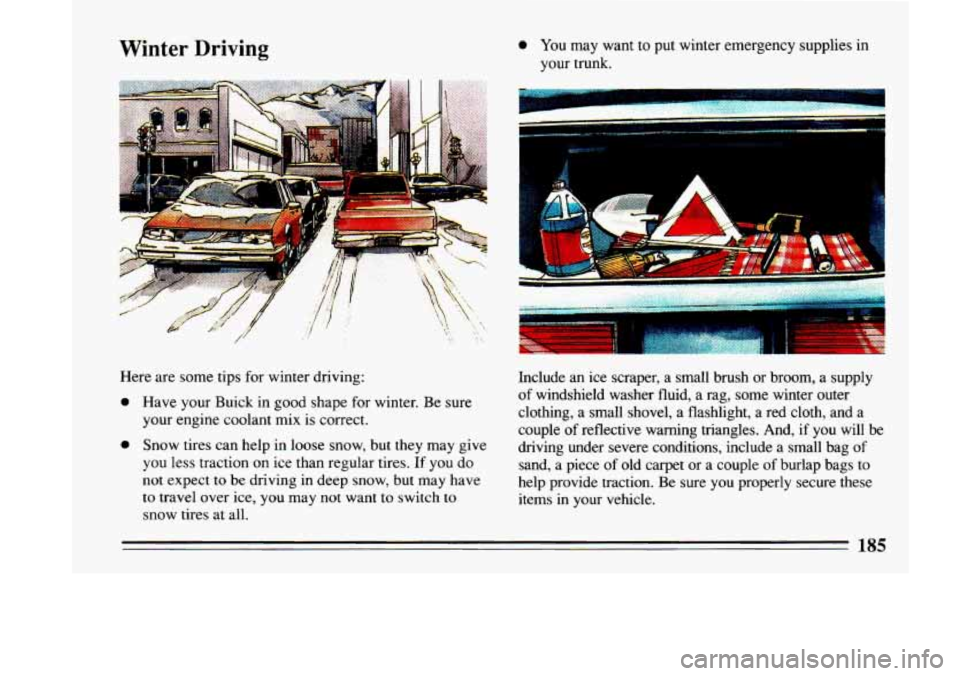
Winter Driving 0 You may want to put winter emergency supplies in
your trunk.
Here are some tips for winter driving:
0 Have your Buick in good shape for winter. Be sure
your engine coolant mix
is correct.
0 Snow tires can help in loose snow, but they may give
you less traction
on ice than regular tires. If you do
not expect
to be driving in deep snow, but may have
to travel over ice, you may not want to switch to
snow tires at all. Include an ice scraper,
a small brush
or broom, a supply
of windshield washer fluid, a rag, some winter outer
clothing, a small shovel, a flashlight, a red cloth, and a
couple
of reflective warning triangles. And, if you will be
driving under severe conditions, include a small bag
of
sand, a piece of old carpet or a couple of burlap bags to
help provide traction. Be sure you properly secure these
items in your vehicle.
185
Page 194 of 324
e e Will you have to make any holes in the body of your vehicle when you install a trailer hitch? If you
do,
then be sure to seal the holes later when you remove
the hitch. If you don’t seal them, deadly carbon
monoxide
(CO) from your exhaust can get into your
vehicle (see “Carbon Monoxide” in the Index). Dirt
and water can, too.
The bumpers on your vehicle are not intended for
hitches.
Do not attach rental hitches or other
bumper-type hitches to them. adequate.
Be sure to read and follow the instructions for
the trailer brakes
so you’ll be able to install, adjust and
maintain them properly. Because you have anti-lock
brakes, do not try to tap into your vehicle’s brake
system.
If you do, both brake systems won’t work well,
or at all.
Driving with a Trailer
Towing a trailer requires a certain amount of experience.
Before setting out for the open road, you’ll want to get
to know your rig. Acquaint yourself with the feel of
handling and braking with the added weight of the
trailer. And always keep in mind that the vehicle you are
driving is now a good deal longer and not nearly
so
responsive as your vehicle is by itself.
Safety Chains
You should always attach chains between your vehicle
and your trailer.
Cross the safety chains under the
tongue
of the trailer so that the tongue will not drop to
the road if it becomes separated from the hitch.
Instructions about safety chains may be provided by the
hitch manufacturer or by the trailer manufacturer.
Follow the manufacturer’s recommendation for
attaching safety chains. Always leave just enough slack
so you can turn with your rig. And, never allow safety
chains to drag
on the ground.
Trailer Brakes
If your trailer weighs more than 1,000 pounds (450 kg)
loaded, then it needs its own brakes
-- and they must be
192
~-
Before you start, check the trailer hitch and platform,
safety chains, electrical connector, lights, tires
and
mirror adjustment. If the trailer has electric brakes, start
your vehicle and trailer moving and then apply the
trailer brake controller by hand to be sure the brakes are
working. This lets you check your electrical connection
at the same time.
During your trip, check occasionally
to be sure that the
load is secure, and that the lights and any trailer brakes
are still working.
Page 206 of 324
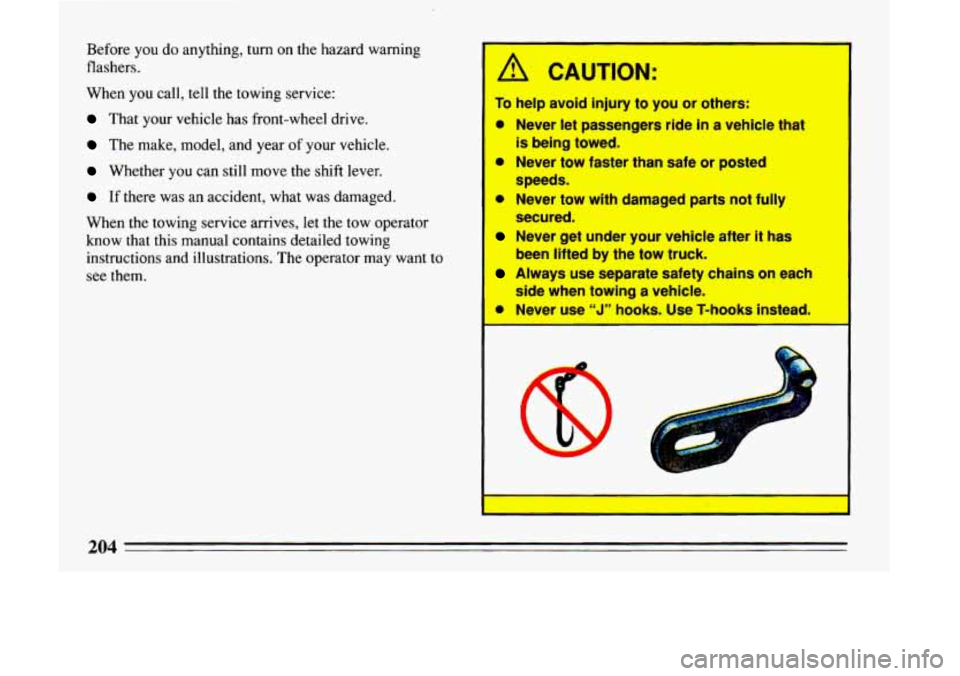
Before you do anything, turn on the hazard warning
flashers.
When you call, tell the towing service:
That your vehicle has front-wheel drive.
The make, model, and year of your vehicle.
Whether you can still move the shift lever.
If there was an accident, what was damaged.
When the towing service arrives, let
the tow operator
know that this manual contains detailed towing instructions and illustrations. The operator may want to
see them.
A CAUTION:
To help avoid injury to you or others:
0 Never let passengers ride in a vehicle that
@ Never tow faster than safe or posted
0 Never tow with damaged parts not fully
Never get under your vehicle after it has
Always use separate safety chains on each
@ Never use “J’* hooks. Use T-hooks instead.
is being towed.
speeds.
secured.
been lifted
by the tow truck.
side when towing
a vehicle.
rn
204
Page 207 of 324
When your vehicle is being towed, have the ignition key
off. The steering wheel should be clamped in a
straight-ahead position, with a clamping device designed
for towing service.
Do not use the vehicle’s steering
column lock for this. The transaxle should be in Neutral
and the parking brake released.
Don’t have your vehicle towed on the front wheels,
unless
you must. If the vehicle must be towed on the
front wheels, don’t
go more than 55 mph (88 kph) or
farther than
500 miles (800 km) or your transaxle will
be damaged.
If these limits must be exceeded, then the
front wheels have to be supported on a dolly.
-
A CAUTION:
A vehicle can fall from a car carrier if it isn’t
properly secured, This can cause a collision,
serious personal injury and vehlcle damage. The
vehicle should be tightly secured with chains
or
steel cables before it is transported.
Don’t use substitutes (ropes, leather straps,
canvas webbing, etc.) that can be cut by sharp
zdges underneath the towed vehicle.