radiator cap BUICK LESABRE 1993 Owners Manual
[x] Cancel search | Manufacturer: BUICK, Model Year: 1993, Model line: LESABRE, Model: BUICK LESABRE 1993Pages: 324, PDF Size: 17.02 MB
Page 211 of 324
If you no longer have the overheat warning, you can
drive. Just
to be safe, drive slower for about ten minutes.
If the warning doesn't come back on, you can drive
normally.
If
the warning continues, pull over, stop, and park your
vehicle right away.
If there's still no sign
of steam, you can idle the engine
for two or three minutes while you're parked, to see if
the warning stops. But then, if you still have the
warning, TURN
OFF THE ENGINE AND GET
EVERYONE OUT OF THE VEHICLE until it cools
down. You
may decide not to lift
the hood but to get service
help right away.
I 4
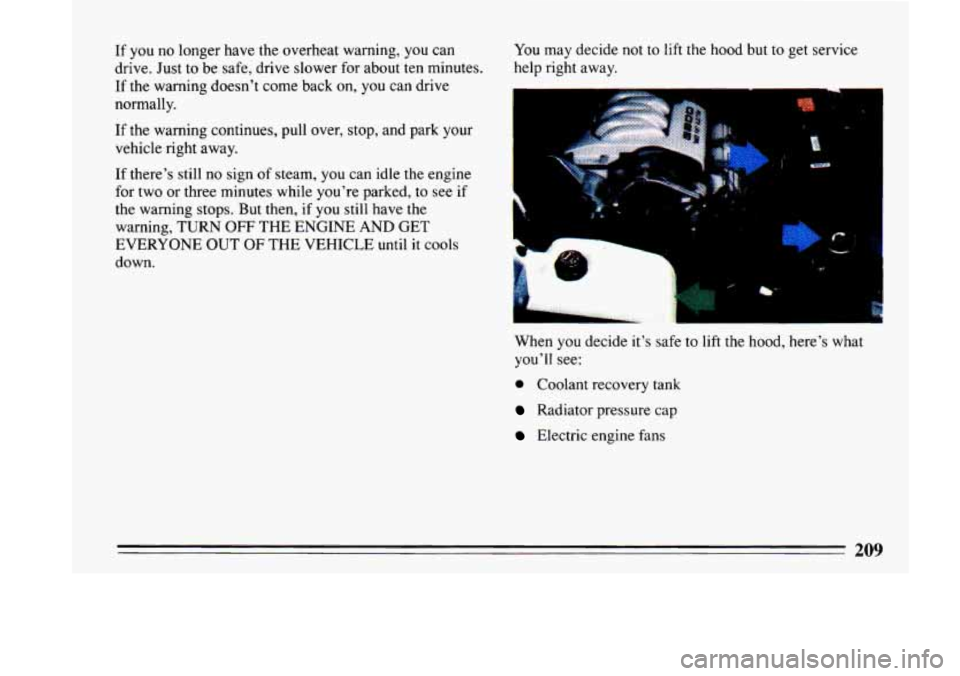
When you decide it's safe to lift the hood, here's what
you'll
see:
0 Coolant recovery tank
Radiator pressure cap
Electric engine fans
209
Page 214 of 324
A CAUTION:
You can be burned if you spill coolant on hot
engine parts. Coolant contains ethylene
glycol
and it will burn if the engine parts are hot
enough. Don’t
spill coolant on a hot engine.
When the coolant in the coolant recovery tank is at or
above “FULL COLD,” start your vehicle.
If the overheat warning continues, there’s one more
thing you can try.
You can add the proper coolant mix
directly to the radiator, but be sure the cooling system
is
cool before you do it.
Steam and scalding -liquids from a hot cooling
system
can blow out and burn you badly. They
are under pressure,
and if you turn the radiator
pressure cap
- even a little -- they can come out
at high speed..Never turn the cap when the
cooling system, including the radiatorpressure
cap, is hot. Wait for the cooling system and
radiator pressure
cap to cool if you ever have40
turn the pressure cap.
212
Page 215 of 324
How to Add Coolant to the Radiator I
A@' #, I
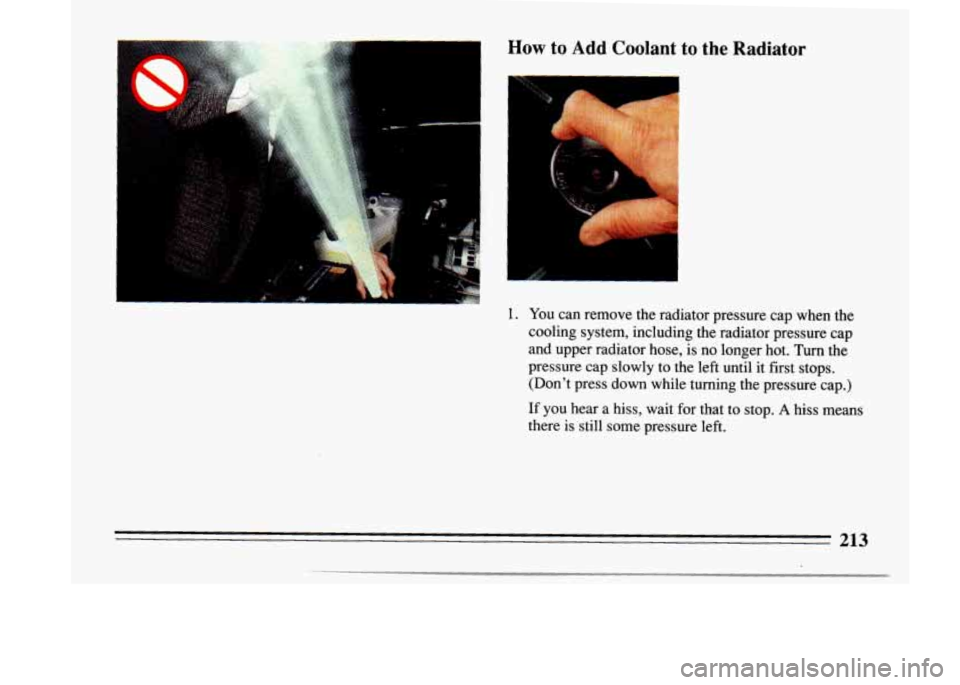
1. You can remove the radiator pressure cap when the
cooling system, including the radiator pressure cap
and upper radiator hose,
is no longer hot. Turn the
pressure cap slowly to the left until
it first stops.
(Don't press down while turning the pressure cap.)
If you hear a hiss, wait for that to stop. A hiss means
there is still
some pressure left.
213
Page 216 of 324
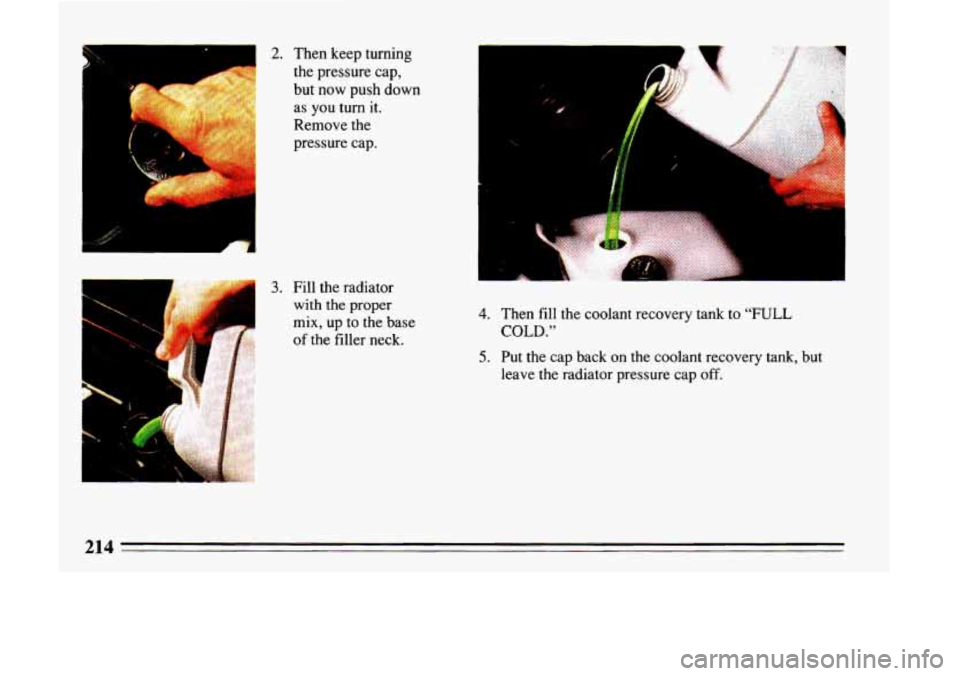
2. Then keep turning
the pressure cap,
but now push down
as you turn it.
Remove the
pressure cap.
I
3. Fill the radiator
with the proper
mix, up to the base
of the filler neck.
E
4. Then fill the coolant recovery tank to "FULL
COLD."
5. Put the cap back on the coolant recovery tank, but
leave the radiator pressure cap
off.
214
Page 217 of 324
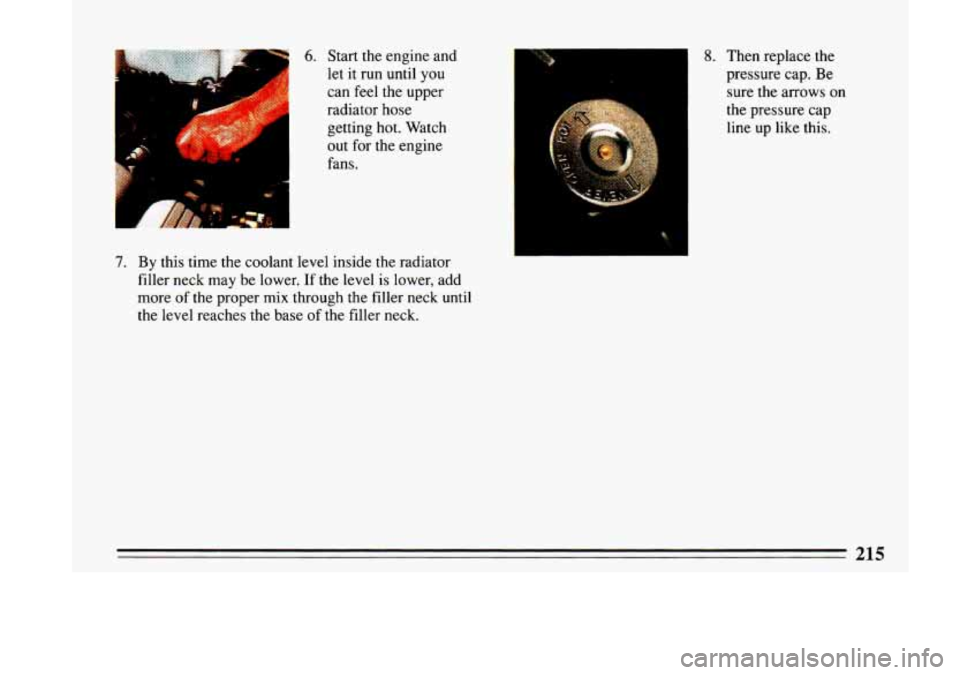
Bp. 6. Start the engine and
let
it run until you
can feel the upper
radiator hose
getting hot. Watch
out for the engine
fans.
7. By this time the coolant level inside the radiator
filler neck may be lower. If the level is lower, add
more of the proper mix through the filler neck until
the level reaches the base
of the filler neck.
:. . L *- 1 8. Then replace the
pressure cap. Be
sure the arrows on
the pressure cap
line up like this.
215
Page 247 of 324
To Check Coolant: When your engine is cold, the
coolant level should
be at “FULL COLD,’’ or a little
higher. When your engine is
warm, the level should be
up to “FULL HOT,” or a little higher.
To Add Coolant: If you need more coolant, add the
proper mix at the coolant recovery tank.
I
I
A CAUTION:
Turning the radiator pressure cap when the
engine and radiator are hot can
allow steam and
scaldlng
liquids to blow out and burn you badly.
With the coolant recovery tank, you will almost
never have
to add coolant at the radiator. Never
turn the radiator pressure cap -- even a little -
when the engine and radiator are hot.
Add coolant mix at the recovery tank, but be careful not
to spill
it.
A CAUTION: I
You can be burned if you spill coolant on hot
engine parts. Coolant contains ethylene glycol,
-..d
it will burn if the engine parts are hot
enough. Don’t spill coolant on a hot engine.
Radiator Pressure Cap
I Tour rar
I I.
cap IS a 13 PSI (105 kPa1
pressure-rype cap and must be tightly Insrawe
to prevent coolant loss and possible engine
damage from overheating. Be sure the arrows
o
I
the cap line up with
radiator filler neck. I
When you replace your radiator pressure cap, an AC@
cap is recommended.
245
Page 248 of 324
Thermostat
Engine coolant temperature is controlled by a thermostat
in the engine coolant system. The thermostat stops the
flow of coolant through the radiator until the coolant
reaches a preset temperature.
When
you replace your thermostat, an ACS thermostat
is recommended.
Power Steering Fluid
:i
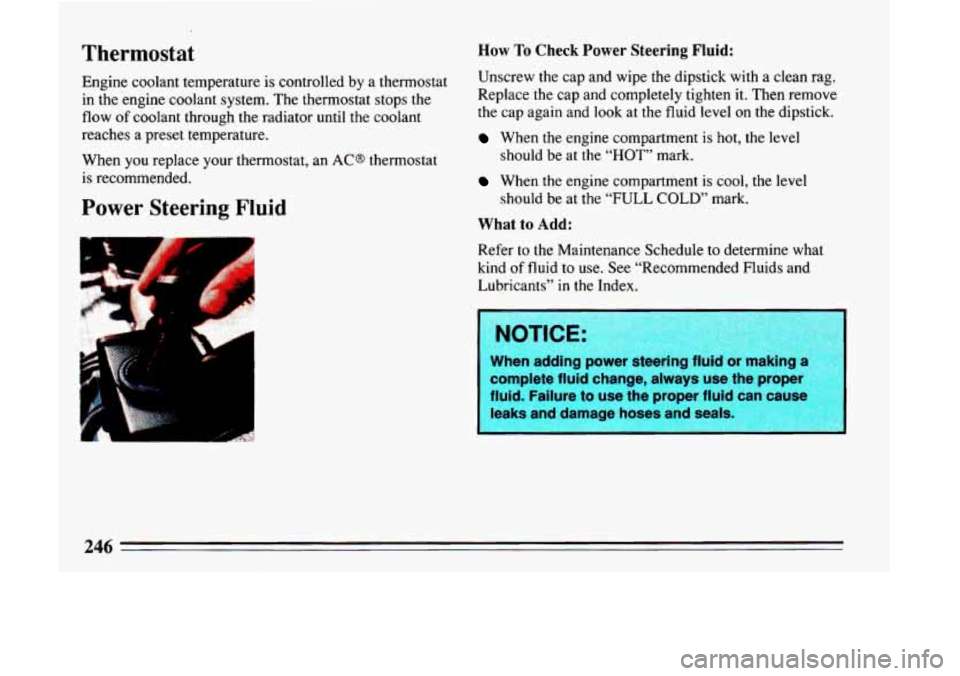
How To Check Power Steering Fluid:
Unscrew the cap and wipe the dipstick with a clean rag.
Replace the cap and completely tighten it. Then remove
the cap again and look at the fluid level on the dipstick.
When the engine compartment is hot, the level
When the engine compartment is cool, the level
What to Add:
Refer to the Maintenance Schedule to determine what
kind
of fluid to use. See “Recommended Fluids and
Lubricants” in the Index.
should be
at the
“HOT” mark.
should be at the
“FULL COLD” mark.
When adding power steering fli or making a
complete fluid change, always use the proper
fluid. Failure
to use the proper fluid can cause
leaks and damage hoses and seals.
Page 249 of 324
Windshield Washer Fluid
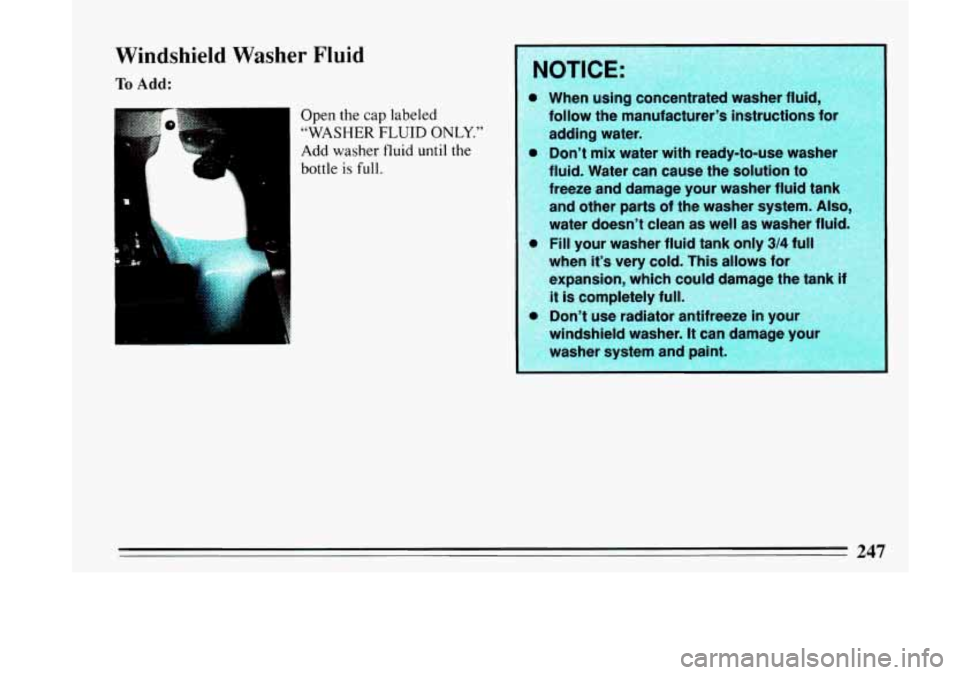
To Add:
Open the cap labeled
“WASHER FLUID ONLY.”
Add washer fluid until the
bottle
is full.
P
a
0
4OTICE
When using
follow the man
adding wate
Don’t mix wate
fluid. Water can cause the solution to
freeze and damage your washer fluid
and other parts of the washer system. Also
water doesn’t clean as well as washer
0 Fill your washer fluid tank only 3/4 fu
when it’s very cold. This allows for
expansion, which could damage the
it
is completely full.
0 Don’t use radiator antifreeze in you1
windshield washer. It can damage you
washer system and paint.
Page 277 of 324
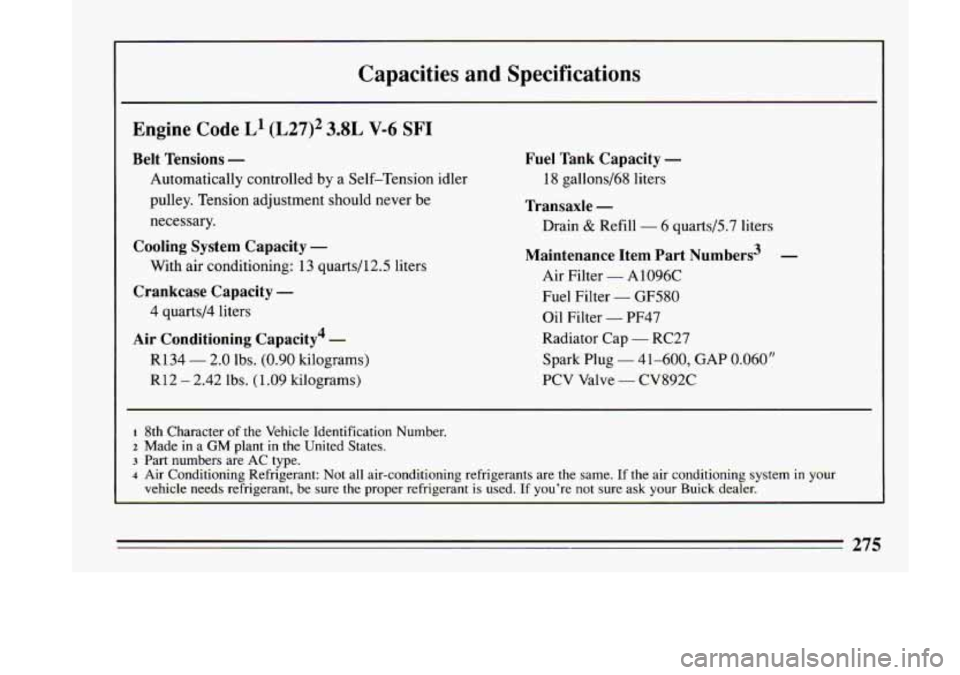
Capacities and Specifications
Engine Code L1 (L27)2 3.8L V-6 SF1
Belt Tensions -
Automatically controlled by a Self-Tension idler
pulley. Tension adjustment should never
be
necessary.
Cooling System Capacity -
Crankcase Capacity -
Air Conditioning Capacity4 -
With air conditioning: 13 quarts/l2.5 liters
4 quarts/4 liters
R134
- 2.0 lbs. (0.90 kilograms)
R12 - 2.42 lbs. ( 1.09 kilograms)
Fuel Tank Capacity -
18 gallons/68 liters
Transaxle -
Drain & Refill - 6 quarts/5.7 liters
Maintenance Item Part Numbers3 -
Air Filter - A1096C
Fuel Filter
- GF580
Oil Filter
- PF47
Radiator Cap - RC27
Spark Plug
- 41-600, GAP 0.060”
PCV Valve
- CV892C
1 8th Character of the Vehicle Identification Number.
2 Made in a GM plant in the United States.
3 Part numbers are AC type.
4 Air Conditioning Refrigerant: Not all air-conditioning refrigerants are the same. If the air conditioning system in your
vehicle needs refrigerant, be sure the proper refrigerant
is used. If you’re not sure ask your Buick dealer.
Page 289 of 324
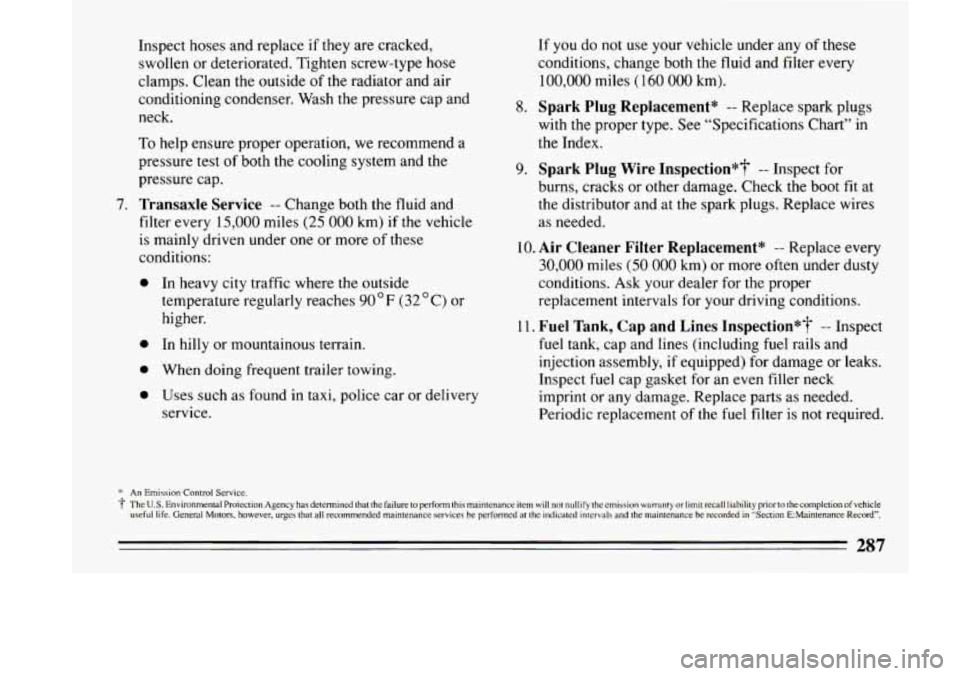
Inspect hoses and replace if they are cracked,
swollen or deteriorated. Tighten screw-type hose
clamps. Clean the outside
of the radiator and air
conditioning condenser. Wash the pressure cap and
neck.
8.
To help ensure proper operation, we recommend a
pressure test of both the cooling system and the
pressure cap.
7. Transaxle Service -- Change both the fluid and
filter every
15,000 miles (25 000 km) if the vehicle
is mainly driven under one or more of these
conditions:
0 In heavy city traffic where the outside
temperature regularly reaches
90 F (32 C) or
higher.
0 In hilly or mountainous terrain.
0 When doing frequent trailer towing.
0 Uses such as found in taxi, police car or delivery
service.
9.
If you do not use your vehicle under any of these
conditions, change both the fluid and filter every
100,000 miles
(140 000 km).
Spark Plug Replacement* -- Replace spark plugs
with the proper type. See "Specifications Chart" in
the Index.
Spark Plug Wire Inspection*? -- Inspect for
burns, cracks or other damage. Check the boot fit at
the distributor and at the spark plugs. Replace wires
as needed.
10. Air Cleaner Filter Replacement* -- Replace every
30,000 miles (50 000 km) or more often under dusty
conditions. Ask your dealer for the proper
replacement intervals for your driving conditions.
11. Fuel Tank, Cap and Lines Inspection"? -- Inspect
fuel tank, cap and lines (including fuel rails and
injection assembly,
if equipped) for damage or leaks.
Inspect fuel cap gasket for an even filler neck
imprint or any damage. Replace parts as needed.
Periodic replacement
of the fuel filter is not required.
* An Emission Control Service.
-t The U.S. Environmental Protection Agency has determined that the failure to perform this maintenance item will not nullify the emission warranty or limit recall liability prior to the completion of vehicle
useful life. General Motors, however, urges that all recommended maintenance services be perlormed at the indicated intervals and the maintenance be recorded in "Section E:Maintenance Record".
287