engine BUICK LESABRE 1993 User Guide
[x] Cancel search | Manufacturer: BUICK, Model Year: 1993, Model line: LESABRE, Model: BUICK LESABRE 1993Pages: 324, PDF Size: 17.02 MB
Page 72 of 324
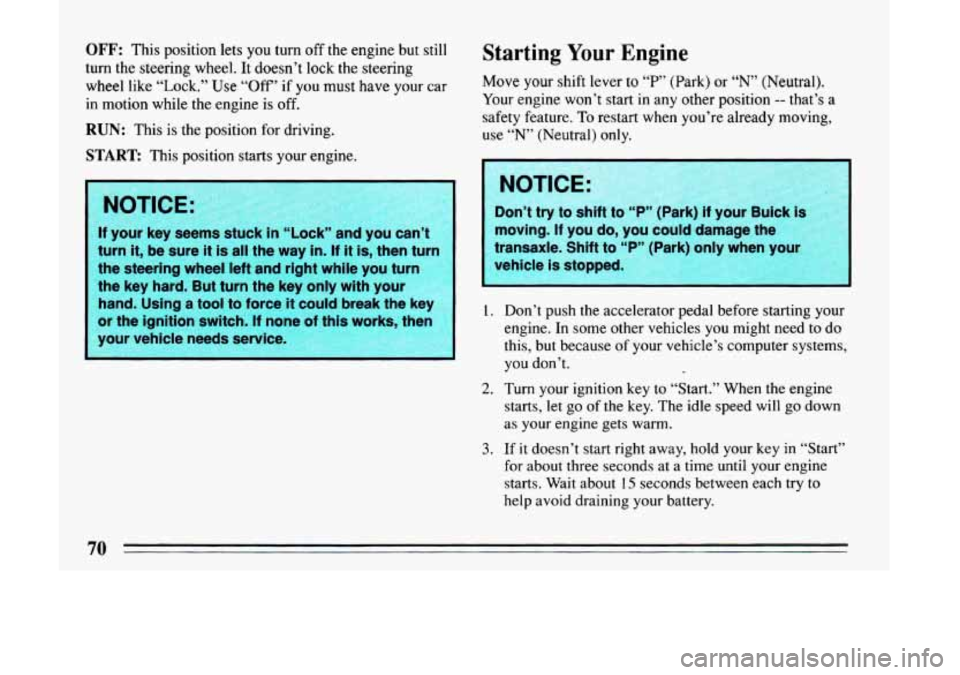
OFF: This position lets you turn off the engine but still
turn the steering wheel. It doesn’t lock the steering
wheel like
“Lock.” Use “Off’ if you must have your car
in motion while the engine is off.
RUN: This is the position for driving.
START: This position starts your engine.
I
NOTICE:
IT your Key seems stuck In “Lock” and you can-
turn
it, be sure it is all the way in. If it is, then turn
the steering wheel left and right while you turn
the key hard. But turn the key only with your
hand. Using
a tool to force it could break the key
or the ignition switch. If none
your vehicle needs service
Starting Your Engine
Move your shift lever to “P’ (Park) or “N” (Neutral).
Your engine won’t start in any other position
-- that’s a
safety feature.
To restart when you’re already moving,
use “N” (Neutral) only.
n’t try to shift to “P” (Park) if your Buick is
ving.
If you do, Id damage the
nsaxle. Shift to
“ rk) only when you .. . . -
1.
2.
3.
Don’t push the accelerator pedal before starting your
engine. In some other vehicles
you might need to do
this, but because
of your vehicle’s computer systems,
you don’t.
Turn your ignition key to “Start.” When the engine
starts, let go
of the key. The idle speed will go down
as your engine gets warm.
If it doesn’t start right away, hold your key in “Start”
for about three seconds at a time until your engine
starts. Wait about
15 seconds between each try to
help avoid draining your battery.
70
~
Page 73 of 324
4. If your engine still won’t start (or starts but then
stops),
it could be flooded with too much gasoline.
Try pushing your accelerator pedal all the way to the
floor and holding it there as you hold the key in
“Start” for about three seconds. If the car starts
briefly but then stops again, do the same thing, but
this time keep the pedal
down for five or six seconds.
This clears the extra gasoline
from the engine. After
waiting about
15 seconds, repeat the normal starting
procedure.
Driving Through Deep Standing
Water
NOTICE:
71
Page 74 of 324
Engine Block Heater (Canada Only)
In very cold weather, 0 OF (- 18 C) or colder, the engine
block heater can help. You’ll get easier starting and
better fuel economy during engine warm-up.
To use the block heater:
1. Turn off the engine.
2. Open the hood and unwrap the electrical cord.
3. Plug it into a normal, grounded 110-volt outlet.
CAUTION: 0
Plugging the cord into an ungrounded outlet
could cause an electrical shock. Also, the wrong
kind
of extension cord could overheat and cause
a fire. You could be seriously injured. Plug the
cord into a properly grounded three-prong
110-volt outlet. If the cord won’t reach, use a
heavy-duty three-prong extension cord rated for
at least 15 amps. After you’ve
used the block heater, be sure to
store the
cord as it was before, to keep it away
from moving engine parts.
If you m’t, it could
be damaged
w1 ~
How long should you keep the block heater plugged in?
The answer depends on the weather,
the kind of oil you
have, and some other things. Instead
of trying to list
everything here,
we ask that you contact a Buick dealer
in the area where you’ll be parking your vehicle. The
dealer can give you the best advice for that particular
area.
Page 75 of 324
PARK RNO321
Automatic Transaxle
r
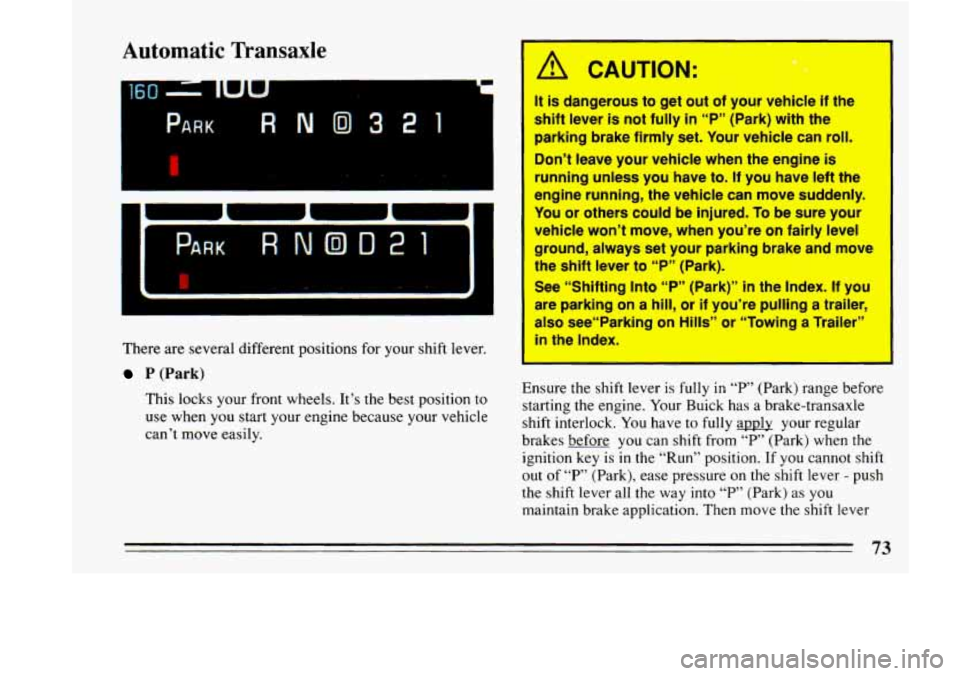
There are several different positions for your shift lever.
P (Park)
This locks your front wheels. It’s the best position to
use when you start your engine because your vehicle
can’t move easily.
A CAUTION: .
a -II
It is dangerous to get out of your vehicle If the
shift [ever is not fully in “P” (Park) with the
parking
brake firmly set. Your vehicle can roll.
Don’t leave your vehicle when ihe engine is
running unless you hsve to. If you have left the
engine
running, the vehicle can move suddenly.
You or others could be Injured. To be sure your
vehicle won’t move, when you’re on fairly level
ground, always set your parking brake and move
the shift lever to V“ (Park).
See “Shifting Into “P” (Park)” in the Index. If you
arb parkfng on a hill, or if you’re pulling a trailer,
also see“Parking on Hills” or “Towing a Trailer”
in’ the Index.
- i
Ensure the shift lever is fully in “F‘” (Park) range before
starting the engine. Your Buick has a brake-transaxle
shift interlock.
You have to fully apply your regular
brakes before
you can shift from “P” (Park) when the
ignition key is
in the “Run” position. If you cannot shift
out of “P” (Park), ease pressure on the shift lever - push
the shift lever all
the way into “P” (Park) as you
maintain brake application. Then move the shift lever
73
Page 76 of 324
into the gear you wish. See “Shifting Out of ‘P’ (Park)”
in this part.
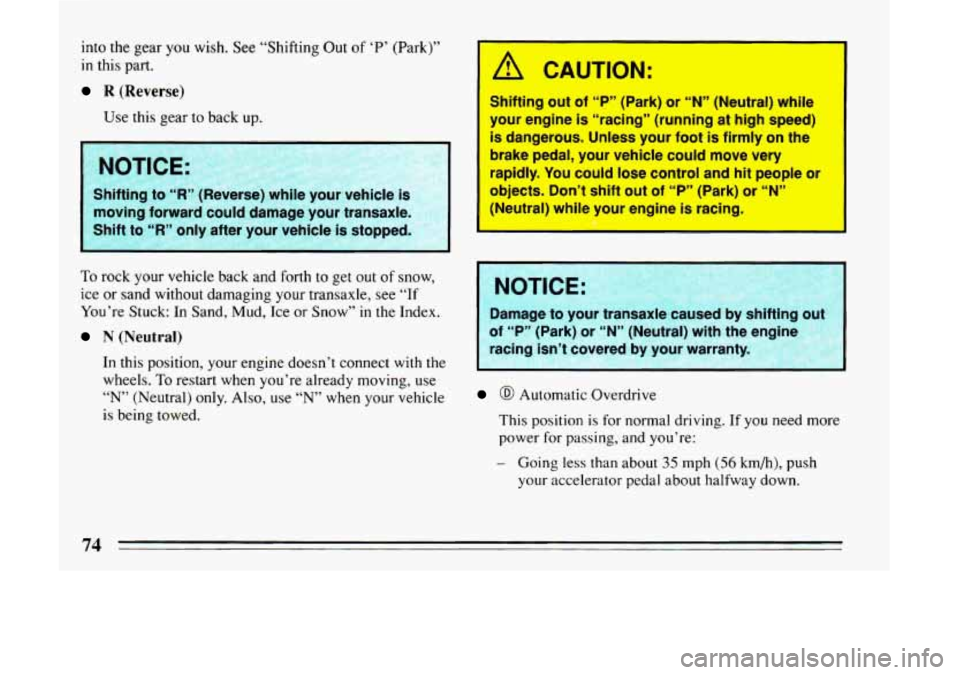
R (Reverse)
Use this gear to back up.
Shifting to “R” (Reverse) while your vehicle iz
ng forward could damage your transaxle
only after your vehicle is stopped
To rock your vehicle back and forth to get out of snow,
ice or
sand without damaging your transaxle, see “If
You’re Stuck: In Sand, Mud, Ice
or Snow” in the Index.
N (Neutral)
In this position, your engine doesn’t connect with the
wheels.
To restart when you’re already moving, use
“N” (Neutral) only. Also, use “N” when your vehicle
is being towed.
~ A CAUTION:
Shifting out of “P” (Park) or “N” (Neutral) while .
your engine is “racing” (running at high speed)
is dangerous. Unless your foot-is firmly on the
brake pedal, your.vehicle
could move very ~
rapidJy. You could lose control and hit people or
objects. Don’t shift out of “P” (Park) or “N”
(Neutral) while your engine is racing. Q
Damage to yo-.- transaxle caused by shifting aut I
of “P” (Park) or “N” (Neutral) with the engine
racing isn’t covered by your warranty.
I
@ Automatic Overdrive
This position is for normal driving.
If you need more
power for passing, and you’re:
- Going less than about 35 mph (56 km/h), push
your accelerator pedal about halfway down.
74
Page 80 of 324
Shifting Into cc P 99 (Park)
A CAUTION:
It can be dangerous to get out of your vehicle if
the shift lever is not fully In ‘6P’’ (Park) with the
parking brake firmly set. Your vehicle
can roll.
If you have left the*engine running, the vehicle
can move suddenly.
You or others could be
injured.
To be sure your vehicle won’t move,
when you’re on fairly level ground, use the steps
that
follow. If you are parking on a hill, or if
you’re pulling
a trailer, also see “Parking On
Hills” or “Towing a Trailer” in the Index.
1
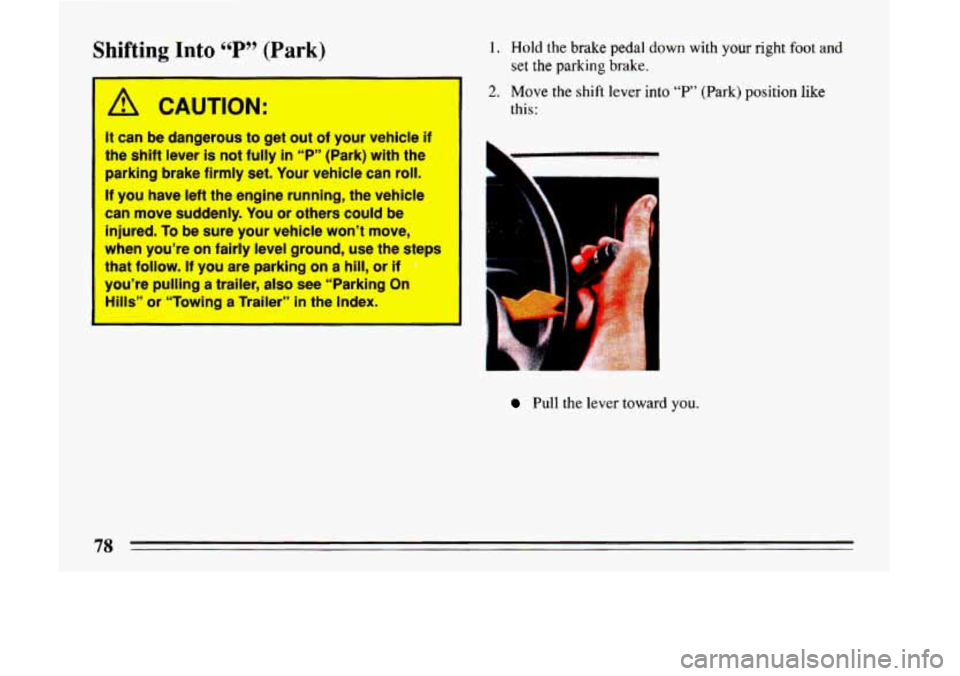
1. Hold the brake pedal down with your right foot and
2. Move the shift lever into “P” (Park) position like
set the parking brake.
this:
Pull the lever toward you.
Page 81 of 324
Leaving Your Vehicle With the Engine
Running
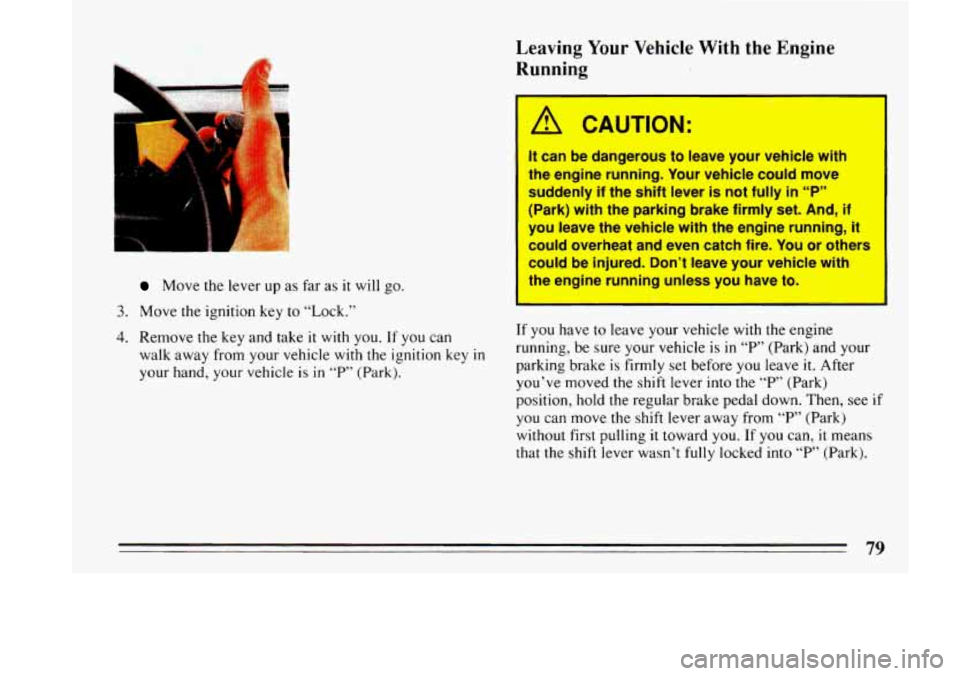
Move the lever up as far as it will go.
3. Move the ignition key to “Lock.”
4. Remove the key and take it with you. If you can
walk away from
your vehicle with the ignition key in
your hand, your vehicle is in “P” (Park).
It can be dangerous to leave your vehicle with
the engine running. Your vehicle could
move
suddenly if the shift lever is not fully in “P”
[Park) with the parking brake firmly set. And, if
you leave the vehicle with the engine running, St
could overheat and even catch fire. You or others
could be injured. Don’t leave your vehicle with
the engine running unless you have to.
If you have to leave your vehicle with the engine
running, be sure your vehicle is
in “P” (Park) and your
parking brake is firmly set before you leave it. After
you’ve moved the shift lever into the “P” (Park)
position, hold the regular brake pedal down. Then,
see if
you can move the shift lever away from
“P” (Park)
without first pulling it toward you. If
you can, it means
that the shift lever wasn’t fully locked into “P” (Park).
79
Page 83 of 324
Engine Exhaust
‘A CAUTION:
--
Engine exhaust can kill. It contains the gas
,,rbon monoxide
(CO), which you can’t see or
smell. It can cause unconsciousness and death.
You might have exhaust coming
in if:
rn Your exhaust system sounds strange or
different.
0 Your vehicle gets rusty underneath.
Your vehicle
was damaged in a collision.
a Your vehicle was damaged when driving
over
high points on the road or over road
debris.
Your vehicle or exhaust system had been
modified improperly.
If
you ever suspect exhaust is coming into your
vehicle:
Drive it only with all the windows down to
blow out any CO; and a
a Have it fixed immediately.
@ Repairs weren’t done correctly.
Running Your Engine While You’re
Parked
It’s better not to park with the engine running. But if you
wer have to, here are some things to know.
A CAUTION:
Idling the engine with the air system control off
could allow dangerous exhaust into your vehicle
(see the earlier Caution under “Engine Exhaust”).
Also, idling in’a closed-in place can let deadly
cdrbon monoxide (CO)
into your vehicle even if
the fan switch is at the highest setting. One place
this can happen is a garage. Exhaust
-- with CO -
can come in easily. NEVER park in a garage with
the engine running.
Another closed-in place
can be a blizzard. (See
“Blizzard”
in the Index.)
CAUTION: (Continued)
-
Page 84 of 324
CAUTION: (Continued)
It can be dangerous to get out of your vehicle if
the shift lever
is not fully in “P’ (Park) with the
parking brake firmly
set. Your vehicle can roll.
Don’t leave your vehicle when the engine
is
running unless you have to. If you’ve left the
engine running, the
vehicle can move suddenly.
You or others could be injured. To be sure your
vehicle won’t move, even when you’re
on fairly
level ground, always set your parking brake
and
after you move the shift lever to “P” (Park).&
Follow the proper steps to be sure your vehicle
won’t move. See “Shifting Into ‘P’ (Park)’’ in the’
Index.
If you are parking OR a hill, or if you’re pulling a
trailer, also $&e “Parking on Hills’’ or “Towing a
Trailer” in the Index. , I
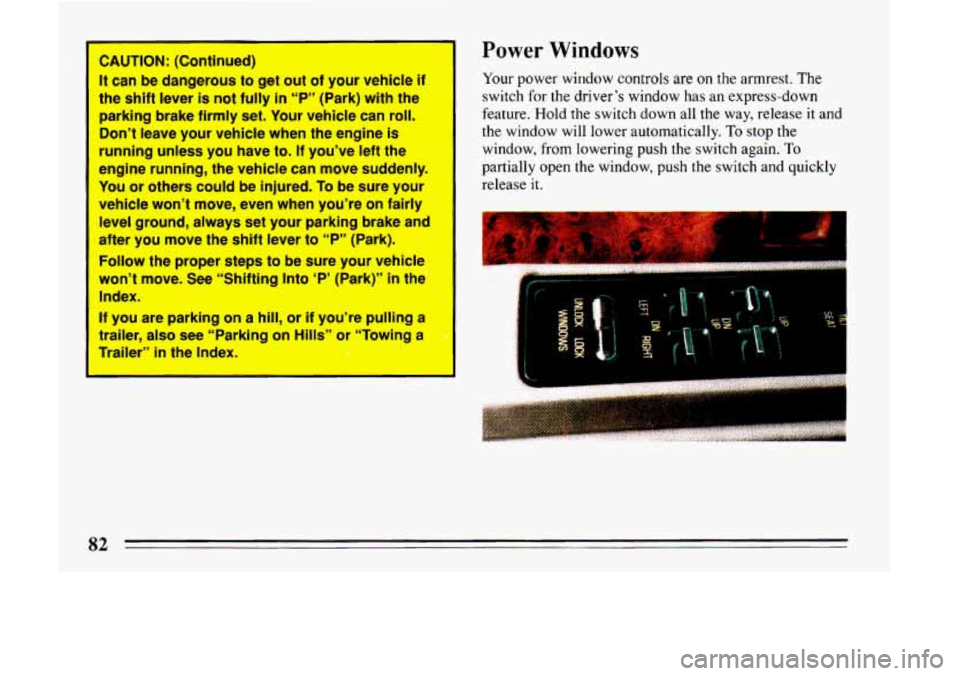
Power Windows
Your power window controls are on the armrest. The
switch for the driver’s window has an express-down
feature. Hold the switch down all the way, release it and
the window will lower automatically.
To stop the
window, from lowering push the switch again.
To
partially open the window, push the switch and quickly
release it.
82
Page 109 of 324
Your fuel gage shows about how much fuel is in your
tank. It works
only when the engine is on. When the
indicator nears
“E,” you still have a little fuel left. You
need to get more
fuel right away.
Here are four concerns some owners have had about the
fuel gage. All these situations are normal and indicate
nothing wrong with the
fuel gage.
0
0
0
0
At the gas station, the gas pump shuts off before the
gage reads
“F’.
It takes more (or less) gas to fill up than the gage
indicated. For example, the gage may have indicated
1/2
full, but it took more (or less) than half of the
tank’s capacity to fill it.
The gage moves a little when you turn a corner,
speed up, or stop your vehicle.
When
you turn the engine off, the gage doesn’t go all
the way back to “E”.
Low Fuel Light
If your Buick has this option, a yellow light near the fuel
gage, will
go on when your vehicle is low on fuel.
You should get more fuel as soon as you can.
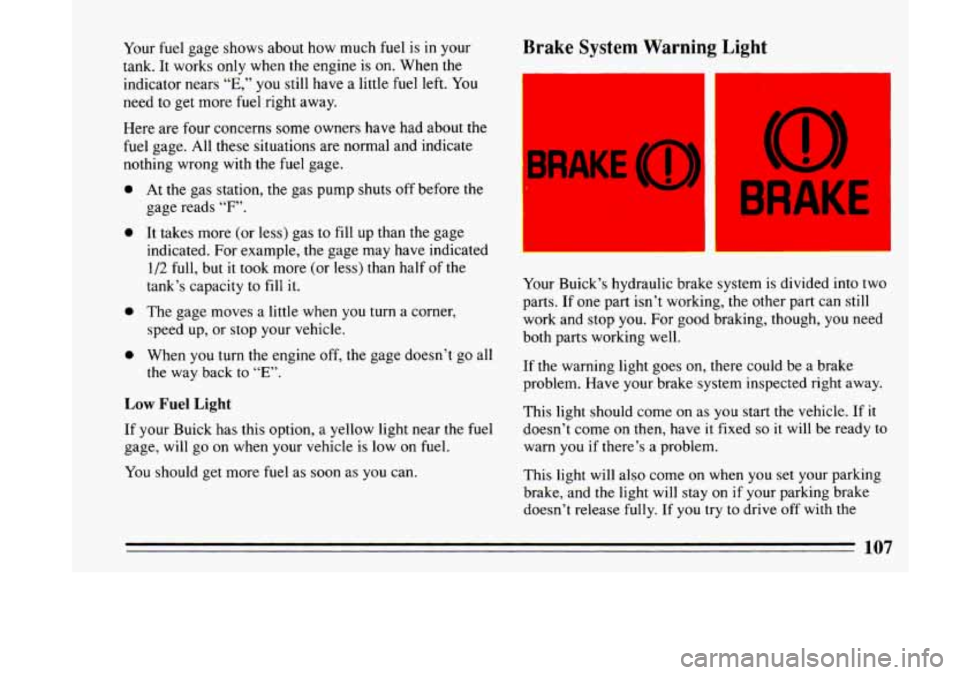
Brake System Warning Light
Your Buick’s hydraulic brake system is divided into two
parts. If one part isn’t working, the other part can still
work and stop
you. For good braking, though, you need
both parts working well.
If the warning light goes on, there could be a brake
problem. Have your brake system inspected right away.
This light should come on as
you start the vehicle. If it
doesn’t come on then, have it fixed so it will be ready to
warn you if there’s a problem.
This light will also come on when you set your parking
brake, and the light will stay on
if your parking brake
doesn’t release
fully. If you try to drive off with the
107