engine BUICK LESABRE 1993 Owners Manual
[x] Cancel search | Manufacturer: BUICK, Model Year: 1993, Model line: LESABRE, Model: BUICK LESABRE 1993Pages: 324, PDF Size: 17.02 MB
Page 6 of 324
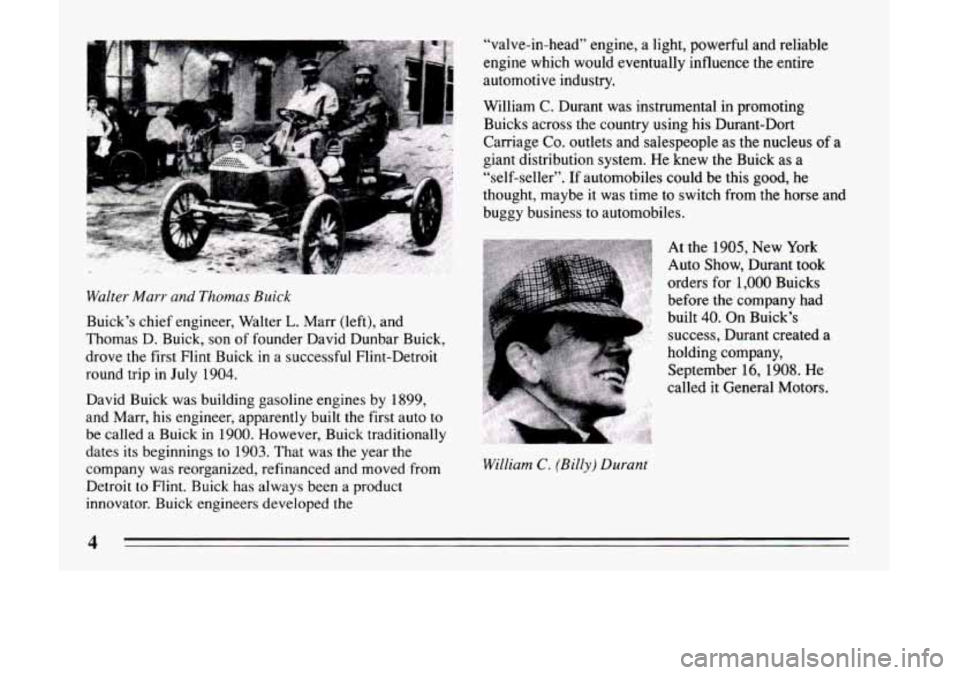
Walter Marr and Thomas Buick
Buick’s chief engineer, Walter L. Marr (left), and
Thomas
D. Buick, son of founder David Dunbar Buick,
drove the first Flint Buick in a successful Flint-Detroit
round trip in July 1904.
David Buick was building gasoline engines by 1899,
and Marr, his engineer, apparently built
the first auto to
be called a Buick in 1900. However, Buick traditionally
dates its beginnings to 1903. That was the year the
company was reorganized, refinanced and moved
from
Detroit to Flint. Buick has always been a product
innovator. Buick engineers developed the “valve-in-head”
engine, a light, powerful and reliable
engine which would eventually influence the entire
automotive industry.
William
C. Durant was instrumental in promoting
Buicks across the country using his Durant-Dort
Carriage Co. outlets and salespeople as the nucleus
of a
giant distribution system. He knew the Buick as a
“self-seller”. If automobiles could be this good, he
thought, maybe it was time to switch from the horse and
buggy business to automobiles.
At the 1905, New York
Auto Show, Durant took
orders for
1,000 Buicks
before
the company had
built 40. On Buick’s
’ . success, Durant created a
holding company,
September 16, 1908. He
called it General Motors.
..
William C. (Billy) Durant
4
Page 7 of 324
Durant also created a racing team that won 500 racing
trophies in 1909 and 19
10, including successes at
Indianapolis two years before the Indy
500 began.
The success of Buick engines was visible not only
on
the race track, but in endurance tests across the country
and around the world. Buick was the only car to
complete a 1,000-mile Chicago-to-New York race in
1906. And a Buick was the first car to travel across
South America, driven
from Buenos Aires, Argentina,
over the Andes to Santiago, Chile in 19 14.
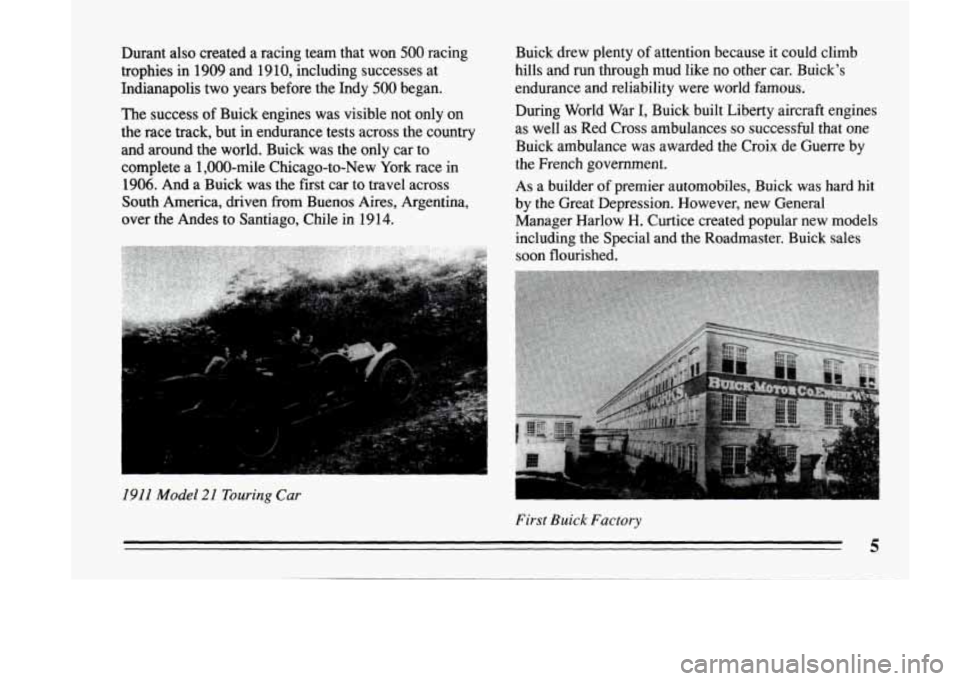
I911 Model 21 Touring Car
Buick drew plenty of attention because it could climb
hills and run through mud like no other car. Buick’s
endurance and reliability were world famous.
During World War
I, Buick built Liberty aircraft engines
as well as Red Cross ambulances
so successful that one
Buick ambulance was awarded the Croix de Guerre by
the French government.
As a builder of premier automobiles, Buick was hard hit
by the Great Depression. However, new General
Manager Harlow
H. Curtice created popular new models
including the Special and the Roadmaster. Buick sales
soon flourished.
First Buick Factory
5
Page 8 of 324
In World War 11, Buick built aircraft engines, tanks and
other military hardware. This post-war period brought
great styling and engineering changes which resulted in
increased sales. The torque converter automatic
transmission, Dynaflow, was introduced in the 1948
Roadmaster. Buick’s famous “portholes” came along in
1949.
1
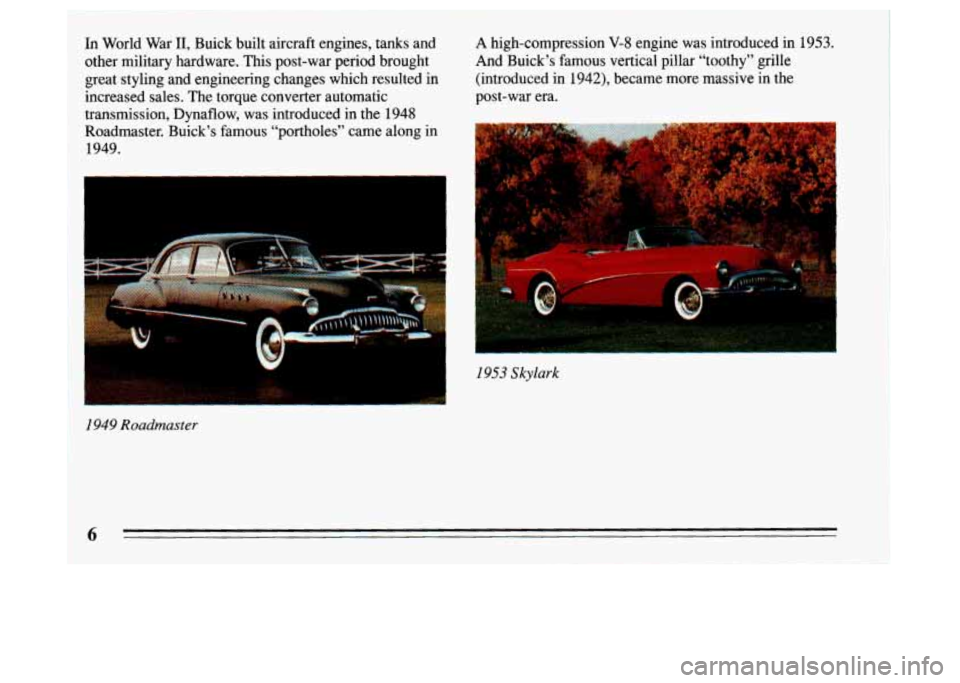
1949 Roadmaster
A high-compression V-8 engine was introduced in 1953.
And Buick’s famous vertical pillar “toothy” grille
(introduced in 1942), became more massive in the
post-war era.
’* R
1953 Skylark
c
Page 9 of 324
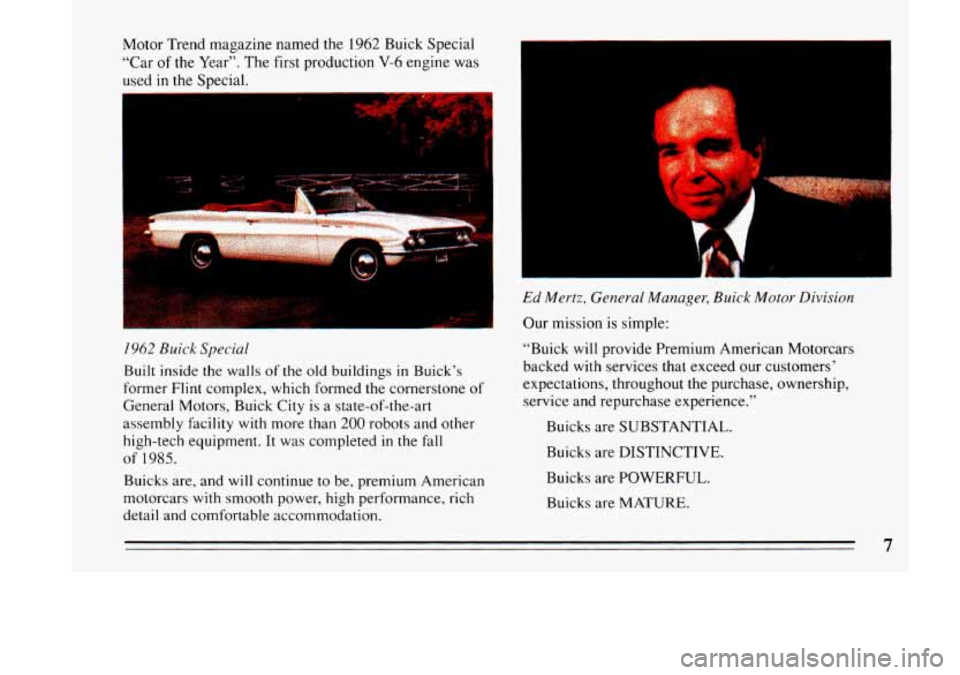
Motor Trend magazine named the 1962 Buick Special
“Car
of the Year”. The first production V-6 engine was
used
in the Special.
Y
I
1962 Buick Special
Built inside the walls of the old buildings in Buick’s
former
Flint complex, which formed the cornerstone of
General Motors, Buick City is a state-of-the-art
assembly facility with more than
200 robots and other
high-tech equipment. It was completed
in the fall
of 1985.
Buicks are, and
will continue to be, premium American
motorcars with smooth power, high performance, rich
detail and comfortable accommodation.
Ed Mertz, General Manager, Buick Motor Division
Our mission is simple:
“Buick
will provide Premium American Motorcars
backed
with services that exceed our customers’
expectations, throughout the purchase, ownership,
service and repurchase experience.”
Buicks are SUBSTANTIAL.
Buicks are DISTINCTIVE.
Buicks are POWERFUL.
Buicks are
MATURE.
7
Page 11 of 324
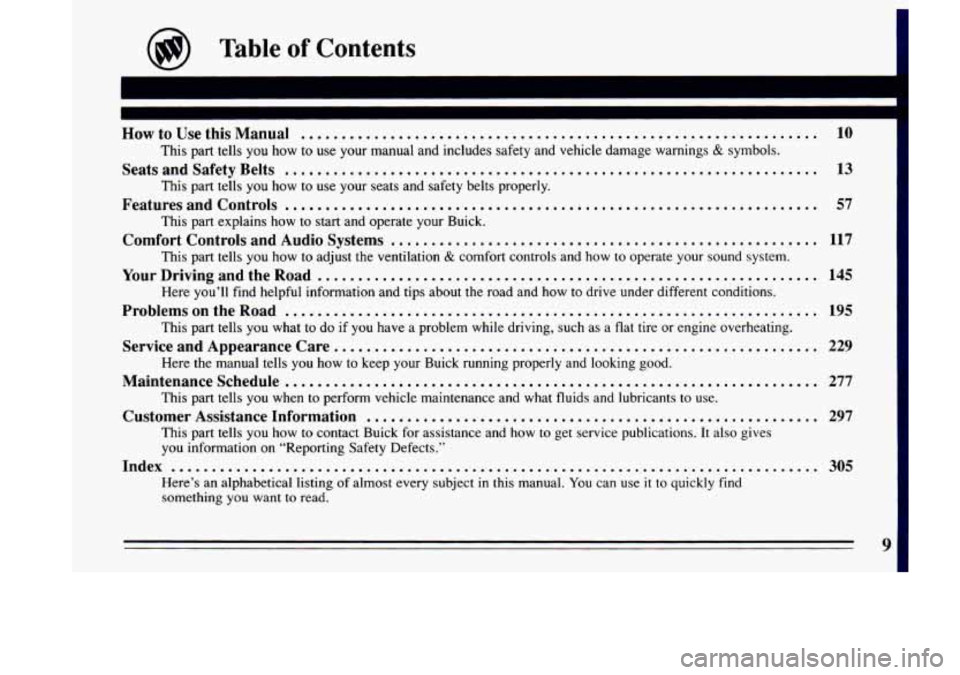
How to Use this Manual ................................................................
This part tells you how to use your manual and includes safety and vehicle damage warnings & symbols.
SeatsandSafetyBelts ..................................................................
This part tells you how to use your seats and safety belts properly.
Featuresandcontrols ..................................................................
This part explains how to start and operate your Buick.
Comfort Controls and Audio Systems .....................................................
This part tells you how to adjust the ventilation & comfort controls and how to operate your sound system.
YourDrivingandtheRoad ..............................................................
Here you’ll find helpful information and tips about the road and how to drive under different conditions.
ProblemsontheRoad ..................................................................
This part tells you what to do if you have a problem while driving, such as a flat tire or engine overheating.
ServiceandAppearanceCare ............................................................
Here the manual tells you how to keep your Buick running properly and looking good.
Maintenanceschedule ..................................................................
This part tells you when to perform vehicle maintenance and what fluids and lubricants to use.
Customer Assistance Information ........................................................
This part tells you how to contact Buick for assistance and how to get service publications. It also gives
you information on “Reporting Safety Defects.”
Index ........................................................................\
........
Here’s an alphabetical listing of almost every subject in this manual. You can use it to quickly find
something you want
to read.
(@ Table of Contents
9
10
13
57
117
145
195
229
277
297
305
Page 14 of 324
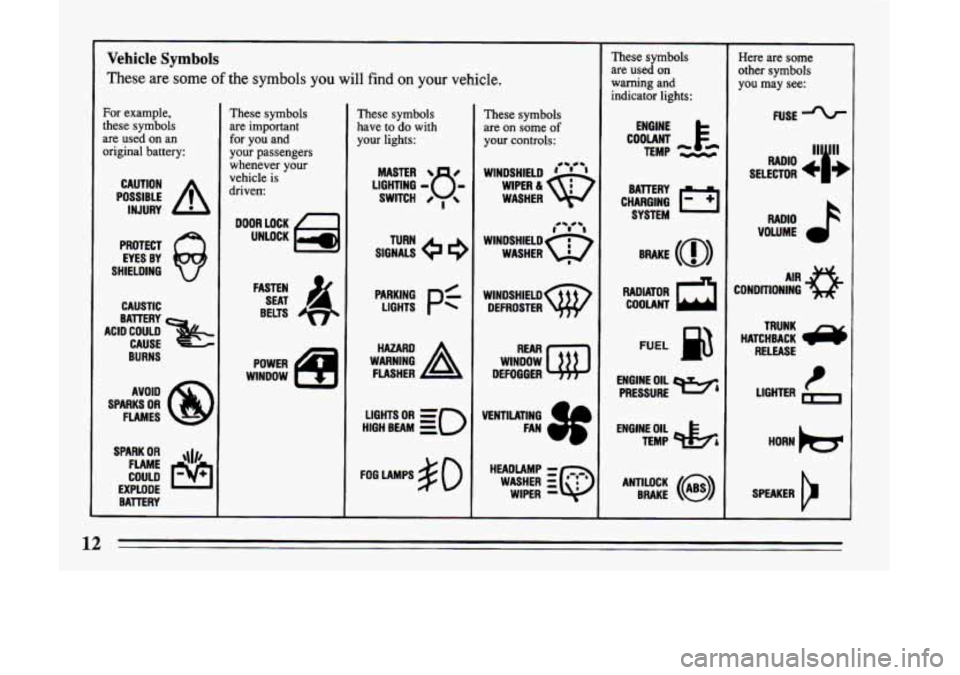
Vehicle Symbols
These
are some of the symbols you will find on your vehicle.
For example,
these symbols
are used on an
original battery:
POSSIBLE A
CAUTION
INJURY
PROTECT EYES BY
SHIELDING
Q
CAUSTIC
BURNS AVOID
SPARKS
OR
FLAMES
SPARK
OR ,\I/,
COULD FLAME
EXPLODE BATTERY
These symbols
are important
for you and
your passengers
whenever your
vehicle is
driven
DOOR LOCK
UNLOCK
FASTEN SEAT
4
BELTS
WINDOW POWER
These symbols
have
to do with
your lights:
LIGHTING - 8 -
MASTER 8
SWITCH 0 ,
SIGNALS e 9
TURN
LIGHTS
Pf
HIGH BEAM OR = =o
FOG LAMPS # 0
These symbols
are on some
of
your controls:
WINDSHIELD ' ' ' 4- e-
WASHER
wlNDsHIELDw DEFROSTER
WINDOW
DEFOGGER
HEADLAMP
- r~.c.r
WASHER :Q
WIPER -
These symbols
are used on
warning and
indicator lights:
COOLANT F*
TEMP -.--
ENGINE
CHARGING
I-1
BATTERY SYSTEM
RADIATOR
a
COOLANT
FUEL
ENGINE OIL
PRESSURE
TEMP OIL
&
ANTILOCK (@)
BRAKE
Here are some
other symbols
you
may see:
FUSE
RADIO >
VOLUME
CONDITIONING
AIR 33
HATCHBACK /y
TRUNK
RELEASE
t LIGHTER
Page 59 of 324
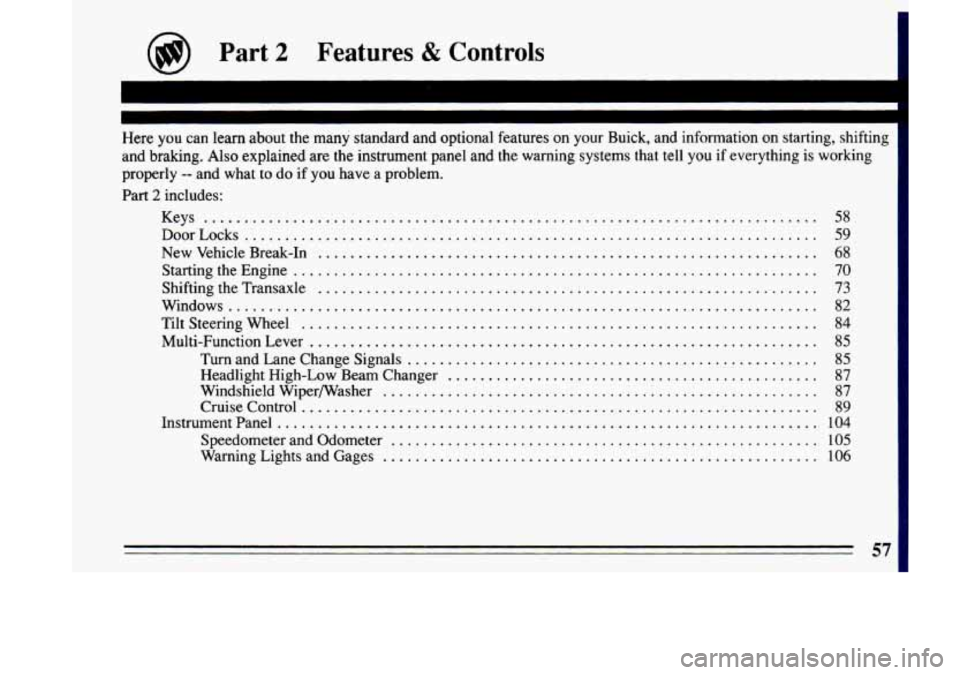
@ Part 2 Features & Controls I
I
L-
Here you can learn about the many standard and optional features on your Buick. and information on starting. shifting
and braking
. Also explained are the instrument panel and the warning systems that tell you if everything is working
properly
.. and what to do if you have a problem .
Part 2 includes:
Keys
........................................................................\
.... 58
DoorLocks ....................................................................... \
59
NewVehicleBreak-In .............................................................. 68
StartingtheEngine ................................................................. 70
ShiftingtheTransaxle .............................................................. 73
Windows ........................................................................\
. 82
Tilt Steering Wheel ................................................................ 84
Multi-Function Lever ............................................................... 85
TunrandLaneChangeSignals ................................................... 85
Headlight High-Low Beam Changer .............................................. 87
Windshield Wipermasher ...................................................... 87
CruiseControl ................................................................ 89
Instrumentpanel ................................................................... 104
Speedometer and Odometer ..................................................... 105
Warning Lights and Gages ...................................................... 106
57
Page 69 of 324
e Put your valuables in a storage area, like your trunk
0 Lock the glove box.
Lock all the doors except the driver’s.
Then take the door key with you.
or glove box.
PASS-Key I1 TM
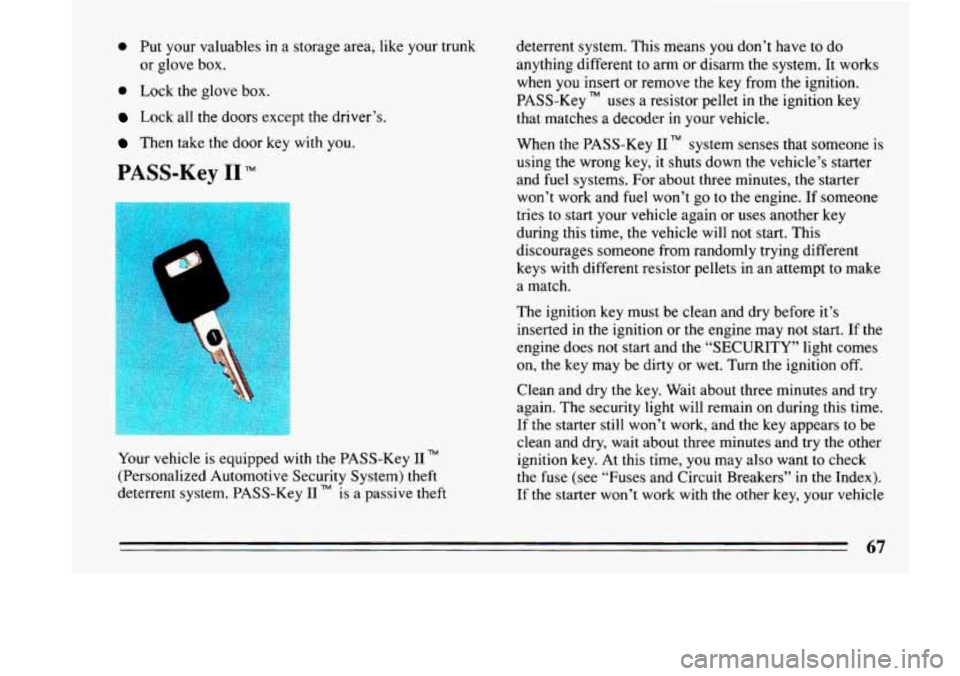
Your vehicle is equipped with the PASS-Key I1 TM
(Personalized Automotive Security System) theft
deterrent system. PASS-Key I1
TM is a passive theft deterrent system.
This means you don’t have to do
anything different
to arm or disarm the system. It works
when you insert or remove the key from the ignition.
PASS-Key uses a resistor pellet in the ignition key
that matches
a decoder in your vehicle.
When the PASS-Key I1
TM system senses that someone is
using the wrong key, it
shuts down the vehicle’s starter
and fuel systems. For about three minutes, the starter
won’t work and
fuel won’t go to the engine. If someone
tries to start your vehicle again or uses another key
during this time, the vehicle will not start. This
discourages someone from randomly trying different
keys with different resistor pellets in an attempt to make
a match.
The ignition key must be clean and dry before it’s
inserted in the ignition or the engine may not start.
If the
engine does not start and the “SECURITY” light comes
on, the key may be dirty or wet. Turn the ignition off.
Clean and dry the key. Wait about three minutes and try
again. The security light will remain on during this time.
If the starter still won’t work, and the key appears to be
clean and dry, wait about three minutes and try the other
ignition key. At this time, you may also want to check
the
fuse (see “Fuses and Circuit Breakers” in the Index).
If the starter won’t work with the other key, your vehicle
67
Page 70 of 324
needs service. If your vehicle does start, the first ignition
key may be faulty. See
your Buick dealer or a locksmith
who can service the PASS-Key
I1 .
If you accidentally use a key that has a damaged or
missing resistor pellet, the starter won’t work and the
security light will flash. But
you don’t have to wait three
minutes before trying one
of the other ignition keys.
See your Buick dealer or a locksmith who can service
the Pass-Key
I1 TM to have a new key made.
If you’re ever driving and
the “SECURITY” light comes
on and stays on,
you will be able to restart your engine if
you
turn it off. Your PASS-Key I1 system, however, is
not working properly and must be serviced by your
Buick dealer. Your vehicle is not protected by the
PASS-Key I1 system.
If you lose or damage a PASS-Key I1 TM ignition key, see
your Buick dealer or
a locksmith who can service
PASS-Key I1
TM to have a new key made.
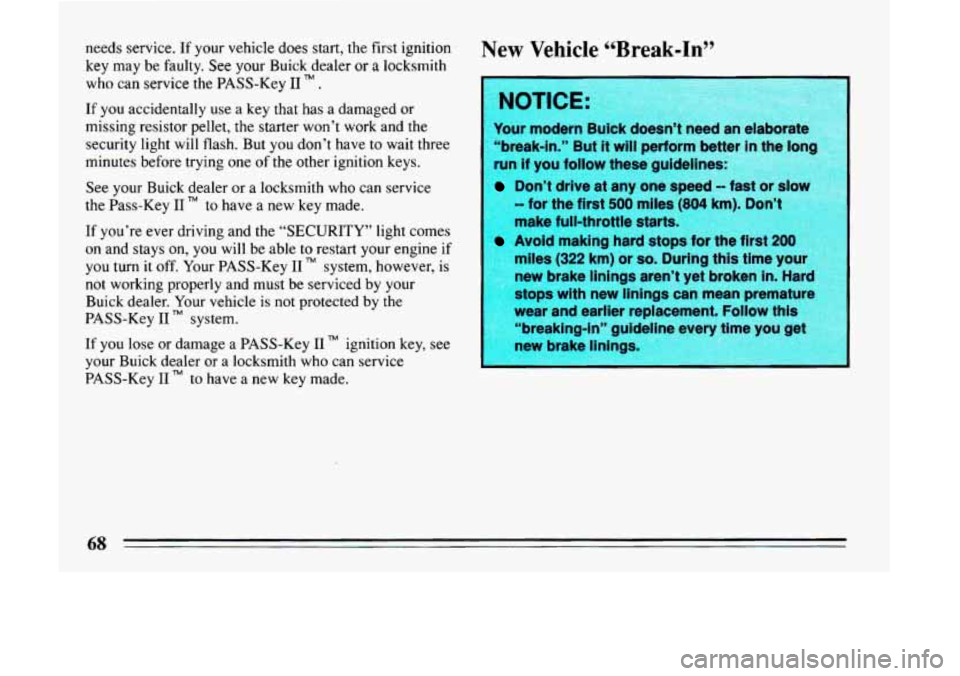
New Vehicle CLBreak-InSS
Your modern
Don’t drive at any one speed -- f
-- for the first 500 miles i804 km). Don’
make full-throttle starts.
fee
Avoid making hard stops for the first ~UU
miles (322 km) or so. During this time your
I new brake linings aren’t yet broken in. Hard
stops with new linings can mean prematl
wear and earlier replacement. Follow
this
I “breaking-in” guidel’
Page 71 of 324
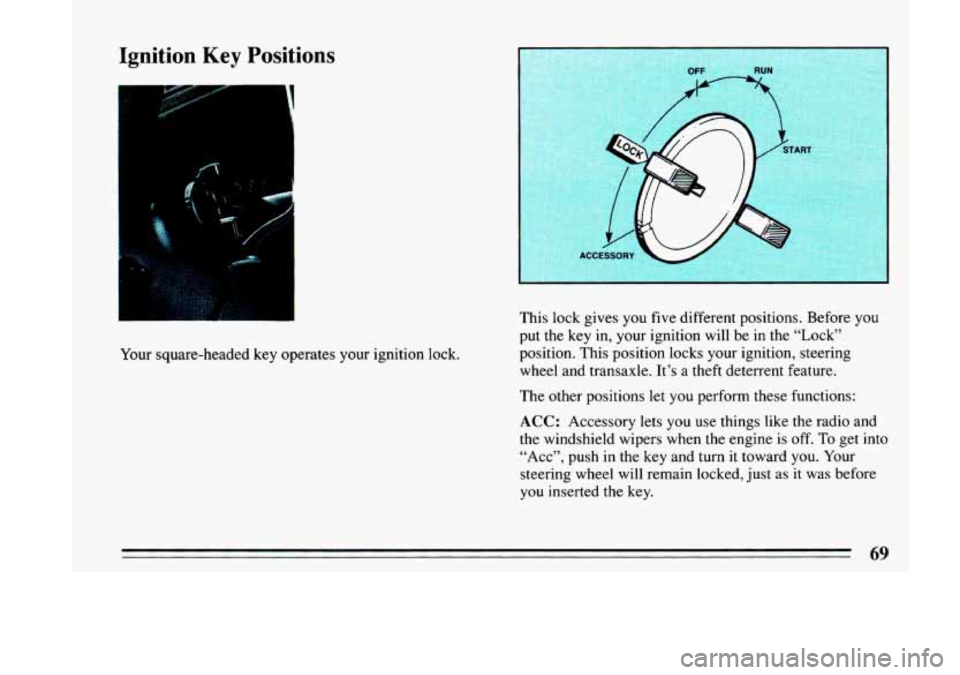
Ignition Key Positions
I
Your square-headed key operates your ignition lock. This
lock gives you five different positions. Before
you
put the key in, your ignition will be in the “Lock”
position. This position locks your ignition, steering
wheel and transaxle. It’s a theft deterrent feature.
The other positions let you perform these functions:
ACC: Accessory lets you use things like the radio and
the windshield wipers when the engine is
off. To get into
“Acc”, push in the key and turn it toward
you. Your
steering wheel will remain locked, just as it was before
you inserted the key.
69