service BUICK LESABRE 1993 Owner's Manual
[x] Cancel search | Manufacturer: BUICK, Model Year: 1993, Model line: LESABRE, Model: BUICK LESABRE 1993Pages: 324, PDF Size: 17.02 MB
Page 204 of 324
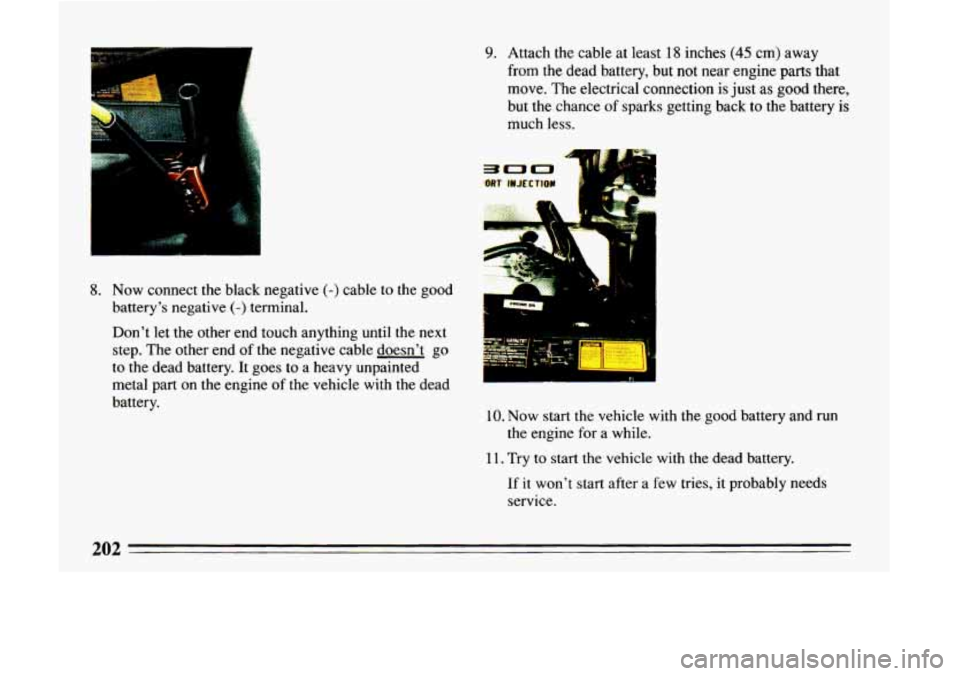
8. Now connect the black negative (-) cable to the good
battery’s negative
(-) terminal.
Don’t let the other end touch anything until the next
step. The other end
of the negative cable doesn’t go
to the dead battery. It goes to
a heavy unpainted
metal part on the engine
of the vehicle with the dead
battery.
9. Attach the cable at least 18 inches (45 cm) away
from the dead battery, but
not near engine parts that
move. The electrical connection is just
as good there,
but the chance of sparks getting back to the battery
is
much less.
R
10. Now start the vehicle with the good battery and run
11. Try
to start the vehicle with the dead battery.
the
engine for a while.
If it won’t start after a few tries, it probably needs
service.
Page 205 of 324
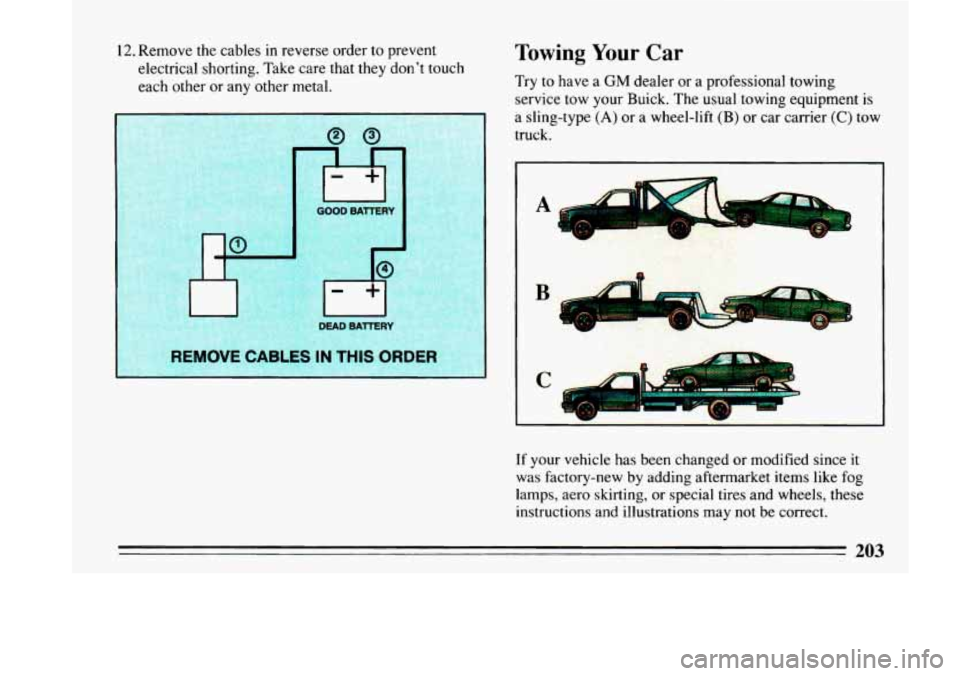
12. Remove the cables in reverse order to prevent
electrical shorting. Take care that they don't touch
each other
or any other metal.
rp+,
GOOD BATTERY
I:
Towing Your Car
Try to have a GM dealer or a professional towing
service tow your Buick. The usual towing equipment is
a sling-type
(A) or a wheel-lift (B) or car carrier (C) tow
truck.
I
If your vehicle has been changed or modified since it
was factory-new by adding aftermarket items like fog
lamps, aero skirting, or special tires and wheels, these
instructions and illustrations may not be correct.
203
Page 206 of 324
Before you do anything, turn on the hazard warning
flashers.
When you call, tell the towing service:
That your vehicle has front-wheel drive.
The make, model, and year of your vehicle.
Whether you can still move the shift lever.
If there was an accident, what was damaged.
When the towing service arrives, let
the tow operator
know that this manual contains detailed towing instructions and illustrations. The operator may want to
see them.
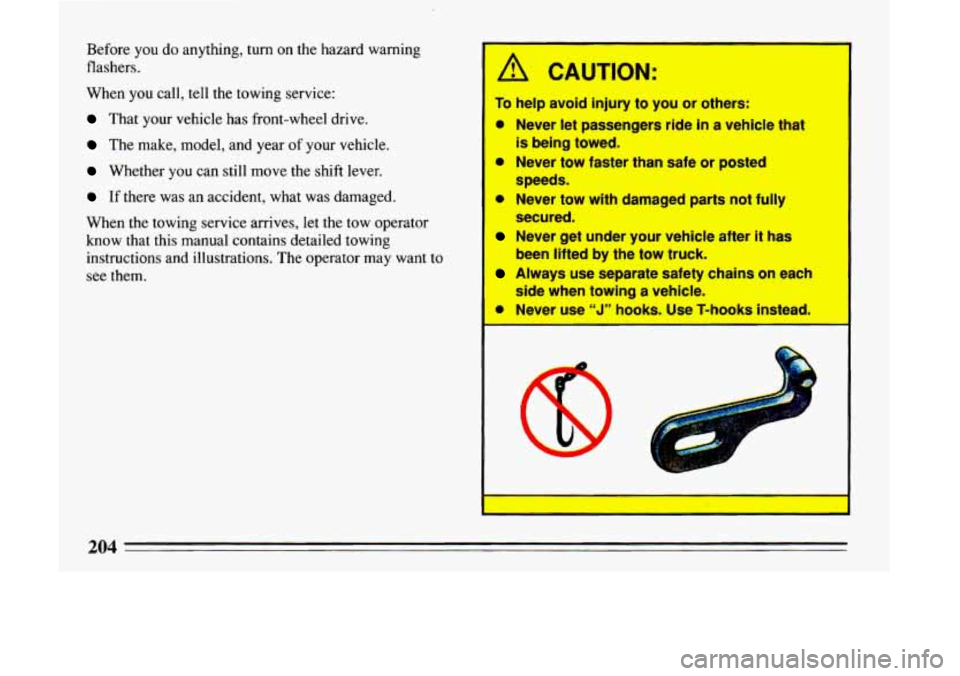
A CAUTION:
To help avoid injury to you or others:
0 Never let passengers ride in a vehicle that
@ Never tow faster than safe or posted
0 Never tow with damaged parts not fully
Never get under your vehicle after it has
Always use separate safety chains on each
@ Never use “J’* hooks. Use T-hooks instead.
is being towed.
speeds.
secured.
been lifted
by the tow truck.
side when towing
a vehicle.
rn
204
Page 207 of 324
When your vehicle is being towed, have the ignition key
off. The steering wheel should be clamped in a
straight-ahead position, with a clamping device designed
for towing service.
Do not use the vehicle’s steering
column lock for this. The transaxle should be in Neutral
and the parking brake released.
Don’t have your vehicle towed on the front wheels,
unless
you must. If the vehicle must be towed on the
front wheels, don’t
go more than 55 mph (88 kph) or
farther than
500 miles (800 km) or your transaxle will
be damaged.
If these limits must be exceeded, then the
front wheels have to be supported on a dolly.
-
A CAUTION:
A vehicle can fall from a car carrier if it isn’t
properly secured, This can cause a collision,
serious personal injury and vehlcle damage. The
vehicle should be tightly secured with chains
or
steel cables before it is transported.
Don’t use substitutes (ropes, leather straps,
canvas webbing, etc.) that can be cut by sharp
zdges underneath the towed vehicle.
Page 211 of 324
If you no longer have the overheat warning, you can
drive. Just
to be safe, drive slower for about ten minutes.
If the warning doesn't come back on, you can drive
normally.
If
the warning continues, pull over, stop, and park your
vehicle right away.
If there's still no sign
of steam, you can idle the engine
for two or three minutes while you're parked, to see if
the warning stops. But then, if you still have the
warning, TURN
OFF THE ENGINE AND GET
EVERYONE OUT OF THE VEHICLE until it cools
down. You
may decide not to lift
the hood but to get service
help right away.
I 4
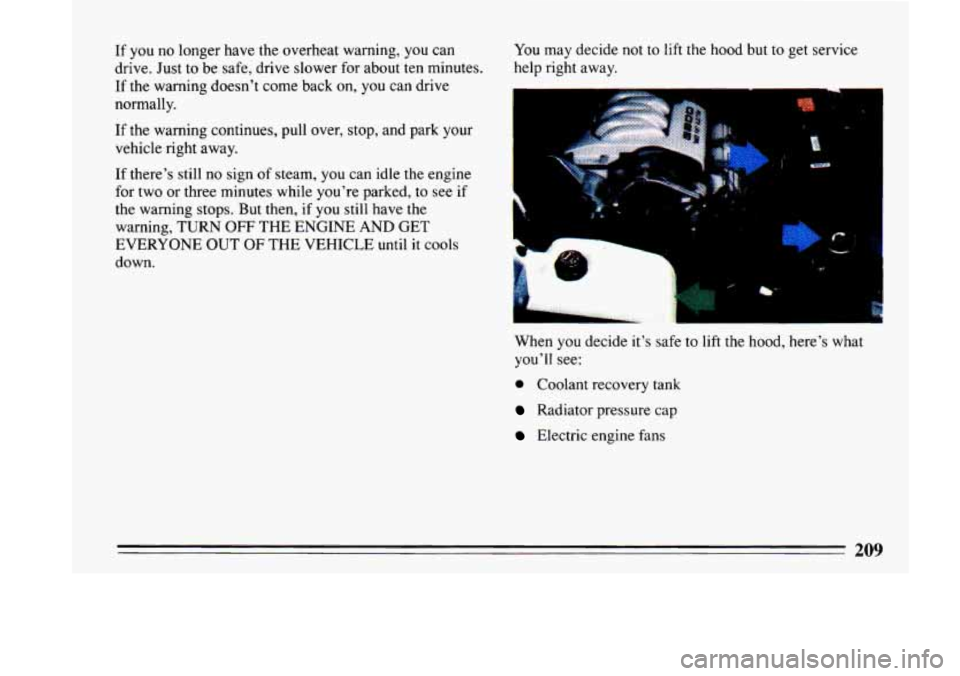
When you decide it's safe to lift the hood, here's what
you'll
see:
0 Coolant recovery tank
Radiator pressure cap
Electric engine fans
209
Page 212 of 324
0 -' e
A! ek-bic fan under the kod-can start up even
when' the endne is not runniiig and can Injure
yoG. Keep hands, clothing and tools away from
any underhood electric fan.
I
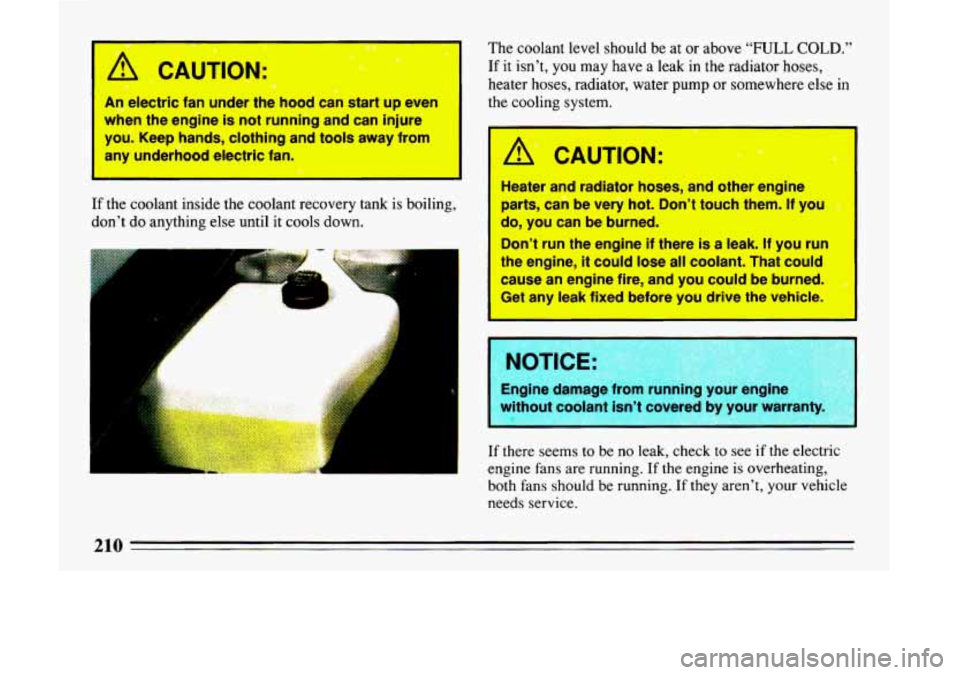
If the coolant inside the coolant recovery tank is boiling,
don't do anything else until it cools down.
I-
rs-
L
I
P
The coolant level should be at or above "FULL COLD.''
If it isn't, you may have a leak in the radiator hoses,
heater hoses, radiator, water
pump or somewhere else in
the cooling system,
I
/A CAUTION: 0
Heater and radiator hoses, and other engine
parts, can be very
hot. Don't touch them. If you p
do, you can be burned.
Don't run the engine if there is a leak.
If you run
the engine,
it could lose all coolant. That could
cause an engine fire, and you could be burned.
Get any leak fixed before you drive the vehicle.
I
Engine damage from running your engine
without coolant isn't covered by your warranty.
If there seems to be no leak, check to see if the electric
engine fans are running.
If the engine is overheating,
both fans
should be running. If they aren't, your vehicle
needs service.
Page 231 of 324
@ Part 6 Service & Appearance Lare
Here you will find information about the care of your Buick . This part begins with service and fuel information. and
then it shows how to check important fluid and lubricant level\
s
. There is also technical information about your
vehicle. and a section devoted to its appearance care .
Part 6 includes:
ServiceTips
......................................................................
Fuel ........................................................................\
.....
HoodRelease .....................................................................
Engineoil ....................................................................... \
AirFilter ........................................................................\
.
Automatic Transaxle Fluid ............................................................
Enginecoolant ....................................................................
Power Steering Fluid ...............................................................
Windshield Washer Fluid ............................................................
Brakes ........................................................................\
...
Battery ........................................................................\
..
BulbReplacement .................................................................
Tires ........................................................................\
.....
Appearancecare ..................................................................
Vehicle Identification Number (VIN) ..................................................
FusesandCircuitBreake ............................................................
Capacities and Specifications .........................................................
LoadingYourVehicle ...............................................................
230
231
234
236
240
241
243
246 247
248
249
250
253
255
262
269
270
275
229
Page 232 of 324
Service
Your Buick dealer knows your vehicle best and wants
you to be happy with it. We hope you’ll go to your
dealer for all your service needs. You’ll get genuine
GM
parts and GM-trained and supported service people.
We hope you’ll want to keep your
GM vehicle all GM.
Genuine GM parts have one of these marks:
Doing Your Own Service Work
If you want to do some of your own service work, you’ll
want
to get the proper Buick Service Manual. It tells you
much more about how to service your Buick than this
manual can.
To order the proper service manual, see
“Service Publications” in
the Index.
You should keep
a record with all parts receipts and list
the mileage and the date
of any service work you
perform. See “Maintenance Record” in the Index.
A CAUTION:
You can be fnjured if you try to do service work
“I a vehicle without knowing enough about it.
Be sure you have sufficient knowledge,
expefience, and
the proper replacement
parts and tools before you attempt any
vehicle maintenance task.
Be sure to u& the proper nuts, t -ts and
other fasteners. “English” and “metric’#
fasteners can be easily confused. If you
use the wrong fastener%, parts can later
brea- lr fall off. You could be hurt.
1 NOTICE:
I
If you try to t your own service worK )U t
knowing enough about it, your vehicle could be
damaged.
._.
-
230
Page 233 of 324
Fuel
Use regular unleaded gasoline rated at 87 octane or
higher. It should meet specifications ASTM D48 14
in
the U.S. and CGSB 3.5-92 in Canada. These fuels
should have the proper additives,
so you should not have
to add anything to the fuel.
In the
U.S. and Canada, it’s easy to be sure you get the
right kind of gasoline (unleaded). You’ll see
“UNLEADED’ right on the pump. And only unleaded
nozzles will fit into your vehicle’s filler neck.
Be sure the posted octane
is at least 87. If the octane is
less than
87, you may get a heavy knocking noise when
you drive. If it’s bad enough, it can damage your engine.
If you’re using
fuel rated at 87 octane or higher and you
still hear heavy knocking, your engine needs service.
But don’t worry
if you hear a little pinging noise when
you’re accelerating or driving up a
hill. That’s normal,
and you don’t have to buy a higher octane
fuel to get rid
of pinging. It’s the heavy, constant knock that means
you have a problem.
What about gasoline with blending materials that
contain oxygen, such as MTBE or alcohol?
MTBE is “methyl tertiary-butyl ether.” Fuel that is
no
more than 15% MTBE is fine for your vehicle. Ethanol is ethyl
or grain alcohol. Properly-blended fuel
that is
no more than 10% ethanol is fine for your
vehicle.
Methanol is methyl
or wood alcohol.
Fuel that is more than 5% methanol is bad for
your vehicle. Don’t use it. It can corrode I..,
parts in your fuel system and also damage
plastic and rubber parts. That damage wouldn’t
be covered under your warranty. And even
at 5
or less, there must be “cosolvents” and
corrosion preventers in this fuel to help
avoid
these problems.
Gasolines for Cleaner Air
Your use of gasoline with detergent additives will help
prevent deposits from forming in your engine and
fuel
system. That helps keep your engine in tune and your
emission control system working properly.
It’s good for
your vehicle, and you’ll
be doing your part for cleaner
air.
Many gasolines are now blended with materials called
oxygenates. General Motors recommends that you
use
231
Page 234 of 324
gasolines with these blending materials, such as MTBE
and ethanol. By doing
so, you can help clean the air,
especially in those parts of the country that have
high
carbon monoxide levels.
In addition, some gasoline suppliers are now producing
reformulated gasolines. These gasolines are specially
designed to reduce vehicle emissions. General Motors
recommends that you use reformulated gasoline. By
doing
so, you can help clean the air, especially in those
parts of the country that have high ozone levels.
You should ask your service station operators if their
gasolines contain detergents and oxygenates, and
if they
have been reformulated to reduce vehicle emissions.
Fuels in Foreign Countries
If you plan on driving in another country outside the
U.S. or Canada, unleaded fuel may be hard to find. Do
not use leaded gasoline. If you use even one tankful, your emission controls won’t work well or at all. With
continuous use, spark plugs can get fouled, the exhaust
system can corrode, and your engine oil can deteriorate
quickly. Your vehicle’s oxygen sensor will be damaged.
All of that means costly repairs that wouldn’t
be covered
by your warranty.
To check on fuel availability, ask an auto club, or
contact
a major oil company that does business in the
country where you’ll be driving.
You can also write us at the following address for
advice. Just
tell us where you’re going and give your
Vehicle Identification Number
(VIN).
General Motors of Canada Ltd.
International Export Sales
P.O. Box 828
Oshawa, Ontario L1 H 7N1, Canada
.
323