map light BUICK LESABRE 1993 Owners Manual
[x] Cancel search | Manufacturer: BUICK, Model Year: 1993, Model line: LESABRE, Model: BUICK LESABRE 1993Pages: 324, PDF Size: 17.02 MB
Page 177 of 324
lights on, start your hazard warning flashers, and sound
your horn at intervals or when you hear approaching
traffic.
Pass other vehicles in fog only if you can see far enough
ahead to pass safely. Even then, be prepared
to delay
your pass if you suspect the fog is worse up ahead. If
other vehicles try
to pass you, make it easy for them.
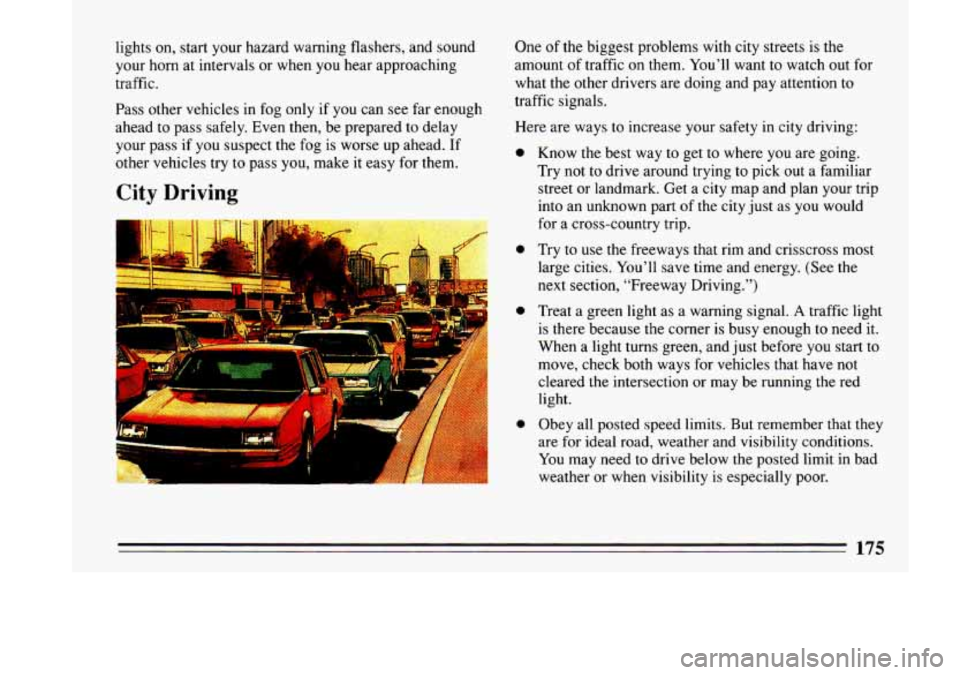
City Driving
I
One of the biggest problems with city streets is the
amount
of traffic on them. You’ll want to watch out for
what the other drivers are doing and pay attention to
traffic signals.
Here are ways
to increase your safety in city driving:
0
0
0
0
Know the best way to get to where you are going.
Try not to drive around trying to pick out a familiar
street or landmark. Get a city map and plan your trip
into an unknown part of the city just
as you would
for a cross-country trip.
Try
to use the freeways that rim and crisscross most
large cities. You’ll save time and energy. (See the
next section, “Freeway Driving.”)
Treat a green light as a warning signal.
A traffic light
is there because the corner is busy enough to need it.
When a light turns green, and just before you start to
move, check both ways for vehicles that have not
cleared
the intersection or may be running the red
light.
Obey all posted speed limits. But remember that they
are for ideal road, weather and visibility conditions.
You may need to drive below the posted limit in bad
weather or when visibility is especially poor.
Page 180 of 324
Driving a Long Distance
Although most long trips today are made on freeways,
there are still many made on regular highways. Long-distance driving on freeways and regular
highways is the same in some ways. The trip has to be
planned and the vehicle prepared, you drive at
higher-than-city speeds, and there are longer turns
behind the wheel. You’ll enjoy your trip more if you and
your vehicle are in good shape. Here are some tips for a
successful long trip.
Before Leaving on a Long Trip
Make sure you’re ready. Try to be well rested. If you
must start when you’re not fresh
-- such as after a day’s
work
-- don’t plan to make too many miles that first part
of the journey. Wear comfortable clothing and shoes you
can easily drive
in.
Is your vehicle ready for a long trip? If you keep it
serviced and maintained,
it’s ready to go. If it needs
service, have it done before starting out. Of course,
you’!! find experienced and able service experts in
Buick dealerships all across North America. They’ll be
ready and willing to help
if you need it.
Here are some things you can check before a trip:
0
e
e
0
e
0
0
Windshield Washer Fluid: Is the reservoir full? Are
all windows clean inside and outside?
Wiper Blades: Are they in good shape?
Fuel, Engine Oil. Other Fluids: Have
you checked
all levels?
Lights: Are they all working? Are the lenses clean?
- Tires: They are vitally important to a safe,
trouble-free trip.
Is the tread good enough for
long-distance driving? Are the tires all inflated to the
recommended pressure?
Weather Forecasts: What’s the weather outlook
along your route? Should you delay your trip
a short
time to avoid a major storm system?
Maps:
Do you have up-to-date maps?
On the Road
Unless you are the only driver, it is good to share the
driving task with others. Limit turns behind the wheel to
about
100 miles (160 km) or two hours at a sitting.
Then, either change drivers or stop for some refreshment
like coffee, tea
or soft drinks and some limbering up.
But do stop and move around. Eat lightly along the way.
Heavier meals tend to make some people sleepy.