lights BUICK LESABRE 2004 User Guide
[x] Cancel search | Manufacturer: BUICK, Model Year: 2004, Model line: LESABRE, Model: BUICK LESABRE 2004Pages: 392, PDF Size: 4.3 MB
Page 163 of 392
If you choose ON for KEYLESS FEEDBACK and ON for
HORN FEEDBACK, your horn will chirp when all
doors are unlocked and when locking your vehicle.
If you choose ON for KEYLESS, LIGHTS and HORN
FEEDBACK, your exterior lamps will ash twice at
the rst unlock button press, your exterior lamps will
ash twice and the horn will chirp once at the second
unlock button press, and the exterior lamps will ash and
the horn will chirp once when locking your vehicle.
For more information on this feature, see “Security
Feedback” underRemote Keyless Entry System
Operation on page 2-5.
Delayed Locking
This feature, which delays the locking of the vehicle,
can be made active or inactive through the DIC. When
DELAYED LOCKING – OFF/ON appears on the
display, use the ENG/MET button to toggle the arrow
between OFF and ON. When you have made your
choice, press the RESET button to record your
selection.
For more information on this feature, seeDelayed
Locking on page 2-11.
Perimeter Lighting
Press the unlock button on the remote keyless entry
transmitter to turn on the DRL (high-beams at reduced
intensity), parking lamps and back-up lamps if it is
dark enough according to the Twilight Sentinel
®.
You can control activation of this feature by choosing
OFF or ON when the PERIMETER LIGHTS choice
is displayed on the DIC. Make your choice by pressing
the ENG/MET button and record your choice by
pressing the RESET button. You will then be prompted
to choose a TIMEOUT period. See “Exterior Lights”
following for more information.
For more information on this feature, see “Perimeter
Lighting” underInterior Lamps on page 3-17.
Exterior Lights
The EXTERIOR LIGHTS/TIMEOUT feature can be
changed to a desired setting by using the ENG/MET to
toggle from 5 to 30 seconds. Each toggle will increase
the time by ve seconds. Once the desired timeout
is displayed, press RESET to record your choice and
move on to the next personal choice feature.
3-53
Page 209 of 392
You can be temporarily blinded by approaching
headlamps. It can take a second or two, or even several
seconds, for your eyes to readjust to the dark. When
you are faced with severe glare (as from a driver
who does not lower the high beams, or a vehicle with
misaimed headlamps), slow down a little. Avoid
staring directly into the approaching headlamps.
Keep your windshield and all the glass on your vehicle
clean — inside and out. Glare at night is made much
worse by dirt on the glass. Even the inside of the glass
can build up a lm caused by dust. Dirty glass makes
lights dazzle and ash more than clean glass would,
making the pupils of your eyes contract repeatedly.
Remember that your headlamps light up far less of a
roadway when you are in a turn or curve. Keep
your eyes moving; that way, it is easier to pick out dimly
lighted objects. Just as your headlamps should be
checked regularly for proper aim, so should your eyes
be examined regularly. Some drivers suffer from
night blindness — the inability to see in dim light — and
are not even aware of it.Driving in Rain and on Wet Roads
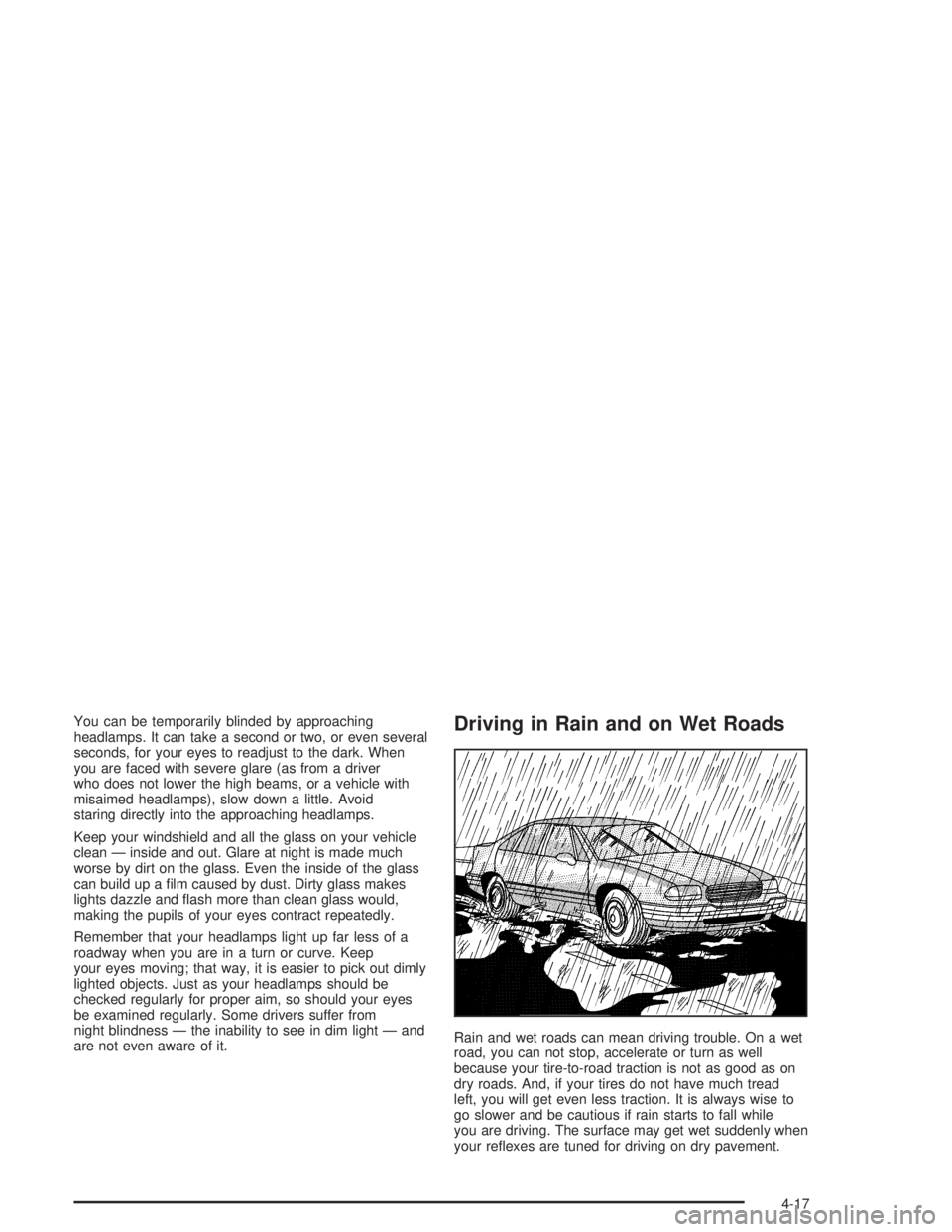
Rain and wet roads can mean driving trouble. On a wet
road, you can not stop, accelerate or turn as well
because your tire-to-road traction is not as good as on
dry roads. And, if your tires do not have much tread
left, you will get even less traction. It is always wise to
go slower and be cautious if rain starts to fall while
you are driving. The surface may get wet suddenly when
your reexes are tuned for driving on dry pavement.
4-17
Page 237 of 392
Your vehicle has bulb warning lights. When you plug a
trailer lighting system into your vehicle’s lighting
system, its bulb warning lights may not let you know if
one of your lamps goes out. So, when you have a trailer
lighting system plugged in, be sure to check your
vehicle and trailer lamps from time to time to be sure
they are all working. Once you disconnect the trailer
lamps, the bulb warning lights again can tell you if one
of your vehicle lamps is out.
Driving On Grades
Reduce speed and shift to a lower gearbeforeyou start
down a long or steep downgrade. If you do not shift
down, you might have to use your brakes so much that
they would get hot and no longer work well.
On a long uphill grade, shift down to THIRD (3) and
reduce your speed to around 45 mph (70 km/h) to
reduce the possibility of engine and transaxle
overheating.
Parking on Hills
{CAUTION:
You really should not park your vehicle, with a
trailer attached, on a hill. If something goes
wrong, your rig could start to move. People
can be injured, and both your vehicle and the
trailer can be damaged.
But if you ever have to park your rig on a hill, here is
how to do it:
1. Apply your regular brakes, but do not shift into
PARK (P) yet.
2. Have someone place chocks under the trailer
wheels.
3. When the wheel chocks are in place, release the
regular brakes until the chocks absorb the load.
4. Reapply the regular brakes. Then apply your
parking brake, and then shift to PARK (P).
5. Release the regular brakes.
4-45
Page 262 of 392
A 50/50 mixture of clean, drinkable water and
DEX-COOL®coolant will:
Give freezing protection down to−34°F (−37°C).
Give boiling protection up to 265°F (129°C).
Protect against rust and corrosion.
Help keep the proper engine temperature.
Let the warning lights and gages work as they
should.
Notice:Using coolant other than DEX-COOL
®may
cause premature engine, heater core or radiator
corrosion. In addition, the engine coolant may
require changing sooner, at 30,000 miles (50 000 km)
or 24 months, whichever occurs rst. Any repairs
would not be covered by your warranty. Always use
DEX-COOL
®(silicate-free) coolant in your vehicle.
What to Use
Use a mixture of one-halfclean, drinkable waterand
one-half DEX-COOL®coolant which will not damage
aluminum parts. If you use this coolant mixture, you do
not need to add anything else.
{CAUTION:
Adding only plain water to your cooling
system can be dangerous. Plain water, or
some other liquid such as alcohol, can boil
before the proper coolant mixture will. Your
vehicle’s coolant warning system is set for the
proper coolant mixture. With plain water or the
wrong mixture, your engine could get too hot
but you would not get the overheat warning.
Your engine could catch re and you or others
could be burned. Use a 50/50 mixture of clean,
drinkable water and DEX-COOL
®coolant.
Notice:If you use an improper coolant mixture,
your engine could overheat and be badly damaged.
The repair cost wouldn’t be covered by your
warranty. Too much water in the mixture can freeze
and crack the engine, radiator, heater core and
other parts.
If you have to add coolant more than four times a year,
have your dealer check your cooling system.
Notice:If you use the proper coolant, you don’t
have to add extra inhibitors or additives which claim
to improve the system. These can be harmful.
5-24
Page 381 of 392
Driving (cont.)
In Rain and on Wet Roads...........................4-17
Winter........................................................4-25
Driving On Grades..........................................4-45
Driving on Snow or Ice....................................4-26
Driving Through Deep Standing Water...............4-19
Driving Through Flowing Water.........................4-20
Driving with a Trailer.......................................4-43
Dual Automatic Climate Control System.............3-26
E
Electrical System
Add-On Equipment......................................5-91
Fuses and Circuit Breakers...........................5-92
Power Windows and Other Power Options......5-92
Removing the Rear Seat Cushion..................5-95
Emergency Trunk Release Handle.....................2-15
Emissions Inspection and Maintenance
Programs...................................................3-42
Engine
Air Cleaner/Filter.........................................5-18
Battery.......................................................5-40
Check and Service Engine Soon Light............3-40
Coolant......................................................5-23
Coolant Heater............................................2-24
Coolant Temperature Gage...........................3-40
Cooling System Inspection............................6-22
Engine Compartment Overview......................5-12Engine (cont.)
Exhaust.....................................................2-31
Oil .............................................................5-13
Overheating................................................5-26
Starting......................................................2-23
Engine Compartment Fuse Block......................5-92
Engine Coolant Level Check.............................6-17
Engine Cooling When Trailer Towing..................4-46
Engine Oil Additives........................................5-16
Engine Oil Level Check...................................6-17
Entry Lighting.................................................3-18
Erasing HomeLink
®Buttons..............................2-41
Event Data Records (EDR)................................ 7-9
Express-Down Window....................................2-17
Extender, Safety Belt.......................................1-26
Exterior Lamps...............................................3-14
Exterior Lighting Battery Saver..........................3-17
Exterior Lights................................................3-53
F
Filter
Engine Air Cleaner......................................5-18
Finding a PTY Station.....................................3-59
Finding a PTY Station (RDS and XM™).............3-66
Finding a Station....................................3-56, 3-64
Finish Care....................................................5-87
Finish Damage...............................................5-89
Flash-To-Pass.................................................. 3-9
5
Page 391 of 392
V
Vehicle
Control........................................................ 4-5
Damage Warnings........................................... iv
Loading......................................................4-33
Service Soon Light......................................3-44
Symbols......................................................... iv
Vehicle Data Collection and Event Data Records . . 7-9
Vehicle Identication
Number (VIN).............................................5-91
Service Parts Identication Label...................5-91
Vehicle Personalization
DIC ...........................................................3-50
Memory Seat and Mirrors.............................2-44
Vehicle Storage..............................................5-41
Ventilation Adjustment......................................3-30
Visors...........................................................2-17
W
Warning Lights, Gages and Indicators................3-32
Warnings
DIC Warnings and Messages........................3-49
Hazard Warning Flashers............................... 3-6
Other Warning Devices.................................. 3-6
Safety and Symbols......................................... iii
Vehicle Damage.............................................. ivWashing Your Vehicle......................................5-87
Weatherstrip Lubrication...................................6-18
Weight of the Trailer........................................4-41
Weight of the Trailer Tongue.............................4-41
What Kind of Engine Oil to Use........................5-14
What to Do with Used Oil................................5-17
What to Use..........................................5-24, 5-36
Wheels
Alignment and Tire Balance..........................5-71
Replacement...............................................5-71
When to Add Engine Oil..................................5-14
When to Change Engine Oil (Vehicles with
the GM Oil Life System)...............................5-17
When to Change Engine Oil (Vehicles
Without the GM Oil Life System)...................5-16
When to Check..............................................5-65
When to Check and Change............................5-21
When to Check Power Steering Fluid................5-36
When to Inspect the Engine Air Cleaner/Filter.....5-18
When You Are Ready to Leave After
Parking on a Hill.........................................4-46
Where to Put the Restraint...............................1-36
Why Safety Belts Work..................................... 1-8
Window Lock Out...................................2-17, 3-52
Windows.......................................................2-16
Power........................................................2-17
Windshield Washer.........................................3-10
Fluid..........................................................5-36
15