battery BUICK LUCERNE 2007 User Guide
[x] Cancel search | Manufacturer: BUICK, Model Year: 2007, Model line: LUCERNE, Model: BUICK LUCERNE 2007Pages: 496, PDF Size: 2.77 MB
Page 143 of 496
Programming Universal Home
Remote — Fixed Code
Fixed Code garage door openers are used for
garage doors produced prior to 1996. Fixed code
uses the same coded signal every time, which
is manually programmed by setting DIP switches
for a unique personal code.
Follow these steps to program up to
three channels:
1. Remove the battery cover of the hand-held
transmitter.
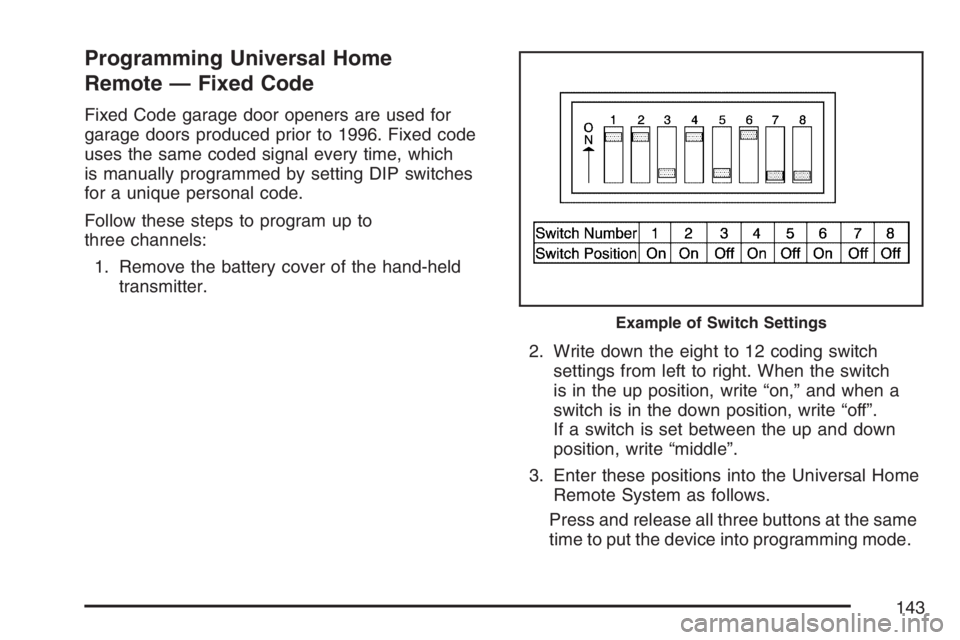
2. Write down the eight to 12 coding switch
settings from left to right. When the switch
is in the up position, write “on,” and when a
switch is in the down position, write “off”.
If a switch is set between the up and down
position, write “middle”.
3. Enter these positions into the Universal Home
Remote System as follows.
Press and release all three buttons at the same
time to put the device into programming mode.
Example of Switch Settings
143
Page 147 of 496
Universal Home Remote
System Operation
(With One Triangular LED)
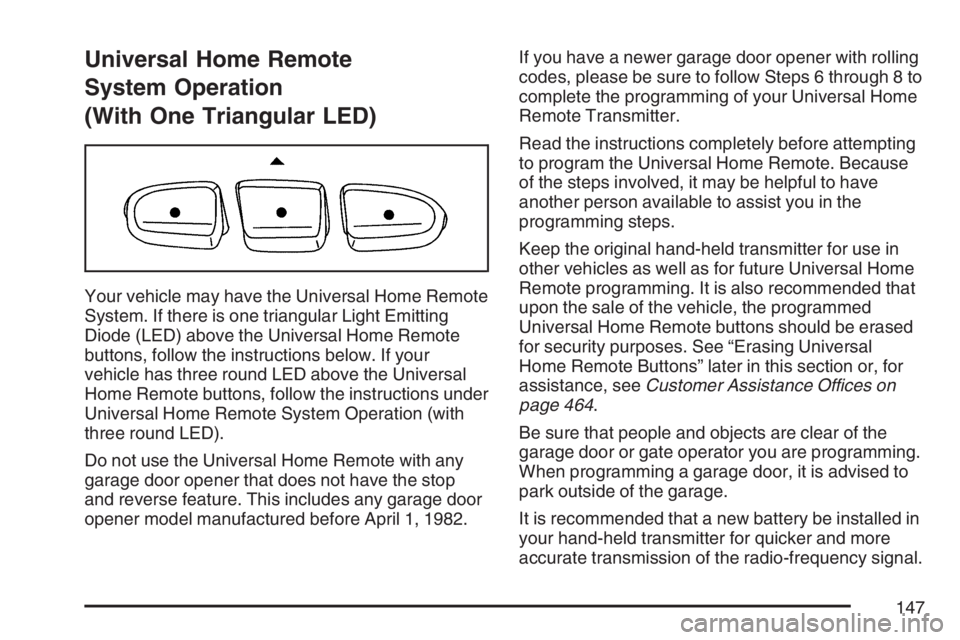
Your vehicle may have the Universal Home Remote
System. If there is one triangular Light Emitting
Diode (LED) above the Universal Home Remote
buttons, follow the instructions below. If your
vehicle has three round LED above the Universal
Home Remote buttons, follow the instructions under
Universal Home Remote System Operation (with
three round LED).
Do not use the Universal Home Remote with any
garage door opener that does not have the stop
and reverse feature. This includes any garage door
opener model manufactured before April 1, 1982.If you have a newer garage door opener with rolling
codes, please be sure to follow Steps 6 through 8 to
complete the programming of your Universal Home
Remote Transmitter.
Read the instructions completely before attempting
to program the Universal Home Remote. Because
of the steps involved, it may be helpful to have
another person available to assist you in the
programming steps.
Keep the original hand-held transmitter for use in
other vehicles as well as for future Universal Home
Remote programming. It is also recommended that
upon the sale of the vehicle, the programmed
Universal Home Remote buttons should be erased
for security purposes. See “Erasing Universal
Home Remote Buttons” later in this section or, for
assistance, seeCustomer Assistance Offices on
page 464.
Be sure that people and objects are clear of the
garage door or gate operator you are programming.
When programming a garage door, it is advised to
park outside of the garage.
It is recommended that a new battery be installed in
your hand-held transmitter for quicker and more
accurate transmission of the radio-frequency signal.
147
Page 155 of 496
Instrument Panel Overview........................ 158
Hazard Warning Flashers.......................... 160
Other Warning Devices............................. 160
Horn.......................................................... 160
Tilt Wheel.................................................. 161
Heated Steering Wheel............................. 161
Turn Signal/Multifunction Lever.................. 162
Turn and Lane-Change Signals................. 162
Headlamp High/Low-Beam Changer.......... 163
Flash-to-Pass............................................ 164
Windshield Wipers..................................... 164
Rainsense™ II Wipers............................... 165
Windshield Washer.................................... 166
Cruise Control........................................... 167
Exterior Lamps.......................................... 170
Wiper Activated Headlamps....................... 171
Headlamps on Reminder........................... 171
Daytime Running Lamps (DRL)................. 172
Fog Lamps................................................ 173
Cornering Lamps....................................... 173
Exterior Lighting Battery Saver.................. 173
Instrument Panel Brightness...................... 174
Courtesy Lamps........................................ 174
Entry Lighting............................................ 174Delayed Entry Lighting.............................. 174
Theater Dimming....................................... 175
Delayed Exit Lighting ................................. 175
Perimeter Lighting..................................... 175
Front Reading Lamps................................ 175
Electric Power Management...................... 176
Inadvertent Power Battery Saver............... 177
Battery Run-Down Protection..................... 177
Ultrasonic Rear Parking Assist (URPA)...... 178
Accessory Power Outlet(s)........................ 181
Ashtray(s) and Cigarette Lighter................ 182
Climate Controls......................................... 182
Climate Control System............................. 182
Dual Automatic Climate Control System.... 186
Outlet Adjustment...................................... 192
Passenger Compartment Air Filter............. 192
Warning Lights, Gages, and Indicators..... 194
Instrument Panel Cluster........................... 194
Speedometer and Odometer...................... 196
Trip Odometer........................................... 196
Tachometer............................................... 196
Safety Belt Reminder Light........................ 196
Section 3 Instrument Panel
155
Page 173 of 496
Fog Lamps
-(Fog Lamps):If your vehicle has fog lamps,
the button is located on the exterior lamps control.
The exterior lamps control is located on the
instrument panel to the left of the steering column.
Your ignition must be in RUN for the fog lamps to
illuminate.
To turn the fog lamps on, press the exterior lamps
button. A light will come on in the instrument
panel cluster to let you know that the fog lamps
are on. SeeInstrument Panel Cluster on page 194.
Press the exterior lamps button again to turn the
fog lamps off.
The ignition must be in RUN and the parking
lamps must be on for your fog lamps to work.
The fog lamps will go off while you change
to high-beam headlamps.
Some localities have laws that require the
headlamps to be on along with the fog lamps.
Cornering Lamps
If your vehicle has this feature, the cornering lamps
come on when: the headlamps or parking lamps are
on, the vehicle is not in PARK (P), and you signal a
turn with the turn signal/multifunction lever. They
provide more light for cornering.
Exterior Lighting Battery Saver
If the exterior lamp button has been left on, the
exterior lamps will turn off about 10 minutes after
the ignition is turned to OFF and a door has been
opened. This protects against draining the battery
in case you have accidentally left the headlamps or
parking lamps on. If you need to leave the lamps on
for more than 10 minutes, use the manual control to
turn the lamps back on after the ignition is turned to
OFF and any door is opened.
173
Page 176 of 496
Electric Power Management
The vehicle has Electric Power Management
(EPM) that estimates the battery’s temperature and
state of charge. It then adjusts the voltage for
best performance and extended life of the battery.
When the battery’s state of charge is low, the
voltage is raised slightly to quickly put the charge
back in. When the state of charge is high, the
voltage is lowered slightly to prevent overcharging.
If the vehicle has a voltmeter gage or voltage
display on the Driver Information Center (DIC),
you may see the voltage move up or down. This
is normal. If there is a problem, an alert will
be displayed.
The battery can be discharged at idle if the
electrical loads are very high. This is true for all
vehicles. This is because the generator (alternator)
may not be spinning fast enough at idle to produce
all the power that is needed for very high electrical
loads.A high electrical load occurs when several of the
following loads are on: headlamps, high beams, fog
lamps, rear window defogger, climate control fan at
high speed, heated seats, engine cooling fans,
trailer loads, and loads plugged into accessory
power outlets.
EPM works to prevent excessive discharge of the
battery. It does this by balancing the generator’s
output and the vehicle’s electrical needs. It can
increase engine idle speed to generate more
power, whenever needed. It can temporarily
reduce the power demands of some accessories.
Normally, these actions occur in steps or levels,
without being noticeable. In rare cases at the
highest levels of corrective action, this action
may be noticeable to the driver. If so, a Driver
Information Center (DIC) message might be
displayed, such as Battery Saver Active or Service
Battery Charging System. If this message is
displayed, it is recommended that the driver
reduce the electrical loads as much as possible.
SeeDIC Warnings and Messages on page 221.
176
Page 177 of 496
Inadvertent Power Battery Saver
This feature is designed to protect your vehicle’s
battery against drainage from the interior lamps, or
garage door opener. When the ignition is turned
off, the power to these features will automatically
turn off after 10 minutes. Power will be restored
for an additional 10 minutes if any door is opened,
the trunk is opened or the courtesy lamp switch
is turned on.
Battery Run-Down Protection
This vehicle has a feature to help prevent the
battery from being drained, if the interior courtesy
lamps, reading/map lamps, visor vanity lamps
or trunk lamp are accidentally left on. If any
of these lamps are left on, they will automatically
turn off after 10 minutes, if the ignition is off.
The lamps will not come back on again until one
of the following occurs:
The ignition is turned on.
The exterior lamps control is turned off, then
on again.
The headlamps will timeout after 10 minutes, if they
are manually turned on before the ignition is off.
177
Page 181 of 496
For Driver Information Center messages related to
URPA, seeDIC Warnings and Messages on
page 221.
If the bumper is damaged, your URPA system
may not work properly. Take the vehicle to
your dealer to repair the system.
Accessory Power Outlet(s)
The accessory power outlets can be used to plug in
electrical equipment such as a cellular telephone or
CB radio.
Your vehicle may have up to three power outlets
depending on the type of front seat you have.
If your vehicle has front bucket seats with a center
console, you will nd two outlets inside the rear
storage compartment. An extra power outlet
can be found in the ashtray.
Your vehicle may have a small cap that must be
pulled down to access the accessory power outlet.
If it does, when not using the outlet be sure to
cover it with the protective cap.
Notice:Leaving electrical equipment on for
extended periods will drain the battery. Always
turn off electrical equipment when not in use
and do not plug in equipment that exceeds the
maximum amperage rating.Certain electrical accessories may not be
compatible to the accessory power outlets and
could result in blown vehicle or adapter fuses. If
you experience a problem see your dealer for
additional information on the accessory power
outlets.
Notice:Adding any electrical equipment to
your vehicle may damage it or keep other
components from working as they should. The
repairs would not be covered by your warranty.
Do not use equipment exceeding maximum
amperage rating of 20 amperes. Check with
your dealer before adding electrical equipment.
When adding electrical equipment, be sure to
follow the proper installation instructions included
with the equipment.
Notice:Improper use of the power outlet can
cause damage not covered by your warranty.
Do not hang any type of accessory or
accessory bracket from the plug because the
power outlets are designed for accessory
power plugs only.
181
Page 200 of 496
If, after several seconds, all status indicator lights
remain on, or if there are no lights at all, there
may be a problem with the lights or the passenger
sensing system. See your dealer for service.
{CAUTION:
If the off indicator and the airbag readiness
light ever come on together, it means that
something may be wrong with the airbag
system. If this ever happens, have the
vehicle serviced promptly, because an
adult-size person sitting in the right front
passenger seat may not have the
protection of the airbags. SeeAirbag
Readiness Light on page 197.
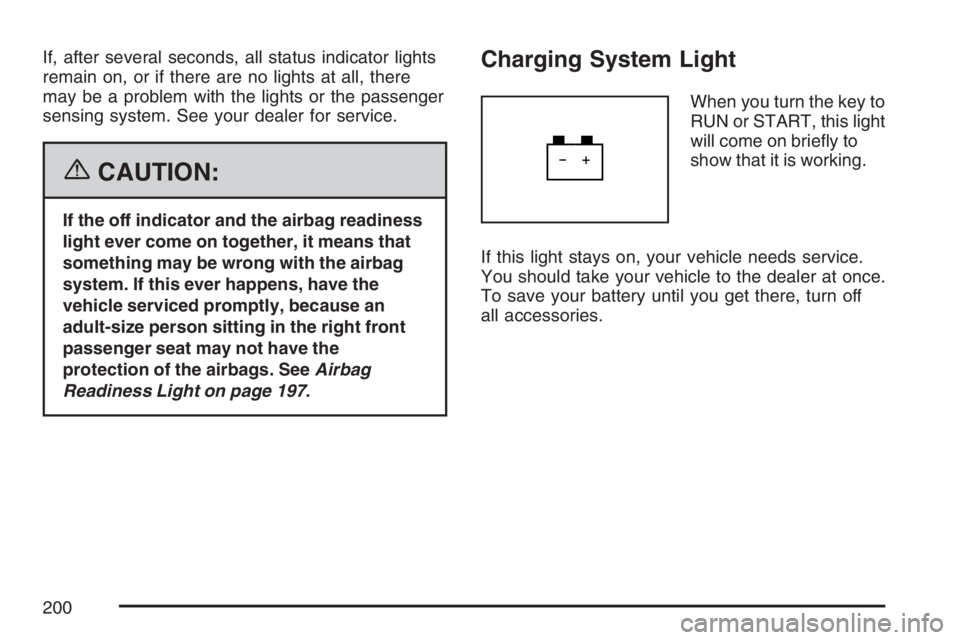
Charging System Light
When you turn the key to
RUN or START, this light
will come on briey to
show that it is working.
If this light stays on, your vehicle needs service.
You should take your vehicle to the dealer at once.
To save your battery until you get there, turn off
all accessories.
200
Page 208 of 496
Did you just drive through a deep puddle of
water?
If so, your electrical system may be wet. The
condition will usually be corrected when the
electrical system dries out. A few driving trips
should turn the light off.
Have you recently changed brands of fuel?
If so, be sure to fuel your vehicle with quality fuel.
SeeGasoline Octane on page 327. Poor fuel
quality will cause your engine not to run as
efficiently as designed. You may notice this as
stalling after start-up, stalling when you put
the vehicle into gear, misring, hesitation on
acceleration, or stumbling on acceleration. (These
conditions may go away once the engine is warmed
up.) This will be detected by the system and cause
the light to turn on.
If you experience one or more of these conditions,
change the fuel brand you use. It will require at
least one full tank of the proper fuel to turn the
light off.
If none of the above steps have made the light turn
off, your dealer can check the vehicle. Your dealer
has the proper test equipment and diagnostic tools
to x any mechanical or electrical problems that
may have developed.Emissions Inspection and Maintenance
Programs
Some state/provincial and local governments have
or may begin programs to inspect the emission
control equipment on your vehicle. Failure to pass
this inspection could prevent you from getting a
vehicle registration.
Here are some things you need to know in order
to help your vehicle pass an inspection:
Your vehicle will not pass this inspection if the
check engine light is on or not working properly.
Your vehicle will not pass this inspection if the OBD
(on-board diagnostic) system determines that
critical emission control systems have not been
completely diagnosed by the system. The vehicle
would be considered not ready for inspection. This
can happen if you have recently replaced your
battery or if your battery has run down. The
diagnostic system is designed to evaluate critical
emission control systems during normal driving.
This may take several days of routine driving. If you
have done this and your vehicle still does not pass
the inspection for lack of OBD system readiness,
your dealer can prepare the vehicle for inspection.
208
Page 221 of 496
DIC Warnings and Messages
Messages are displayed on the DIC to notify the
driver that the status of the vehicle has changed
and that some action may be needed by the driver
to correct the condition. Multiple messages may
appear one after another. Some messages may not
require immediate action, but you can press the
set/reset button to acknowledge that you received
the message and clear it from the DIC display.
Pressing any of the DIC buttons also acknowledges
and clears any messages. Some messages cannot
be cleared from the DIC display because they are
more urgent. These messages require action
before they can be cleared. You should take any
messages that appear on the display seriously and
remember that clearing the messages will only
make the messages disappear, not correct the
problem. The following are the possible messages
that can be displayed and some information
about them.
AUTOMATIC LIGHT CONTROL OFF
This message displays when the automatic
headlamps are turned off. SeeExterior Lamps
on page 170for more information.
AUTOMATIC LIGHT CONTROL ON
This message displays when the automatic
headlamps are turned on. SeeExterior Lamps
on page 170for more information.
BATTERY SAVER ACTIVE
This message displays when the system detects
that the battery voltage is dropping beyond a
reasonable level. The battery saver system starts
reducing certain features of the vehicle that you
may be able to notice. At the point that the features
are disabled, this message is displayed. It means
that the vehicle is trying to save the charge in the
battery.
Turn off all unnecessary accessories to allow the
battery to recharge.
The normal battery voltage range is
11.5 to 15.5 volts.
221