rear seats BUICK LUCERNE 2009 Owner's Manual
[x] Cancel search | Manufacturer: BUICK, Model Year: 2009, Model line: LUCERNE, Model: BUICK LUCERNE 2009Pages: 436
Page 1 of 436
Seats and Restraint System............................. 1-1
Head Restraints
......................................... 1-2
Front Seats
............................................... 1-4
Rear Seats
..............................................1-12
Safety Belts
.............................................1-12
Child Restraints
.......................................1-35
Airbag System
.........................................1-58
Restraint System Check
............................1-74
Features and Controls..................................... 2-1
Keys
........................................................ 2-3
Doors and Locks
......................................2-10
Windows
.................................................2-15
Theft-Deterrent Systems
............................2-17
Starting and Operating Your Vehicle
...........2-20
Mirrors
....................................................2-34
Object Detection Systems
..........................2-38
OnStar
®System
......................................2-46
Universal Home Remote System
................2-50
Storage Areas
.........................................2-57
Instrument Panel............................................. 3-1
Instrument Panel Overview
.......................... 3-4
Climate Controls
......................................3-21
Warning Lights, Gages, and Indicators
........3-32
Driver Information Center (DIC)
..................3-49
Audio System(s)
.......................................3-75Driving Your Vehicle....................................... 4-1
Your Driving, the Road, and the Vehicle
....... 4-2
Towing
...................................................4-23
Service and Appearance Care.......................... 5-1
Service
..................................................... 5-3
Fuel
......................................................... 5-5
Checking Things Under the Hood
...............5-12
Headlamp Aiming
.....................................5-51
Bulb Replacement
....................................5-54
Windshield Wiper Blade Replacement
.........5-57
Tires
......................................................5-59
Appearance Care
.....................................5-92
Vehicle Identication
...............................5-100
Electrical System
....................................5-100
Capacities and Specications
...................5-109
Maintenance Schedule..................................... 6-1
Maintenance Schedule
................................ 6-2
Customer Assistance Information.................... 7-1
Customer Assistance and Information
........... 7-2
Reporting Safety Defects
...........................7-15
Vehicle Data Recording and Privacy
...........7-17
Index................................................................ 1
2009 Buick Lucerne Owner ManualM
Page 5 of 436
Head Restraints...............................................1-2
Front Seats......................................................1-4
Manual Seats................................................1-4
Power Seats..................................................1-5
Power Lumbar ...............................................1-5
Heated Seats.................................................1-6
Heated and Cooled Seats................................1-7
Memory Seat and Mirrors................................1-8
Reclining Seatbacks........................................1-9
Center Seat.................................................1-12
Rear Seats.....................................................1-12
Rear Seat Pass-Through Door........................1-12
Safety Belts...................................................1-12
Safety Belts: They Are for Everyone................1-12
How to Wear Safety Belts Properly.................1-18
Lap-Shoulder Belt.........................................1-27
Safety Belt Use During Pregnancy..................1-33
Lap Belt......................................................1-33
Safety Belt Extender.....................................1-34
Child Restraints.............................................1-35
Older Children..............................................1-35
Infants and Young Children............................1-38
Child Restraint Systems.................................1-41Where to Put the Restraint.............................1-44
Lower Anchors and Tethers for
Children (LATCH)......................................1-45
Securing a Child Restraint in a
Rear Seat Position....................................1-51
Securing a Child Restraint in the
Center Front Seat Position..........................1-54
Securing a Child Restraint in the
Right Front Seat Position............................1-54
Airbag System...............................................1-58
Where Are the Airbags?................................1-60
When Should an Airbag Inate?.....................1-63
What Makes an Airbag Inate?.......................1-65
How Does an Airbag Restrain?......................
.1-65
What Will You See After an Airbag Inates?.....1-66
Passenger Sensing System............................1-67
Servicing Your Airbag-Equipped Vehicle...........1-72
Adding Equipment to Your
Airbag-Equipped Vehicle.............................1-73
Restraint System Check..................................1-74
Checking the Restraint Systems......................1-74
Replacing Restraint System Parts
After a Crash............................................1-75
Section 1 Seats and Restraint System
1-1
Page 8 of 436
Front Seats
Manual Seats
{CAUTION:
You can lose control of the vehicle if you try to
adjust a manual driver’s seat while the vehicle is
moving. The sudden movement could startle and
confuse you, or make you push a pedal when you
do not want to. Adjust the driver’s seat only when
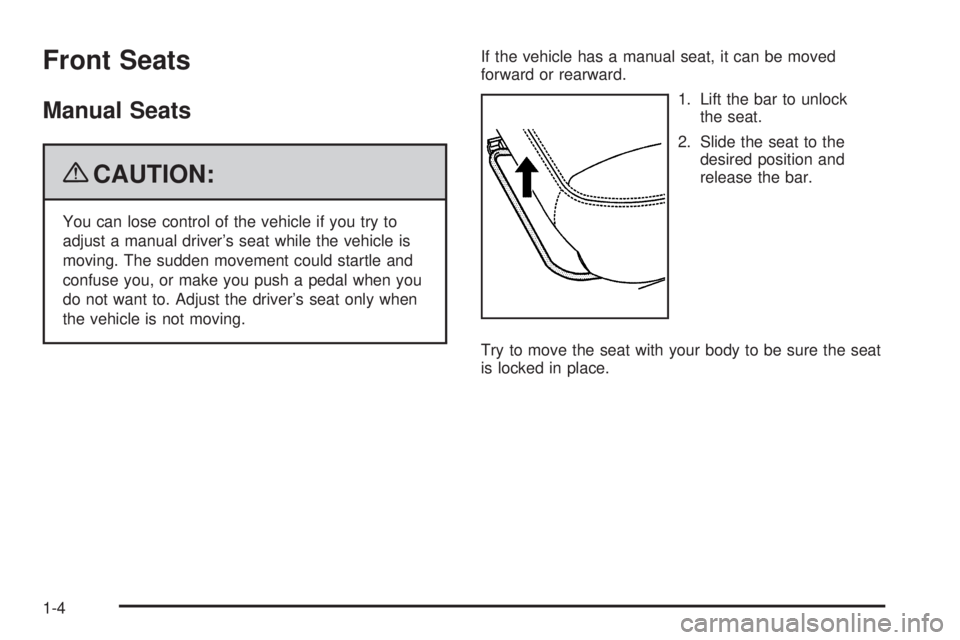
the vehicle is not moving.If the vehicle has a manual seat, it can be moved
forward or rearward.
1. Lift the bar to unlock
the seat.
2. Slide the seat to the
desired position and
release the bar.
Try to move the seat with your body to be sure the seat
is locked in place.
1-4
Page 9 of 436
Power Seats
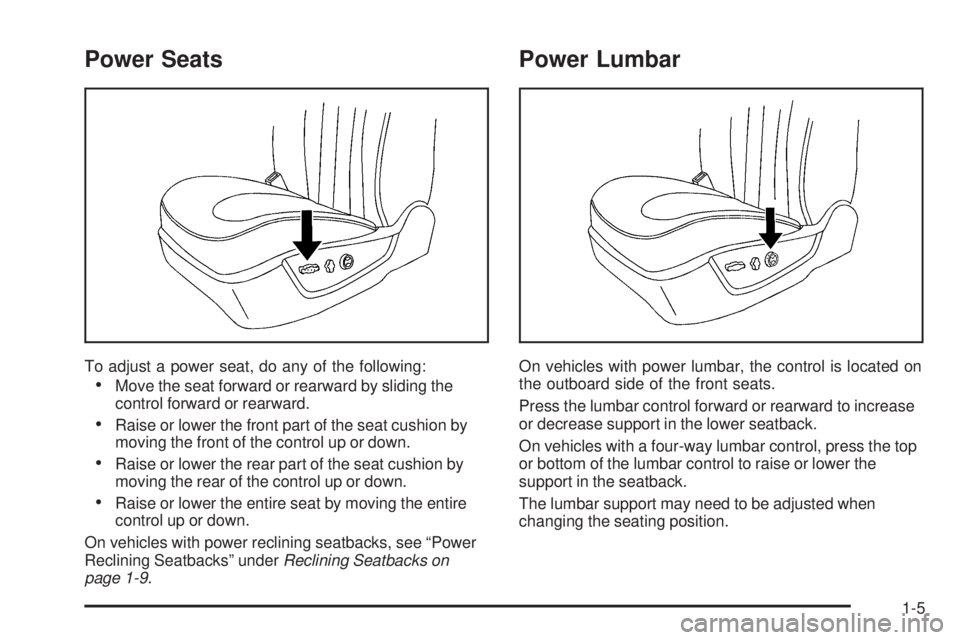
To adjust a power seat, do any of the following:
Move the seat forward or rearward by sliding the
control forward or rearward.
Raise or lower the front part of the seat cushion by
moving the front of the control up or down.
Raise or lower the rear part of the seat cushion by
moving the rear of the control up or down.
Raise or lower the entire seat by moving the entire
control up or down.
On vehicles with power reclining seatbacks, see “Power
Reclining Seatbacks” underReclining Seatbacks on
page 1-9.
Power Lumbar
On vehicles with power lumbar, the control is located on
the outboard side of the front seats.
Press the lumbar control forward or rearward to increase
or decrease support in the lower seatback.
On vehicles with a four-way lumbar control, press the top
or bottom of the lumbar control to raise or lower the
support in the seatback.
The lumbar support may need to be adjusted when
changing the seating position.
1-5
Page 14 of 436
To return the seatback to an upright position, do the
following:
1. Lift the lever fully without applying pressure to the
seatback and the seatback will return to the upright
position.
2. Push and pull on the seatback to make sure it is
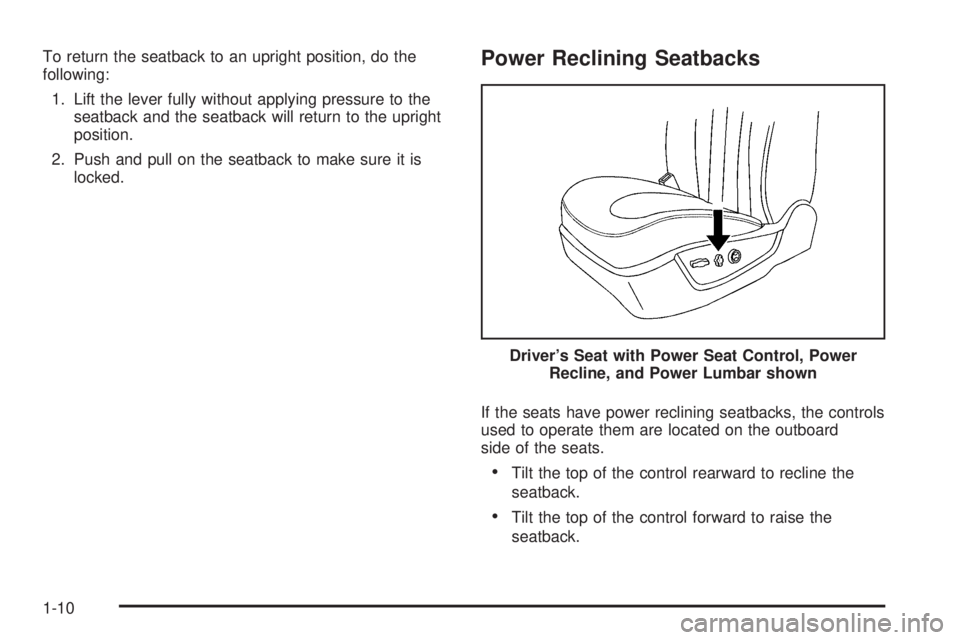
locked.Power Reclining Seatbacks
If the seats have power reclining seatbacks, the controls
used to operate them are located on the outboard
side of the seats.
Tilt the top of the control rearward to recline the
seatback.
Tilt the top of the control forward to raise the
seatback. Driver’s Seat with Power Seat Control, Power
Recline, and Power Lumbar shown
1-10
Page 16 of 436
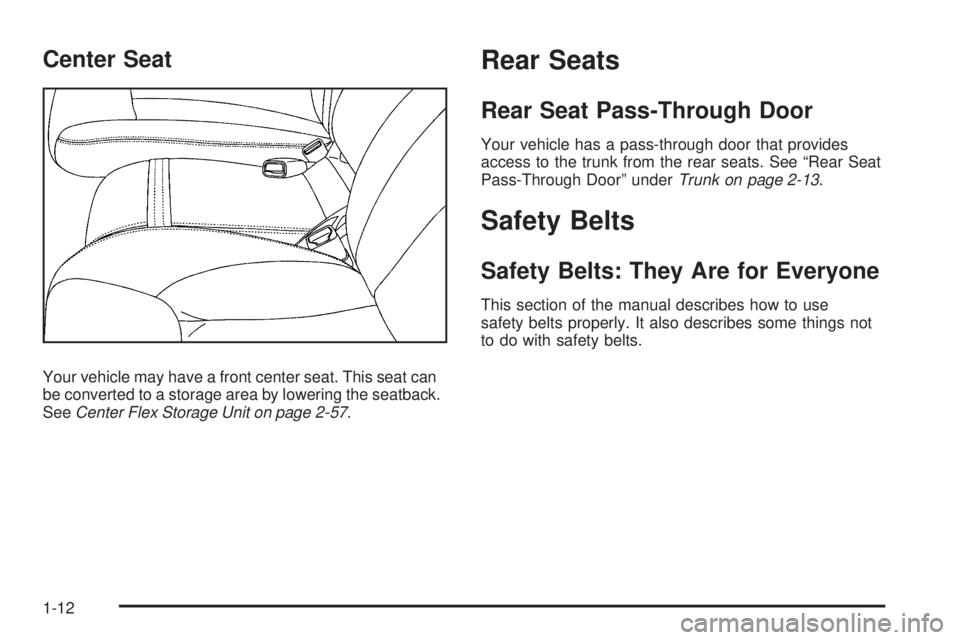
Center Seat
Your vehicle may have a front center seat. This seat can
be converted to a storage area by lowering the seatback.
SeeCenter Flex Storage Unit on page 2-57.
Rear Seats
Rear Seat Pass-Through Door
Your vehicle has a pass-through door that provides
access to the trunk from the rear seats. See “Rear Seat
Pass-Through Door” underTrunk on page 2-13.
Safety Belts
Safety Belts: They Are for Everyone
This section of the manual describes how to use
safety belts properly. It also describes some things not
to do with safety belts.
1-12
Page 34 of 436
Safety Belt Pretensioners
This vehicle has safety belt pretensioners for
front outboard occupants. Although the safety belt
pretensioners cannot be seen, they are part of the
safety belt assembly. They can help tighten the safety
belts during the early stages of a moderate to severe
frontal or near frontal crash if the threshold conditions
for pretensioner activation are met. And, if your vehicle
has side impact airbags, safety belt pretensioners can
help tighten the safety belts in a side crash.
Pretensioners work only once. If the pretensioners
activate in a crash, they will need to be replaced,
and probably other new parts for the vehicle’s safety
belt system. SeeReplacing Restraint System Parts
After a Crash on page 1-75.
Rear Safety Belt Comfort Guides
Rear shoulder belt comfort guides may provide added
safety belt comfort for older children who have outgrown
booster seats and for some adults. When installed on
a shoulder belt, the comfort guide positions the shoulder
belt away from the neck and head.
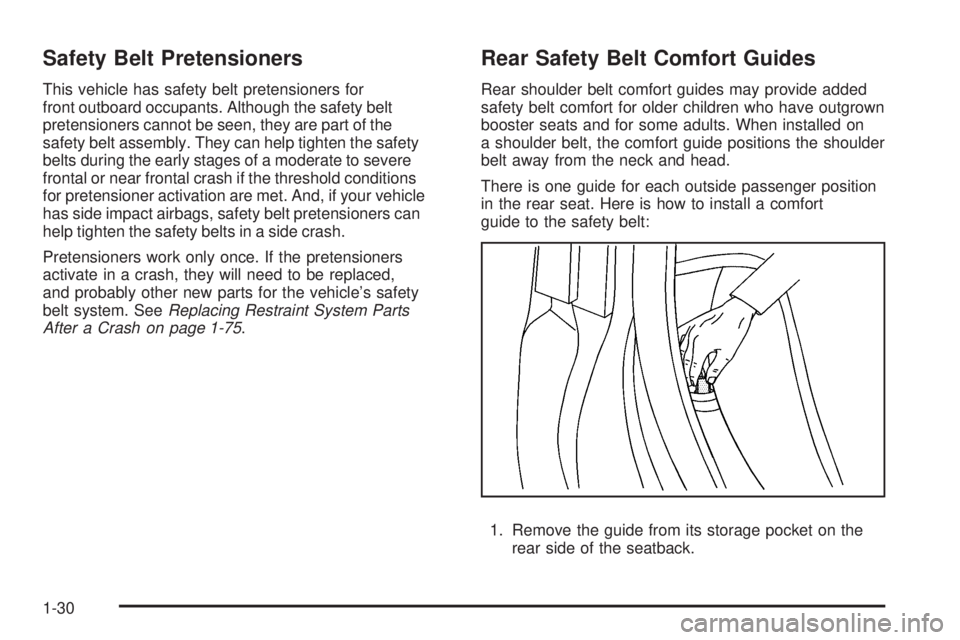
There is one guide for each outside passenger position
in the rear seat. Here is how to install a comfort
guide to the safety belt:
1. Remove the guide from its storage pocket on the
rear side of the seatback.
1-30
Page 39 of 436
Child Restraints
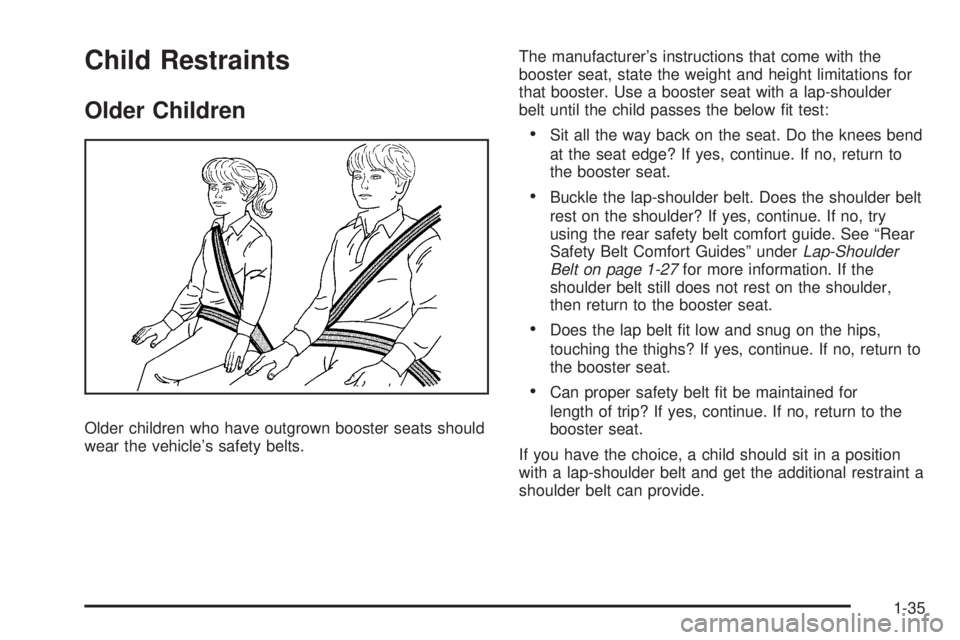
Older Children
Older children who have outgrown booster seats should
wear the vehicle’s safety belts.The manufacturer’s instructions that come with the
booster seat, state the weight and height limitations for
that booster. Use a booster seat with a lap-shoulder
belt until the child passes the below t test:
Sit all the way back on the seat. Do the knees bend
at the seat edge? If yes, continue. If no, return to
the booster seat.
Buckle the lap-shoulder belt. Does the shoulder belt
rest on the shoulder? If yes, continue. If no, try
using the rear safety belt comfort guide. See “Rear
Safety Belt Comfort Guides” underLap-Shoulder
Belt on page 1-27for more information. If the
shoulder belt still does not rest on the shoulder,
then return to the booster seat.
Does the lap belt t low and snug on the hips,
touching the thighs? If yes, continue. If no, return to
the booster seat.
Can proper safety belt t be maintained for
length of trip? If yes, continue. If no, return to the
booster seat.
If you have the choice, a child should sit in a position
with a lap-shoulder belt and get the additional restraint a
shoulder belt can provide.
1-35
Page 88 of 436
Remote Vehicle Start
Your vehicle may have a remote starting feature. This
feature allows you to start the engine from outside the
vehicle. It may also start the vehicle’s heating or air
conditioning systems, rear window defogger, and heated
seats. SeeHeated Seats on page 1-6andHeated and
Cooled Seats on page 1-7for additional information.
When the remote start system is active, the climate
control system will heat or cool the inside of the vehicle at
the setting the vehicle was set to when the vehicle was
last turned off. The rear window defogger will be turned
on by the climate control system when it is cold outside.
If the vehicle has heated seats, they may also turn on
when it is cold outside. Cooled seats are not activated
during a remote start. Normal operation of the system will
return after the key is turned to the ON/RUN position.
Laws in some communities may restrict the use of remote
starters. For example, some laws may require a person
using the remote start to have the vehicle in view when
doing so. Check local regulations for any requirements on
remote starting of vehicles.
Do not use the remote start feature if your vehicle is low
on fuel. Your vehicle may run out of fuel.
If your vehicle has the remote start feature, the RKE
transmitter functions will have an increased range
of operation. However, the range may be less while
the vehicle is running.There are other conditions which can affect the
performance of the transmitter, seeRemote Keyless
Entry (RKE) System on page 2-4for additional
information.
/(Remote Start):This button will be on the RKE
transmitter if you have remote start.
To start the vehicle using the remote start feature:
1. Aim the transmitter at the vehicle.
2. Press and release the transmitter’s lock button, then
immediately press and hold the transmitter’s remote
start button until the turn signal lights ash or if the
vehicle’s lights are not visible, press and hold the
remote start button for at least four seconds. The
vehicle’s doors will lock.
When the vehicle starts, the parking lamps will turn
on and remain on while the vehicle is running.
3. If it is the rst remote start since the vehicle has
been driven, repeat these steps, while the engine is
still running, to extend the engine running time by
10 minutes. Remote start can be extended one time.
After entering the vehicle during a remote start, insert
and turn the key to ON/RUN to drive the vehicle.
If the vehicle is left running it will automatically shut off
after 10 minutes unless a time extension has been done.
2-8
Page 157 of 436
Electric Power Management
The vehicle has Electric Power Management (EPM) that
estimates the battery’s temperature and state of charge.
It then adjusts the voltage for best performance and
extended life of the battery.
When the battery’s state of charge is low, the voltage is
raised slightly to quickly bring the charge back up. When
the state of charge is high, the voltage is lowered slightly
to prevent overcharging. If the vehicle has a voltmeter
gage or a voltage display on the Driver Information
Center (DIC), you may see the voltage move up or down.
This is normal. If there is a problem, an alert will be
displayed.
The battery can be discharged at idle if the electrical
loads are very high. This is true for all vehicles.
This is because the generator (alternator) may not
be spinning fast enough at idle to produce all the
power that is needed for very high electrical loads.
A high electrical load occurs when several of the
following are on, such as: headlamps, high beams,
fog lamps, rear window defogger, climate control fan at
high speed, heated seats, engine cooling fans, trailer
loads, and loads plugged into accessory power outlets.EPM works to prevent excessive discharge of the battery.
It does this by balancing the generator’s output and the
vehicle’s electrical needs. It can increase engine idle
speed to generate more power, whenever needed.
It can temporarily reduce the power demands of some
accessories.
Normally, these actions occur in steps or levels, without
being noticeable. In rare cases at the highest levels of
corrective action, this action may be noticeable to the
driver. If so, a Driver Information Center (DIC) message
might be displayed, such as BATTERY SAVER ACTIVE,
BATTERY VOLTAGE LOW, or LOW BATTERY. If this
message is displayed, it is recommended that the driver
reduce the electrical loads as much as possible. SeeDIC
Warnings and Messages on page 3-56.
Inadvertent Power Battery Saver
This feature is designed to protect your vehicle’s battery
against drainage from the interior lamps, or garage door
opener. When the ignition is turned off, the power to
these features will automatically turn off after 10 minutes.
Power will be restored for an additional 10 minutes if any
door is opened, the trunk is opened or the courtesy lamp
switch is turned on.
3-19