Brake cylinder BUICK LUCERNE 2010 Owner's Manual
[x] Cancel search | Manufacturer: BUICK, Model Year: 2010, Model line: LUCERNE, Model: BUICK LUCERNE 2010Pages: 474
Page 319 of 474

A.Underhood Fuse Blockon page 6‑110.
B. Remote Positive (+) Terminal. See Jump Starting
on page 6‑44.
C. Windshield Washer Fluid Reservoir. See “Adding
Washer Fluid” underWindshield Washer Fluid
on
page 6‑39.
D. Engine Coolant Surge Tank and Pressure Cap. See Cooling System on page 6‑26.
E. Remote Negative (−) Terminal. See Jump Starting
on page 6‑44.
F. Power Steering Fluid on page 6‑38.
G. Engine Oil Fill Cap. See “When to Add Engine Oil”
under Engine Oil on page 6‑17.
H. Engine Oil Dipstick. See “Checking Engine Oil”
under Engine Oil on page 6‑17.
I. Brake Master Cylinder Reservoir. See “Brake
Fluid” under Brakes on page 6‑40.
J. Automatic Transmission Fluid Cap and Dipstick (Out of View). See Automatic Transmission Fluid
on page 6‑23.
K. Engine Air Cleaner/Filter on page 6‑21.
Engine Oil
Checking Engine Oil
It is a good idea to check the engine oil level at each
fuel fill. In order to get an accurate reading, the oil must
be warm and the vehicle must be on level ground.
The engine oil dipstick handle is a yellow loop. See
Engine Compartment Overview
on page 6‑14for the
location of the engine oil dipstick.
1. Turn off the engine and give the oil several minutes to drain back into the oil pan. If this is not done, the
oil dipstick might not show the actual level.
2. Pull out the dipstick and clean it with a paper towel or cloth, then push it back in all the way. Remove it
again, keeping the tip down, and check the level.
6-17
Page 342 of 474
Brakes
Brake Fluid
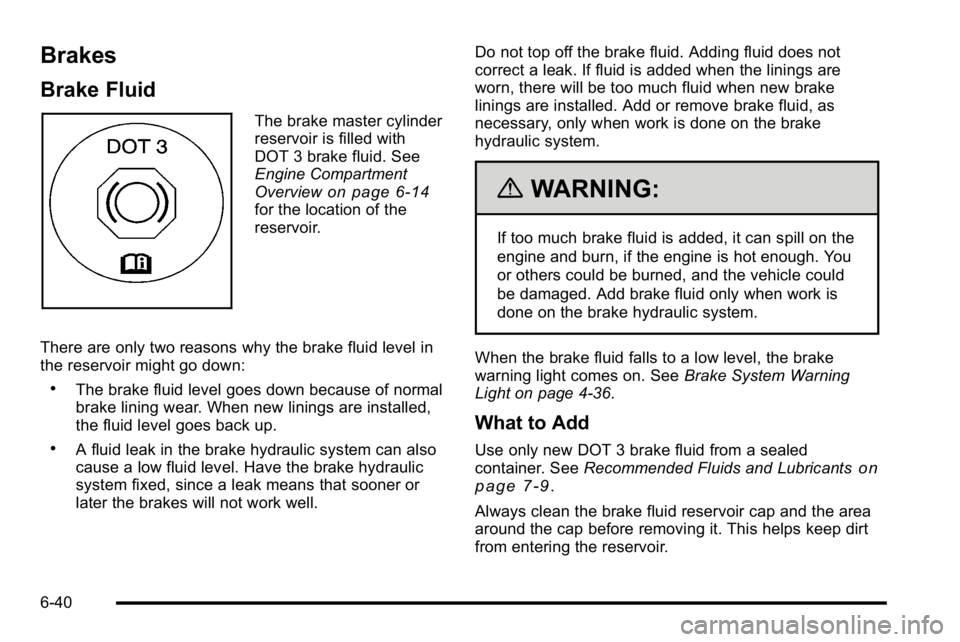
The brake master cylinder
reservoir is filled with
DOT 3 brake fluid. See
Engine Compartment
Overview
on page 6‑14for the location of the
reservoir.
There are only two reasons why the brake fluid level in
the reservoir might go down:
.The brake fluid level goes down because of normal
brake lining wear. When new linings are installed,
the fluid level goes back up.
.A fluid leak in the brake hydraulic system can also
cause a low fluid level. Have the brake hydraulic
system fixed, since a leak means that sooner or
later the brakes will not work well. Do not top off the brake fluid. Adding fluid does not
correct a leak. If fluid is added when the linings are
worn, there will be too much fluid when new brake
linings are installed. Add or remove brake fluid, as
necessary, only when work is done on the brake
hydraulic system.
{WARNING:
If too much brake fluid is added, it can spill on the
engine and burn, if the engine is hot enough. You
or others could be burned, and the vehicle could
be damaged. Add brake fluid only when work is
done on the brake hydraulic system.
When the brake fluid falls to a low level, the brake
warning light comes on. See Brake System Warning
Light on page 4‑36.
What to Add
Use only new DOT 3 brake fluid from a sealed
container. See Recommended Fluids and Lubricantson
page 7‑9.
Always clean the brake fluid reservoir cap and the area
around the cap before removing it. This helps keep dirt
from entering the reservoir.
6-40
Page 426 of 474
.Fluids visual leak check (or every 12 months,
whichever occurs first). A leak in any system must
be repaired and the fluid level checked.
.Engine air cleaner filter inspection (vehicles driven
in dusty conditions only). SeeEngine Air Cleaner/
Filter on page 6‑21.
.Brake system inspection (or every 12 months,
whichever occurs first).
Maintenance II
.Perform all services described in Maintenance I.
.Steering and suspension inspection. Visual
inspection for damaged, loose, or missing parts or
signs of wear.
.Engine cooling system inspection. Visual
inspection of hoses, pipes, fittings, and clamps
and replacement, if needed.
.Windshield wiper blade inspection for wear,
cracking, or contamination and windshield and
wiper blade cleaning, if contaminated. See
Windshield and Wiper Blades
on page 6‑106. Worn
or damaged wiper blade replacement. See
Windshield Wiper Blade Replacement
on
page 6‑55.
.Body hinges and latches, key lock cylinders, and
rear compartment, hood, glove box door, and
console door hinges and latches lubrication. See
Recommended Fluids and Lubricants
on
page 7‑9. More frequent lubrication may be
required when vehicle is exposed to a corrosive
environment. Applying silicone grease on
weatherstrips with a clean cloth makes them last
longer, seal better, and not stick or squeak.
.Restraint system component check. See Checking
the Restraint Systems on page 2‑74.
.Engine air cleaner filter inspection. See Engine Air
Cleaner/Filter on page 6‑21.
.Passenger compartment air filter replacement
(or every 12 months, whichever occurs first). More
frequent replacement may be required if vehicle is
driven regularly under dusty conditions.
7-4
Page 432 of 474

UsageFluid/Lubricant
Engine Coolant50/50 mixture of clean, drinkable
water and use only DEX-COOL
®
Coolant. See
Engine Coolant
(4.6L Engine)on page 6‑27or
Engine Coolant (3.9L Engine)on
page 6‑31.
Hydraulic Brake System DOT 3 Hydraulic Brake Fluid
(GM Part No. U.S. 88862806,
in Canada 88862807).
Windshield Washer Optikleen
®Washer Solvent.
Parking Brake Cable Guides Chassis Lubricant
(GM Part No. U.S. 12377985,
in Canada 88901242) or lubricant
meeting requirements of NLGI #2,
Category LB or GC-LB.
Power Steering System GM Power Steering Fluid
(GM Part No. U.S. 89021184,
in Canada 89021186).
Usage
Fluid/Lubricant
Automatic
Transmission DEXRON®-VI Automatic Transmission
Fluid.
Key Lock
Cylinders Multi-Purpose Lubricant, Superlube
(GM Part No. U.S. 12346241,
in Canada 10953474).
Hood Latch Assembly,
Secondary
Latch, Pivots,
Spring Anchor, and
Release Pawl Lubriplate Lubricant Aerosol
(GM Part No. U.S. 12346293,
in Canada 992723) or lubricant
meeting requirements of NLGI #2,
Category LB or GC-LB.
Hood and Door Hinges Multi-Purpose Lubricant, Superlube
(GM Part No. U.S. 12346241,
in Canada 10953474).
Weatherstrip Conditioning Weatherstrip Lubricant
(GM Part No. U.S. 3634770,
in Canada 10953518) or
Dielectric Silicone Grease
(GM Part No. U.S. 12345579,
in Canada 992887).
7-10