warning BUICK LUCERNE 2011 Owner's Manual
[x] Cancel search | Manufacturer: BUICK, Model Year: 2011, Model line: LUCERNE, Model: BUICK LUCERNE 2011Pages: 450, PDF Size: 3.63 MB
Page 380 of 450
Black plate (94,1)Buick Lucerne Owner Manual - 2011
10. Install the compact spare tire.
{WARNING:
Never use oil or grease on bolts or nuts because
the nuts might come loose. The vehicle's wheel
could fall off, causing a crash.
11. Put the wheel nuts back on with the rounded end of the nuts toward the wheel. Turn each nut
clockwise by hand until the wheel is held against
the hub.
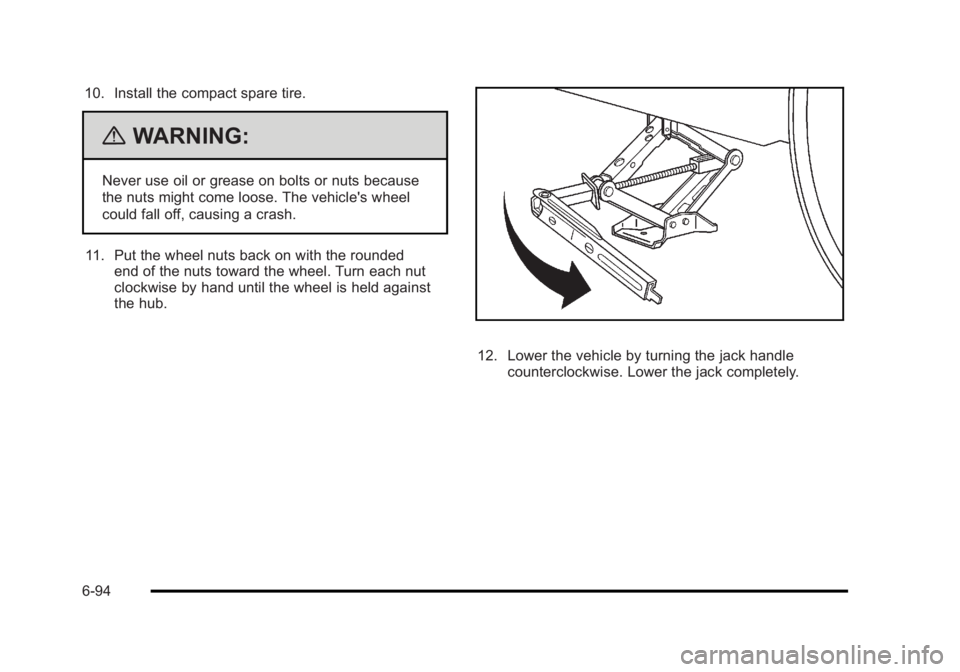
12. Lower the vehicle by turning the jack handle counterclockwise. Lower the jack completely.
6-94
Page 381 of 450
Black plate (95,1)Buick Lucerne Owner Manual - 2011
{WARNING:
Wheel nuts that are improperly or incorrectly
tightened can cause the wheels to become
loose or come off. The wheel nuts should be
tightened with a torque wrench to the proper
torque specification after replacing. Follow the
torque specification supplied by the aftermarket
manufacturer when using accessory locking wheel
nuts. SeeCapacities and Specifications
on
page 6‑116
for original equipment wheel nut
torque specifications.
Notice: Improperly tightened wheel nuts can lead
to brake pulsation and rotor damage. To avoid
expensive brake repairs, evenly tighten the
wheel nuts in the proper sequence and to the
proper torque specification. See Capacities and
Specifications
on page 6‑116for the wheel nut
torque specification.
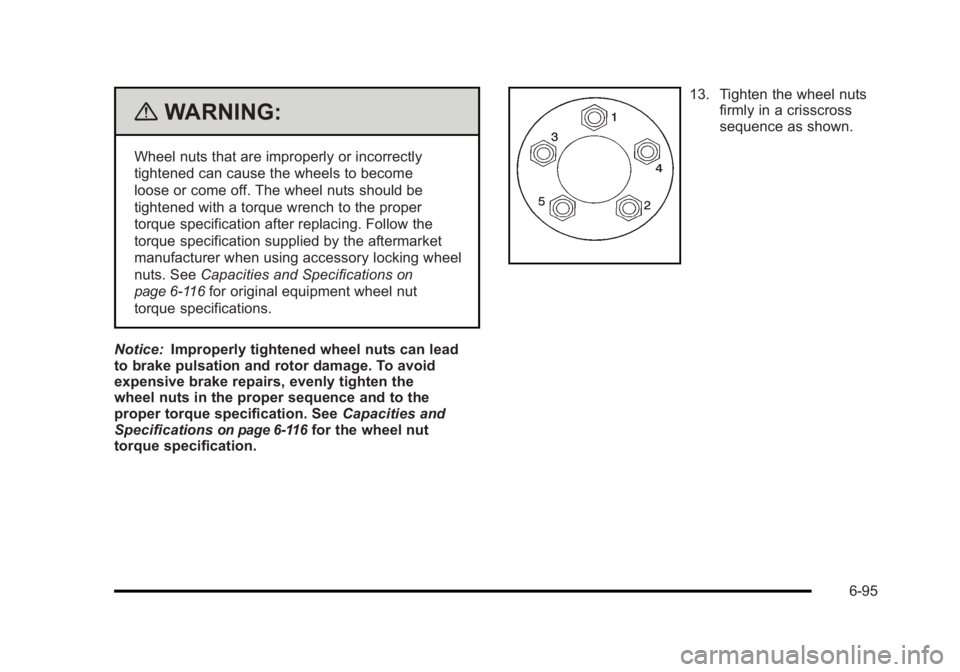
13. Tighten the wheel nuts
firmly in a crisscross
sequence as shown.
6-95
Page 382 of 450
Black plate (96,1)Buick Lucerne Owner Manual - 2011
Storing a Flat or Spare Tire and
Tools
{WARNING:
Storing a jack, a tire, or other equipment in the
passenger compartment of the vehicle could
cause injury. In a sudden stop or collision, loose
equipment could strike someone. Store all these
in the proper place.
After you have put the compact spare tire on your
vehicle, you need to store the flat tire in your trunk.
Store the flat tire as far forward in the trunk as possible.
Store the jack and wheel wrench in their compartment
in the trunk. For storage, the jack lift head must be
raised until the screw end is even with the edge of the
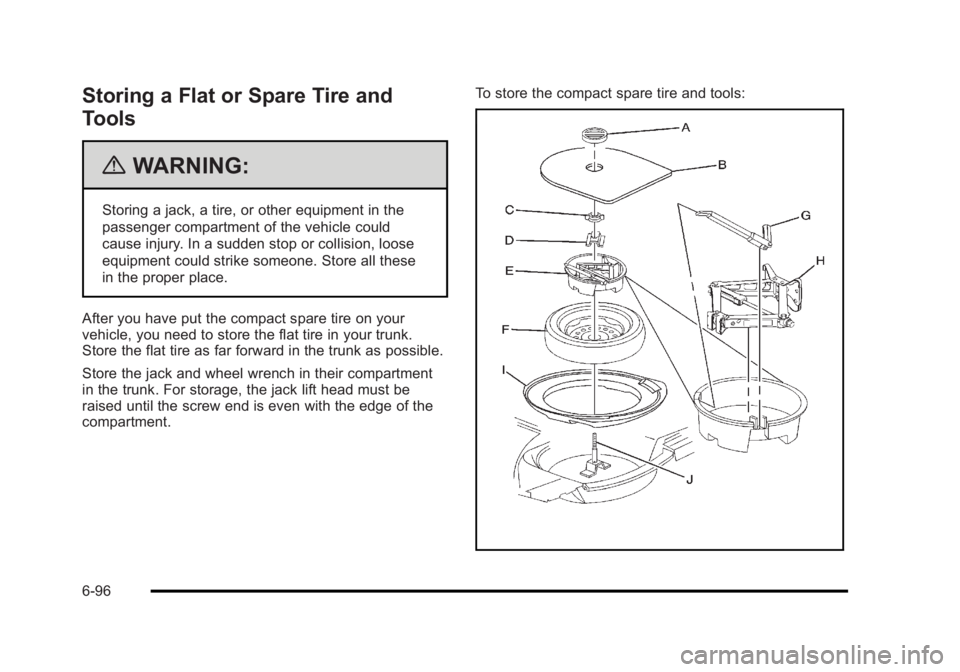
compartment. To store the compact spare tire and tools:
6-96
Page 383 of 450
Black plate (97,1)Buick Lucerne Owner Manual - 2011
A. Center Retainer
B. Compact SpareTire Cover
C. Retainer
D. Washer E. Jack Container F. Spare Tire
G. Wheel Wrench H. Jack
I. Foam Insert
J. Bolt
1. Open the trunk. See Trunk on page 3‑12.
2. Place the foam insert (I) in the trunk compartment.
3. Reinstall the compact spare tire (F) face down. Line up the wheel center hole with the bolt (J).
Then place it on the compartment floor.
4. Insert the jack container (E) into the spare tire (F).
5. Insert the wheel wrench (G) and jack (H) into the center of the compact spare tire making sure to
line up the wheel nut hole with the bolt (I) on the
compartment floor.
6. Secure the compact spare tire and the jack container (E) with the washer (D) and the
retainer (C).
7. Reinstall the compact spare tire cover (B).
8. Secure with the center retainer (A). The compact spare tire is for temporary use only.
Replace the compact spare tire with a full-size tire
as soon as you can. See
Compact Spare Tire
on
page 6‑97.
Compact Spare Tire
{WARNING:
Driving with more than one compact spare tire at
a time could result in loss of braking and handling.
This could lead to a crash and you or others could
be injured. Use only one compact spare tire at
a time.
If this vehicle has a compact spare tire it was fully
inflated when the vehicle was new, however, it can lose
air after a time. Check the inflation pressure regularly.
It should be 60 psi (420 kPa).
6-97
Page 387 of 450
Black plate (101,1)Buick Lucerne Owner Manual - 2011
Instrument Panel, Vinyl, and Other
Plastic Surfaces
A soft cloth dampened with water may be used to
remove dust. If a more thorough cleaning is necessary,
a clean soft cloth dampened with a mild soap solution
can be used to gently remove dust and dirt. Never use
spot lifters or removers on plastic surfaces. Many
commercial cleaners and coatings that are sold to
preserve and protect soft plastic surfaces may
permanently change the appearance and feel of the
interior and are not recommended. Do not use silicone
or wax-based products, or those containing organic
solvents to clean the vehicle's interior because they
can alter the appearance by increasing the gloss in a
non-uniform manner.
Some commercial products may increase gloss on the
instrument panel. The increase in gloss may cause
annoying reflections in the windshield and even make it
difficult to see through the windshield under certain
conditions.
Notice:Air fresheners contain solvents that may
cause damage to plastics and painted surfaces.
Follow the manufacturer ’s instructions when using
air fresheners in the vehicle. If air freshener comes
in contact with paint or a plastic surface, blot
immediately with a soft cloth. Damage caused by
using air fresheners would not be covered by the
vehicle warranty.
Care of Safety Belts
Keep belts clean and dry.
{WARNING:
Do not bleach or dye safety belts. It may severely
weaken them. In a crash, they might not be able
to provide adequate protection. Clean safety belts
only with mild soap and lukewarm water.
Weatherstrips
Silicone grease on weatherstrips will make them last
longer, seal better, and not stick or squeak. Apply
silicone grease with a clean cloth. During very cold,
damp weather frequent application may be required.
See Recommended Fluids and Lubricants
on
page 7‑8.
6-101
Page 398 of 450
Black plate (112,1)Buick Lucerne Owner Manual - 2011
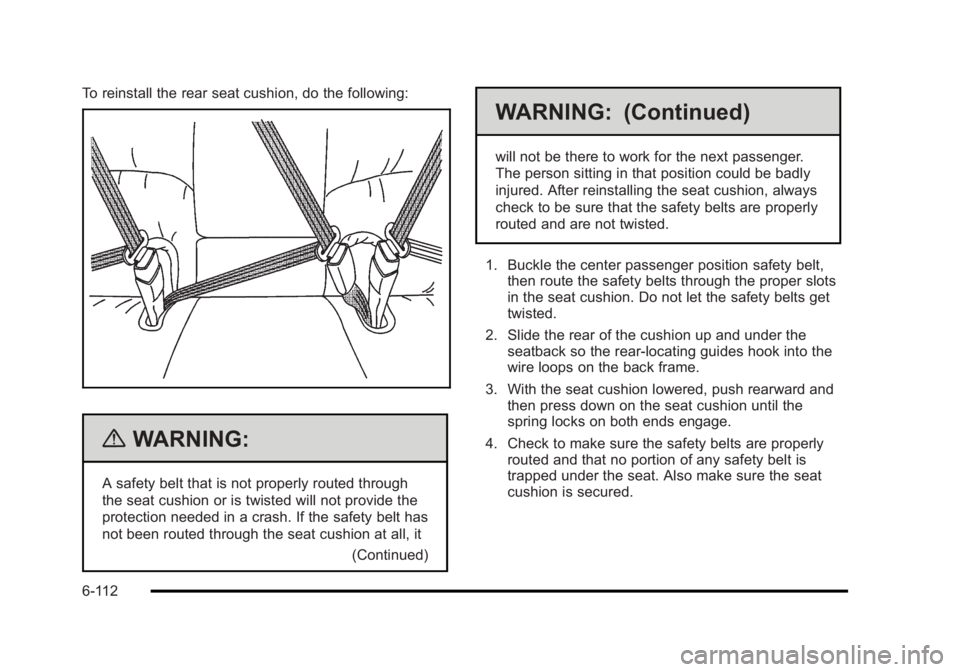
To reinstall the rear seat cushion, do the following:
{WARNING:
A safety belt that is not properly routed through
the seat cushion or is twisted will not provide the
protection needed in a crash. If the safety belt has
not been routed through the seat cushion at all, it(Continued)
WARNING: (Continued)
will not be there to work for the next passenger.
The person sitting in that position could be badly
injured. After reinstalling the seat cushion, always
check to be sure that the safety belts are properly
routed and are not twisted.
1. Buckle the center passenger position safety belt, then route the safety belts through the proper slots
in the seat cushion. Do not let the safety belts get
twisted.
2. Slide the rear of the cushion up and under the seatback so the rear-locating guides hook into the
wire loops on the back frame.
3. With the seat cushion lowered, push rearward and then press down on the seat cushion until the
spring locks on both ends engage.
4. Check to make sure the safety belts are properly routed and that no portion of any safety belt is
trapped under the seat. Also make sure the seat
cushion is secured.
6-112
Page 406 of 450
Black plate (2,1)Buick Lucerne Owner Manual - 2011
Maintenance Schedule
Introduction
Notice:Maintenance intervals, checks, inspections,
recommended fluids, and lubricants are necessary
to keep this vehicle in good working condition.
Damage caused by failure to follow scheduled
maintenance might not be covered by the vehicle
warranty.
As the vehicle owner, you are responsible for the
scheduled maintenance in this section. We recommend
having your dealer perform these services. Proper
vehicle maintenance helps to keep the vehicle in good
working condition, improves fuel economy, and reduces
vehicle emissions for better air quality.
Because of all the different ways people use vehicles,
maintenance needs vary. The vehicle might need
more frequent checks and services. Please read the
information under Scheduled Maintenance. To keep the
vehicle in good condition, see your dealer.
The maintenance schedule is for vehicles that:
.carry passengers and cargo within recommended
limits on the Tire and Loading Information label.
See Loading the Vehicle on page 5‑18.
.are driven on reasonable road surfaces within legal
driving limits.
.use the recommended fuel. See Gasoline Octaneon page 6‑6.
{WARNING:
Performing maintenance work on a vehicle can be
dangerous. In trying to do some jobs, you can be
seriously injured. Do your own maintenance work
only if you have the required know-how and the
proper tools and equipment for the job. If you
have any doubt, see your dealer to have a
qualified technician do the work. See Doing Your
Own Service Work on page 6‑4.
At your dealer, you can be certain that you will receive
the highest level of service available. Your dealer has
specially trained service technicians, uses genuine
replacement parts, as well as, up‐to‐date tools and
equipment to ensure fast and accurate diagnostics.
The proper replacement parts, fluids, and lubricants to
use are listed in Recommended Fluids and Lubricants
on page 7‑8andMaintenance Replacement Partson
page 7‑10. We recommend the use of genuine parts
from your dealer.
7-2
Page 410 of 450
Black plate (6,1)Buick Lucerne Owner Manual - 2011
Replace as needed.An Emission Control Service.
The U.S. Environmental Protection Agency or the
California Air Resources Board has determined
that the failure to perform this maintenance item
will not nullify the emission warranty or limit
recall liability prior to the completion of the
vehicle's useful life. We, however, urge that all
recommended maintenance services be performed
at the indicated intervals and the maintenance be
recorded.
First Engine Oil Change After Every
160 000 km/100,000 Miles
.Automatic transmission fluid change (normal
service). See Automatic Transmission Fluidon
page 6‑24.
.Spark plug replacement and spark plug wires
inspection. An Emission Control Service.
First Engine Oil Change After Every
240 000 km/150,000 Miles
.Engine cooling system drain, flush, and refill (or
every five years, whichever occurs first). See
Engine Coolant (4.6L Engine)
on page 6‑28or
Engine Coolant (3.9L Engine)on page 6‑31. An
Emission Control Service.
.Engine drive belts inspection for fraying, excessive
cracks, or obvious damage (or every 10 years,
whichever occurs first). Replace, if needed.
Owner Checks and Services
Starter Switch Check
{WARNING:
When you are doing this inspection, the vehicle
could move suddenly. If the vehicle moves, you or
others could be injured.
1. Before starting this check, be sure there is enough room around the vehicle.
2. Firmly apply both the parking brake and the regular brake. See Parking Brake on page 3‑26.
Do not use the accelerator pedal, and be ready to
turn off the engine immediately if it starts.
3. Try to start the engine in each gear. The vehicle should start only in P (Park) or N (Neutral). If the
vehicle starts in any other position, contact your
dealer for service.
7-6
Page 411 of 450
Black plate (7,1)Buick Lucerne Owner Manual - 2011
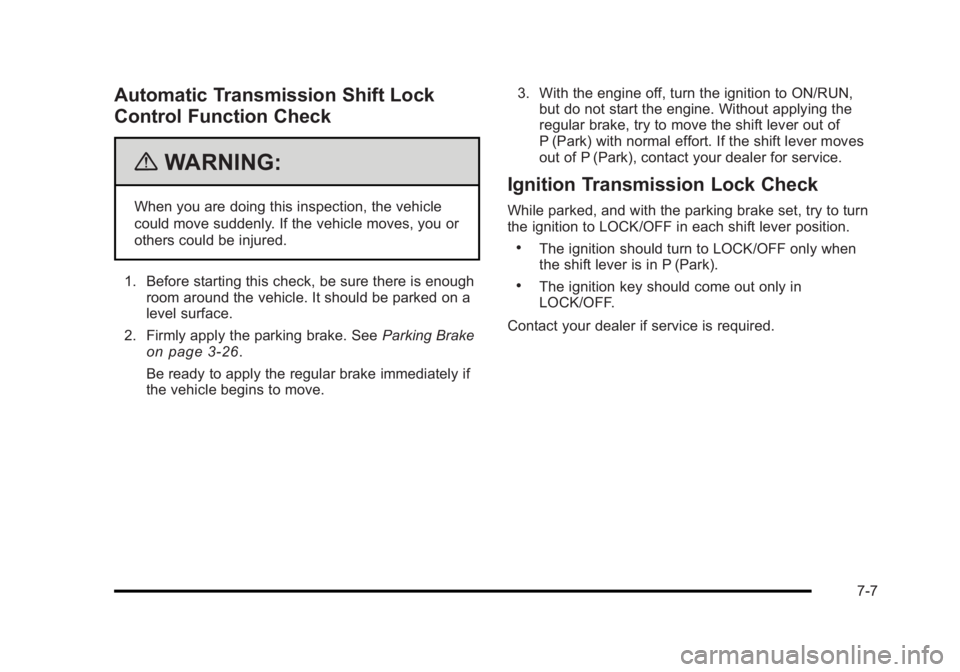
Automatic Transmission Shift Lock
Control Function Check
{WARNING:
When you are doing this inspection, the vehicle
could move suddenly. If the vehicle moves, you or
others could be injured.
1. Before starting this check, be sure there is enough room around the vehicle. It should be parked on a
level surface.
2. Firmly apply the parking brake. See Parking Brake
on page 3‑26.
Be ready to apply the regular brake immediately if
the vehicle begins to move. 3. With the engine off, turn the ignition to ON/RUN,
but do not start the engine. Without applying the
regular brake, try to move the shift lever out of
P (Park) with normal effort. If the shift lever moves
out of P (Park), contact your dealer for service.
Ignition Transmission Lock Check
While parked, and with the parking brake set, try to turn
the ignition to LOCK/OFF in each shift lever position.
.The ignition should turn to LOCK/OFF only when
the shift lever is in P (Park).
.The ignition key should come out only in
LOCK/OFF.
Contact your dealer if service is required.
7-7
Page 412 of 450
Black plate (8,1)Buick Lucerne Owner Manual - 2011
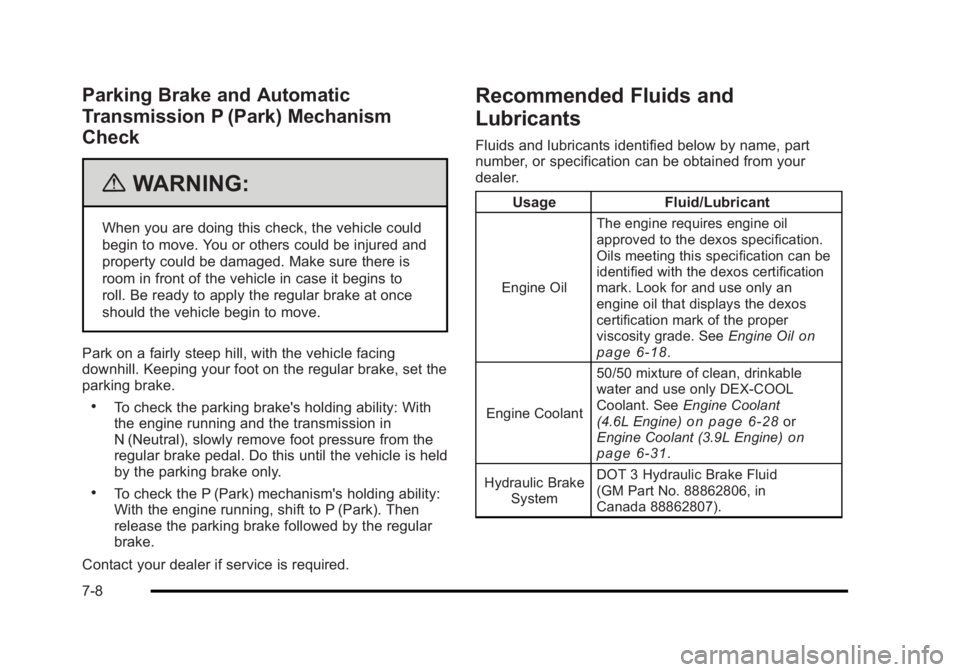
Parking Brake and Automatic
Transmission P (Park) Mechanism
Check
{WARNING:
When you are doing this check, the vehicle could
begin to move. You or others could be injured and
property could be damaged. Make sure there is
room in front of the vehicle in case it begins to
roll. Be ready to apply the regular brake at once
should the vehicle begin to move.
Park on a fairly steep hill, with the vehicle facing
downhill. Keeping your foot on the regular brake, set the
parking brake.
.To check the parking brake's holding ability: With
the engine running and the transmission in
N (Neutral), slowly remove foot pressure from the
regular brake pedal. Do this until the vehicle is held
by the parking brake only.
.To check the P (Park) mechanism's holding ability:
With the engine running, shift to P (Park). Then
release the parking brake followed by the regular
brake.
Contact your dealer if service is required.
Recommended Fluids and
Lubricants
Fluids and lubricants identified below by name, part
number, or specification can be obtained from your
dealer.
Usage Fluid/Lubricant
Engine Oil The engine requires engine oil
approved to the dexos specification.
Oils meeting this specification can be
identified with the dexos certification
mark. Look for and use only an
engine oil that displays the dexos
certification mark of the proper
viscosity grade. See
Engine Oil
on
page 6‑18.
Engine Coolant 50/50 mixture of clean, drinkable
water and use only DEX-COOL
Coolant. See
Engine Coolant
(4.6L Engine)
on page 6‑28or
Engine Coolant (3.9L Engine)on
page 6‑31.
Hydraulic Brake System DOT 3 Hydraulic Brake Fluid
(GM Part No. 88862806, in
Canada 88862807).
7-8