engine overheat BUICK PARK AVENUE 1993 User Guide
[x] Cancel search | Manufacturer: BUICK, Model Year: 1993, Model line: PARK AVENUE, Model: BUICK PARK AVENUE 1993Pages: 340, PDF Size: 18.17 MB
Page 223 of 340
Engine Overheating
You will find the warning light about a hot engine on
your Buick instrument panel and if you have the
optional gage cluster,
a coolant temperature gage.
You will also find a low coolant warning light
on your
Buick instrument panel.
If Steam Is Coming From Your Engine:
A CAUTION:
- _earn from an overheated engine can burn you
badly, even
if you just open the hood. Stay away
from the engine
if you see or hear steam coming
.. -m it. Just turn it off and get everyone away
from the vehicle until it cools down. Wait until
there
is no sign of steam or coolant before
opening the hood.
If you keep driving when your engine is
overheated, the liquids in
it can catch fire. You or
others could be badly burned. Stop your engine
if it overheats, and get out of the vehicle until the
sngine is cool.
- -
If No Steam Is Coming From Your Engine:
If you get the overheat warning but see or hear no
steam, the problem may not be too serious. Sometimes
the engine can get a little
too hot when you:
Climb a long hill on a hot day.
Stop after high speed driving.
Idle for long periods in traffic.
Tow a trailer.
221
ProCarManuals.com
Page 224 of 340
If you get the overheat warning with no sign of steam,
try this for a minute or
so:
1. Turn off your air conditioner.
2. Turn on your heater to full hot at the highest fan
speed and open the window as necessary.
3. If you’re in a traffic jam, shift to “N” (Neutral).
If
you no longer have the overheat warning, you can
drive. Just
to be safe, drive slower for about ten minutes.
If the warning doesn’t come back on,
you can drive
normally.
If the warning continues, pull over, stop, and park your
vehicle right away.
If there’s still no sign of steam, you can idle the engine
for two or three minutes while you’re parked, to see if
the warning stops. But then, if
you still have the
warning, TURN
OFF THE ENGINE AND GET
EVERYONE OUT
OF THE VEHICLE until it cools
down. You
may decide not to lift the hood but to get service
help right away.
e
w . ._
,
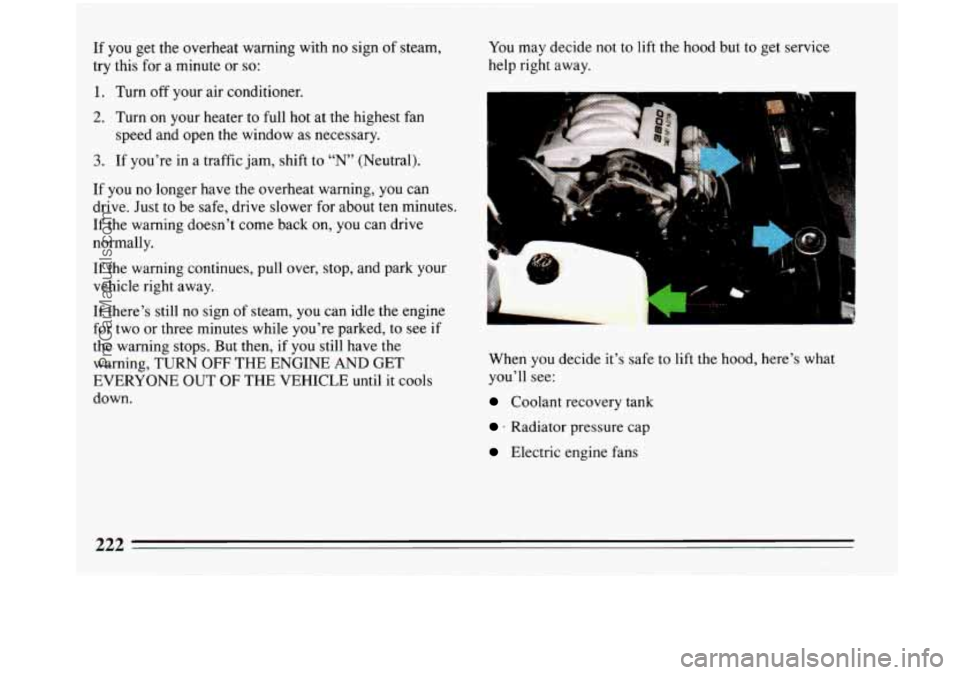
When you decide it’s safe to lift the hood, here’s what
you’ll see:
Coolant recovery tank
* Radiator pressure cap
Electric engine fans
ProCarManuals.com
Page 225 of 340
I A CAUTION:
An electric fan under the hood can start up even
when the engine
is not running and can injure
you. Keep hands, clothing and tools away from
any underhood electric fan.
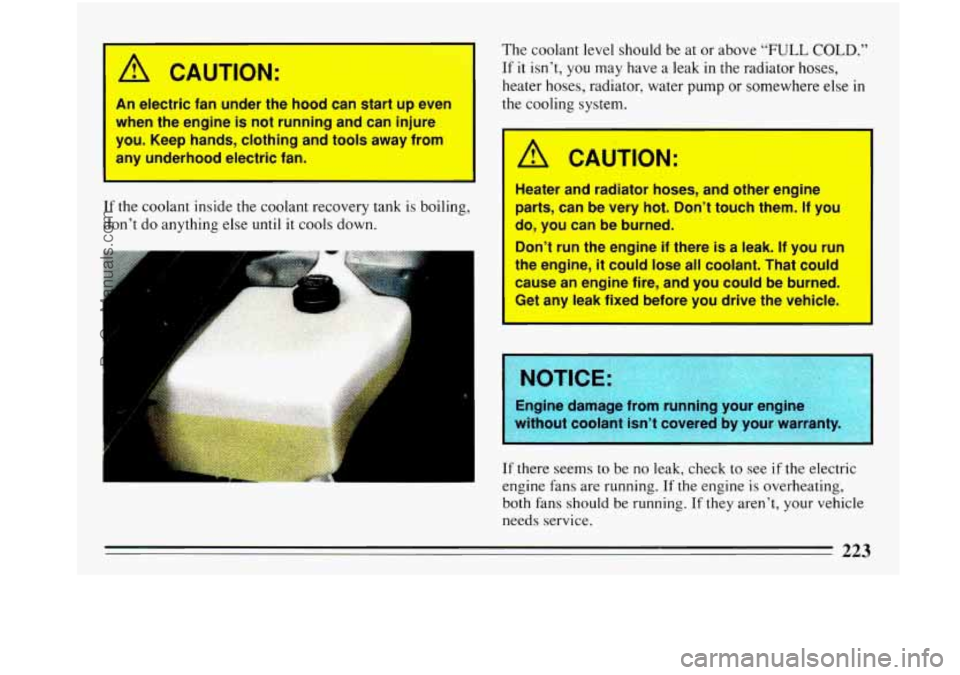
If the coolant inside the coolant recovery tank is boiling,
don’t do anything else until it cools down.
. .” P
The coolant level should be at or above “FULL COLD.”
If it isn’t, you may have a leak in the radiator hoses,
heater hoses, radiator, water pump
or somewhere else in
the cooling system.
I I
A CAUTION:
Heater and radiator hoses, and other engine
parts, can be very hot. Don’t touch them.
If you
do, you can be burned.
Don’t run the engine
if there is a leak. If you run
the engine, it could lose all coolant. That could
cause an engine fire, and you could be burned.
Get any leak fixed before you drive the vehicle.
I
Engine damage? Il’onl I mning bUrlr engine
without coolant isn’t covered by your warrbllr
If there seems to be no leak, check to see if the electric
engine fans are running. If the engine
is overheating,
both fans should be running. If they aren’t, your vehicle
needs service.
223
ProCarManuals.com
Page 226 of 340
How to Add Coolant to the Coolant
Recovery
Tank
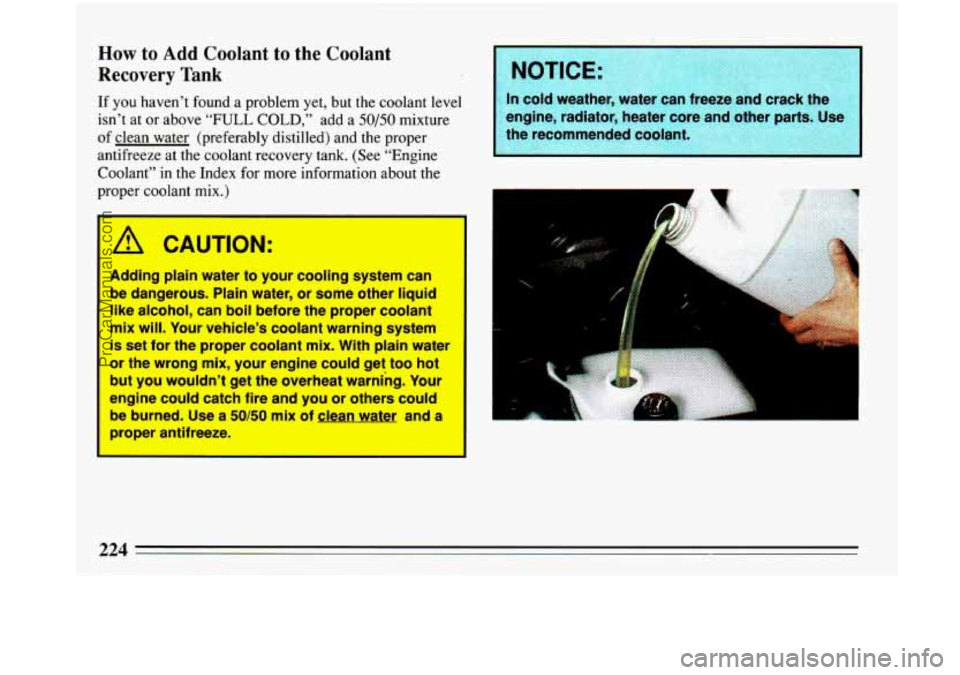
If you haven’t found a problem yet, but the coolant level In cold weather, water can free
isn’t at or above “FULL COLD,” add a 50/50 mixture
of clean water (preferably distilled) and the proper
antifreeze at the coolant recovery tank. (See “Engine
Coolant’’ in the Index for more information about the
proper coolant mix.)
I A CAUTION:
I Adding plain water to your cooling system can
be dangerous. Plain water, or some other liquid
like alcohol, can boll befare the proper coolant
mix will. Your vehicle’s coolant warning system
is set for the groper coolant mix. With plain water
.of the wrung mix, your engine could get too hot
but you wouldn’t get the overheat warning. Your
engine could catch fire and you or others could
be burned. Use a 50/50 mix of Glean water and a
proper antifreeze.
I
I
I
ProCarManuals.com
Page 227 of 340
A CAUTION: A CAUTION:
You can be burned if you spill cootant on hot
engine parts. Coolant contains ethylene glycol
and it will burn if the engine parts are hot
enough. Don’t spill coolant on a hot engine.
When the coolant in the coolant recovery tank is at or
above
“FULL COLD,” start your vehicle.
If the overheat warning continues, there’s one more
thing you can try.
You can add the proper coolant mix
directly
to the radiator, but be sure the cooling system is
cool before
you do it.
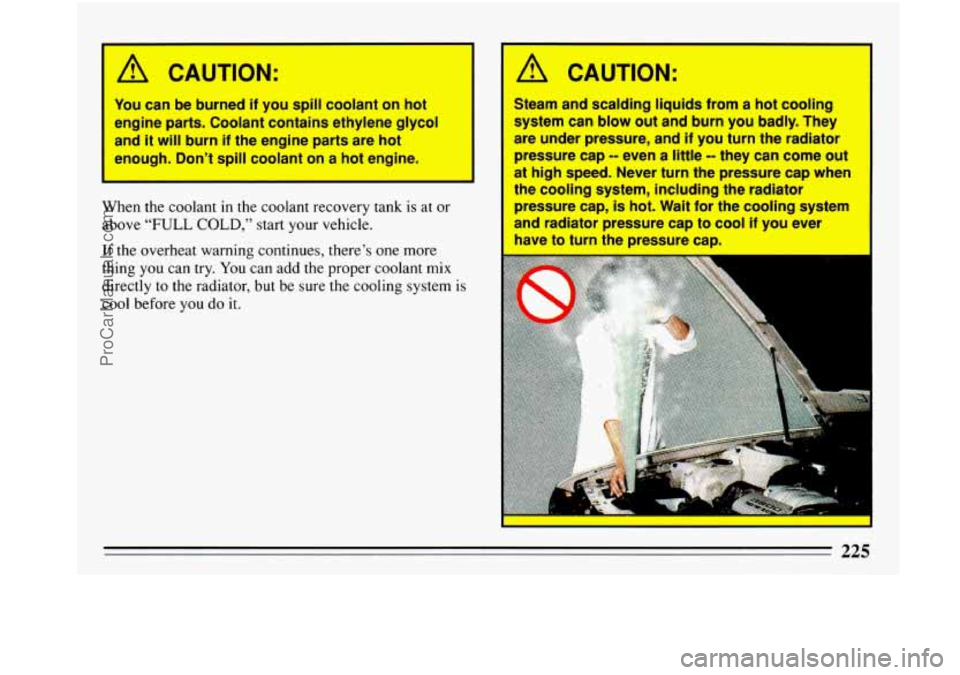
Steam and scalding liquids from a hot cooling
system can blow out and burn you badly. They
are under pressure, and if you turn the radiator
pressure cap
-- even a little -- they can come out
at high speed. Never turn the pressure cap when
e cooling system, including the radiator
pressure cap, is hot. Wait for the cooling system
and radiator pressure cap to cool
if you ever
have
to turn the pressure cap.
L
L
ProCarManuals.com
Page 241 of 340
If You’re Stuck: In Sand, Mud, Ice or
Snow
What you don’t want to do when your vehicle is stuck is
to spin your wheels. The method known as “rocking” can
help
you get out when you’re stuck, but you must use
caution.
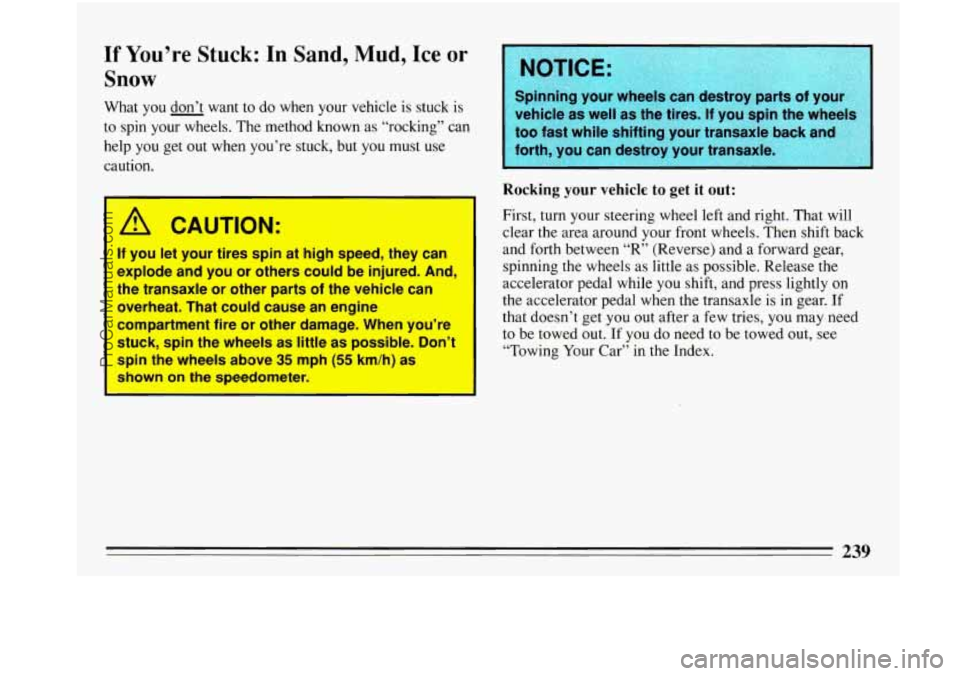
I A CAUTION:
If you let your tires spin at high speed, they can
explode and you or others could be injured. And,
the transaxle or other parts of the vehicle can
overheat. That could cause an engine
compartment fire or other damage. When you’re
stuck, spin the wheels as little as possible. Don’t
spin the wheels above
35 mph (55 km/h) as
shown
on the speedometer.
I = I
Spinning your wheels lestroy par __ of your
vehicle as well as the tires. If you spin the whe
too fast while shifting your transaxle back
forth, you can destroy your transaxle.
Rocking your vehicle to get it out:
First, turn your steering wheel left and right. That will
clear the area around your front wheels. Then shift back
and forth between
“R” (Reverse) and a forward gear,
spinning the wheels as little as possible. Release the
accelerator pedal while you shift, and press lightly on
the accelerator pedal when the transaxle is
in gear. If
that doesn’t get
you out after a few tries, you may need
to be towed out.
If you do need to be towed out, see
“Towing Your Car”
in the Index.
ProCarManuals.com
Page 260 of 340
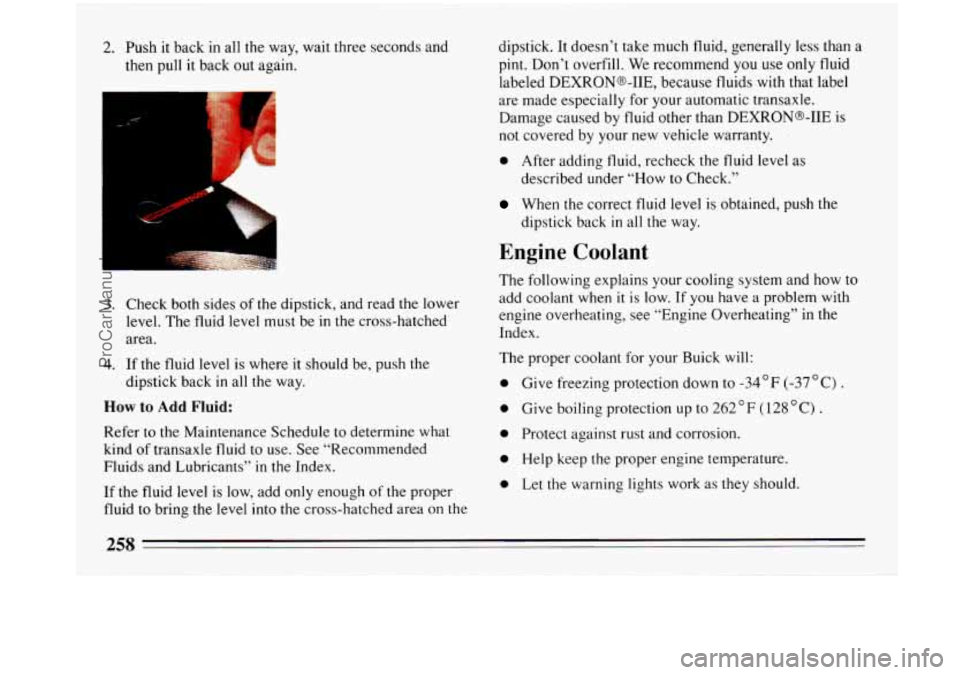
2. Push it back in all the way, wait three seconds and
then pull it back out again.
3. Check both sides of the dipstick, and read the lower
level. The fluid level must be in the cross-hatched
area.
4. If the fluid level is where it should be, push the
dipstick back
in all the way.
How to Add Fluid:
Refer to the Maintenance Schedule to determine what
kind of transaxle fluid to use. See “Recommended
Fluids and Lubricants” in the Index.
If the fluid level is low, add only enough of the proper
fluid to bring the level
into the cross-hatched area on the dipstick, It
doesn’t take much fluid, generally less than a
pint. Don’t overfill. We recommend
you use only fluid
labeled DEXRONWIE, because
fluids with that label
are made especially for your automatic transaxle.
Damage caused by fluid other than DEXRONB-IIE is
not covered by your new vehicle warranty.
0 After adding fluid, recheck the fluid level as
described under “How to Check.”
When the correct fluid level is obtained, push the
dipstick back
in all the way.
Engine Coolant
The following explains your cooling system and how to
add coolant when
it is low. If you have a problem with
engine overheating, see “Engine Overheating” in the
Index.
The proper coolant for your Buick will:
0 Give freezing protection down to -34°F (-37 “C) .
0 Give boiling protection up to 262 F ( 128 ” C) .
0 Protect against rust and corrosion.
0 Help keep the proper engine temperature.
0 Let the warning lights work as they should.
ProCarManuals.com
Page 261 of 340
What to Use:
Use a mixture of one-half clean water (preferably
distilled) and one-half antifreeze that meets “GM
Specification
1825-M,” which won’t damage aluminum
parts.
You can also use a recycled coolant conforming to
GM Specification
1825-M with a complete coolant flush
and refill. Use GM Engine Coolant Supplement (sealer)
with any complete coolant change. If you use these, you
don’t need
to add anything else.
A CAUTION:
Adding only plain water to your cooling system
can be dangerous. Plain water, or some other
liquid like alcohol, can boil before the proper
coolant mix will. Your vehicle’s coolant warning
system
is set for the proper coolant mix. With
plain water or the wrong mix, your engine could
get too hot but you wouldn’t get the overheat
warning. Your engine could catch fire and you or
others could be burned. Use
a 50/50 mix of clean
water and a proper antifreeze.
If you use an improper coolant mix, your
engine :,,I could overheat and be badly damaged. The’: . -
repair cost wouldn’t be covered by your -.. - ’
warranty. Too much water in the mix can !ete;::
and crack the engine, radiator, heater
Core and
other parts.
~. -.- . ~. .. ..._ - . . :-: -. ~ . . ~.., -
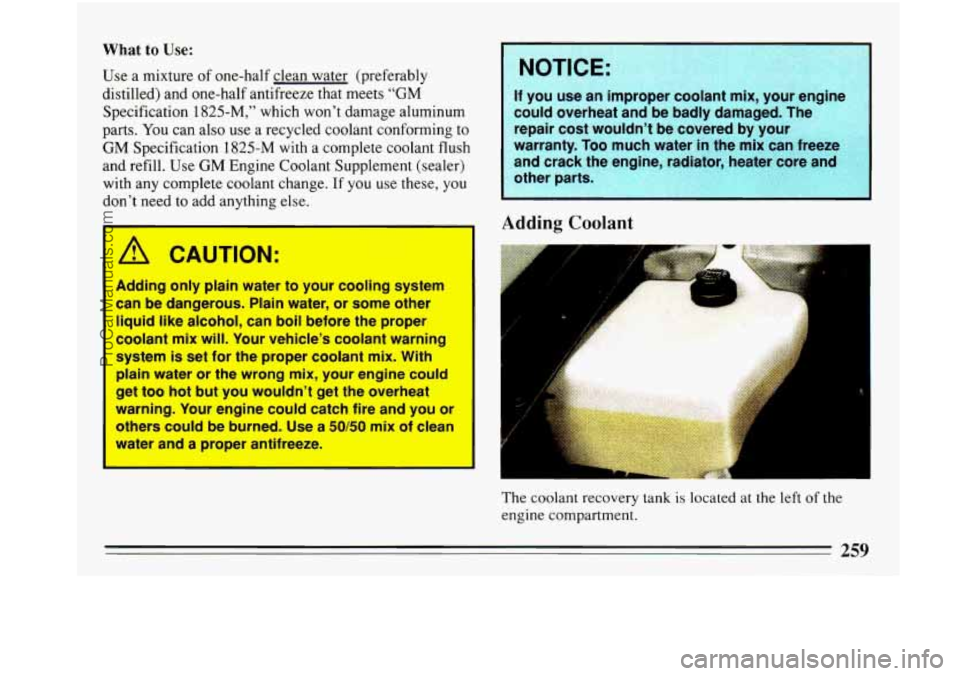
Adding Coolant
6
The coolant recovery tank IS located at the left of the
engine compartment.
259
ProCarManuals.com
Page 263 of 340
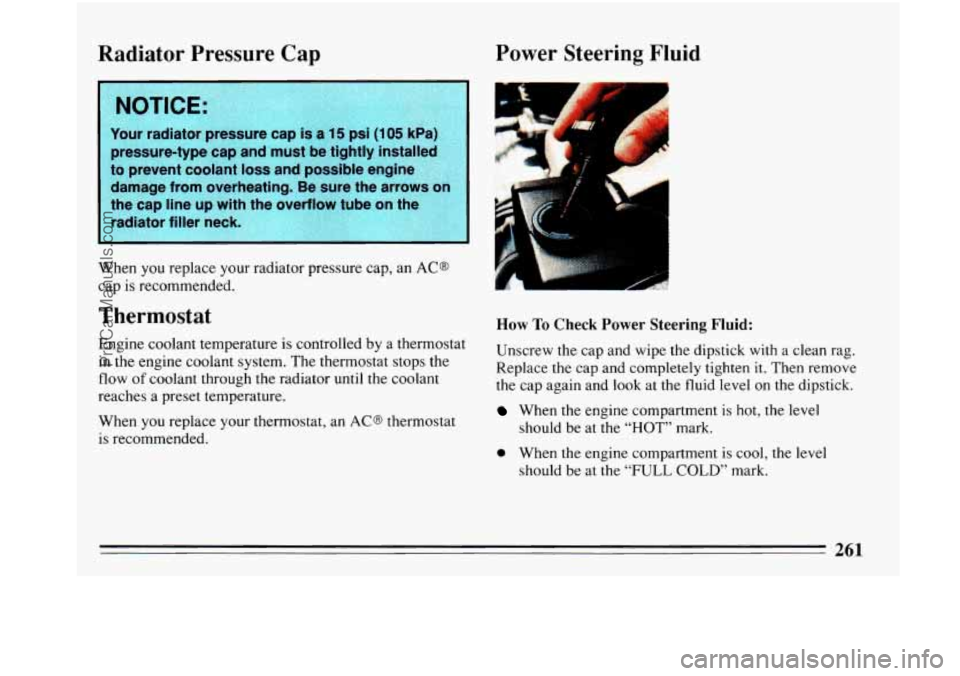
Radiator Pressure Cap
Your radiator pressure cap is a 15 psi (105 kPa)
pressure-type cap and must be tightly install
to prevent coolant
loss and possible engine
damage from overheating. Be sure the arro
the cap line up with the
ov be on t
radiator filler neck.
Power Steering Fluid
When you replace your radiator pressure cap, an AC@
cap
is recommended.
Thermostat
Engine coolant temperature is controlled by a thermostat
in the engine coolant system. The thermostat stops the
flow
of coolant through the radiator until the coolant
reaches a preset temperature.
When
you replace your thermostat, an AC@ thermostat
is recommended.
How To Check Power Steering Fluid:
Unscrew the cap and wipe the dipstick with a clean rag.
Replace
the cap and completely tighten it. Then remove
the cap again and look at the fluid level on the dipstick.
When the engine compartment is hot, the level
should be at the
“HOT” mark.
0 When the engine compartment is cool, the level
should be at the “FULL COLD” mark.
ProCarManuals.com
Page 329 of 340
Gages and Warning Indicators ................... 117
Panel
....................................... 101
Time Out Feature
............................. 113
Traffic
...................................... 165
“On” Warning
................................ 101
Operation
.................................... 92
Loading Your Vehicle
............................ 268
Locks. Door
..................................... 62
Locks. Rear Door Security
.......................... 69
Long Distance Driving
............................ 190
Loss of Control
................................. 180
Low Oil Pressure. Warning Light
................... 124
LowFuelLight
................................. 119
Maintenance
Inspections
.................................. 308
Record
...................................... 311
Schedule
.................................... 293
Underbody
.................................. 284
Malfunction Indicator Light
........................ 126
Manualseat
..................................... 14
Markings, Pavement
............................. 166
Master Cylinder, Brake
........................... 263
Memory Seat and Mirrors
.......................... 15
Methanol in Gasoline ............................. 243
Mirrors Automatic
................................... 106
Convex Outside
.............................. 108 Heated
Outside Rearview
....................... 108
Inside
...................................... 106
Outside
..................................... 108
Mist, Driving in
................................. 186
Mobile Telephone, Adding a
....................... 140
Monitors, Lamp
................................. 105
Mountain Driving
................................ 192
MTBE In Gasoline
............................... 243
N (Neutral) Gear Position ......................... 81
Netconvenience
................................ 109
New Vehicle “Break-In”
........................... 74
NightDriving
................................... 181
Nightvision
.................................... 182
Notices About Damage
............................ 11
Octane Required for Your Car
..................... 243
Odometer
...................................... 117
Odometer. Trip
.................................. 117
Off (Ignition Key Position)
......................... 76
Off Road Recovery .............................. 178
Oil. Change Your Engine
...................... 25 1. 293
Oil. Engine
..................................... 251
Oil Pressure Warning Light
........................ 123
Operation in Foreign Countries
..................... 245
Overdrive. Automatic ............................. 82
Overheated Engine
............................... 221
327
ProCarManuals.com