tow BUICK PARK AVENUE 1993 User Guide
[x] Cancel search | Manufacturer: BUICK, Model Year: 1993, Model line: PARK AVENUE, Model: BUICK PARK AVENUE 1993Pages: 340, PDF Size: 18.17 MB
Page 94 of 340
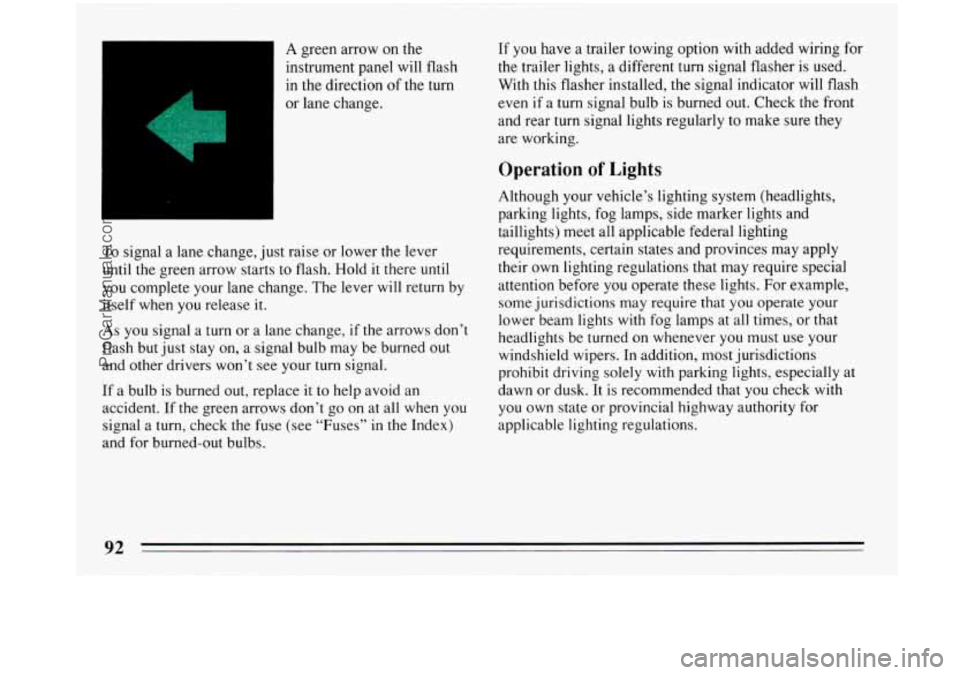
A green arrow on the
instrument panel
will flash
in the direction of the turn
or lane change.
To signal a lane change, just raise or lower the lever
until
the green arrow starts to flash. Hold it there until
you complete your lane change. The lever will return by
itself when you release it.
As you signal a turn or a lane change, if the arrows don’t
flash but just stay on, a signal bulb may be burned out
and other drivers won’t see your turn signal.
If a bulb is burned out, replace it to help avoid an
accident. If
the green arrows don’t go on at all when you
signal a turn, check the fuse (see “Fuses”
in the Index)
and for burned-out bulbs.
If you have a trailer towing option with added wiring for
the trailer lights, a different turn signal flasher is used.
With this flasher installed, the signal indicator will flash
even
if a turn signal bulb is burned out. Check the front
and rear turn signal lights regularly to make sure they
are working.
Operation of Lights
Although your vehicle’s lighting system (headlights,
parking lights, fog lamps, side marker lights and
taillights) meet all applicable federal lighting
requirements, certain states and provinces may apply
their own lighting regulations that may require special
attention before
you operate these lights. For example,
some jurisdictions may require that you operate your
lower beam lights with fog lamps at all times, or that
headlights be turned on whenever you must use your
windshield wipers. In addition, most jurisdictions
prohibit driving solely with parking lights, especially at
dawn or dusk. It is recommended that
you check with
you own state or provincial highway authority for
applicable lighting regulations.
ProCarManuals.com
Page 95 of 340
Headlight High-Low Beam
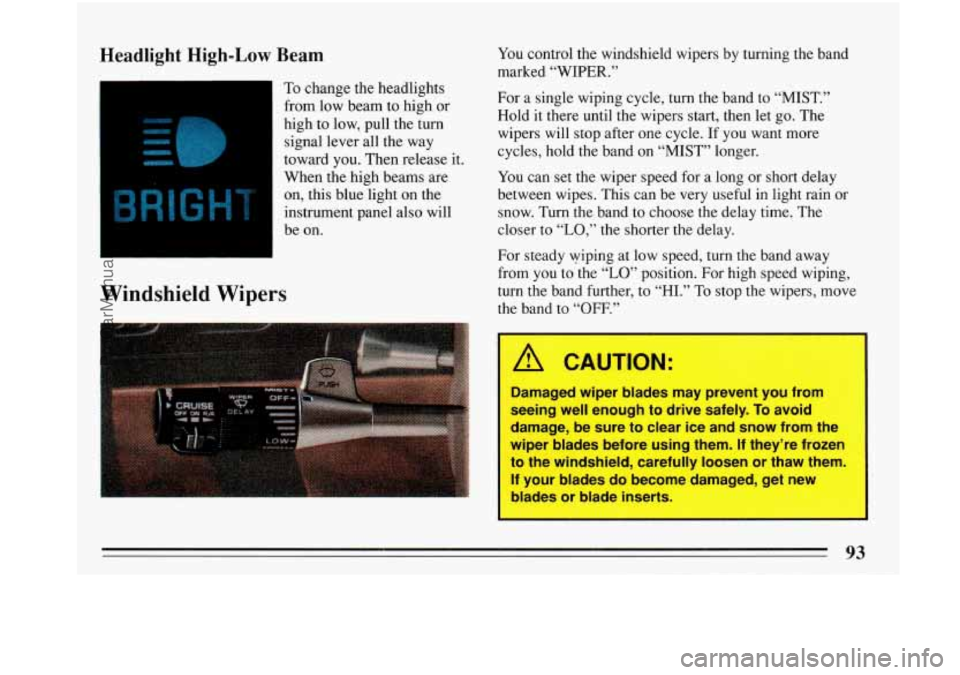
To change the headlights
from low beam to high or
high to low, pull the turn
signal lever. all the way
toward you. Then release it.
When the high beams are
on, this blue light on the
instrument panel also will
be on.
R 1J H
Windshield Wipers
You control the windshield wipers by turning the band
marked
“WIPER.”
For a single wiping cycle, turn the band to “MIST.”
Hold it there until the wipers start, then let go. The
wipers will stop after one cycle. If you want more
cycles, hold the band on “MIST” longer.
You can set the wiper speed for a long or short delay
between wipes. This can be very useful in light rain or
snow. Turn the band to choose the delay time. The
closer to
“LO,” the shorter the delay.
For steady wiping at low speed, turn the band away
from you to the
“LO” position. For high speed wiping,
turn the band further, to “HI.”
To stop the wipers, move
the band to
“OFF.”
A CAUTION:
Damaged wiper blades may prevent you from
seeing well enough to drive safely.
To avoid
damage, be sure to clear ice and snow from the
wiper blades before using them.
If they’re frozen
to the windshield, carefully loosen or thaw them.
If your blades do become damaged, get new
blades or blade inserts.
93
ProCarManuals.com
Page 122 of 340
This light will also come on when you set your parking
brake, and the light will stay on if your parking brake
doesn’t release fully. If
you try to drive off with the
parking brake set, a chime will also come
on until you
release the parking brake. If the light and chime stay on
after your parking brake is fully released, it means
you
have a brake problem. If the light and chime come on
while driving, pull
off the road and stop carefully. You
may notice that the pedal is harder to .push. Or, the peda
may go closer to the floor. It may take longer
to stop. If
the light
is still on, have the vehicle towed for service.
(See “Towing Your Car” in the Index.)
I -
A CAUTION:
Your brake system may not be working properly
if the brake warning light is on. Driving with the
brake warning light on can lead to an accident.
If
the light is still on after you’ve pulled off the road
and stopped carefully, have the vehicle towed for
service.
1
Anti-Lock Brake System Warning Light
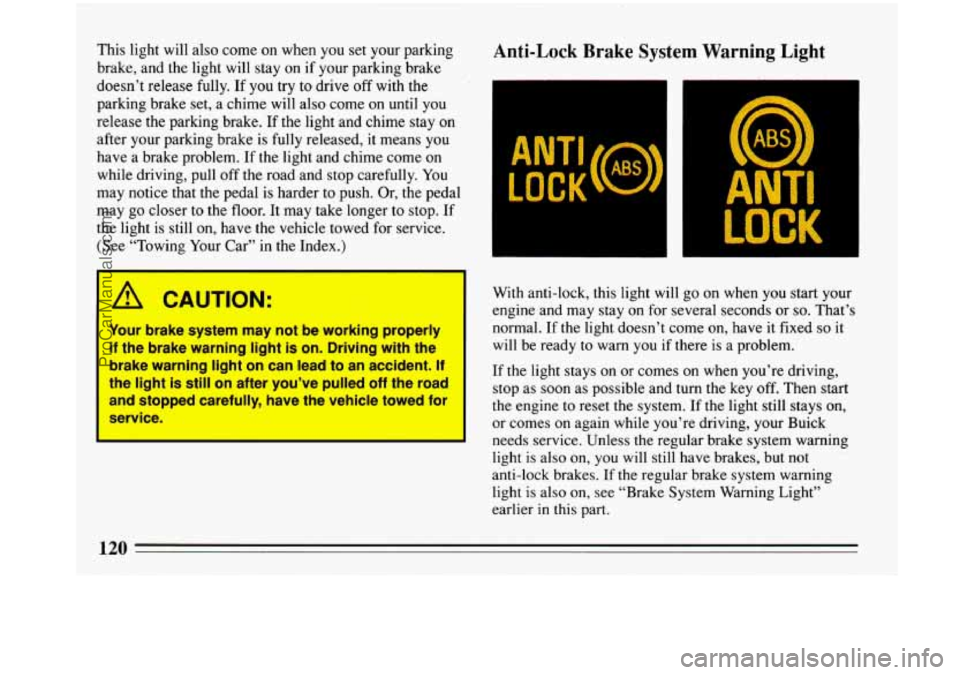
With anti-lock, this light will go on when you start your
engine and may stay on for several seconds or
so. That’s
normal. If the light doesn’t come on, have it fixed
so it
will be ready to warn
you if there is a problem.
If the light stays
on or comes on when you’re driving,
stop as soon as possible and turn the key
off. Then start
the engine
to reset the system. If the light still stays on,
or comes on again while you’re driving, your Buick
needs service. Unless the regular brake system warning
light
is also on, you will still have brakes, but not
anti-lock brakes.
If the regular brake system warning
light
is also on, see “Brake System Warning Light”
earlier
in this part.
ProCarManuals.com
Page 138 of 340
Defrost Rear Window Defogger
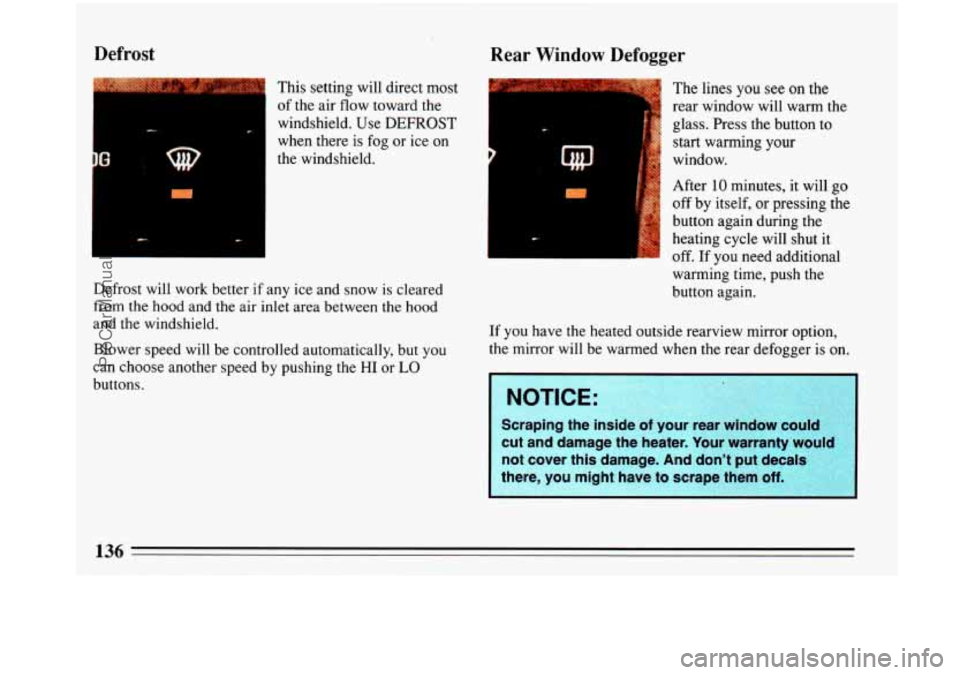
This setting will direct most
of the air flow toward the
windshield. Use
DEFROST
when there is fog or ice on
the-windshield.
Defrost will work better if any ice and snow is cleared
from the hood and the air inlet area between the hood
and the windshield.
Blower speed will be controlled automatically, but
you
can choose another speed by pushing the HI or LO
buttons. The
lines
you see on the
rear window will warm the
glass. Press the button to
start warming your
window.
After
10 minutes, it will go
off by itself, or pressing the
button again during the
heating cycle will shut it
off. If you need additional
warming time, push the
button again.
c. i
If you have the heated outside rearview mirror option,
the mirror will be warmed when the rear defogger is on.
1.
i NOTICE: , .' '2 , .. , ,.. ~. , ..~
I: Scraping the inside of your rear window could
cut and damage the heater. Your warranty would
ProCarManuals.com
Page 140 of 340
The Bi-level setting directs outside air into your vehicle
in two ways. Cool air is directed toward your upper
body through instrument panel outlets, while slightly
warmed air is directed through the heater outlet at your
feet.
The air conditioner compress& operates in all Air
Conditioning positions and the Defrost position when
the outside temperature is above
48 OF (9 “C).
When you don’t need to cool the outside air, use the
VENT, HEAT and
DEFROST settings. Adjust the
temperature control for comfort. You’ll get better fuel
economy (gas mileage) if you’re not cooling the outside
air. When you cool the air, your engine runs a
refrigeration compressor, and it has to work harder.
Vent
For mild outside temperature, when little heating or
cooling is needed, use the
VENT setting. Air will flow
thought the instrument panel outlets. Use the air outlets
to turn on, adjust and turn
off the air flow. Adjust the
temperature lever
to the desired temperature.
Heater
When outside temperatures are cold, pressing the HTR
setting and adjusting the temperature lever will send
warm air through the floor outlets and some through the
defroster vents.
Defrost
The DEFROST setting directs most of the air flow
toward the windshield. Use defrost when you want to
remove
fog or ice from the windshield. When it’s 48OF
(9 * C) or warmer, you’ll get cooled air.
Defog
Air entering the vehicle will be evenly split between the
floor outlets and the outlets near the windshield. You
can control the temperature of the air and the fan speed
to clear the foggy windows.
138
ProCarManuals.com
Page 161 of 340
@ Part 4 Your Driving and the Road
~ . ~~~~~ ~~~ ~ ~ ~~ ~ ~~ ~ ~~ ~ ~ ~~ ~ ~
Here you’ll find information about driving on different kinds of roads and in varying weather conditions . We’ve also
included many other useful tips on driving
.
Part 4 includes:
RoadSigns
....................................................................... \
DefensiveDriving .................................................................
DrunkenDriving ................................................................
Control of a Vehicle ......................... ...................................
Braking .....................................................................
Steering .....................................................................
Passing .....................................................................
LossofControl ...............................................................
DrivingatNight ...................................................................
DrivingintheRain .................................................................
Driving in Fog, Mist and Haze ........................................................
CityDriving ......................................................................
FreewayDriving ...................................................................
DrivingonaLongTrip .............................................................
HillandMountainRoads ............................................................
ParkingonHills ...................................................................
TowingaTrailer ...................................................................
WinterDriving ....................................................................
160
166
167 170
171
176
178
180
181
183 186
187
188
190
192 194
197
201
ProCarManuals.com
Page 169 of 340
Defensive driving really means “be ready for anything.”
On city streets, rural roads, or freeways, it means
“always expect the unexpected.”
Assume that pedestrians or other drivers are going to be
careless and make mistakes. Anticipate what they might
do. Be ready for their mistakes.
Expect children to dash out from behind parked cars,
often followed by other children. Expect occupants in
parked cars to open doors into traffic. Watch for
movement in parked cars
-- someone may be about to
open a door.
Expect other drivers to run stop signs when you are on
a
through street. Be ready to brake if necessary as you go
through intersections. You may not have to use the
brake, but if
you do, you will be ready.
If you’re driving through a shopping center parking lot
where there are well-marked lanes, directional arrows,
and designated parking areas, expect some drivers to
ignore all these markings and dash straight toward one
part of the
lot.
Pedestrians can be careless. Watch for them. In general,
you must give way to pedestrians even if you know you
have the right of way.
Rear-end collisions are about
the most preventable of
accidents. Yet they are common. Allow enough following
distance. It’s the best defensive driving
maneuver, in both city and rural driving. You never
know when the vehicle in front
of you is going to brake
or
turn suddenly.
Here’s a final bit
of information about defensive driving.
The most dangerous time for driving in the
U.S. is very
early on Sunday morning. In fact,
GM Research studies
show that the most and the least dangerous times for
driving, every week, fall on the same day. That day is
Sunday. The most dangerous time
is Sunday from 3 a.m.
to
4 a.m. The safest time is Sunday from 10 a.m. to 11
a.m. Driving the same distance on a Sunday at 3 a.m.
isn’t just a little more dangerous than it is at
10 a.m. It’s
about
134 times more dangerous!
That leads
to the next section.
Drunken Driving
Death and injury associated with drinking and driving is
a national tragedy. It’s the number one contributor to the
highway death
toll, claiming thousands of victims every
year. Alcohol takes away three things that anyone needs
to drive a vehicle:
0 Judgment
0 Muscular Coordination
0 Vision
ProCarManuals.com
Page 176 of 340
I CAUTION:
Anti-lock doesn’t change the time you need to
get your foot
up to the brake pedal. If you get too
close to the vehicle in front of you, you won’t
have time to
apply your brakes ifethat vehicle
suddenly
stows or stops. Always leave enough
room up ahead to stop, even though you have
antblock brakes.
To Use Anti-Lock:
Don’t pump the brakes. Just hold the brake pedal down
and let anti-lock work for
you.
When you start your vehicle and begin to drive away,
you may hear a momentary motor or clicking noise. And
you may even notice that your brake pedal moves a little
while this is going on. This is the ABS system testing
itself. You may also hear this during a hard stop.
Traction Control System (Option)
Your vehicle may have a traction control system that
limits wheel spin. This is especially useful
in slippery
road conditions. The traction control system works at
low speeds only, such as when you accelerate from a stop. It
applies brake pressure
to an individual wheel
that the system senses is about to spin.
You may feel the system working, or you may notice
some noise, but this is normal.
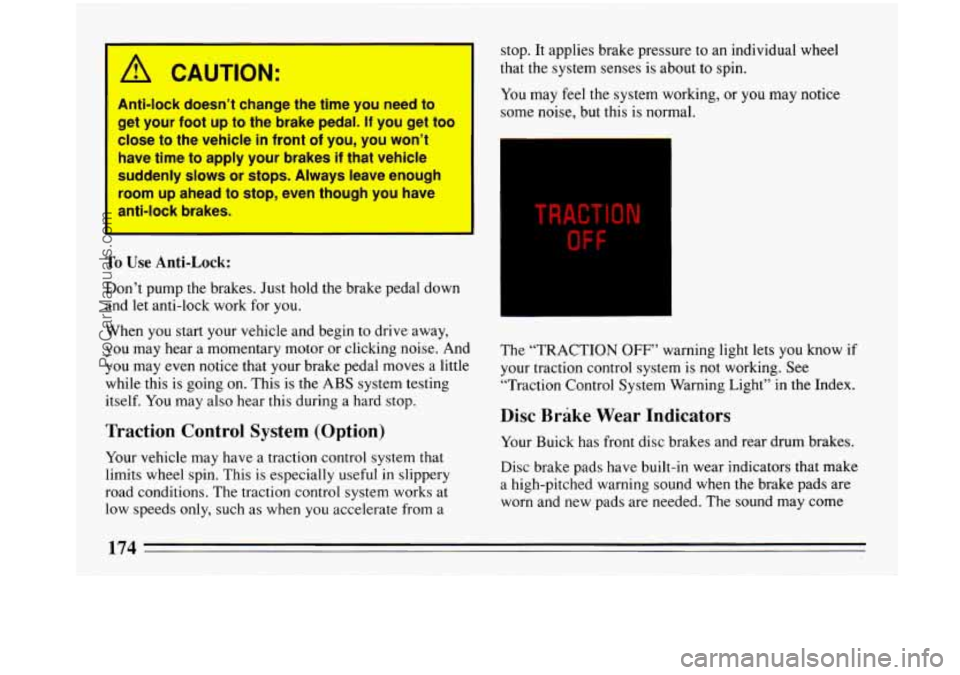
TRACTION
OFF
The “TRACTION OFF” warning light lets you know if
your traction control system is not working. See
“Traction Control System Warning Light” in the Index.
Disc Brake Wear Indicators
Your Buick has front disc brakes and rear drum brakes.
Disc brake pads have built-in wear indicators that make
a high-pitched warning sound when the brake pads are
worn and new pads are needed. The sound may come
174
ProCarManuals.com
Page 191 of 340
too-slow driving breaks a smooth traffic flow. Treat the
left lane on a freeway as a passing lane.
Entering the Freeway
At the entrance there is usually a ramp mat leads to the
freeway.
If you have a clear view of the freeway as you
drive along the entrance ramp, you should begin to
check traffic. Try to. determine where you expect to
blend with the flow.
If traffic is light, you may have no
problem. But if it is heavy, find a gap as you move along
the entering lane and time your approach. Try to merge
into the gap at,close to the prevailing speed. Switch on
your
turn signal, check your rearview mirrors as you
move along, and glance over your shoulder as often as
necessary. Try to blend smoothly with the traffi.c flow.
Driving on the Freeway
Once you are on the freeway, adjust your speed to the
posted limit or to the prevailing rate if it’s slower. Stay
in the right lane unless you want to ‘pass. If you are on a
two-lane freeway, treat the right Lane as the slow lane
and the left lane as the passing lane.
If you are on a three-lane freeway, treat the right lane as
the slower-speed through lane, the middle lane as the
higher-speed through lane, and
the left lane as the
passing lane. Before changing lanes, check
your rearview mirrors.
Then use your turn signal.
Just before
you leave the lane, glance quickly over your
shoulder to make sure there isn’t another vehicle in your
“blind” spot.
If you are moving from an outside.to a center lane on a
freeway having more than two lanes, make sure another
vehicle isn’t about to move into the same spot. Look at
the vehicles two lanes over and watch for telltale signs:
turn signals flashing,
an increase in speed, or moving
toward the edge of the lane. Be prepared to delay your
move.
.
Once you are moving on the freeway, make certain you
allow a reasonable following distance. Expect to move
slightly slower at night.
Leaving the Freeway
When you want to leave the freeway, move to the proper
lane well in advance. Dashing across lanes at the last
minute is dangerous.
If you miss your exit do not, under
any circumstances, stop and back up. Drive on to the
next exit.
At each.exit point is a’deceleration lane. Ideally it
should be long enough for you to enter it at freeway
speed (after signaling, of course) and then do your
ProCarManuals.com
Page 195 of 340
Know how to go down hills. The most important
thing to know is this: let your engine do some
of the
slowing down. Don’t make your brakes do
it all.
Shift to
a lower gear when you go down a steep or
long hill. That way, you will slow down without
excessive use
of your brakes.
CAUTION:
If you don’t shift down, your brakes could get so
hot that they wouldn’t work well. You would then
have poor braking or even none going down a hill.
You could crash. Sh‘rft down to let your mgilne
assist your brakes on a steep downhill slope.
I
I
IA
I
Coastlng downhill On “N (Neutral) or with the
ignltbn off 5s dangerous. Your brakes will have
to do all the work of slowing down. They touid
get so hot that they woufdn’t work well. You
could crash. Always have your engine running
and your vehicle in gear when you go dawnhill,
I
Know how to go uphill. Shift down to “D’ (Drive).
This
will help cool your engine and transaxle, and
you can climb the hill better.
0 Stay in your own lane when driving on two-lane
roads in hills or mountains. Don’t swing wide or cut
across the center of the road. Drive at speeds that let
you stay
in your own lane. That way, you won’t be
surprised by a vehicle coming toward you in the
same lane.
It takes longer to pass another vehicle when you’re
going uphill. You’ll want to leave extra room to pass.
If a vehicle is passing you and doesn’t have enough
room, slow down to make it easier for the other
vehicle to get by.
As you go over the top of a hill, be alert. There could
be something
in your lane, like a stalled car or an
accident.
You may see highway signs on mountains that warn
of special problems. Examples are long grades,
passing or no-passing zones, a falling rocks area, or
winding roads. Be alert to these and take appropriate
action.
0 Winter driving can present special problems. See
“Winter Driving”
in the Index.
193
ProCarManuals.com