tow BUICK PARK AVENUE 1993 Owner's Guide
[x] Cancel search | Manufacturer: BUICK, Model Year: 1993, Model line: PARK AVENUE, Model: BUICK PARK AVENUE 1993Pages: 340, PDF Size: 18.17 MB
Page 222 of 340
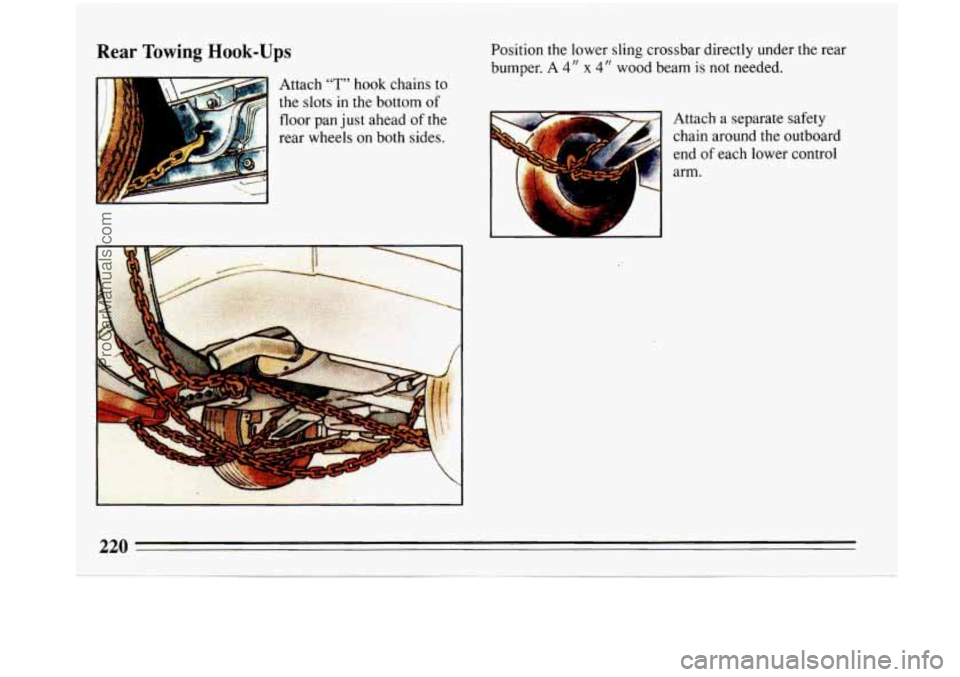
Rear Towing Hook-Ups
Attach '7"' hook chains to
the slots in the bottom
of
floor pan just ahead of the
rear wheels
on both sides. Position the lower sling crossbar directly under the rear
bumper. A
4" x 4" wood beam is not needed.
Attach a separate safety
chain around the outboard
end
of each lower control
arm.
220
ProCarManuals.com
Page 223 of 340
Engine Overheating
You will find the warning light about a hot engine on
your Buick instrument panel and if you have the
optional gage cluster,
a coolant temperature gage.
You will also find a low coolant warning light
on your
Buick instrument panel.
If Steam Is Coming From Your Engine:
A CAUTION:
- _earn from an overheated engine can burn you
badly, even
if you just open the hood. Stay away
from the engine
if you see or hear steam coming
.. -m it. Just turn it off and get everyone away
from the vehicle until it cools down. Wait until
there
is no sign of steam or coolant before
opening the hood.
If you keep driving when your engine is
overheated, the liquids in
it can catch fire. You or
others could be badly burned. Stop your engine
if it overheats, and get out of the vehicle until the
sngine is cool.
- -
If No Steam Is Coming From Your Engine:
If you get the overheat warning but see or hear no
steam, the problem may not be too serious. Sometimes
the engine can get a little
too hot when you:
Climb a long hill on a hot day.
Stop after high speed driving.
Idle for long periods in traffic.
Tow a trailer.
221
ProCarManuals.com
Page 230 of 340
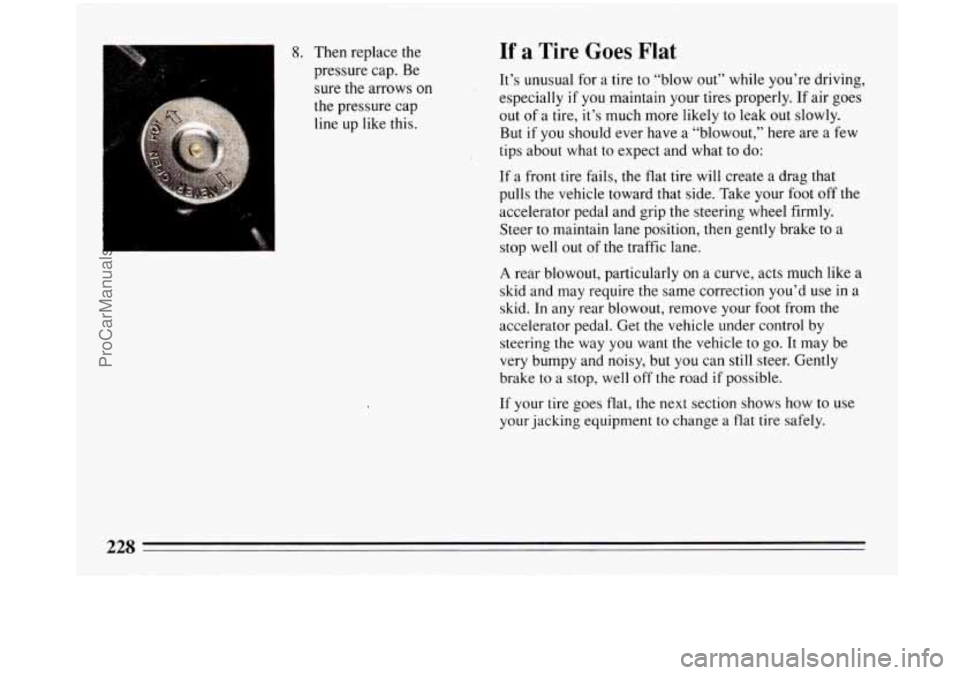
8. Then replace the
pressure cap. Be
sure the arrows
on
the pressure cap
line up like this.
If a Tire Goes Flat
It’s unusual for a tire to “blow out” while you’re driving,
especially
if you maintain your tires properly. If air goes
out of a tire, it’s much more likely to leak out slowly.
But if you should ever have
a “blowout,” here are a few
tips about what to expect and what
to do:
If a front .tire fails, the flat tire will create a drag that
pulls the vehicle toward that side. Take your foot
off the
accelerator pedal and grip the steering wheel firmly.
Steer to maintain lane position, then gently brake to a
stop well out
of the traffic lane.
A rear blowout, particularly on a curve, acts much like a
skid and may require the same correction you’d use in
a
skid. In any rear blowout, remove your foot from the
accelerator pedal. Get the vehicle under control by
steering the way you want the vehicle to
go. It may be
very bumpy and noisy, but you can still steer. Gently
brake to
a stop, well off the road if possible.
If your tire goes flat, the next section shows how to use
your jacking equipment
to change a flat tire safely.
ProCarManuals.com
Page 237 of 340
A CAUTION:
Rust or dirt on the wheel, or on the parts to
which
it is fastened, can make the wheel nuts
become loose after a time. The wheel could come
off and cause an accident. When you change a
wheel, remove any rust or dirt from the places
where the wheel attaches to the vehicle.
In an
emergency, you can use a cloth or a paper towel
to do
this; but be sure to use a scraper or wire
brush later,
if you need to, to get all the rust or
dirt
off.
kemove any rust or dirt from the wheel bolts, mounting
urfaces or spare wheel.
CAUTION:
Never use oil or grease on studs or nuts. If you
do, the nuts might come loose. Your wheel could
.
fall off, causing a serious accident. &:aF,;--..& ..*
I
ryr 2:. 74
&
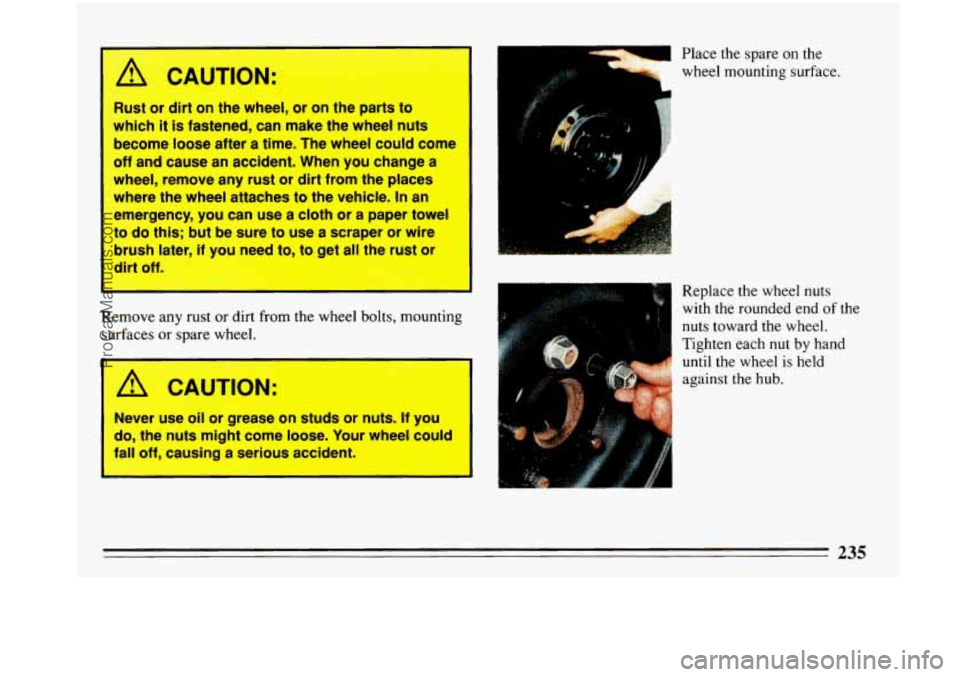
Place the spare on the ~ .*. .. wheel mounting surface.
Replace the wheel nuts
with the rounded end
of the
nuts toward the wheel.
Tighten each nut
by hand
until the wheel
is held
lgainst the hub.
ProCarManuals.com
Page 241 of 340
If You’re Stuck: In Sand, Mud, Ice or
Snow
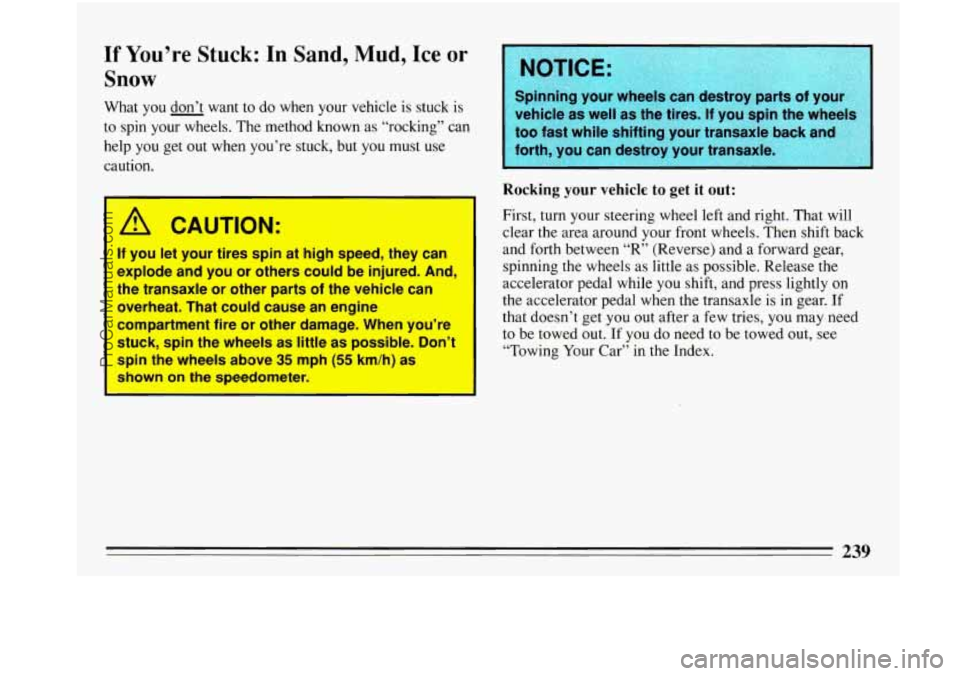
What you don’t want to do when your vehicle is stuck is
to spin your wheels. The method known as “rocking” can
help
you get out when you’re stuck, but you must use
caution.
I A CAUTION:
If you let your tires spin at high speed, they can
explode and you or others could be injured. And,
the transaxle or other parts of the vehicle can
overheat. That could cause an engine
compartment fire or other damage. When you’re
stuck, spin the wheels as little as possible. Don’t
spin the wheels above
35 mph (55 km/h) as
shown
on the speedometer.
I = I
Spinning your wheels lestroy par __ of your
vehicle as well as the tires. If you spin the whe
too fast while shifting your transaxle back
forth, you can destroy your transaxle.
Rocking your vehicle to get it out:
First, turn your steering wheel left and right. That will
clear the area around your front wheels. Then shift back
and forth between
“R” (Reverse) and a forward gear,
spinning the wheels as little as possible. Release the
accelerator pedal while you shift, and press lightly on
the accelerator pedal when the transaxle is
in gear. If
that doesn’t get
you out after a few tries, you may need
to be towed out.
If you do need to be towed out, see
“Towing Your Car”
in the Index.
ProCarManuals.com
Page 254 of 340
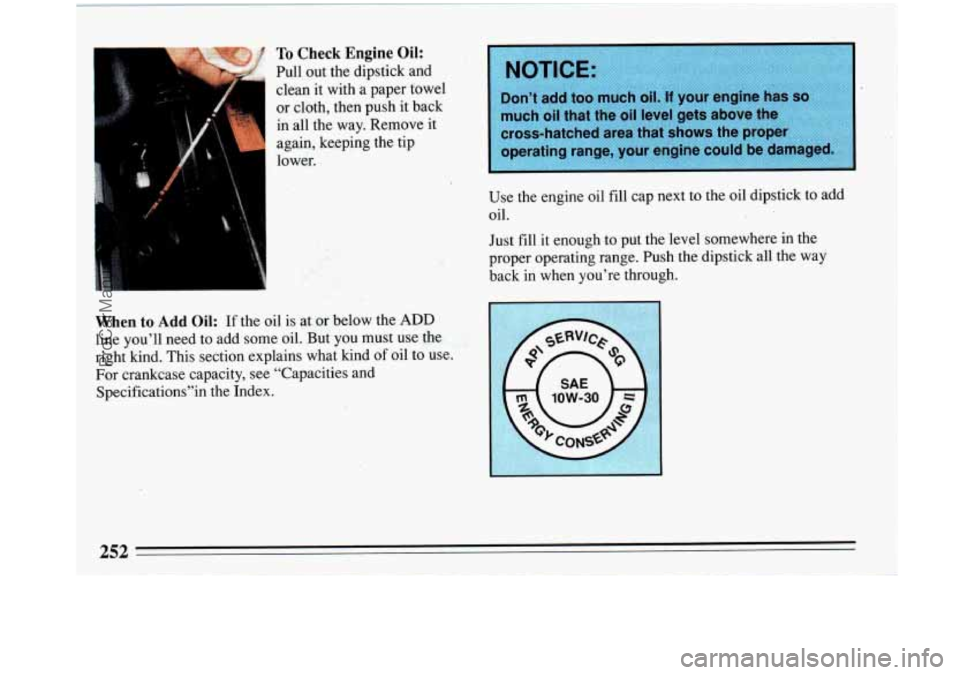
To Check Engine Oil:
Pull out the dipstick and
clean it with a paper towel
or cloth, then push it back
in all the way. Remove it
again, keeping the tip
lower.
I
i
When to Add Oil: If the oil is at or below the ADD
line you’ll need to add some oil. But you must use the
right kind. This section explains what kind of oil to use.
For crankcase capacity, see “Capacities and
Specifications”in the Index.
I NOTICE:
Don’t add too much oil. If your engine has so
much oil that the oil level gets above the
cross-hatched area that shows the proper operating range, your engine could be damaged,
Use the engine oil fill cap next to the oil dipstick to add
oil.
Just
fill it enough,to put the level somewhere in the
proper operating range. Push the-dipstick all the way
back in when you’re through.
252
ProCarManuals.com
Page 256 of 340
0 SAE low-30
As shown in this chart, SAE 1OW-30 is best for your
vehicle. However, you can use
SAE 5W-30 if it’s
going to be colder than
60 OF (1 6 ” C) before your
next oil change. When it’s very cold, below
0°F
(- 18 ” C), you should use SAE 5W-30.
These numbers on an oil container show
its viscosity, or
thickness. Do not use other viscosity oils such as SAE
low-40 or SAE 20W-50.
0 Energy Conserving I1
Oils with these words
on the container will help you
save
fuel.
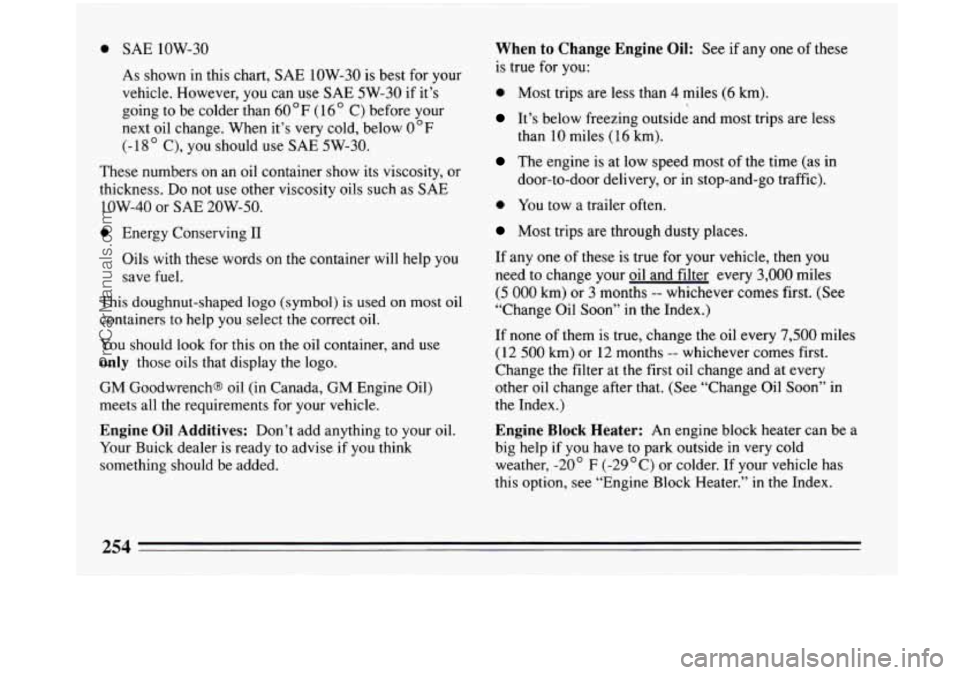
This doughnut-shaped logo (symbol) is used on most oil
containers to help you select the correct oil.
You should look for this on
the oil container, and use
only those oils that display the logo.
GM Goodwrench@ oil (in Canada, GM Engine Oil)
meets all the requirements for your vehicle.
Engine Oil Additives: Don’t add anything to your oil.
Your Buick dealer is ready
to advise if you think
something should be added.
When to Change Engine Oil: See if any one of these
is true for
you:
0 Most trips are less than 4 miles (6 km).
It’s below freezing outside and most trips are less
The engine is at low speed most of the time (as in
door-to-door delivery, or in stop-and-go traffic).
0 You tow a trailer often.
than
10 miles
(16 km).
Most trips are through dusty places.
If any one of these is true for your vehicle, then
you
need to change your oil and filter every 3,000 miles
(5 000 km) or 3 months -- whichever comes first. (See
“Change Oil Soon” in the Index.)
If none of them is true, change the oil every 7,500 miles
(12 500 km) or 12 months -- whichever comes first.
Change
the filter at the first oil change and at every
other oil change after that. (See “Change
Oil Soon” in
the Index.)
Engine Block Heater: An engine block heater can be a
big help
if you have to park outside in very cold
weather,
-20” F (-29 “C) or colder. If your vehicle has
this option, see “Engine Block Heater.”
in the Index.
ProCarManuals.com
Page 259 of 340
Wait at least 30 minutes before checking the transaxle
fluid level if you have been driving:
When outside temperatures are above 90°F (32 C).
At high speed for quite a while.
In heavy traffic -- especially in hot weather.
0 While pulling a trailer.
To get the right reading, the fluid should be at normal
operating temperature, which is
1 80 F to 200 F
(82OC to 93OC).
Get
the vehicle warmed up by driving about 15 miles
(24 km) when outside temperatures .are above
50 F
(10OC). If it’s colder than 50°F (lO°C), you may have
to drive longer.
To check the fluid level:
Park your vehicle on a level place.
0 Place the shift lever in “P’ (Park) with the parking
brake applied.
0 With your foot on the brake pedal, move the shift
lever through each gear range, pausing for about three seconds
in each range. Then, position the shift
lever
in “P’ (Park).
0 Let the engine run at idle for three to five minutes.
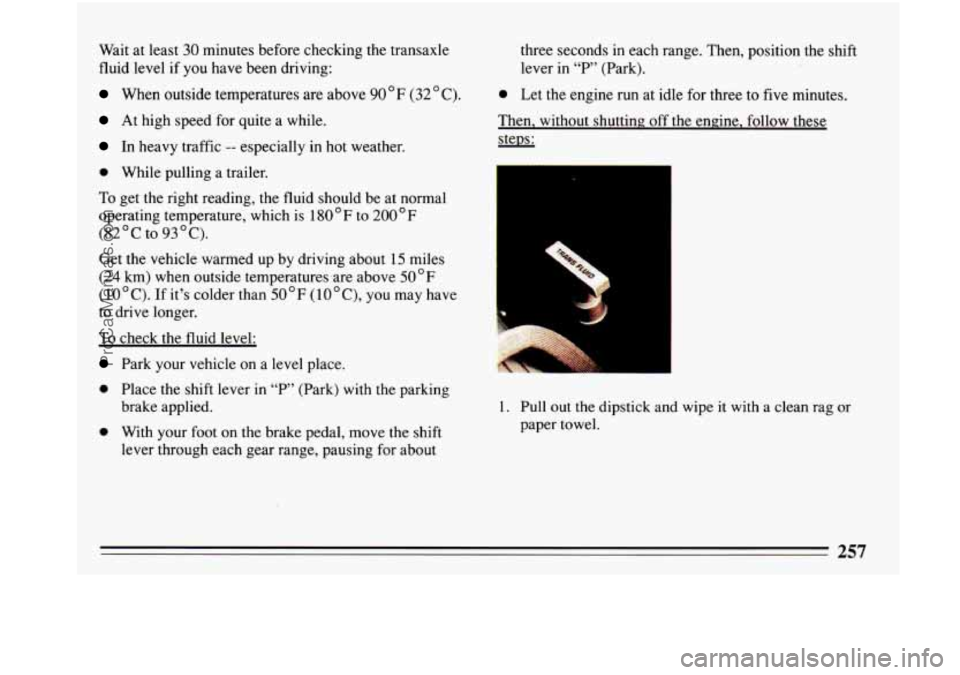
Then, without shutting off the engine, follow these
steps:
1. Pull out the dipstick and wipe it with a clean rag or
paper towel.
ProCarManuals.com
Page 275 of 340
CAUTION:
Rust or dirt on a wheel, or on the parts to which
it is fastened, can make wheel nuts become
loose after a time. The wheel could come
off and
cause an accident. When you change a wheel,
remove any
rust or dirt from places where the
wheel attaches
to the vehicle. In an emergency,
you can use a cloth or a paper towel to
do this;
but be sure to use a scraper or wire brush later, if
you need
to, to get all the rust or dirt off. (See
“Changing a Flat Tire”
in the Index.)
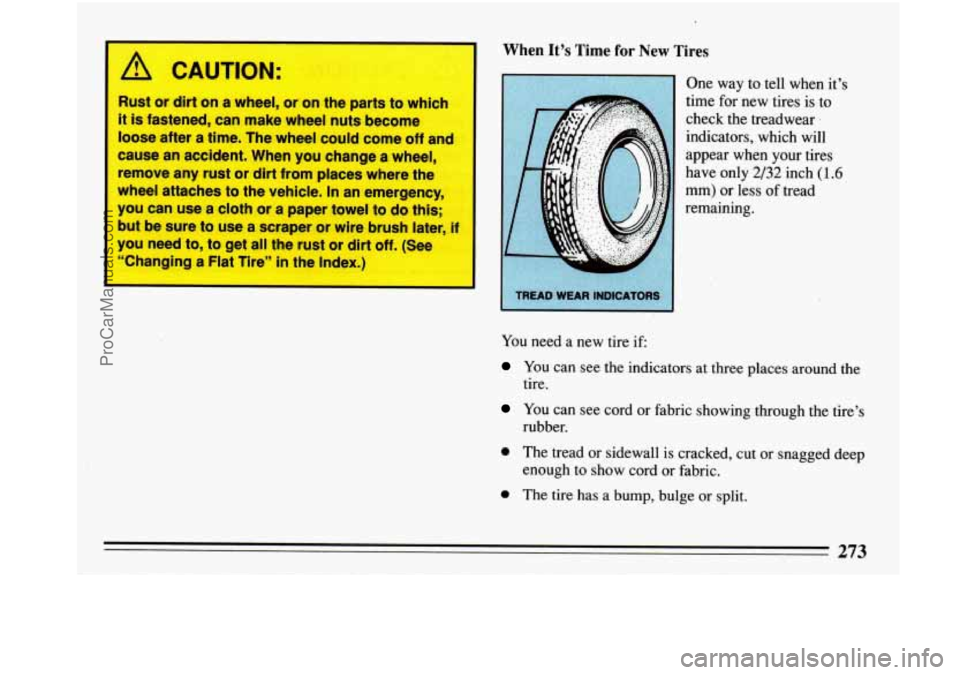
When It’s Time for New Tires
One way to tell when it’s
time for new tires is to
check the treadwear.
indicators, which will
appear when your tires
have only
2/32 inch (1.6
mm) or less of tread
remaining.
You need a new tire if:
YOU can see the indicators at three places around the
tire.
You can see cord or fabric showing through the tire’s
rubber.
0 The tread or sidewall is cracked, cut or snagged deep
enough to show cord or fabric.
0 The tire has a bump, bulge or split.
273
ProCarManuals.com
Page 281 of 340
Use solvent-type cleaners in a well-ventilated area
If a ring forms after spot cleaning, clean the entire
only.
If you use them, don’t saturate the stained area.
area immediately or
it will set.
Using Foam-Type Cleaner on Fabric
Vacuum and brush the area to remove any loose dirt.
0 Always clean a whole trim panel or section. Mask
Mix Multi-Purpose Powdered Cleaner following the
Use suds only and apply with a clean sponge.
surrounding
trim along stitch or welt lines.
directions on the container label.
0 Don’t saturate the material.
0 Don’t rub it roughly.
0 As soon as you’ve cleaned the section, use a sponge
to remove
the suds.
Rinse the section with a clean, wet sponge.
Wipe off what’s left with a slightly damp paper towel
or cloth.
Then dry it immediately with an air hose, a hair
dryer or a heat lamp.
e careful with a hair dry
Wipe with a clean cloth.
Using Solvent-Type Cleaner on
Fabric
First, see if you have to use solvent-type cleaner at all.
Some spots and stains will clean
off better with just
water and mild soap.
If you need to use it, then:
Gently scrape excess soil from the trim material with
a clean, dull knife or scraper. Use very little cleaner,
light pressure and clean cloths (preferably
cheesecloth). Cleaning should start at
the outside of
the stain, “feathering” toward the center. Keep
changing
to a clean section of the cloth,
the area with an air hose, hair dryer, or heat lamp to
help prevent a cleaning ring. (See the previous
NOTICE.)
When you clean a stain from fabric, immediately dry
ProCarManuals.com