key BUICK PARK AVENUE 1993 Owner's Manual
[x] Cancel search | Manufacturer: BUICK, Model Year: 1993, Model line: PARK AVENUE, Model: BUICK PARK AVENUE 1993Pages: 340, PDF Size: 18.17 MB
Page 79 of 340
Move your shift lever to “P” (Park) or “N” (Neutral).
Your engine won’t start in any other position
-- that’s a
safety feature. To restart when you’re already moving,
use “N” (Neutral) only.
Don’t try to shift to “P” (Park) if your Buic
moving.
If you do, you could damage the :
transaxle. Shift to “P” (Park) only when y
To start your 3.8 Liter (Code L) engine:
1. Don’t push the accelerator pedal before starting your
engine. In some other vehicles
you might need to do
this, but because of your vehicle’s computer systems,
you don’t.
starts,
let go of the key. The idle speed will go down
as your engine gets warm.
2. Turn your ignition key to “Start.” When the engine
3. If it doesn’t start right away, hold your key in “Start”
for about three seconds at a time until your engine
starts. Wait about
15 seconds between each try to
help avoid draining your battery.
4. If your engine still won’t start (or starts but then
stops), it could be flooded with too much gasoline.
Try pushing your accelerator pedal all the way to the
floor and holding it there as you hold the key in
“Start” for about three seconds. If the car starts
briefly but then stops again,
do the same thing, but
this time keep the pedal down for five or six seconds.
This clears the extra gasoline from the engine. After
waiting about
15 seconds, repeat the normal starting
procedure.
77
ProCarManuals.com
Page 80 of 340
Your engine is designed to work with the
electronics in your vehicle.
If you add electrical
parts or accessories, you could change the way
If you ever have to have your vehicle towed, see
the part
of this Manual that tells how to do it
without damaging your vehicle. See “Towing
Your Car” in the Index.
To start your SupercharEed V6 3.8 Liter (Code 1)
engine:
1.
2.
Don’t push the accelerator pedal before starting your
engine. In some other vehicles you might need to do
this, but because
of your vehicle’s computer systems,
you don’t.
Turn your ignition key to “Start.” When the engine
starts, let go
of the key. The idle speed will go down
as your engine gets warm.
3. If it doesn’t start right away, hold your key in “Start”
for about three to five seconds at a time until your
engine starts. Wait about
15 seconds between each
try to help avoid draining your battery.
4. If your engine still won’t start (or starts but then
stops),
it could be flooded with too much gasoline.
Try pushing your accelerator pedal all the way to the
floor and holding
it there as you hold the key in
“Start” for about three seconds. If the car starts
briefly but then stops again, do the same thing, but
this time keep the pedal down for five or six seconds.
This clears the extra gasoline from the engine. After
waiting about
15 seconds, repeat the normal starting
procedure.
78
ProCarManuals.com
Page 83 of 340
I A CAUTION:
It is dangerous to get out of your vehicle if the
shift lever is not fully
in “P” (Park) with the
parking brake firmly set. Your vehicle can roll.
Don’t leave your vehicle when the engine is
running unless you have to.
If you have left the
engine running, the vehicle can move suddenly.
You or others could be injured. To be sure your
vehicle won’t move, when you’re on fairly level
ground, always set your parking brake and move
the shift lever to “P” (Park).
See “Shifting Into “P” (Park)”
in the Index. If you
are parking on a
hill, or if you’re pulling a trailer
also see“Parking on Hills” or “Towing a Trailer’
in the Index.
Ensure the shift lever is fully in “P” (Park) range before
starting the engine. Your Buick has a brake-transaxle
shift interlock. You have
to fully apply your regular
brakes before you can shift from “P” (Park) when the
ignition key is in the “Run” position. If you cannot shift out
of
“P” (Park), ease pressure on the shift lever - push
the shift lever all the way into
“P” (Park) as you
maintain brake application. Then move the shift lever
into the gear you wish. See “Shifting Out
of ‘P’ (Park)”
in this part.
0 R (Reverse)
Use this gear to back up.
Shifting to ‘W’ (Reverse) while your vehicle is
moving forward could damage your transaxle.
Shift to
“R” only after your vehicle is stoppc
To rock your vehicle back and forth to get out of snow,
ice or sand without damaging your transaxle, see
“If
You’re Stuck: In Sand, Mud, Ice or Snow” in the Index.
N (Neutral)
In this position, your engine doesn’t connect with the
wheels.
To restart when you’re already moving, use
“N” (Neutral) only. Also, use “N” when your vehicle
is being towed.
ProCarManuals.com
Page 88 of 340
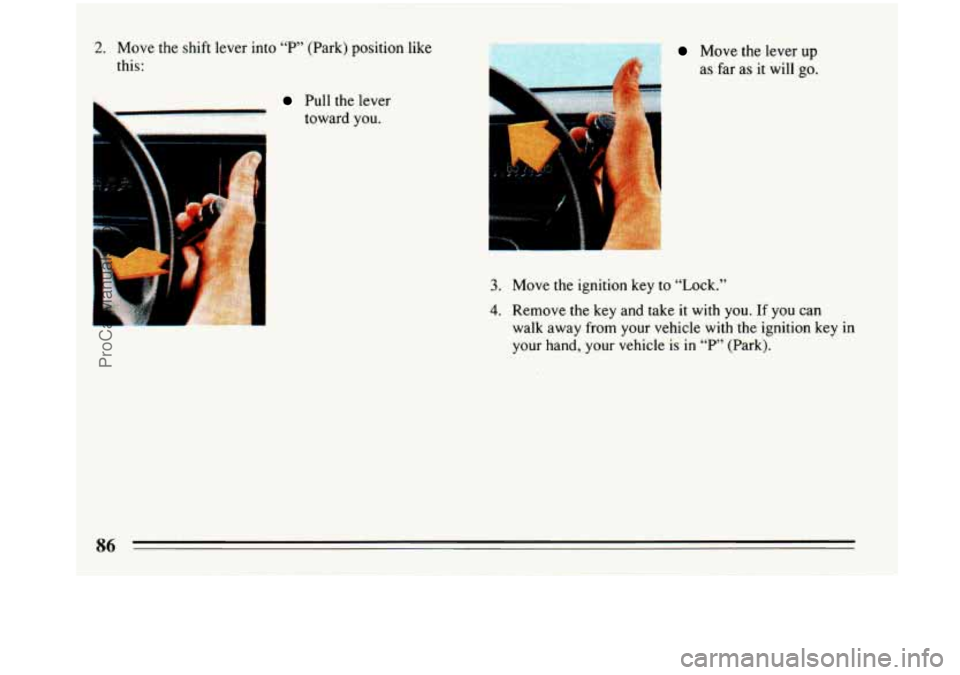
2. Move the shift lever into “P” (Park) position like
this:
Pull the lever
toward
you. L. P.
.= Move the lever up
as
far as it will go.
7.:- .* I .
P
3. Move the ignition key to “Lock.”
4. Remove the key and take it with you. If you can
walk away from your vehicle
with the ignition key in
your hand, your vehicle is in “P” (Park).
ProCarManuals.com
Page 89 of 340
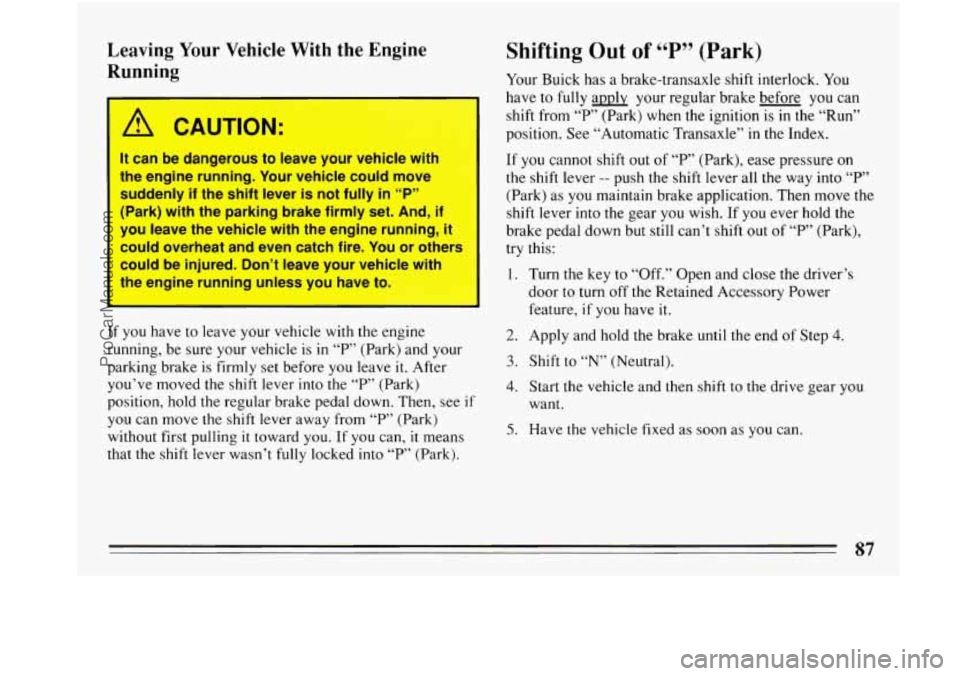
Leaving Your Vehicle With the Engine
Running
I
A CAUTION:
It can be dangerous to leave your vehicle with
the engine running. Your vehicle could move
suddenly
if the shift lever is not fully in “P”
(Park) with the parking brake firmly set. And, if
you leave the vehicle with the engine running,
it
could overheat and even catch fire. You or other3
could be injured. Don’t leave your vehicle with
the engine running unless you have to.
If you have to leave your vehicle with the engine
running, be sure your vehicle is in “P” (Park) and your
parking brake is firmly
set before you leave it. After
you’ve moved the shift lever
into the “P” (Park)
position, hold the regular brake pedal down. Then, see if
you can move the shift lever away from “P” (Park)
without first pulling it toward you. If you can, it means
that the shift lever wasn’t fully locked into “P” (Park).
Shifting Out of 46 P $9 (Park)
Your Buick has a brake-transaxle shift interlock. You
have
to fully apply your regular brake before you can
shift from “P” (Park) when the ignition is in the “Run”
position. See “Automatic Transaxle” in the Index.
If you cannot shift out of
“P” (Park), ease pressure on
the shift lever
-- push the shift lever all the way into “P’
(Park) as you maintain brake application. Then move the
shift lever into the gear
you wish. If you ever hold the
brake pedal down but still can’t shift out of “P” (Park),
try this:
I. Turn the key to “Off.” Open and close the driver’s
door to turn off the Retained Accessory Power
feature,
if you have it.
2. Apply and hold the brake until the end of Step 4.
3. Shift to “N” (Neutral).
4. Start the vehicle and then shift to the drive gear you
want.
5. Have the vehicle fixed as soon as you can.
87
ProCarManuals.com
Page 120 of 340
your warning lights and gages could also save you or
others from injury.
Warning lights go on when there may be or is a problem
with one of your vehicle’s functions.
As you will see in
the details on the next few pages, some warning lights
come on briefly when you turn the ignition key just to
let you know they’re working.
If you are familiar with
this section, you should not be alarmed when this
happens.
Gages can indicate when there may be or
is a problem
with one of your vehicle’s functions. Often gages and
warning lights work together to let you know when
there’s a problem with your vehicle.
When one
of the warning lights comes on and stays on
when you are driving, or when one of the gages shows
there may be a problem, check the section that tells you
what to do about it. Please follow the manual’s advice.
Waiting to do repairs can be costly
-- and even
dangerous.
So please get to know your warning lights
and gages. They’re a big help.
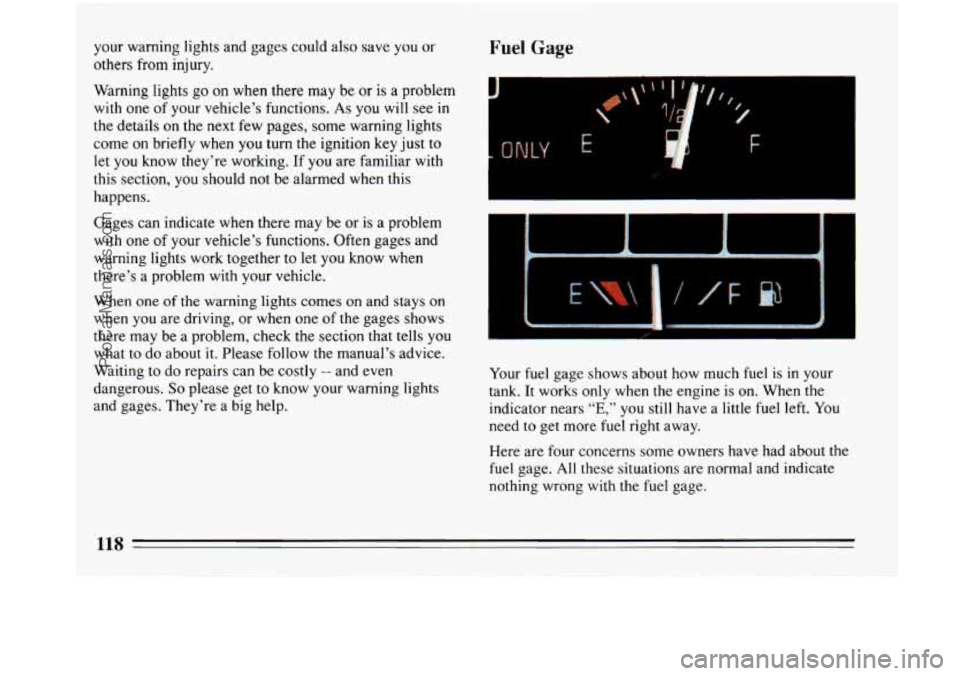
Fuel Gage
Your fuel gage shows about how much fuel is in your
tank. It works only when the engine is on. When the
indicator nears
“E,” you still have a little fuel left. You
need to
get more fuel right away.
Here are four concerns some owners have had about the
fuel gage. All these situations are normal and indicate
nothing wrong
with the fuel gage.
ProCarManuals.com
Page 122 of 340
This light will also come on when you set your parking
brake, and the light will stay on if your parking brake
doesn’t release fully. If
you try to drive off with the
parking brake set, a chime will also come
on until you
release the parking brake. If the light and chime stay on
after your parking brake is fully released, it means
you
have a brake problem. If the light and chime come on
while driving, pull
off the road and stop carefully. You
may notice that the pedal is harder to .push. Or, the peda
may go closer to the floor. It may take longer
to stop. If
the light
is still on, have the vehicle towed for service.
(See “Towing Your Car” in the Index.)
I -
A CAUTION:
Your brake system may not be working properly
if the brake warning light is on. Driving with the
brake warning light on can lead to an accident.
If
the light is still on after you’ve pulled off the road
and stopped carefully, have the vehicle towed for
service.
1
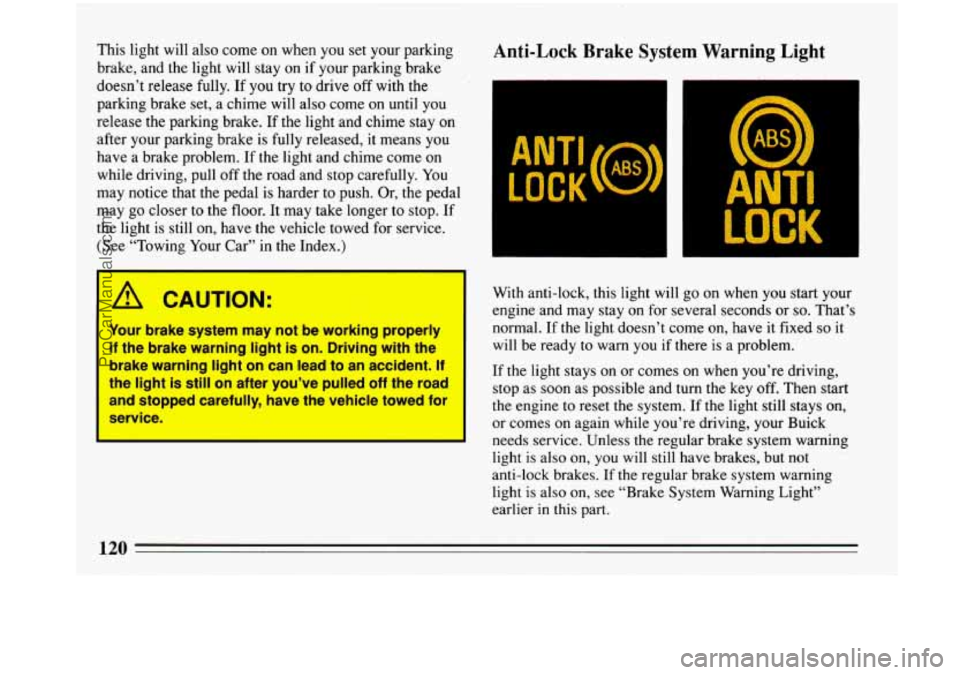
Anti-Lock Brake System Warning Light
With anti-lock, this light will go on when you start your
engine and may stay on for several seconds or
so. That’s
normal. If the light doesn’t come on, have it fixed
so it
will be ready to warn
you if there is a problem.
If the light stays
on or comes on when you’re driving,
stop as soon as possible and turn the key
off. Then start
the engine
to reset the system. If the light still stays on,
or comes on again while you’re driving, your Buick
needs service. Unless the regular brake system warning
light
is also on, you will still have brakes, but not
anti-lock brakes.
If the regular brake system warning
light
is also on, see “Brake System Warning Light”
earlier
in this part.
ProCarManuals.com
Page 125 of 340
have been operating your vehicle under normal driving
conditions,
you should pull off the road, stop your
vehicle and turn off the engine as soon as possible.
HOT COOLANT CAN BURN YOU BADLY!
In “Problems
on the Road,” this manual shows what to
do. See “Engine Overheating”
in the Index.
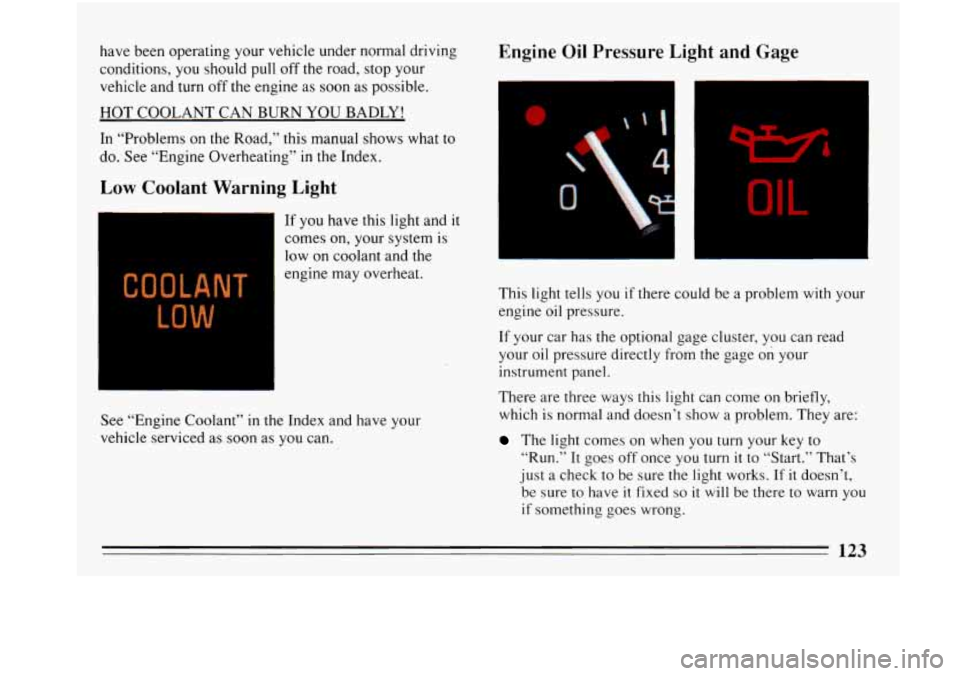
Low Coolant Warning Light
I
1
If you have this light and it
comes on, your system
is
low on coolant and the
engine may overheat.
See “Engine Coolant” in the Index and have your
vehicle serviced as soon as you can.
Engine Oil Pressure Light and Gage
0‘ 1
I
This light tells you if there could be a problem with your
engine oil pressure.
If your car has the optional gage cluster, you can read
your oil pressure directly from the gage
on your
instrument panel.
There are three ways this light can come on briefly,
which
is normal and doesn’t show a problem. They are:
The light comes on when you turn your key to
“Run.” It goes off once you turn
it to “Start.” That’s
just a check to be sure the light works. If it doesn’t,
be sure to have it fixed so it will be there to warn you
if something goes wrong.
123
ProCarManuals.com
Page 126 of 340
If you’re “idling” at a stop sign, the light may blink
on and then
off.
If you make a hard stop, the light may come on for a
moment.
But, when this light comes on and stays on, it means
oil isn’t going through your engine properly.
You could
be low on oil, or you might have some other oil
problem.
A CAUTION:
Don’t keep driving if the oil pressure is low. If
you
do, your engine can become so hot that it
catches fire. You or others could be burned.
Check your oil as soon as possible and have
your vehicle serviced.
NOTICE:
Damage to your engine from neglected oil
problems can be costly and is not covered by
your warranty.
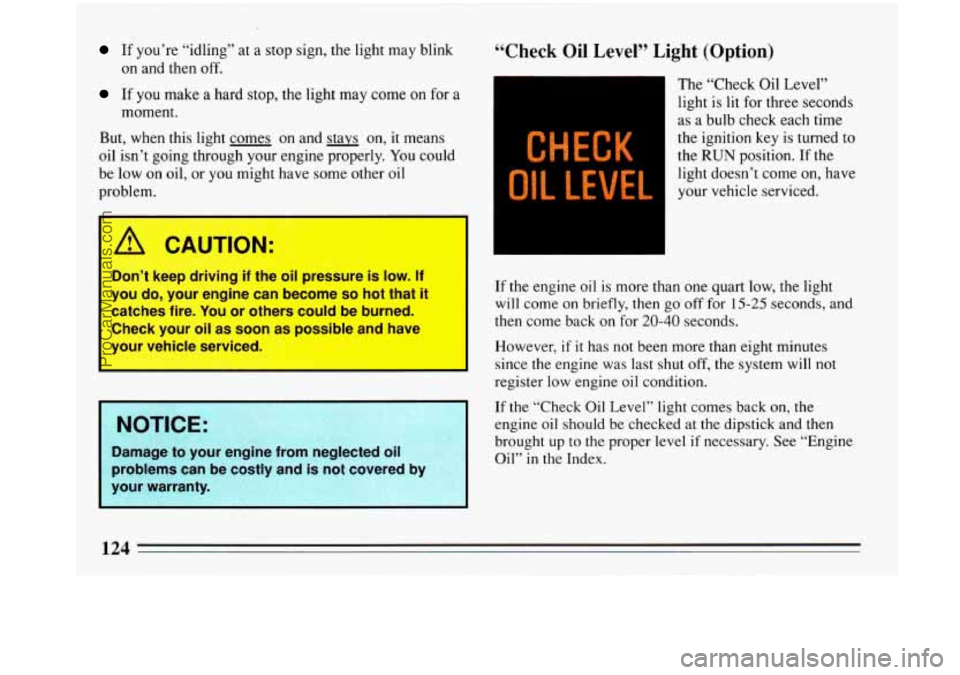
“Check Oil Level’’ Light (Option)
CHECK
OIL LEVEL
The “Check Oil Level”
light is lit for three seconds
as a bulb check each time
the ignition key is turned
to
the RUN position. If the
light doesn’t come on, have
your vehicle serviced.
If the engine oil is more than one quart low, the light
will come on briefly, then go off for 15-25 seconds, and
then come back
on for 20-40 seconds.
However,
if it has not been more than eight minutes
since the engine was last shut
off, the system will not
register low engine oil condition.
If the “Check Oil Level” light comes back on, the
engine
oil should be checked at the dipstick and then
brought up to the proper level if necessary. See “Engine
Oil” in the Index.
ProCarManuals.com
Page 127 of 340
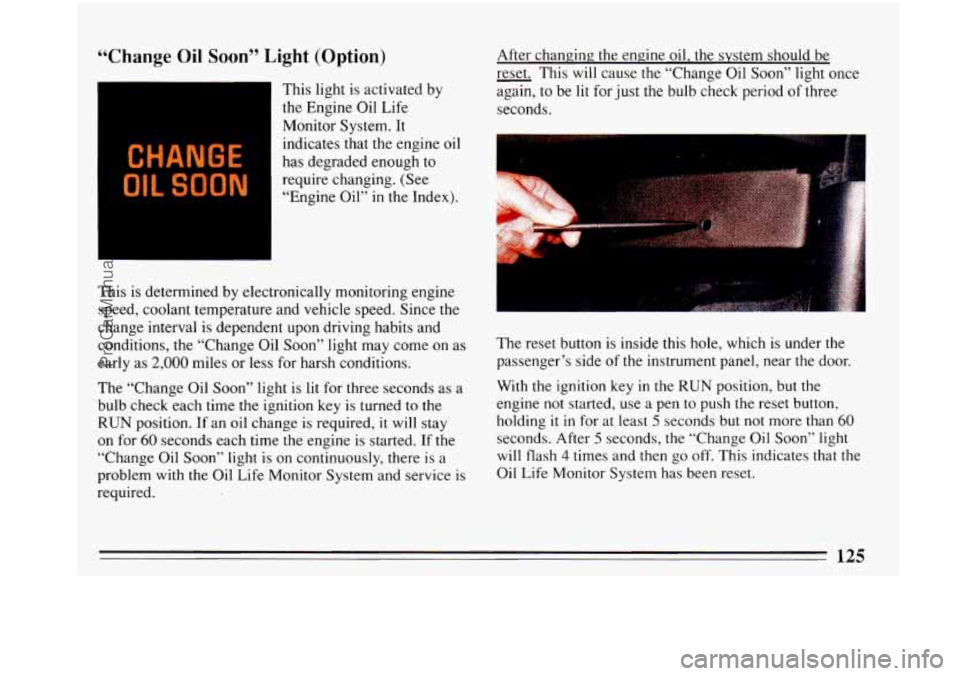
“Change Oil Soon” Light (Option)
CHANGE
OIL SOON
This light is activated by
the Engine Oil Life
Monitor System. It
indicates that the engine oil
has degraded enough to
require changing. (See
“Engine Oil” in the Index).
This is determined by electronically monitoring engine
speed, coolant temperature and vehicle speed. Since the
change interval is dependent upon driving habits and
conditions, the “Change Oil Soon” light may come on as
early as
2,000 miles or less for harsh conditions.
The “Change Oil Soon” light
is lit for three seconds as a
bulb check each time the ignition key is turned to the
RUN position. If an oil change is required, it will stay
on for
60 seconds each time the engine is started. If the
“Change Oil Soon” light is on continuously, there is a
problem with the Oil Life Monitor System and service is
required. After
changing; the engine oil, the system should be
- reset. This
will cause the “Change Oil Soon” light once
again,
to be lit for just the bulb check period of three
seconds.
The reset button is.inside this hole, which is under the
passenger’s side of the instrument panel, near the door.
With the ignition key in the
RUN position, but the
engine not started, use a pen to push the reset button,
holding
it in for at least 5 seconds but not more than 60
seconds. After 5 seconds, the “Change Oil Soon” light
will flash 4 times and then go off. This indicates that the
Oil Life Monitor System has been reset.
ProCarManuals.com