lights BUICK PARK AVENUE 1993 Owner's Guide
[x] Cancel search | Manufacturer: BUICK, Model Year: 1993, Model line: PARK AVENUE, Model: BUICK PARK AVENUE 1993Pages: 340, PDF Size: 18.17 MB
Page 207 of 340
Driving with a Trailer
Towing a trailer requires a certain amount of experience.
Before setting
out for the open road, you’ll want to get
to know your rig. Acquaint yourself with the feel of
handling and braking with the added weight of the
trailer. And always keep in mind that the vehicle
you are
driving is now a good deal longer and not nearly
so
responsive as your vehicle is by itself.
Before you start, check the trailer hitch and platform,
safety chains, electrical connector, lights, tires and
mirror adjustment.
If the trailer has electric brakes, start
your vehicle and trailer moving and then apply the
trailer brake controller by hand
to be sure the brakes are
working. This lets you check your electrical connection
at the same time.
Passing
During your trip, check occasionally to be sure that the
load is secure, and that the lights and any trailer brakes
are still working.
Following Distance
Stay at least twice as far behind the vehicle ahead as you
would when driving your vehicle without a trailer. This
can help you avoid situations that require heavy braking
and sudden turns. You’ll
need more passing distance up ahead when
you’re towing a trailer. And, because you’re a good deal
longer, you’ll need to go much farther beyond the
passed vehicle before you can return to your lane.
Backing Up
Hold the bottom of the steering wheel with one hand.
Then, to move the trailer
to the left, just move that hand
to the
left. To move the trailer to the right, move your
hand to the right. Always back up slowly and, if
possible, have someone guide you.
Making Turns
When you’re turning with a trailer, make wider turns
than normal. Do this
so your trailer won’t strike soft
shoulders, curbs, road signs, trees, or other objects.
Avoid jerky or sudden maneuvers. Signal well
in
advance.
lbrn Signals When Towing a Trailer
When you tow a trailer, your vehicle has to have a
different turn signal flasher and extra wiring. The green
arrows on your instrument panel will flash whenever
you signal a turn or lane change. Properly hooked up,
ProCarManuals.com
Page 208 of 340
the trailer lights will also flash, telling other drivers
you’re about to turn, change lanes or stop.
When towing a trailer, the green arrows
on your
instrument panel will flash for turns even
if the bulbs on
the trailer are burned out. Thus, you may think drivers
behind you are seeing your signal when they are not. It’s
important to check occasionally to be sure the trailer
bulbs are still working.
Your vehicle has bulb warning lights. When you plug
trailer lights into your vehicle’s lighting system, its bulb warning lights may not
let you know if one of your
lights goes
out. So, when you have trailer lights plugged
in, be sure
to check your vehicle and trailer lights from
time to time to be sure they’re-all working. Once
you
disconnect the trailer lights, the bulb warning lights
again can
tell you if one of your vehicle lights is out.
Driving On Grades
Reduce speed and shift to a lower gear before you start
down a long
or steep downgrade. If you don’t shift
down, you might have to use your brakes
so much that
they would get hot and no longer work well. On
a long uphill grade, shift down to
“D or 3” (Drive)
and reduce your speed to around
45 mph (70 km/h) to
reduce the possibility of engine and transaxle
overheating.
Parking on Hills
You really should not park your vehicle, with a trailer
attached,
on a hill. If something goes wrong, your rig
could start to move. People can be injured, and both
your vehicle and the trailer can be damaged.
But
if you ever have to park your rig on a hill, here’s
how to do it:
1. Apply your regular brakes, but don’t shift into “F’”
(Park) yet.
2. Have someone place chocks under the trailer wheels.
3. When the wheel chocks are in place, release the
regular brakes until the chocks absorb the load.
4. Reapply the regular brakes. Then apply your parking
brake, and
then shift to “P’ (Park).
5. Release the regular brakes.
ProCarManuals.com
Page 212 of 340
Hazard Warning Flashers
I
7 '. . ..
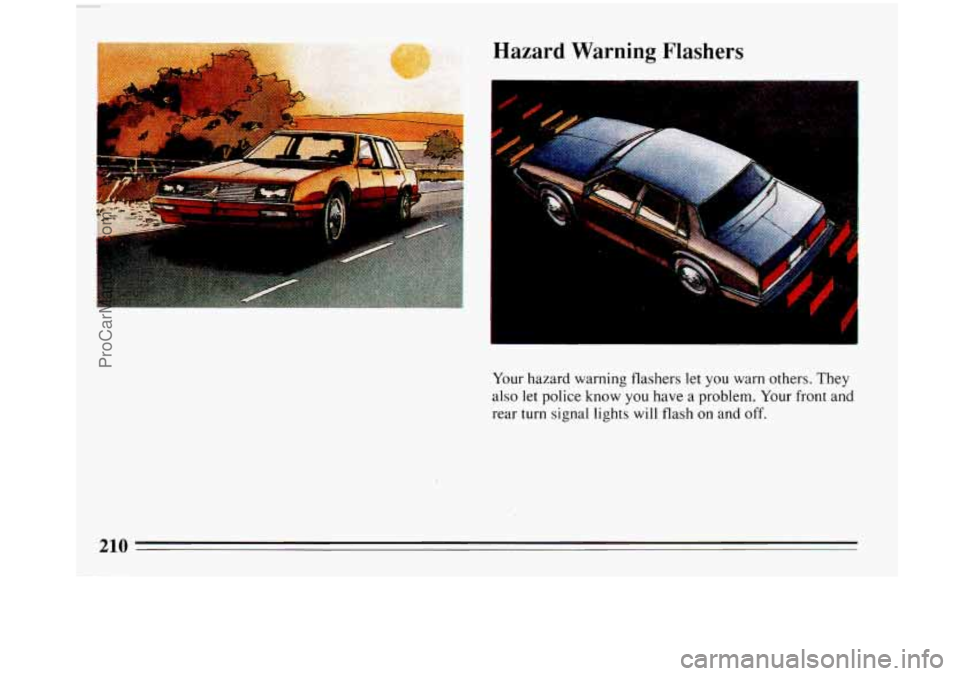
Your hazard warning flashers let you warn others. They
also let police know you have a problem. Your front and
rear turn signal lights will flash on and
off.
210
ProCarManuals.com
Page 213 of 340
, >., :,
, , . ..,
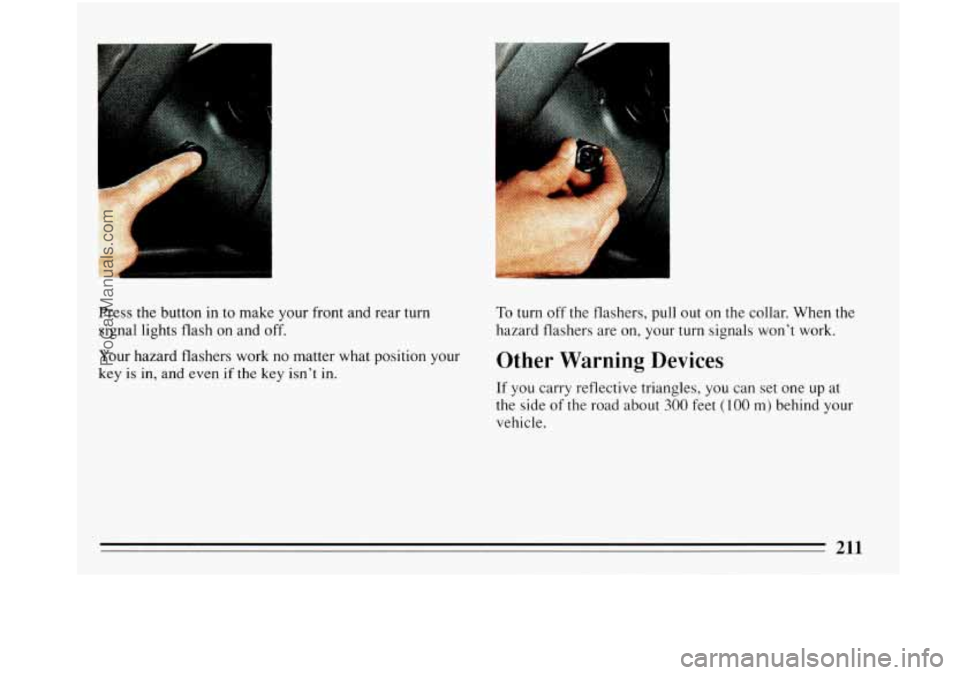
Press the button in to make your front and rear turn
signal lights flash on and off.
Your hazard flashers work no matter what position your
key is
in, and even if the key isn't in.
To turn off the flashers, pull out on the collar. When the
hazard flashers are on, your turn signals won't work.
Other Warning Devices
If you carry reflective triangles, you can set one up at
the side
of the road about 300 feet (100 m) behind your
vehicle.
211
ProCarManuals.com
Page 215 of 340
I
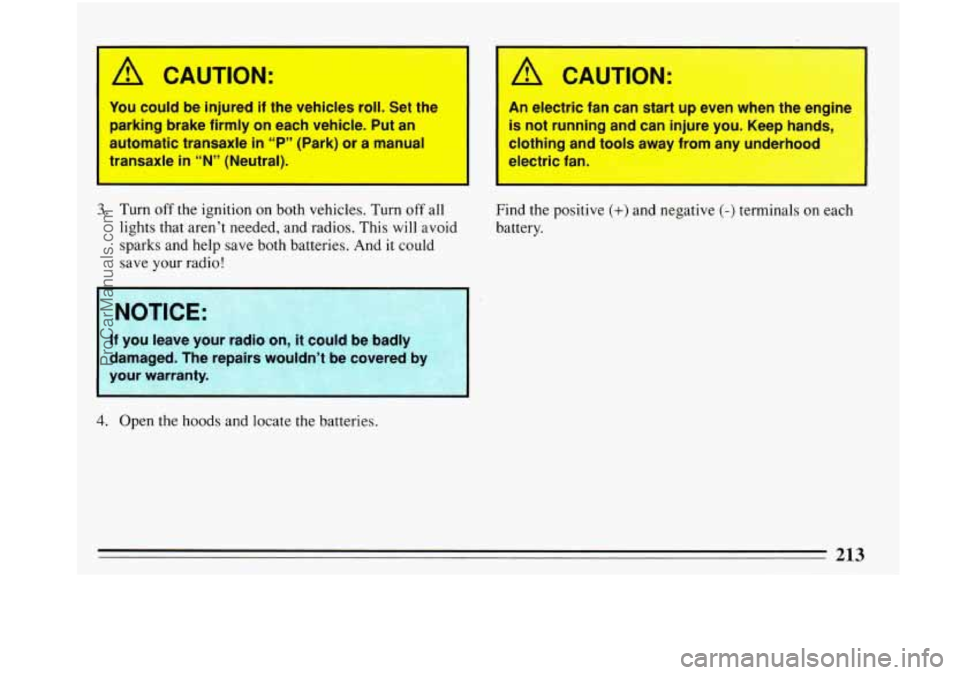
A CAUTION:
You could be injured if the vehicles roll. Set the
parking brake firmly on each vehicle. Put an
automatic transaxle
in “P” (Park) or a manual
transaxle
in “N” (Neutral).
3. Turn off the ignition on both vehicles. Turn off all
lights that aren’t needed, and radios. This will avoid
sparks and help save both batteries. And it could
save your radio!
A CAUTION:
An electric fan can start up even when the engine
is not running and can injure you. Keep hands,
clothing anA
tools away from any underhood
electric fan
1 NOTICE:
3
If you leave your ram0 or ’t could be baaly
damaged. The repairs wouldn’t be covered b)
your warranty.
Find the positive (+) and negative (-) terminals on eact
battery.
4. Open the hoods and locate the batteries.
213
ProCarManuals.com
Page 260 of 340
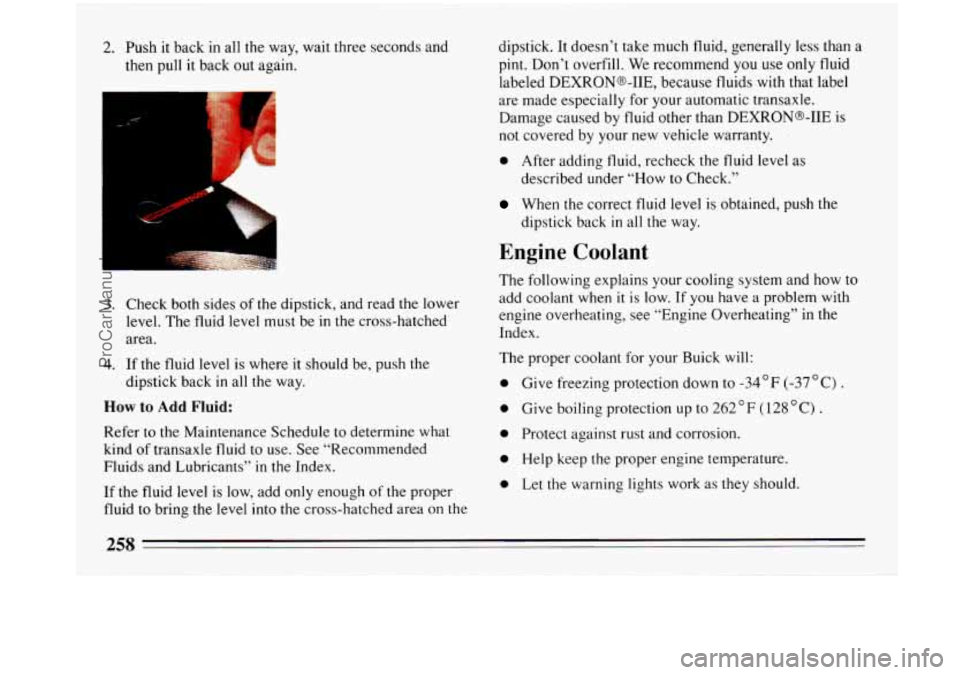
2. Push it back in all the way, wait three seconds and
then pull it back out again.
3. Check both sides of the dipstick, and read the lower
level. The fluid level must be in the cross-hatched
area.
4. If the fluid level is where it should be, push the
dipstick back
in all the way.
How to Add Fluid:
Refer to the Maintenance Schedule to determine what
kind of transaxle fluid to use. See “Recommended
Fluids and Lubricants” in the Index.
If the fluid level is low, add only enough of the proper
fluid to bring the level
into the cross-hatched area on the dipstick, It
doesn’t take much fluid, generally less than a
pint. Don’t overfill. We recommend
you use only fluid
labeled DEXRONWIE, because
fluids with that label
are made especially for your automatic transaxle.
Damage caused by fluid other than DEXRONB-IIE is
not covered by your new vehicle warranty.
0 After adding fluid, recheck the fluid level as
described under “How to Check.”
When the correct fluid level is obtained, push the
dipstick back
in all the way.
Engine Coolant
The following explains your cooling system and how to
add coolant when
it is low. If you have a problem with
engine overheating, see “Engine Overheating” in the
Index.
The proper coolant for your Buick will:
0 Give freezing protection down to -34°F (-37 “C) .
0 Give boiling protection up to 262 F ( 128 ” C) .
0 Protect against rust and corrosion.
0 Help keep the proper engine temperature.
0 Let the warning lights work as they should.
ProCarManuals.com
Page 270 of 340
1
Loading Your Vehicle
The taillamp, sidemarker and back-up lights can now be
accessed. Two of the taillamp bulbs are on a tabbed
assembly. Squeeze the release in and pull the assembly
out. Pull the bulb straight out from the socket. To
replace the assembly, the tabs must be inserted into the
slots. Push the other end in until it locks into place.
To replace the third taillamp bulb and sidemarker bulb,
turn the socket
1/4 turn and pull it out. Pull the bulb
straight out from the socket.
The backup bulb can be replaced by squeezing the lock
on the socket, turning it
l/4 turn and pulling it out. Pull
the bulb straight out. Reverse the above steps
to
reassemble the light and the trunk trim.
Tm OCCUPANTS
VEHICLE CAP. WT.
TIRE-LOADING INFORMATION
FRT. CTR.
RR. TOTAL LBS.
.~ ~~ . . ~
KG-
MAX. LOADING
& GVWR SAME AS VEHICLE
CAPACITY WEIGHT XXX COLD TIRE
TIRE SIZE SPEED PRESSURE RTG PSVKPa
FRT.
RR.
SPA.
IF TIRES ARE HOT, ADD 4PSV28KPa
SEE OWNER'S MANUAL FOR ADDITIONAL
INFORMATION
ll]m\:l .$$;;r#, : M
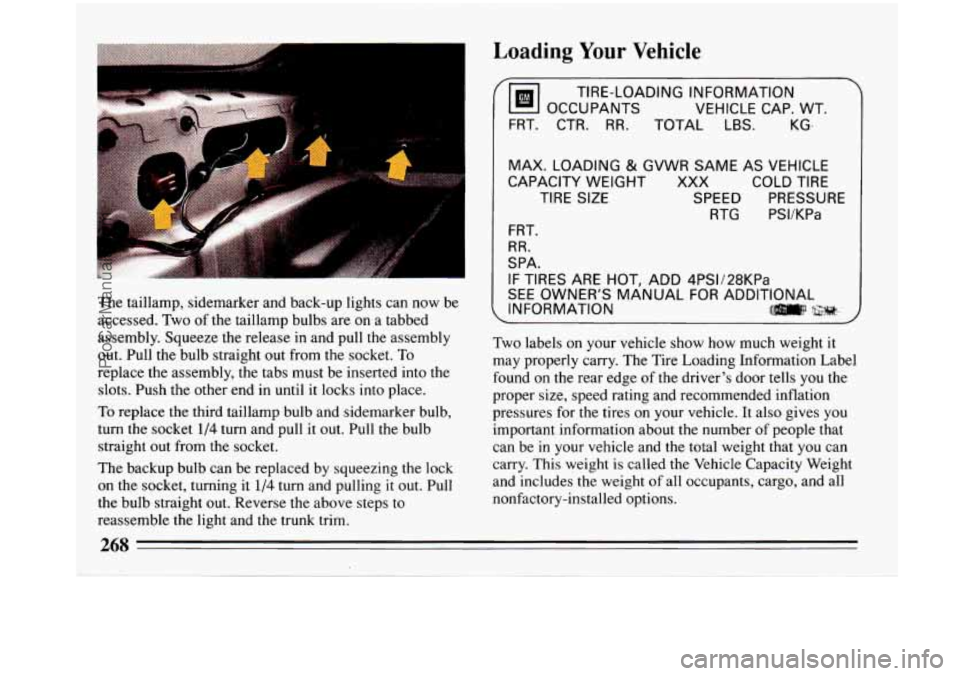
Two labels on your vehicle show how much weight it
may properly carry. The Tire Loading Information Label
found on the rear edge of the driver's door tells you the
proper size, speed rating and recommended inflation
pressures for the tires
on your vehicle. It also gives you
important information about the number
of people that
can be in your vehicle and the total weight that you can
carry. This weight
is called the Vehicle Capacity Weight
and includes the weight of all occupants, cargo, and all
nonfactory-installed options.
268
ProCarManuals.com
Page 291 of 340
There are additional fuses located behind the right sound
insulator panel on the passenger side. If these require
service, see your Buick dealer.
Maxifuse/Relay Center
To check the fuses in this underhood fuse center, turn
the two knobs
1/4 turn counterclockwise and remove the
cover. The inside of
the cover has a chart that explains
the features and controls governed by each fuse and
relay.
The PASS-Key 'I1
TM fuse is located in the right side relay
center.
Headlights
The headlight wiring is protected by a circuit breaker in
the underhood fuse center. An electrical overload will
cause
the lights to go on and off, or in some cases to
remain
off. If this happens, have your headlight wiring
checked right away.
*
Windshield Wipers
The windshield wiper motor is protected by a circuit
breaker and a fuse. If the motor overheats due to heavy
snow, etc., the wiper will stop until the motor cools. If
the overload is caused by some electrical problem and
not snow, etc., be sure to get it fixed.
Power Windows and Other Power Options
Circuit breakers in the fuse panel protect the power
windows and other power accessories. When
the current
load is too heavy, the circuit breaker opens and closes,
protecting the circuit until the problem is fixed or goes
away.
ProCarManuals.com
Page 325 of 340
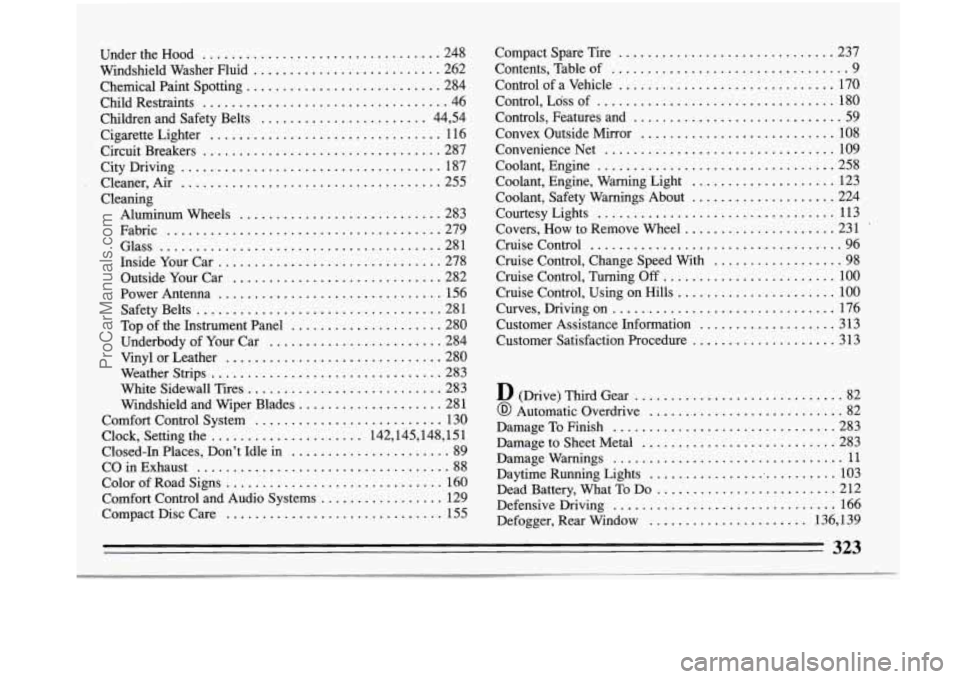
Under the Hood ............. ................... 248
Windshield Washer Fluid
.......................... 262
Chemical Paint Spotting
........................... 284
Child Restraints
.................................. 46
Children and Safety Belts
....................... 4434
Cigarette Lighter
................................ 1 16
Circuit Breakers
................................. 287
CityDriving
.................................... 187
Cleaner, Air
.................................... 255
Cleaning Aluminum Wheels
............................ 283
Fabric
...................................... 279
Glass
....................................... 281
Inside Your Car
............................... 278
Outside
Your Car ............................. 282
Power Antenna
............................... 156
Safety Belts
.................................. 281
Top of the Instrument Panel
..................... 280
Underbody
of Your Car ........................ 284
vinyl or Leather
.............................. 280
Weather
Strips ............................... -283
White Sidewall Tires
........................... 283
Windshield and Wiper Blades
.................... 281
Comfort Control System
.......................... 130
Clock, Setting the
..................... 142,145,148, 151
Closed-In Places, Don’t Idle in
...................... 89
COinExhaust
................................... 88
Color of Road Signs .............................. 160
Comfort Control and Audio Systems
................. 129
Compact Disc Care
.............................. 155 Compact Spare
Tire
.............................. 237
Contents. Table of
................................. 9
Contra1 of a Vehicle
.............................. 170
Control. Loss of ................................. 180
Controls. Features and
............................. 59
Convex Outside Mirror ........................... 108
Convenience Net
................................ 109
Coolant. Engine
................................. 258
Coolant. Engine. Warning Light
.................... 123
Coolant. Safety Warnings About
.................... 224
Courtesy Lights
................................. 113
Covers. How to Remove Wheel
..................... 231
Cruise Control
.................................. -96
Cruise Control. Change Speed With
.................. 98
Cruise Control. Turning
Off ........................ 100
Cruise Control. Using on Hills
...................... 100
Curves. Driving on
............................... 176
Customer Assistance Information
................... 313
Customer Satisfaction Procedure
.................... 313
D (Drive) Third Gear ............................. 82
@ Automatic Overdrive ........................... 82
Damage To Finish
............................... 283
Damage to Sheet Metal
........................... 283
Daytime Running Lights
........................... 103
Dead Battery. What To Do
......................... 212
Defensive Driving
............................... 166
Defogger. Rear Window
...................... 136. 139
Damagewarnings
................................ 11
323
ProCarManuals.com
Page 328 of 340
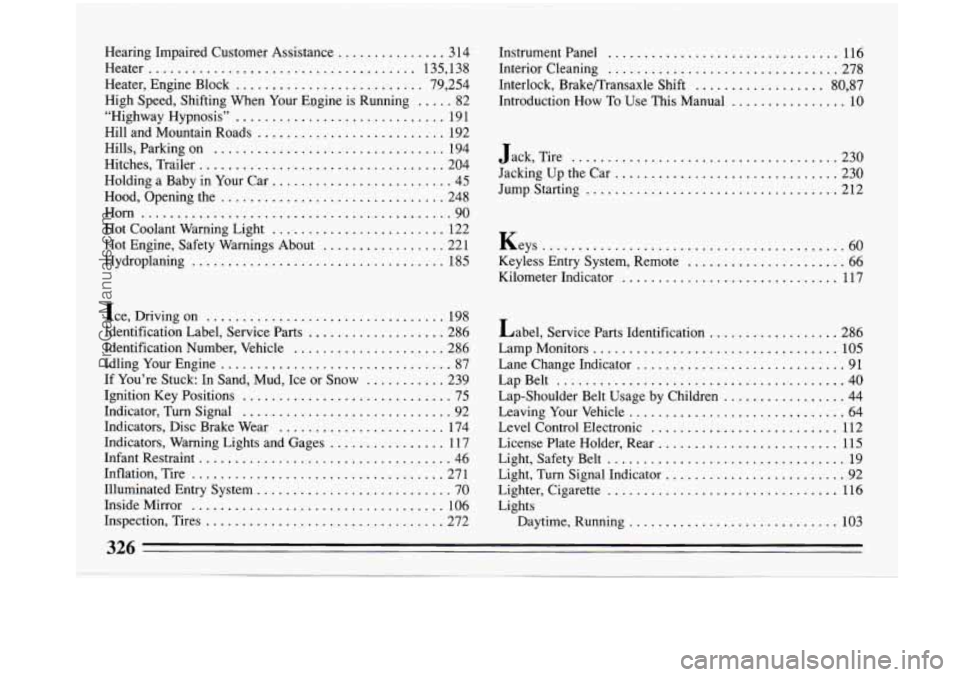
Hearing Impaired Customer Assistance ............... 3 14
Heater
..................................... 135. 138
Heater. Engine Block
.......................... 79. 254
High Speed. Shifting When Your Eogine is Running
..... 82
“Highway Hypnosis’’
............................. 19 1
Hill and Mountain Roads
.......................... 192
Hills. Parking on
................................ 194
Hitches. Trailer
.................................. 204
Holding a Baby
in Your Car ......................... 45
Hood. Opening the
............................... 248
Horn
........................................... 90
Hot Coolant Warning Light
........................ 122
Hot Engine. Safety Warnings About
................. 221
Hydroplaning
................................... 185
Ice. Driving on
................................. 198
Identification Label. Service Parts
................... 286
Identification Number. Vehicle
..................... 286
Idling Your Engine
................................ 87
If You’re Stuck: In Sand. Mud. Ice or Snow ........... 239
Ignition Key Positions
............................. 75
Indicator. Turn Signal
............................. 92
Indicators. Disc Brake Wear
....................... 174
Indicators. Warning Lights and Gages
................ 117
Infant Restraint
................................... 46
Inflation. Tire
................................... 271
Illuminated Entry System
........................... 70
Inside Mirror ................................... 106
Inspection. Tires
................................. 272 Instrument Panel
................................ 1 16
Interior Cleaning
................................ 278
Interlock. BrakeRransaxle Shift
.................. 80. 87
Introduction How
To Use This Manual ................ 10
J ack. Tire ..................................... 230
Jacking Up the Car
............................... 230
Jump Starting
................................... 212
Keys
.......................................... 60
Keyless Entry System. Remote ...................... 66
Kilometer Indicator
.............................. 117
Label. Service Parts Identification
.................. 286
Lamp Monitors
.................................. 105
Lane Change Indicator
............................. 91
Lap-Shoulder Belt Usage by Children
................. 44
Leaving Your Vehicle
.............................. 64
Level Control Electronic
.......................... 112
License Plate Holder, Rear
......................... 115
Light, Safety Belt
................................. 19
Light, Turn Signal Indicator
......................... 92
Lighter, Cigarette
................................ 116
Daytime. Running
............................. 103
LapBelt
........................................ 40
Lights
ProCarManuals.com