ESP BUICK PARK AVENUE 1993 Owners Manual
[x] Cancel search | Manufacturer: BUICK, Model Year: 1993, Model line: PARK AVENUE, Model: BUICK PARK AVENUE 1993Pages: 340, PDF Size: 18.17 MB
Page 26 of 340
Here Are Questions Many People Ask
About Safety Belts
-- and the
Answers
@ Won’t I be trapped in the vehicle after an
accident if I’m wearing a safety belt?
A: You could be -- whether you’re wearing a safety
belt or not. But you can easily unbuckle a safety
belt, even if you’re upside down. And your chance
of being conscious during and after an accident,
so
you can unbuckle and get out, is much greater if
you are belted.
Why don’t they just put in air bags so people
won’t have to wear safety belts?
A: “Air bags,” or Supplemental Inflatable Restraint
systems, are in some vehicles today and will be in
more of them in the future. But they are
supplemental systems only
-- so they work with safety belts,
not instead
of them. Every “air bag”
system ever offered for sale has required the
use of
safety belts. Even if you’re in a vehicle that has “
air bags,” you still have to buckle up to get the
most protection. That’s true not only in frontal
collisions, but especially in side and other
collisions.
&: If I’m a good driver, and I never drive far from
home, why should I wear safety belts?
A: You may be an excellent driver, but if you’re in an
accident
-- even one that isn’t your fault -- you and
your passengers can be hurt. Being a good driver
doesn’t protect
you from things beyond your
control, such as bad drivers.
Most accidents occur within
25 miles (40 km) of home.
And the greatest number of serious injuries and deaths
occur at speeds of less than
40 mph (65 kmh).
Safety belts are for everyone.
ProCarManuals.com
Page 64 of 340
Door Locks There are several ways to lock and unlock your vehicle:
’
/d CAUTION:
Unlocked doors can be dang
Passengers
-- especially children -!
open the doors and fall out. When a door i
locked, the inside handle won’t open it. ;
Outsiders can easily enter through an u
door when you slow down or stop your
This may not be
so obvious: You increase the
chance of being thrown out
of the vehicle in a
crash if the doors aren’t locked. Wear safety
belts properly, lock your doors, and you will be
far better off whenever you drive your vehicle.
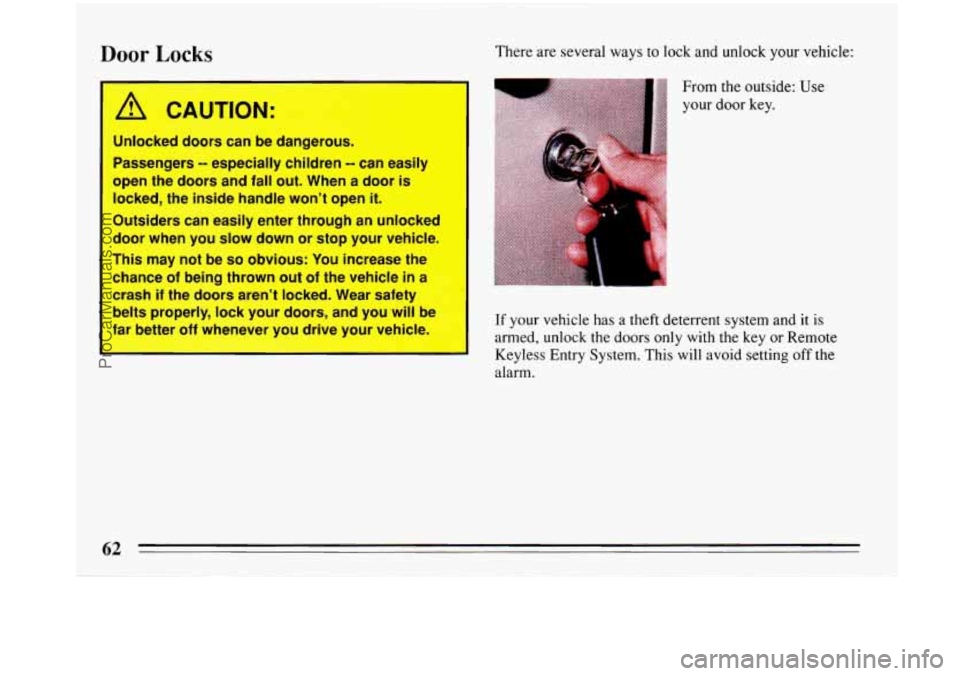
From the outside: Use
your door key.
If your vehicle has a theft deterrent system and it is
armed, unlock the doors only with the
key or Remote
Keyless Entry System. This will avoid setting
off the
alarm.
ProCarManuals.com
Page 70 of 340
3.
4.
5.
6.
7.
Use a jumper wire with alligator clips at both ends to
ground (Terminal
A) to program (Terminal G).
Grounding the program terminal erases the system
memory and causes the doors to lock and unlock
once. This means the system is ready to be matched
to the transmitter.
Keeping the program terminal grounded, press the
UNLOCK button on the first transmitter. The door
locks will lock and unlock again to indicate the
transmitter is now matched. If there is no response,
check the transmitter batteries. If you do not want to
match a second transmitter, proceed to Step
6.
Still keeping the program terminal grounded, repeat
Step
4 with the second transmitter. If you disconnect
the ground wire before completing this step, or if
you press the button
on the first transmitter more
than once, only the first transmitter is matched. If
you make a mistake, disconnect the jumper wire and
start over at Step
3.
Remove the jumper wire. (Note: The system will not
operate if the jumper wire is still connected.)
Test the operation of both transmitters with the
vehicle.
If the lock control does not work as it should, see your
Buick dealer.
Battery Replacement
Under normal use, the batteries in your key chain
transmitter should last about two years.
You can tell the batteries are weak if the transmitter
won’t work at the normal range in any location.
If you
have to get close to your vehicle before the transmitter
works, it’s probably time to change the wlerieg,
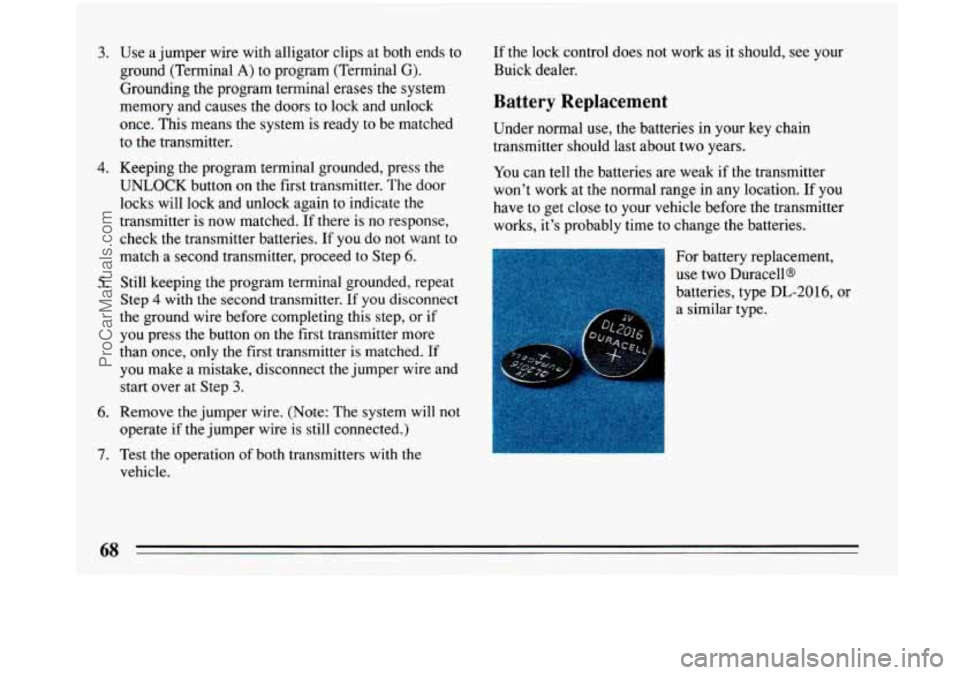
For battery replacement,
use two Duracells
batteries, type DL-2016, or
a similar type.
ProCarManuals.com
Page 73 of 340
Theft
Vehicle theft is big business, especially in some cities.
Although your Buick has a number of theft deterrent
features, we know that nothing we put on
it can make it
impossible to steal. However, there are ways you can
help.
Kev in the ignition: If you walk away from your
vehicle with the keys inside, it’s an easy target for joy
riders or professional thieves
-- so don’t do it.
When you park your Buick and open the driver’s door,
you’ll hear a tone reminding you to remove your key
from
the ignition and take it with you. Always do this.
Your steering wheel will be locked, and
so will your
ignition and transaxle. And remember to lock the doors.
Parking at Night: Park in a lighted spot, close all
windows and lock your vehicle. Remember
to keep your
valuables
out of sight. Put them in a storage area, or take
them with you.
Parking. Lots: If you park
in a lot where someone will
be watching your vehicle, it’s best to lock
it up and take
your keys. But what if you have
to leave your ignition
key? What if you have to leave something valuable
in
your vehicle?
Put your valuables in a storage area, like your trunk
Lock the glove box.
or glove
box.
0 Lock all the doors except the driver’s.
0 Then take the door key with you.
Universal Theft Deterrent (Option)
If your Buick has this option, it has a theft deterrent
alarm system. With this system, the “SECURITY’’ light
will flash as
you open the door (if your ignition is off).
This light reminds you
to arm the theft deterrent system.
Here’s how to do it:
1. Open the door.
2. Lock the door with the power door lock switch or
Remote Keyless Entry System. The “SECURITY”
light should come on
and stay on.
3. Close all doors. The “SECURITY” light should go
off.
If a door or the trunk is opened without the key or
Remote Keyless Entry System, the alarm will
go off. It
will also
go off if a door lock or the trunk lock is
damaged. Your vehicle’s lights will flash and the horn
71
ProCarManuals.com
Page 94 of 340
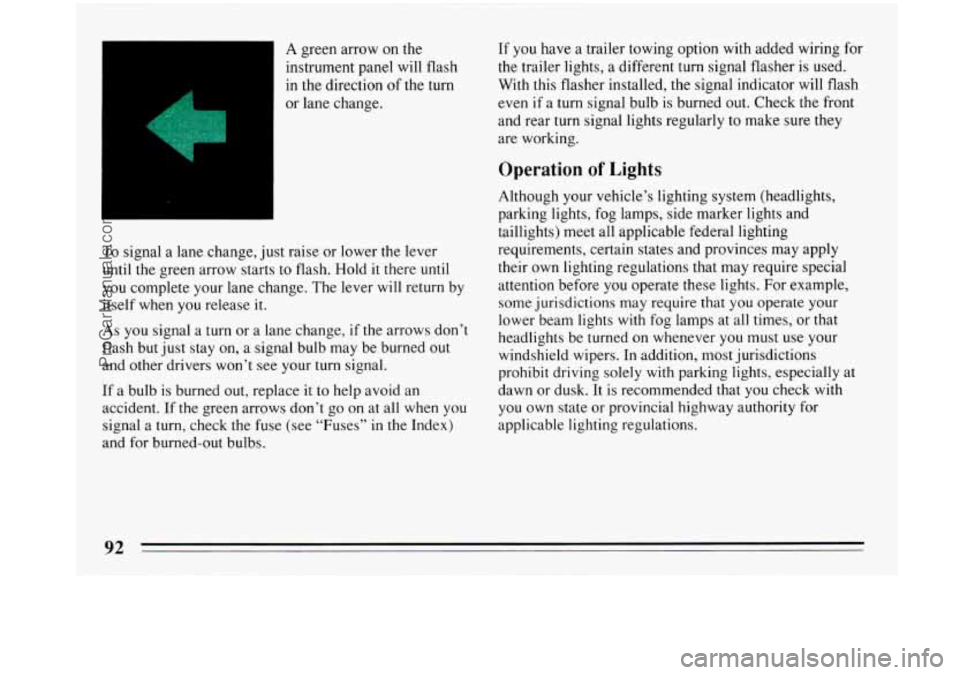
A green arrow on the
instrument panel
will flash
in the direction of the turn
or lane change.
To signal a lane change, just raise or lower the lever
until
the green arrow starts to flash. Hold it there until
you complete your lane change. The lever will return by
itself when you release it.
As you signal a turn or a lane change, if the arrows don’t
flash but just stay on, a signal bulb may be burned out
and other drivers won’t see your turn signal.
If a bulb is burned out, replace it to help avoid an
accident. If
the green arrows don’t go on at all when you
signal a turn, check the fuse (see “Fuses”
in the Index)
and for burned-out bulbs.
If you have a trailer towing option with added wiring for
the trailer lights, a different turn signal flasher is used.
With this flasher installed, the signal indicator will flash
even
if a turn signal bulb is burned out. Check the front
and rear turn signal lights regularly to make sure they
are working.
Operation of Lights
Although your vehicle’s lighting system (headlights,
parking lights, fog lamps, side marker lights and
taillights) meet all applicable federal lighting
requirements, certain states and provinces may apply
their own lighting regulations that may require special
attention before
you operate these lights. For example,
some jurisdictions may require that you operate your
lower beam lights with fog lamps at all times, or that
headlights be turned on whenever you must use your
windshield wipers. In addition, most jurisdictions
prohibit driving solely with parking lights, especially at
dawn or dusk. It is recommended that
you check with
you own state or provincial highway authority for
applicable lighting regulations.
ProCarManuals.com
Page 141 of 340
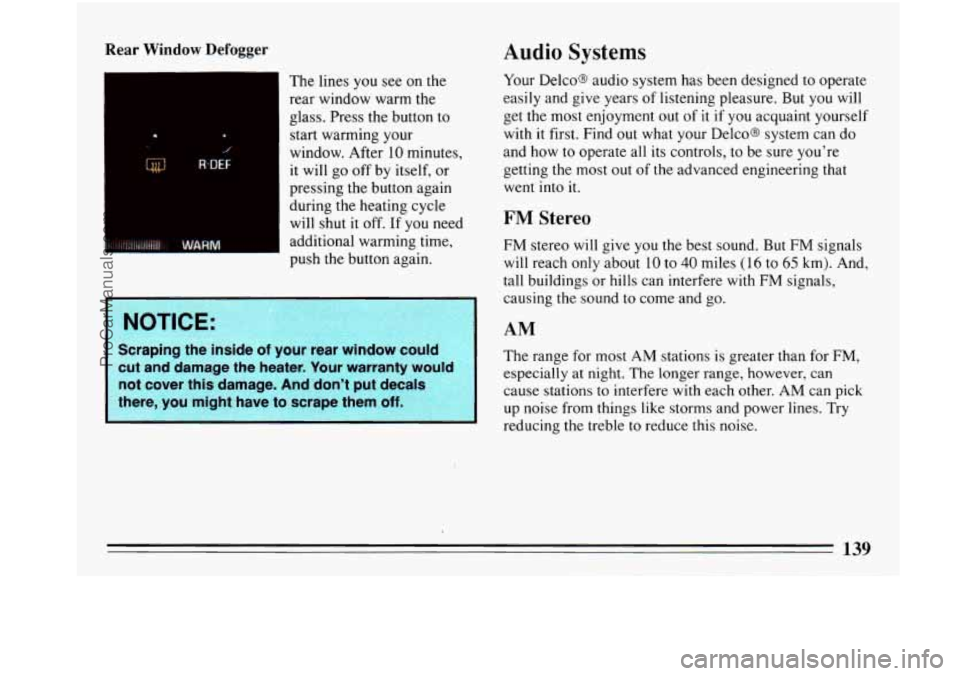
Rear Window Defogger
The lines you see on the
rear window warm the
glass. Press the button to
start warming your
window. After 10 minutes,
it will
go off by itself, or
pressing the button again
during the heating cycle will shut it off. If
you need
additional warming time,
push the button again.
NOTICE:
Scraping the inside of your rear window could
cut and damage the heater. Your warranty would
not cover this damage. And don’t put decals
there, you might have to scrape them
off.
Audio Systems
Your Delco@ audio system has been designed to operate
easily and give years
of listening pleasure. But you will
get the most enjoyment out
of it if you acquaint yourself
with
it first. Find out what your DelcoB system can do
and how to operate all its controls, to be sure you’re
getting
the most out of the advanced engineering that
went into
it.
FM Stereo
FM stereo will give you the best sound. But FM signals
will reach only about 10 to
40 miles (16 to 65 km). And,
tall buildings or hills can interfere with FM signals,
causing the sound to come and go.
AM
The range for most AM stations 1s greater than for FM,
especially at night. The longer range, however, can
cause stations to interfere with each other. AM can pick
up noise from things like storms and power lines. Try
reducing the treble to reduce this noise.
139
ProCarManuals.com
Page 144 of 340
Pushbuttons Clock
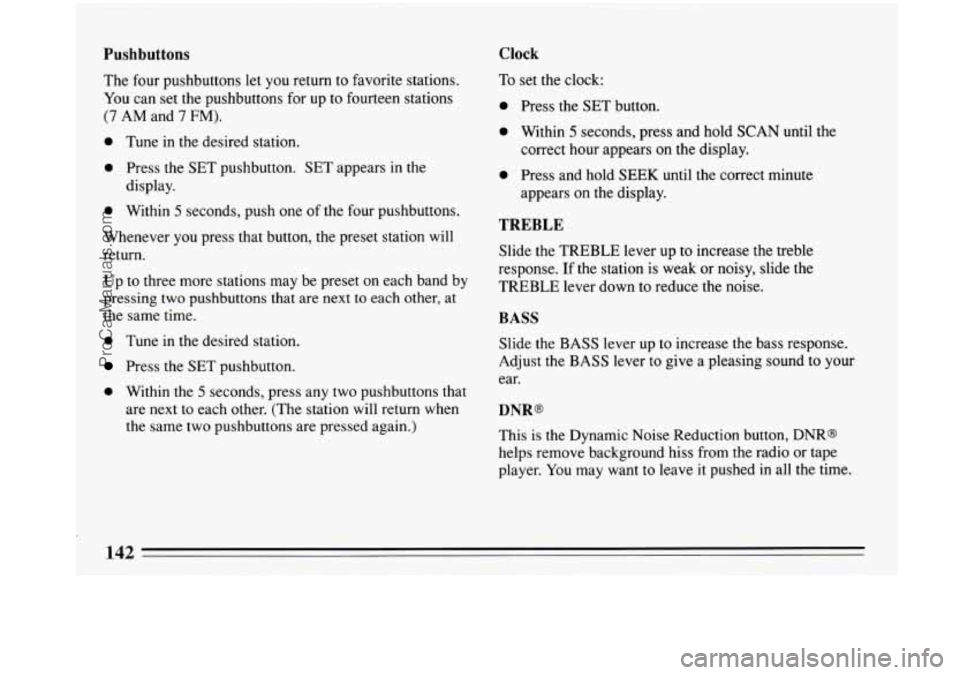
The four pushbuttons let you return to favorite stations.
You can set the pushbuttons for up to fourteen stations
(7 AM and 7 FM).
0 Tune in the desired station.
0 Press the SET pushbutton. SET appears in the
display.
0 Within 5 seconds, push one of the four pushbuttons.
Whenever you press that button, the preset station will
return.
Up to three more stations may be preset on each band by
pressing two pushbuttons that are next to each other, at
the same time.
0 Tune in the desired station.
Press the SET pushbutton.
0 Within the 5 seconds, press any two pushbuttons that
are next to each other. (The station will return when
the same two pushbuttons are pressed again.) To
set the clock:
0 Press the SET button.
0 Within 5 seconds, press and hold SCAN until the
correct hour appears on the display.
0 Press and hold SEEK until the correct minute
appears on the display.
TREBLE
Slide the TREBLE lever up to increase the treble
response. If the station is weak or noisy, slide the
TREBLE lever down to reduce the noise.
BASS
Slide the BASS lever up to increase the bass response.
Adjust the BASS lever to give a pleasing sound to your
ear.
DNR@
This is the Dynamic Noise Reduction button, DNR@
helps remove background hiss from
the radio or tape
player.
You may want to leave it pushed in all the time.
ProCarManuals.com
Page 150 of 340
SCAN Clock
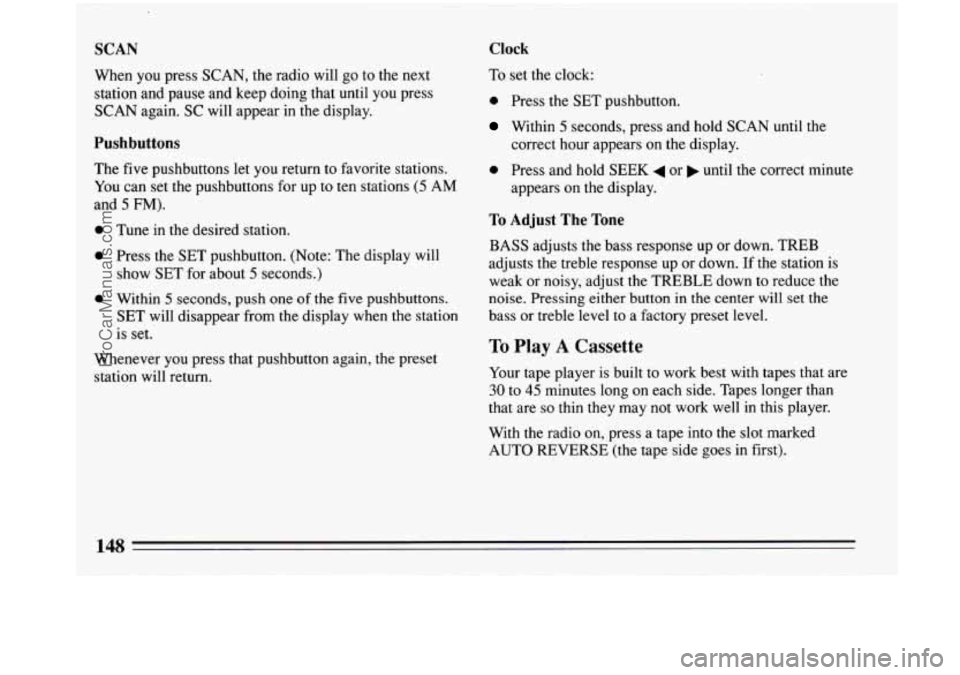
When you press SCAN, the radio will go to the next
station and pause and keep doing that until
you press
SCAN again. SC will appear in the display.
Pushbuttons
The five pushbuttons let you return to favorite stations.
You can set the pushbuttons for up to ten stations
(5 AM
and
5 FM).
0 Tune in the desired station.
0 Press the SET pushbutton. (Note: The display will
shQw SET for about
5 seconds.)
0 Within 5 seconds, push one of the five pushbuttons.
SET will disappear from the display when the station
is set.
Whenever you press that pushbutton again, the preset
station will return. To
set the clock:
0 Press the SET pushbutton.
Within 5 seconds, press and hold SCAN until the
correct hour appears on the display.
0 Press and hold SEEK 4 or until the correct minute
appears on the display.
To Adjust The Tone
BASS adjusts the bass response up or down. TREB
adjusts the treble response up or down. If the station is
weak or noisy, adjust the TREBLE.down to reduce the
noise. Pressing either button in the center will set the
bass or treble
level to a factory preset level.
To Play A Cassette
Your tape player is built to work best with tapes that are
30 to 45 minutes long on each side. Tapes longer than
that are
so thin they may not work well in this player.
With the radio on, press a tape into the
slot marked
AUTO REVERSE (the tape side goes in first).
ProCarManuals.com
Page 172 of 340
alcohol in a person’s system can make crash injuries
worse. That’s especially true for brain, spinal cord and
heart injuries. That means that if anyone who has been
drinking
-- driver or passenger -- is in a crash, the
chance of being killed or permanently disabled is higher
than if that person had not been drinking. And we’ve
already
seen that the chance of a crash itself is higher for
drinking drivers.
/I CAUTION:
Drlnklng and then driving Is very dangerous.
Your reflexes, perceptions, and judgment wlll be
affected by even a small amount of alcohol. You
could have a serious - or even fatal - accident if
you drive after drinking. Please don’t drink and
drive or rlde with a driver who has been drinking.
Ride home in a cab; or if you’re with a group,
designate a driver who will not drink
Control of a Vehicle
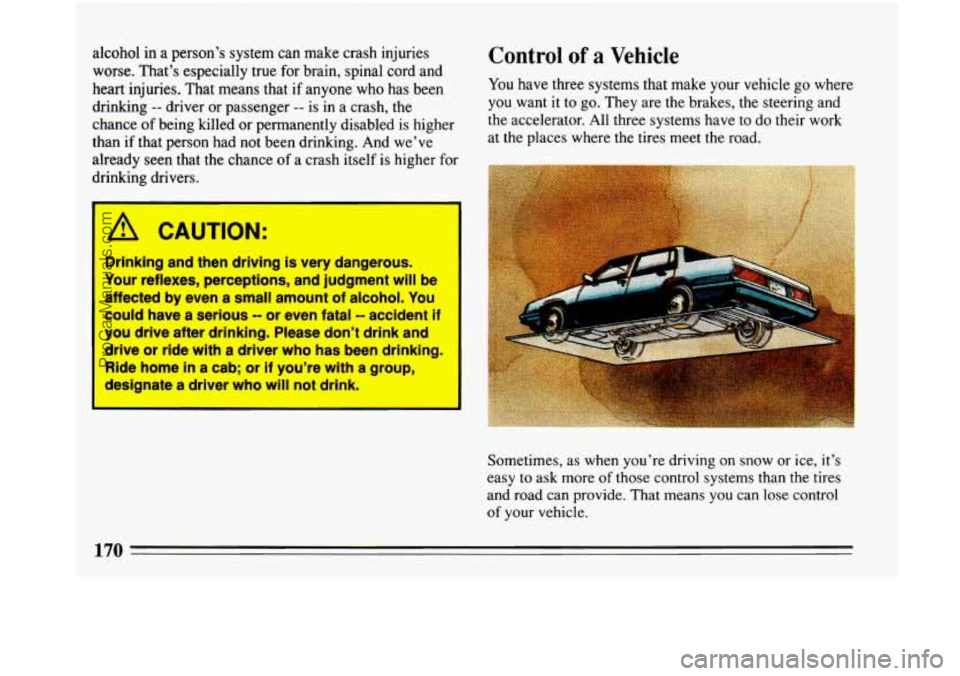
You have three systems that make your vehicle go where
you want it to go. They are the brakes, the steering and
the accelerator. All three systems have to do their work
at
the places where the tires meet the road.
Sometimes, as when you’re driving on snow or ice, it’s
easy
to ask more of those control systems than the tires
and road can provide. That means you can lose control
of your vehicle.
ProCarManuals.com
Page 176 of 340
I CAUTION:
Anti-lock doesn’t change the time you need to
get your foot
up to the brake pedal. If you get too
close to the vehicle in front of you, you won’t
have time to
apply your brakes ifethat vehicle
suddenly
stows or stops. Always leave enough
room up ahead to stop, even though you have
antblock brakes.
To Use Anti-Lock:
Don’t pump the brakes. Just hold the brake pedal down
and let anti-lock work for
you.
When you start your vehicle and begin to drive away,
you may hear a momentary motor or clicking noise. And
you may even notice that your brake pedal moves a little
while this is going on. This is the ABS system testing
itself. You may also hear this during a hard stop.
Traction Control System (Option)
Your vehicle may have a traction control system that
limits wheel spin. This is especially useful
in slippery
road conditions. The traction control system works at
low speeds only, such as when you accelerate from a stop. It
applies brake pressure
to an individual wheel
that the system senses is about to spin.
You may feel the system working, or you may notice
some noise, but this is normal.
TRACTION
OFF
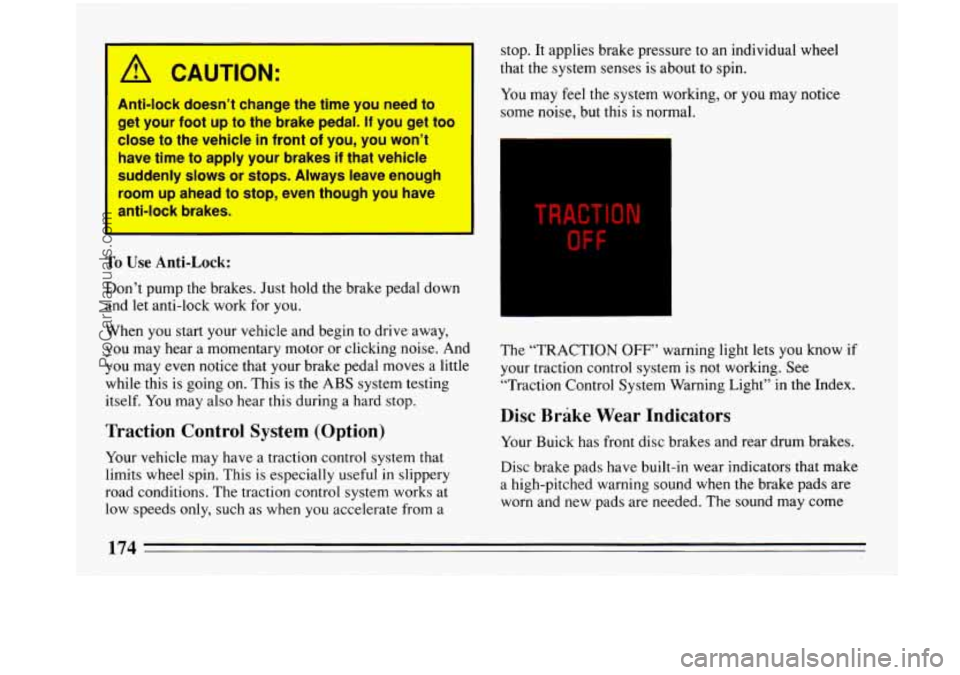
The “TRACTION OFF” warning light lets you know if
your traction control system is not working. See
“Traction Control System Warning Light” in the Index.
Disc Brake Wear Indicators
Your Buick has front disc brakes and rear drum brakes.
Disc brake pads have built-in wear indicators that make
a high-pitched warning sound when the brake pads are
worn and new pads are needed. The sound may come
174
ProCarManuals.com