low beam BUICK PARK AVENUE 1993 Owners Manual
[x] Cancel search | Manufacturer: BUICK, Model Year: 1993, Model line: PARK AVENUE, Model: BUICK PARK AVENUE 1993Pages: 340, PDF Size: 18.17 MB
Page 61 of 340
Part 2 Features & Controls
Here you can learn about the many standard and optional features on your Buick. and information on starting. shifting
and braking
. Also explained are the instrument panel and the warning systems that tell you if everything is working
properly
.. and what to do if you have a problem .
Keys ........................................................................\
.... 60
DoorLocks
....................................................................... \
62
NewVehicleBreak-In .............................................................. 74
StartingtheEngine ................................................................. 76
ShiftingtheTransaxle
.............................................................. 80
Windows ........................................................................\
. 90
TiltSteeringWheel
................................................................ 90
Multi-FunctionLever
............................................................... 91
TurnandLaneChangeSignals ................................................... 91
Headlight High-Low Beam Change Signals
......................................... 91
WindshieldWiper/Washer
...................................................... 94
CruiseControl ................................................................ 96
Instrumentpanel
................................................................... 116
Speedometer and Odometer
..................................................... 117
Warning Lights and Gages
...................................................... 117
59
~ .. . ~ .. .. _.__~ ....... - ...... ... ..._- .... -
ProCarManuals.com
Page 93 of 340
The Turn Signal/Headlight Beam
Lever Turn Signal and Lane Change Indicator
H
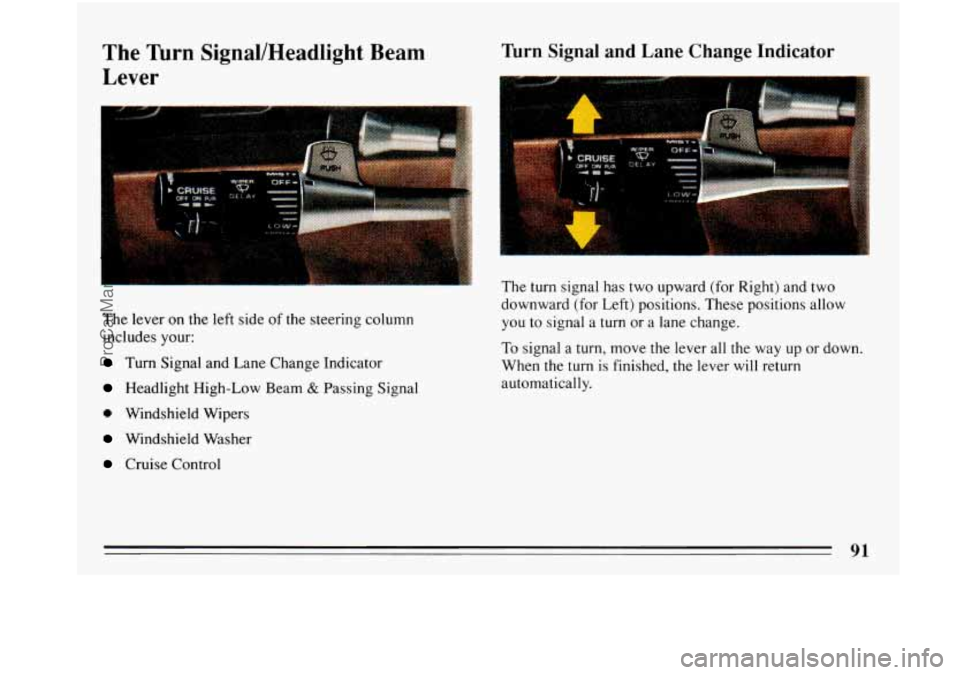
The lever on the left side of the steering column
includes your:
Turn Signal and Lane Change Indicator
Headlight High-Low Beam & Passing Signal
0 Windshield Wipers
Windshield Washer
Cruise Control
C!
The turn signal has two upward (for Right) and two
downward (for Left) positions. These positions allow
you to signal a turn or a lane change.
To signal a turn, move the lever all the way
up or down.
When the turn
is finished, the lever will return
automatically.
ProCarManuals.com
Page 94 of 340
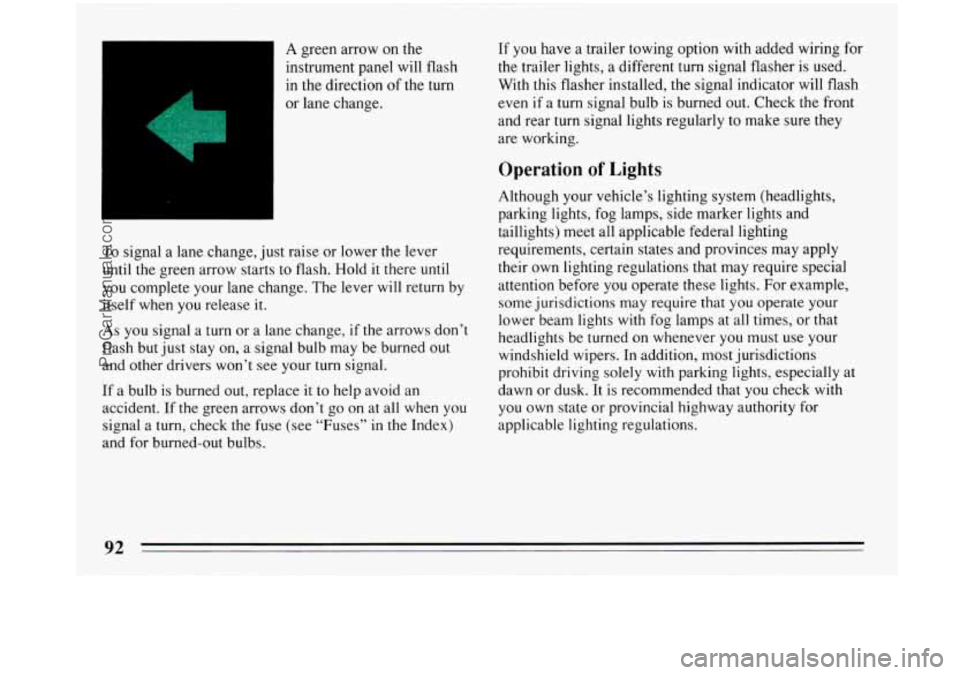
A green arrow on the
instrument panel
will flash
in the direction of the turn
or lane change.
To signal a lane change, just raise or lower the lever
until
the green arrow starts to flash. Hold it there until
you complete your lane change. The lever will return by
itself when you release it.
As you signal a turn or a lane change, if the arrows don’t
flash but just stay on, a signal bulb may be burned out
and other drivers won’t see your turn signal.
If a bulb is burned out, replace it to help avoid an
accident. If
the green arrows don’t go on at all when you
signal a turn, check the fuse (see “Fuses”
in the Index)
and for burned-out bulbs.
If you have a trailer towing option with added wiring for
the trailer lights, a different turn signal flasher is used.
With this flasher installed, the signal indicator will flash
even
if a turn signal bulb is burned out. Check the front
and rear turn signal lights regularly to make sure they
are working.
Operation of Lights
Although your vehicle’s lighting system (headlights,
parking lights, fog lamps, side marker lights and
taillights) meet all applicable federal lighting
requirements, certain states and provinces may apply
their own lighting regulations that may require special
attention before
you operate these lights. For example,
some jurisdictions may require that you operate your
lower beam lights with fog lamps at all times, or that
headlights be turned on whenever you must use your
windshield wipers. In addition, most jurisdictions
prohibit driving solely with parking lights, especially at
dawn or dusk. It is recommended that
you check with
you own state or provincial highway authority for
applicable lighting regulations.
ProCarManuals.com
Page 95 of 340
Headlight High-Low Beam
To change the headlights
from low beam to high or
high to low, pull the turn
signal lever. all the way
toward you. Then release it.
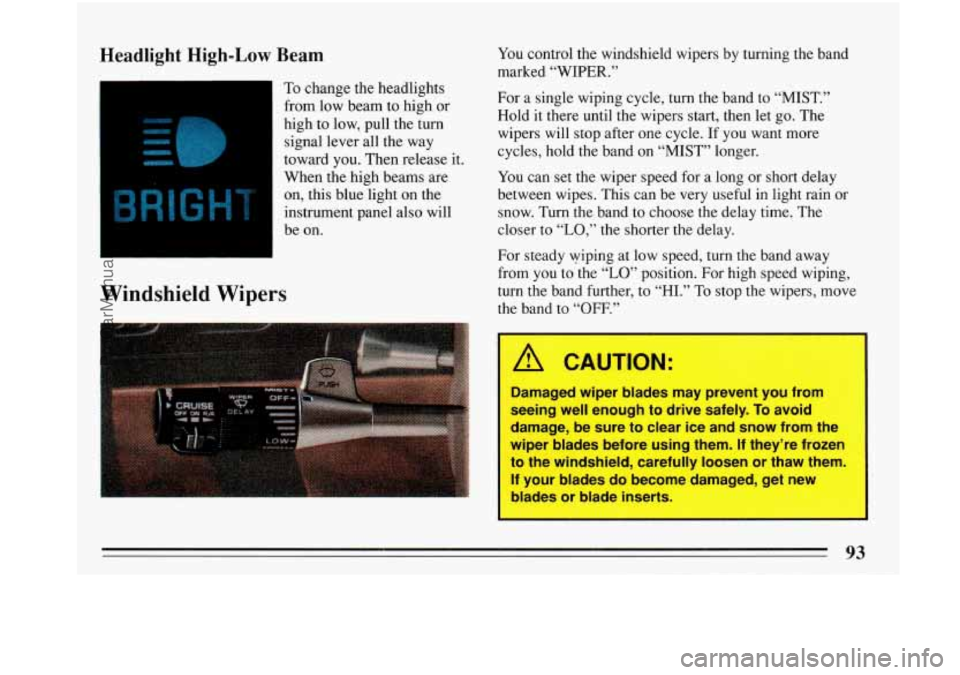
When the high beams are
on, this blue light on the
instrument panel also will
be on.
R 1J H
Windshield Wipers
You control the windshield wipers by turning the band
marked
“WIPER.”
For a single wiping cycle, turn the band to “MIST.”
Hold it there until the wipers start, then let go. The
wipers will stop after one cycle. If you want more
cycles, hold the band on “MIST” longer.
You can set the wiper speed for a long or short delay
between wipes. This can be very useful in light rain or
snow. Turn the band to choose the delay time. The
closer to
“LO,” the shorter the delay.
For steady wiping at low speed, turn the band away
from you to the
“LO” position. For high speed wiping,
turn the band further, to “HI.”
To stop the wipers, move
the band to
“OFF.”
A CAUTION:
Damaged wiper blades may prevent you from
seeing well enough to drive safely.
To avoid
damage, be sure to clear ice and snow from the
wiper blades before using them.
If they’re frozen
to the windshield, carefully loosen or thaw them.
If your blades do become damaged, get new
blades or blade inserts.
93
ProCarManuals.com
Page 105 of 340
Daytime Running Lights (Canada Only)
The Canadian Federal Government has decided that
“Daytime Running Lights” (DRL) are a useful feature,
in that DRL can make your vehicle more visible to
pedestrians and other drivers during daylight hours.
DRL are required on new vehicles sold in Canada.
Your
DRL work with a light sensor on top of the
instrument panel. Don’t cover it up.
The low beam headlights will come on at reduced
brightness in daylight when:
0 The ignition is on
0 The headlight switch is off, and
0 The transaxle is not in “P” (Park). At
dusk, if the Twilight Sentinel feature is turned on, the
exterior lights will come
on automatically and the low
beams will change to
full brightness. At dawn, the
exterior lights will go out and the low beams will
change to the reduced brightness
of DRL (if the
headlight switch is off).
Of course, you may still turn on the headlights any time
you need to.
To idle your vehicle with the DRL off, shift the
transaxle into
“P” (Park). The DRL will stay off until
you shift out of “P” (Park).
To turn
off all exterior lighting at night when you are
parked, move
the twilight sentinel control from ON to
OFF, if it was on from the start. Or, move the control
from OFF to
ON, then back to OFF, if it was off from
the start. The lights will come back
on when you move
the transaxle out
of PARK.
ProCarManuals.com
Page 107 of 340
Lamp Monitors (Option)
I
Bulbs Monitored
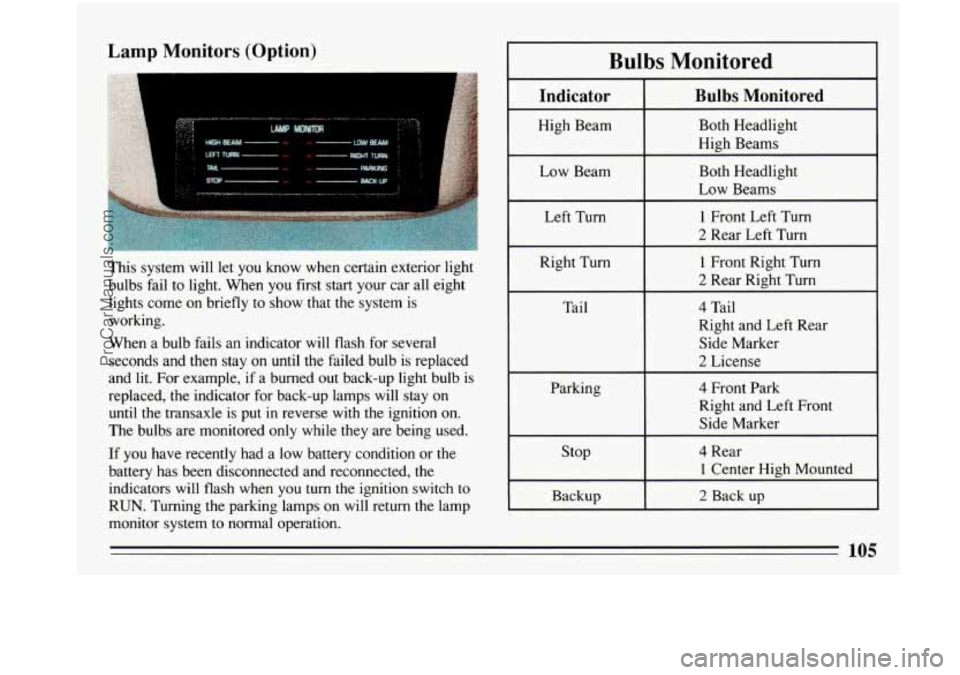
This system will let you know when certain exterior light
bulbs fail to light. When you first start your car all eight
lights come on briefly
to show that the system is
working.
When a bulb fails an indicator will flash for several
seconds and then stay on until the failed bulb is replaced
and lit. For example, if a burned
out back-up light bulb is
replaced, the indicator for back-up lamps will stay on
until the transaxle is put in reverse with the ignition on.
The bulbs are monitored only while they are being used.
If you have recently had a low battery condition or the
battery has been disconnected and reconnected, the
indicators will flash when you turn the ignition switch to
RUN. Turning the parking lamps on will return the lamp
monitor system to normal operation.
Indicator
High Beam
Low Beam
Left Turn
Right Turn Tail
Parking stop
Backup
Bulbs Monitored
Both Headlight
High Beams
Both Headlight
Low Beams
1 Front Left Turn
2 Rear Left Turn
1 Front Right Turn
2 Rear Right Turn
4 Tail
Right and Left Rear Side Marker
2 License
4 Front Park
Right and Left Front
Side Marker
4 Rear
1 Center High Mounted
2 Back up
ProCarManuals.com
Page 179 of 340
When you drive into a curve at night, it’s harder to see
the road ahead of you because it bends away from the
straight beams of your lights. This is one good reason to
drive slower.
Steering in Emergencies
There are timi% when steering can be more effective
than braking. For example,
you come over a hill and
find a truck stopped in your lane, or a car suddenly pulls
out from nowhere, or a child darts out from between
parked cars and stops right
in front of you. You can
avoid these problems by braking
-- if you can stop in
time. But sometimes you can’t; there isn’t room. That’s
the time for evasive action
-- steering around the
problem.
Your Buick can perform very well
in emergencies like
these. First apply your brakes. It is better to remove as
much speed as you can from a possible collision. Then
steer around the problem, to the left or right depending
on the space available.
An emergency like this requires close attention and a
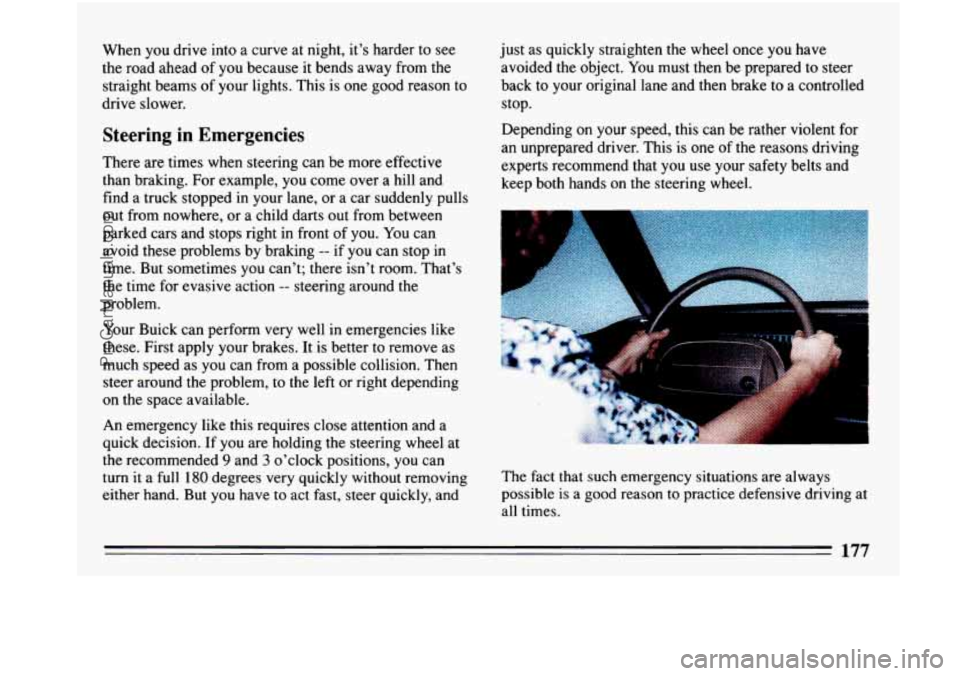
quick decision. If you are holding the steering wheel at
the recommended 9 and 3 o’clock positions, you can
turn it a full 180 degrees very quickly without removing
either hand. But you have
to act fast, steer quickly, and just as
quickly straighten the wheel once you have
avoided the object. You must then be prepared to steer
back
to your original lane and then brake to a controlled
stop.
Depending on your speed, this can be rather violent for
an unprepared driver. This is one of the reasons driving
experts recommend
that you use your safety belts and
keep both hands on the steering wheel.
I
D
The fact that such emergency situations are always
possible
is a good reason to practice defensive driving at
all times.
177
ProCarManuals.com
Page 184 of 340
Night Vision
No one can see as well at night as in the daytime. But as
we get older these differences increase. A 50-year-old
driver may require at least twice as much light to see the
same thing at night as a 20-year-old.
What you do in the daytime can also affect your night
vision. For example,
if you spend the day in bright
sunshine
you are wise to wear sunglasses. Your eyes will
have less trouble adjusting to night.
But if you’re driving, don’t wear sunglasses at night.
They may cut down
on glare from headlights, but they
also make a lot of things invisible that should remain
visible
- such as parked cars, obstacles, pedestrians, or
even trains blocking railway crossings. You may want to
put on your sunglasses after you have pulled into a
brightly-lighted service
or refreshment area. Eyes
shielded from that glare may adjust more quickly to
darkness back
on the road. But be sure to remove your
sunglasses before you leave the service area.
You can be temporarily blinded by approaching lights. It
can take
a second or two, or even several seconds, for
your eyes to readjust
to the dark. When you are faced
with severe glare (as from a driver who doesn’t lower
the high beams, or a vehicle with misaimed headlights),
slow down a little. Avoid staring directly into the
approaching lights. If there is a line of opposing traffic, make occasional glances over
the line of headlights to
make certain that one
of the vehicles isn’t starting to
move into your lane. Once
you are past the bright lights,
give your eyes time to readjust before resuming speed.
High Beams
If the vehicle approaching you has its high beams on,
signal by flicking yours to high and then back to low
beam. This is the usual signal to lower the headlight
beams. If the other driver still doesn’t lower the beams,
resist the temptation to put your high beams
on. This
only makes two half-blinded drivers.
On a freeway, use your high beams
only in remote areas
where you won’t impair approaching drivers. In some
places, like cities, using high beams is illegal.
When you follow another vehicle on a freeway or
highway, use low beams. True, most vehicles now have
day-night mirrors that enable the driver to reduce glare.
But outside mirrors are not of this type and high beams
from behind can bother the driver ahead.
A Few More Night Driving Suggestions
Keep your windshield and all the glass on your vehicle
clean
-- inside and out. Glare at night is made much
worse by dirt on the glass. Even the inside of the glass
can build up a film caused by dust. Tobacco smoke also
ProCarManuals.com
Page 189 of 340
Tips on Driving in Fog
If you get caught in fog, turn your headlights on low
beam, even
in daytime. You’ll see -- and be seen --
better.
Don’t
use your high beams. The light will bounce off
the water droplets that make up fog and reflect back at
you.
Use your defogger. In high humidity, even a light
buildup of moisture on the inside of the glass will cut
down on your already limited visibility.
Run your
windshield wipers and washer occasionally. Moisture
can build up on the outside glass, and what seems to be
fog may actually be moisture
on the outside of your
windshield.
Treat dense fog as an emergency. Try to find a place
IO
pull off the road. Of course you want to respect
another’s property, but you might need
to put something
between you and moving vehicles
-- space, trees,
telephone poles, a private driveway, anything that
removes
you from other traffic.
If visibility is near zero and
you must stop but are
unsure whether you are away from the road, turn your
lights on, start your hazard warning flashers, and sound
your horn at intervals or when you hear approaching
traffic. Pass
other vehicles in fog only if you
can see far enough
ahead to pass safely. Even then, be prepared to delay
your pass if you suspect the fog is worse up ahead.
If
other vehicles try to pass you, make it easy for them.
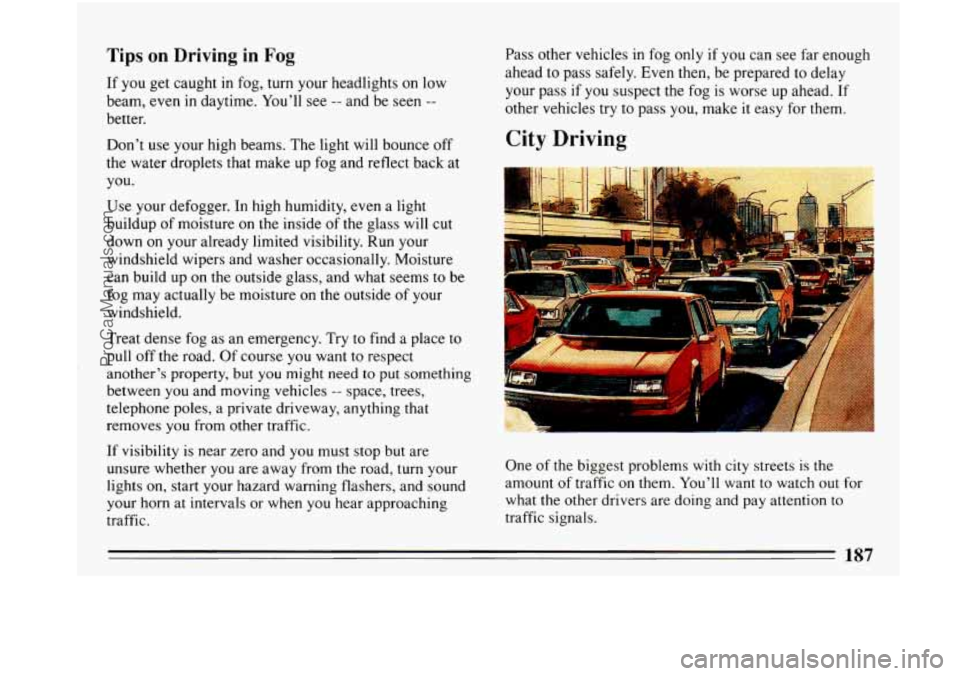
City Driving
L
One of the biggest problems with city streets is the
amount
of traffic on them. You’ll want to watch out for
what
the other drivers are doing and pay attention to
traffic signals.
187
ProCarManuals.com
Page 221 of 340
Front Towing Hook- JPS
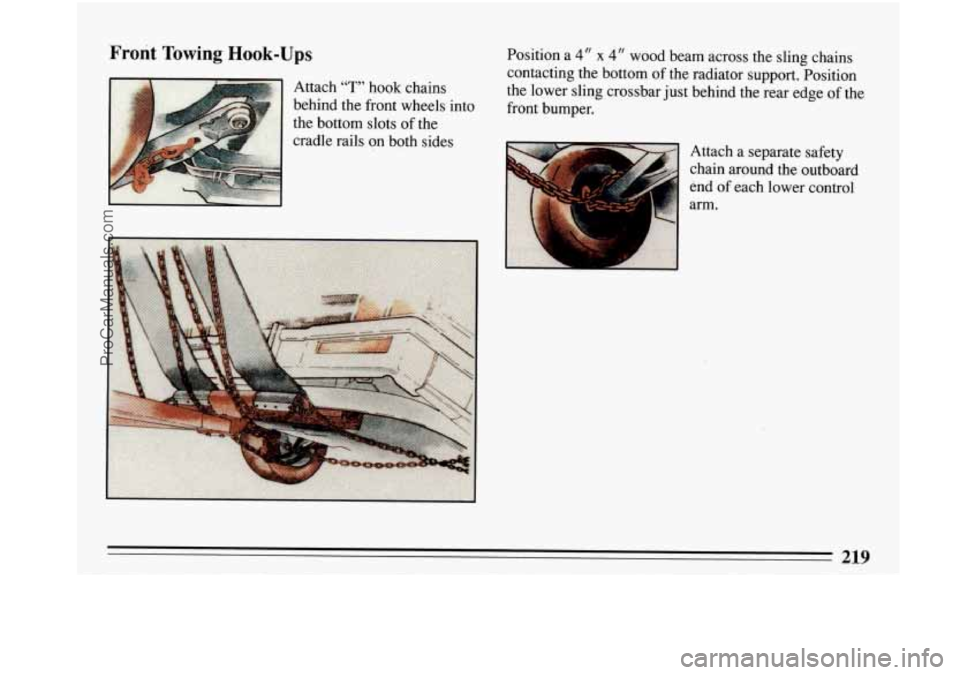
Attach "T" hook chains
behind the front wheels into
the bottom
slots of the
cradle rails on both sides Position a
4" x 4" wood beam
across the sling chains
contacting the bottom of the radiator support. Position
the lower sling crossbar just behind the rear edge of the
front bumper.
219
ProCarManuals.com