check engine BUICK PARK AVENUE 1994 User Guide
[x] Cancel search | Manufacturer: BUICK, Model Year: 1994, Model line: PARK AVENUE, Model: BUICK PARK AVENUE 1994Pages: 324, PDF Size: 17.01 MB
Page 185 of 324
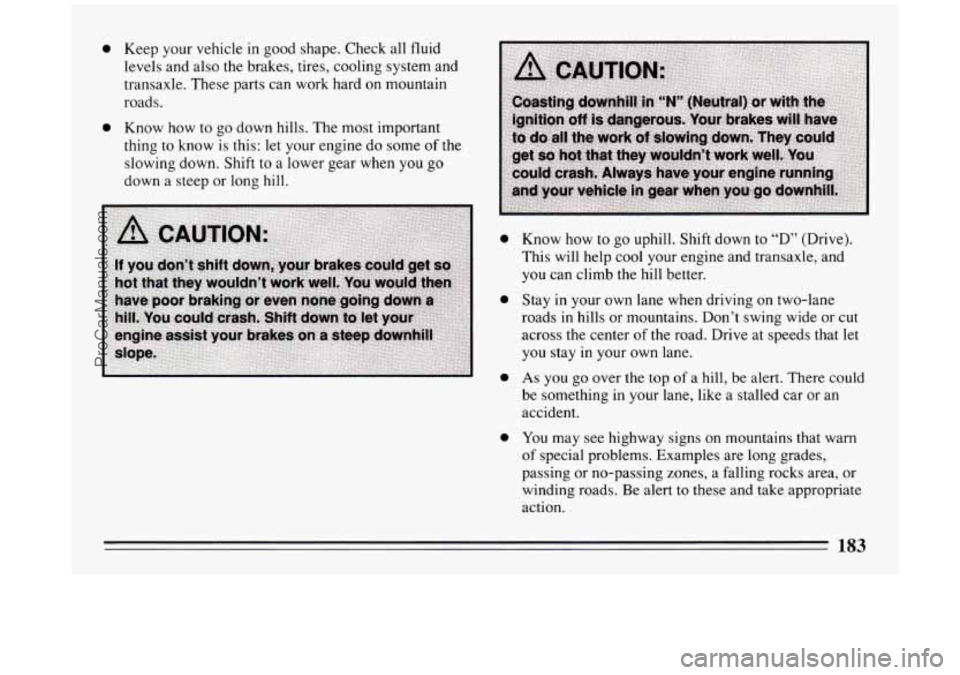
0 Keep your vehicle in good shape. Check all fluid
levels and also the brakes, tires, cooling system and
transaxle. These parts can work hard on mountain
roads.
0 Know how to go down hills. The most important
thing
to know is this: let your engine do some of the
slowing down. Shift to
a lower gear when you go
down a steep or long hill.
0
0
0
0
Know how to go uphill. Shift down to “D” (Drive).
This will help cool your engine and transaxle, and
you can climb the hill better.
Stay
in your own lane when driving on two-lane
roads
in hills or mountains. Don’t swing wide or cut
across the center
of the road. Drive at speeds that let
you stay in your own lane.
As you go over the top of a hill, be alert. There could
be something in your lane, like a stalled car or an
accident.
You may see highway signs on mountains that warn
of special problems. Examples are long grades,
passing or no-passing zones, a falling rocks area, or
winding roads. Be alert
to these and take appropriate
action.
183
ProCarManuals.com
Page 195 of 324
Turn Signals When Towing a Trailer
When you tow a trailer, your vehicle has to have a
different turn signal flasher and extra wiring. The green
arrows on your instrument panel
will flash whenever
you signal a turn or lane change. Properly hooked up,
the trailer lights
will also flash, telling other drivers
you’re about to turn, change lanes or stop.
When towing a trailer, the green arrows on your
instrument panel will flash for turns even
if the bulbs on
the trailer are burned out. Thus, you may
think drivers
behind you are seeing your signal when they are not. It’s
important to check occasionally to be sure the trailer
bulbs are still working.
Your vehicle has bulb warning lights. When you plug
trailer lights into your vehicle’s lighting system, its bulb
warning lights may not
let you know if one of your
lights goes out.
So, when you have trailer lights plugged
in, be sure to check your vehicle and trailer lights from
time to time to be sure they’re all working. Once you
disconnect the trailer lights, the bulb warning lights
again can tell you
if one of your vehicle lights is out.
Driving On Grades
Reduce speed and shift to a lower gear before you start
down a long or steep downgrade. If you don’t shift down,
you might have to use your brakes
so much that
they would get hot and no longer work well.
On a long uphill grade, shift down to “D or 3” (Drive)
and reduce your speed to around
45 mph (70 km/h) to
reduce the possibility of engine and transaxle
overheating.
Parking on Hills
You really should not park your vehicle, with a trailer
attached,
on a hill. If something goes wrong, your rig
could start to move. People can be injured, and both
your vehicle and the trailer can be damaged.
But
if you ever have to park your rig on a hill, here’s
how
to do it:
1. Apply your regular brakes, but don’t shift into “P”
(Park) yet.
2. Have someone place chocks under the trailer wheels.
3. When the wheel chocks are in place, release the
regular brakes until the chocks absorb the load.
4. Reapply the regular brakes. Then apply your parking
brake, and the shift to
“P” (Park).
5. Release the regular brakes.
193
ProCarManuals.com
Page 196 of 324
When You Are Ready to Leave After
Parking on a Hill
1. Apply your regular brakes and hold the pedal down
while you:
Start your engine;
0 Shift into a gear; and
0 Release the parking brake.
2. Let up on the brake pedal.
3. Drive slowly until the trailer is clear of the chocks.
4. Stop and have someone pick up and store the chocks.
Maintenance When Trailer Towing
Your vehicle will need service more often when you’re
pulling a trailer. See the Maintenance Schedule for more
on this. Things that are especially important in trailer
operation are automatic transaxle fluid (don’t overfill),
engine oil, belts, cooling system, and brake adjustment.
Each of these is covered in this manual, and the Index
will help you find them quickly. If you’re trailering, it’s
a good idea to review these sections before you start
your trip.
Check periodically to see that all hitch nuts and bolts are
tight.
194
ProCarManuals.com
Page 202 of 324
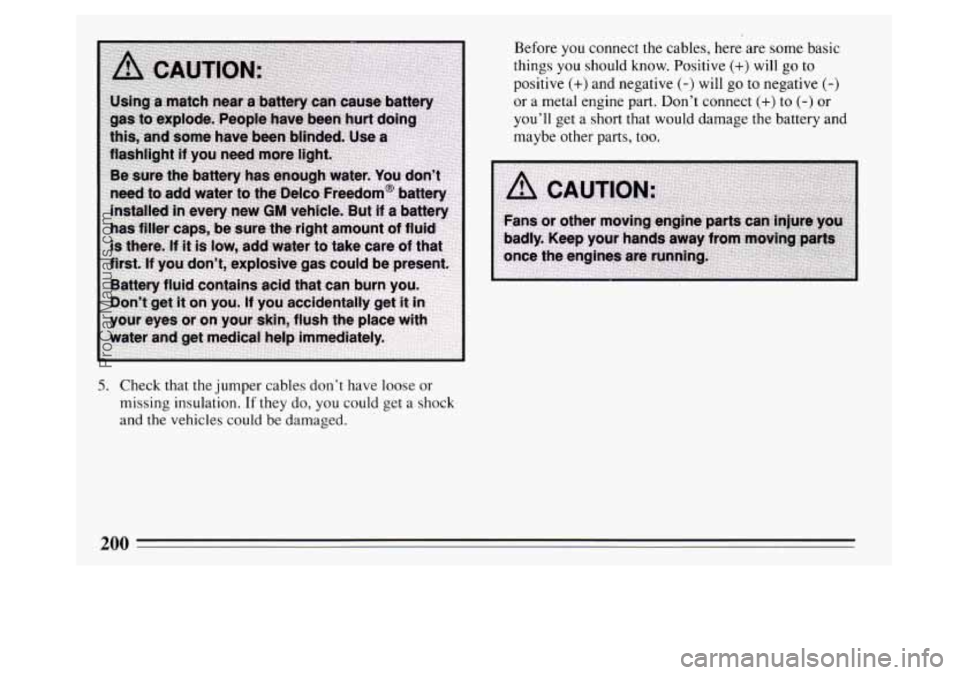
Before you connect the cables, here are some basic
things
you should know. Positive (+) will go to
positive
(+) and negative (-) will go to negative (-)
or a metal engine part. Don’t connect (+) to (-) or
you’ll get a short that would damage the battery and
maybe other parts, too.
5. Check that the jumper cables don’t have loose or
missing insulation.
If they do, you could get a shock
and the vehicles could be damaged.
200
ProCarManuals.com
Page 211 of 324
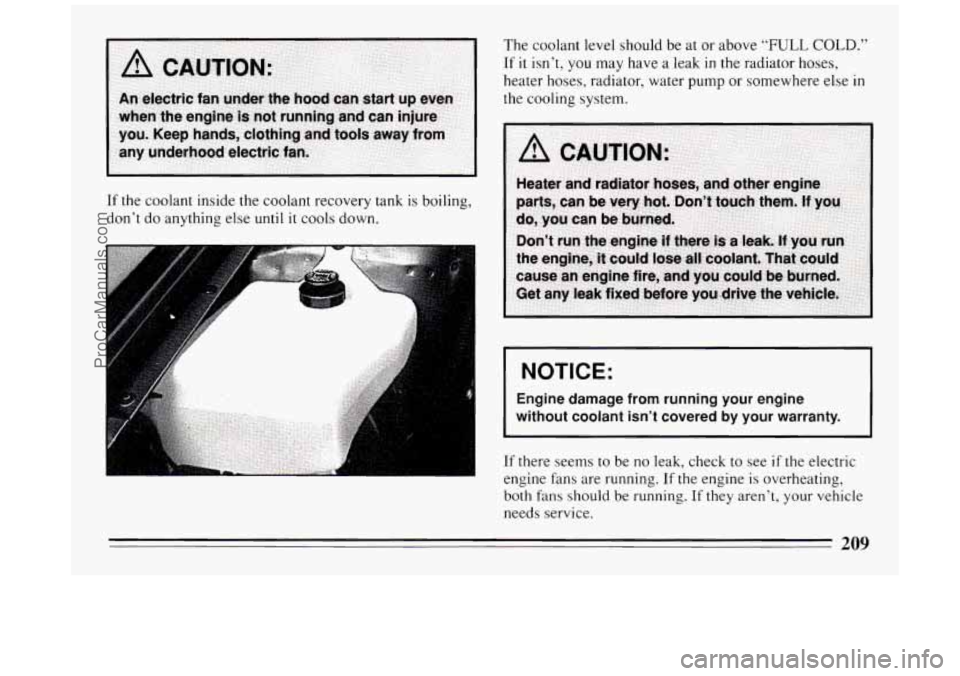
If the coolant inside the coolant recovery tank is boiling,
don’t do anything else
until it cools down.
P
The coolant level should be at or above “FULL COLD.”
If it isn’t, you may have a leak in the radiator hoses,
heater hoses, radiator, water pump or somewhere else in
the cooling system.
I NOTICE:
I
Engine damage from running your engine
without coolant isn’t covered
by your warranty.
If there seems to be no leak, check to see if the electric
engine fans are running.
If the engine is overheating,
both
fans should be running. If they aren’t, your vehicle
needs service.
209
ProCarManuals.com
Page 229 of 324

Part 6 Service and Appearance Care
Here you will find information about the care of your Buick . This part begins with service and fuel information. and
then
it shows how to check important fluid and lubricant levels . There is also technical information about your
vehicle. and a section devoted to its appearance care
.
Part 6 includes:
Service ........................................................................\
.. 228
Fuel
........................................................................\
..... 229
HoodRelease
..................................................................... 234
Engineoil
....................................................................... \
238
Aircleaner
....................................................................... \
243
Automatic Transaxle Fluid
........................................................... 244
Enginecoolant
.................................................................... 247
PowerSteeringFluid ............................................................... 250
Windshield Washer Fluid
............................................................ 251
Brakes
........................................................................\
... 252
Battery
........................................................................\
.. 255
BulbReplacement
................................................................. 256
Loading Your Vehicle
............................................................... 258
Tires
........................................................................\
.... 260
Appearancecare
.................................................................. 268
Vehicle Identification Number (VIN) .................................................. 276
FusesandCircuitBreakers
........................................................... 277
Capacities and Specifications
......................................................... 282
227
ProCarManuals.com
Page 234 of 324
Fuels in Foreign Countries
If you plan on driving in another country outside the
U.S. or Canada, unleaded fuel may be hard to find. Do
not use leaded gasoline.
If you use even one tankful,
your emission controls won’t work well or at all. With
continuous use, spark plugs can get fouled, the exhaust
system can corrode, and your engine oil can deteriorate
quickly. Your vehicle’s oxygen sensor will be damaged.
All of that means costly repairs that wouldn’t be covered
by your warranty.
To check on fuel availability, ask an auto club, or
contact a major oil company that does business
in the
country where you’ll be driving.
You can also write us at the following address for
advice. Just
tell us where you’re going and give your
Vehicle Identification Number (VIN).
General Motors Overseas Distribution Corporation, North American Export Sales (NAES)
1908 Colonel Sam Drive
Oshawa, Ontario
L 1 H 8P7
Filling Your Tank
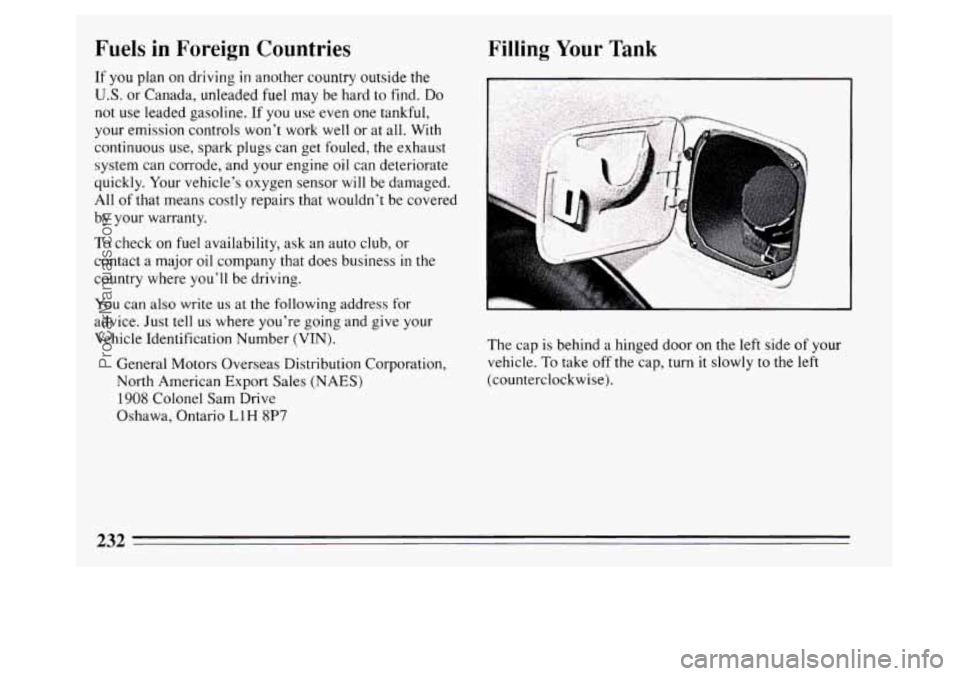
The cap is behind a hinged door on the left side of your
vehicle.
To take off the cap, turn it slowly to the left
(counterclockwise).
232
ProCarManuals.com
Page 238 of 324
Before closing the hood, be sure all the filler caps are on
properly. Then pull the hood down and close it firmly.
Engine Accessory Belt
A
D
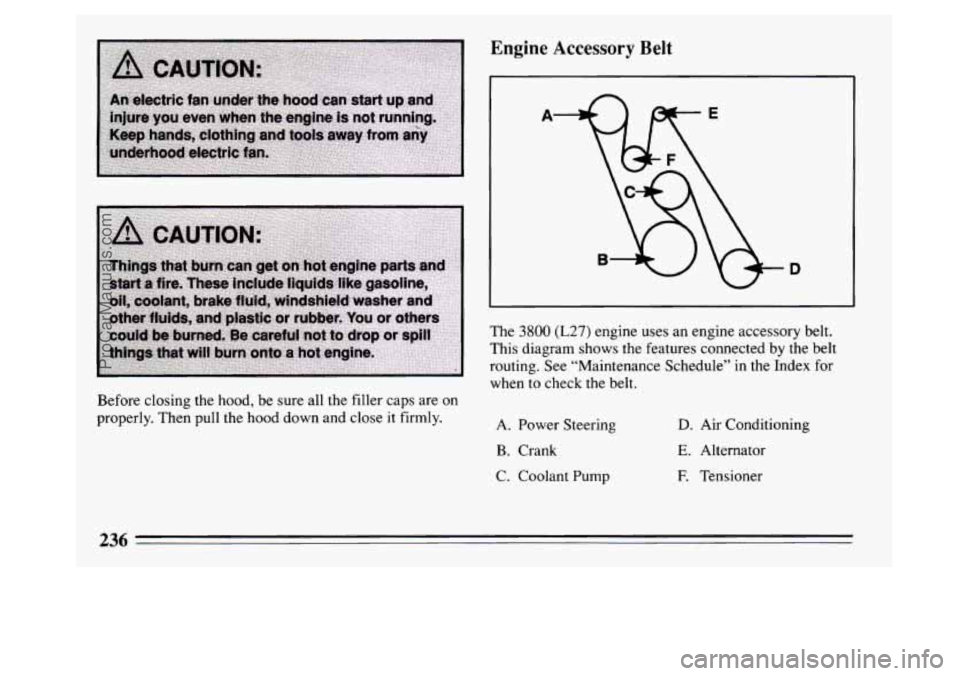
The 3800 (L27) engine uses an engine accessory belt.
This diagram shows the features connected by the belt
routing. See “Maintenance Schedule” in the Index for
when to check
the belt.
A. Power Steering
B. Crank
C. Coolant Pump
D. Air Conditioning
E. Alternator
E Tensioner
236
ProCarManuals.com
Page 239 of 324
3800 Supercharged (L67) Engine
(Option)
Your Park Avenue Ultra has a 3800 Supercharged
engine. Buick chose supercharging rather than
turbocharging because Buick emphasizes smooth,
refined power.
The Supercharger is a device which is designed to pump
more air into the engine than it would normally use.
This air mixed with fuel, creates increased engine
power. Since
the Supercharger is a pump and is driven
from an engine accessory drive belt, increased pressure
is available at all driving conditions.
The powertrain control module (PCM), works with a
vacuum control to regulate the increased pressure
required during specific driving conditions. When this
increased pressure or boost is not desired, such as during
idling and light throttle cruising, the excess air that the
Supercharger is pumping
is routed through a bypass. All
of these controls, working together provide high
performance character and
fuel efficiency in the 3800
V6 Supercharged Buick engine.
The power steering pump uses a remote reservoir
mounted on the throttle and cruise control cable bracket.
See “Maintenance Schedule’’ in
the Index for when you
should check the fluid.
Engine Accessory Belt
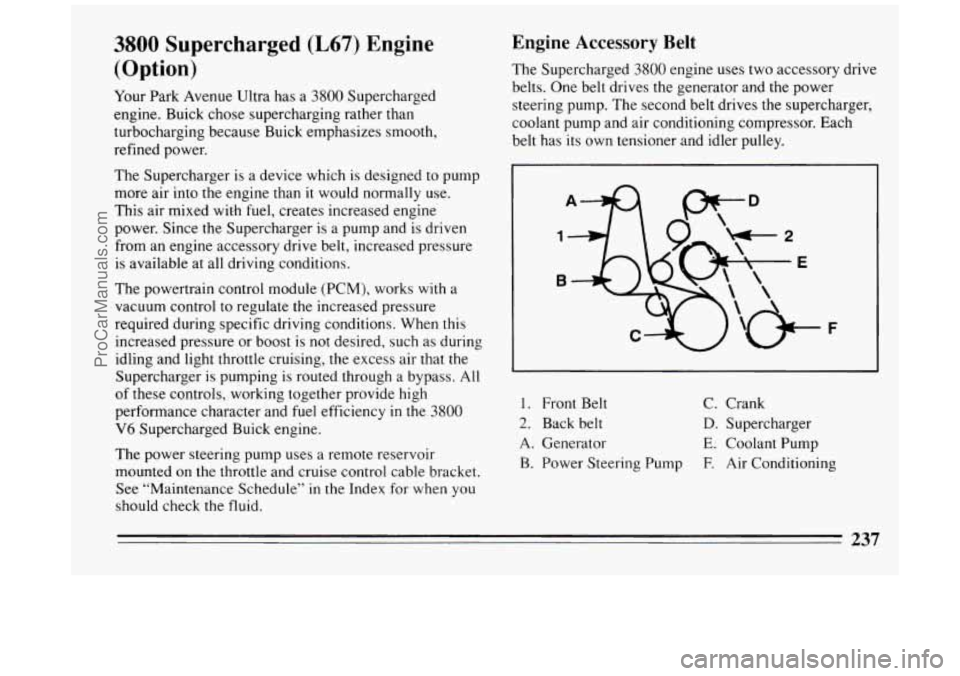
The Supercharged 3800 engine uses two accessory drive
belts. One belt drives the generator and the power
steering pump. The second belt drives the supercharger,
coolant pump and air conditioning compressor. Each
belt has its own tensioner and idler pulley.
1. Front Belt
C. Crank
2. Back belt D. Supercharger
A. Generator
E. Coolant Pump
B. Power Steering Pump E Air Conditioning
237
ProCarManuals.com
Page 240 of 324
Supercharger Oil
Unless you are technically qualified and have the proper
tools, you should
let your dealer or a qualified service
center perform this maintenance.
When to Check: Check oil level every 30,000 miles
(50,000 km) or every 36 months.
What Kind of Oil to Use: See “Recommended Fluids and
Lubricants”
in the Index. Use only the recommended oil.
How to Check and Add Oil: Check oil only when the
engine is cold. Allow the engine to cool
2 to 3 hours after
running.
1. Remove the wiring harness shield.
2. Clean the area around the oil fill plug before
removing
it.
3. Remove the oil fill plug using a 3/16 allen wrench.
4. The oil level is correct when it just reaches the
bottom
of the threads of the inspection hole.
5. Replace the oil plug with the O-ring in place. Torque
to 10 Nom (88 lb. in.).
6. Replace the wiring harness shield.
Engine Oil
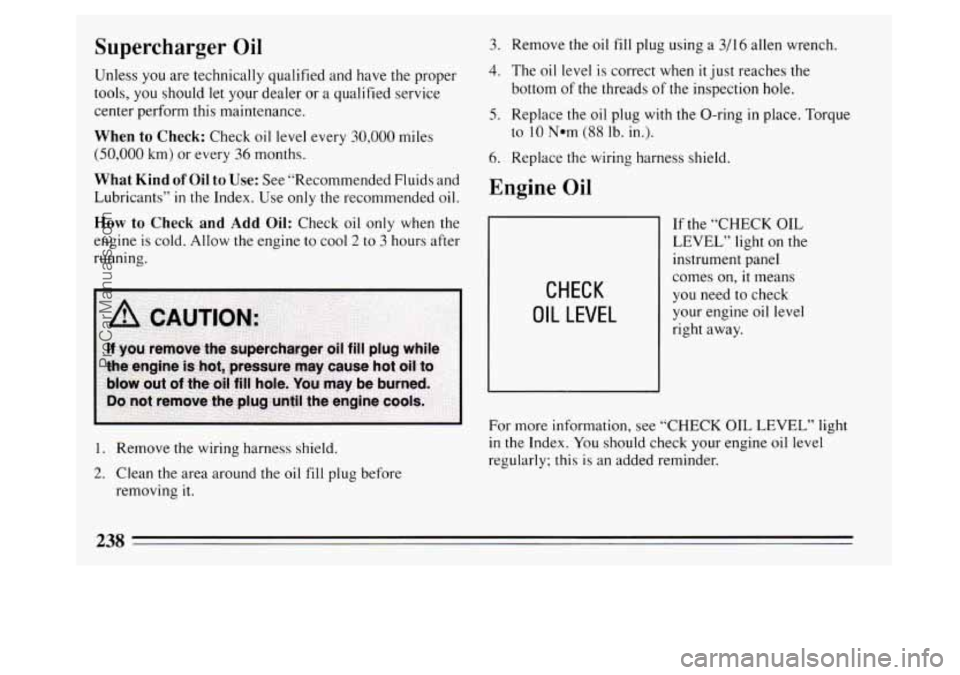
CHECK
OIL LEVEL
If the “CHECK OIL
LEVEL” light on the
instrument panel
comes on,
it means
you need to check
your engine oil level
right away.
For more information, see “CHECK
OIL LEVEL” light
in the Index. You should check your engine oil level
regularly; this is an added reminder.
238
ProCarManuals.com