check engine BUICK PARK AVENUE 1994 Owner's Manual
[x] Cancel search | Manufacturer: BUICK, Model Year: 1994, Model line: PARK AVENUE, Model: BUICK PARK AVENUE 1994Pages: 324, PDF Size: 17.01 MB
Page 241 of 324
It’s a good idea to check your engine oil every time you
get fuel. In order to get an accurate reading, the oil must
be warm and the vehicle must be on level ground.
To Check Engine Oil
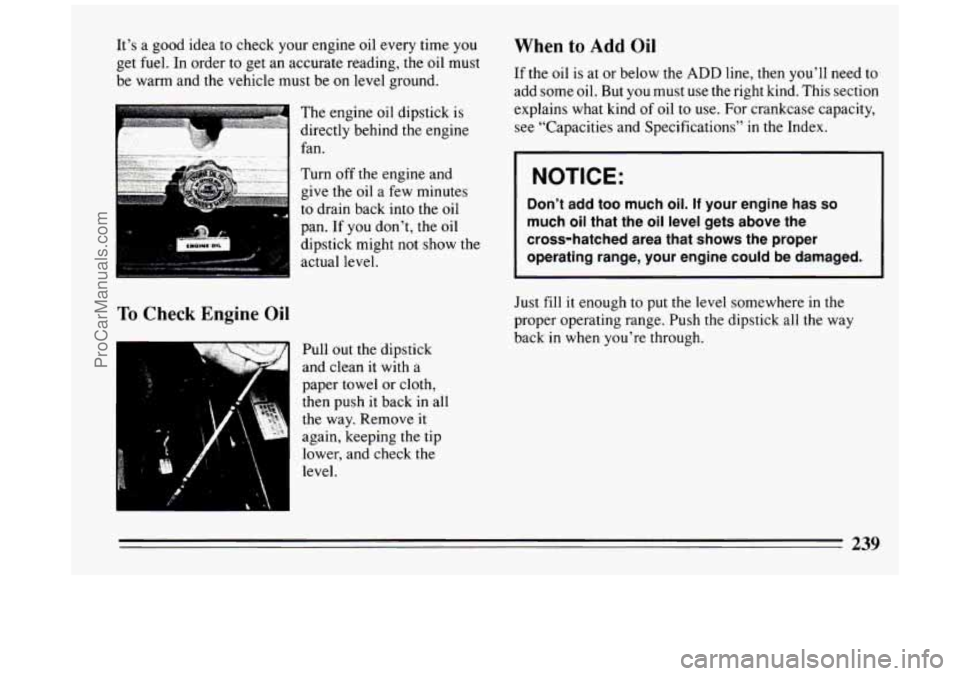
The engine oil dipstick is
directly behind the engine
fan.
Turn off the engine and
give the oil a few minutes
to drain back into
the oil
pan. If you don’t, the oil
dipstick might not show the
actual level.
When to Add Oil
If the oil is at or below the ADD line, then you’ll need to
add some oil. But you must use the right kind. This section
explains what kind
of oil to use. For crankcase capacity,
see “Capacities and Specifications” in the Index.
NOTICE:
Don’t add too much oil. If your engine has so
much oil that the oil level gets above the
cross-hatched area that shows the proper
operating range, your engine could be damaged.
Pull out the dipstick
and clean it with a
paper towel or cloth,
then push it back
in all
the way. Remove
it
again, keeping the tip
lower, and check the
level. Just
fill it enough to put the level somewhere in
the
proper operating range. Push the dipstick all the way
back
in when you’re through.
239
ProCarManuals.com
Page 245 of 324
What to Do with Used Oil
Did you know that used engine oil contains certain
elements
that may be unhealthy for your skin and could
even cause cancer? Don’t let used oil stay on your skin
for very long. Clean your skin and nails with soap and
water, or a good hand cleaner. Wash or properly throw
away clothing or rags containing used engine oil. (See
the manufacturer’s warnings about the use and disposal
of oil products.)
Used oil can be a real threat to the environment. If you
change your own
oil, be sure to drain all free-flowing
oil from the filter before disposal. Don’t ever dispose of
oil by putting it in the trash, pouring
it on the ground,
into sewers, or into streams or bodies of water. Instead,
recycle it by taking
it to a place that collects used oil. If
you have a problem properly disposing of your used oil,
ask your dealer, a service station or a local recycling
center for help.
Air Cleaner
1
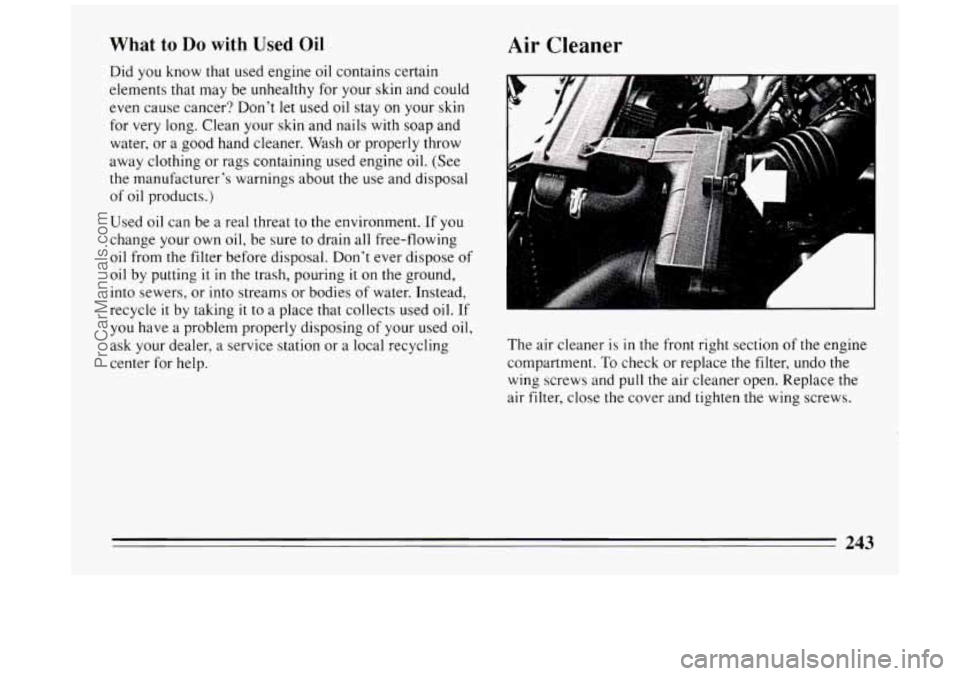
The air cleaner is in the front right section of the engine
compartment.
To check or replace the filter, undo the
wing screws and pull the air cleaner open. Replace the
air filter, close
the cover and tighten the wing screws.
243
ProCarManuals.com
Page 246 of 324

Refer to the Maintenance Schedule to determine when
to replace the air filter.
See “Scheduled Maintenance Services”
in the Index.
NOTICE:
If the air cleaner is off, a backfire can cause a
damaging engine fire. And, dirt can easily get
into your engine, which will damage
it. Always
have the air cleaner
in place when you’re driving.
Automatic Transaxle Fluid
When to- Check and Change
A good time to check your automatic transaxle fluid
level is when the engine oil is changed. Refer
to the
Maintenance Schedule to determine when to change
your fluid. See “Scheduled Maintenance Services’’ in
the Index.
How to Check
Because this operation can be a little difficult, you may
choose
to have this done at a Buick dealership Service
Department.
If you do it yourself, be sure to follow all the
instructions here, or you could get a false reading
on the
dipstick.
NOTICE:
Too much or too little fluid can damage your
transaxle.
Too much can mean that some of the
fluid could come out and fall on hot engine parts
or exhaust system, starting a fire. Be sure
to get
an accurate reading if you check your transaxle
fluid.
244
ProCarManuals.com
Page 247 of 324
Wait at least 30 minutes before checking the transaxle
fluid level
if you have been driving:
0 When outside temperatures are above 90°F (32°C).
0 At high speed for quite a while.
0 In heavy traffic -- especially in hot weather.
0 While pulling a trailer.
To get the right reading, the fluid should be at normal
operating temperature, which is 180°F to 200°F (82°C
to 93°C).
Get the vehicle warmed up by driving about 15 miles
(24 km) when outside temperatures are above 50°F
(10°C). If it's colder than 50°F (lO"C), you may have
to drive longer.
To check the fluid level
Park your vehicle on a level place. Keep the engine
running.
0 With the parking brake applied, place the shift lever
in "P" (Park).
With your foot on the brake pedal, move the shift
lever through each gear range, pausing for about
three seconds
in each range. Then, position the shift
lever in "P" (Park).
0 Let the engine run at idle for three to five minutes.
Then, without shutting
off the engine. follow these
steps:
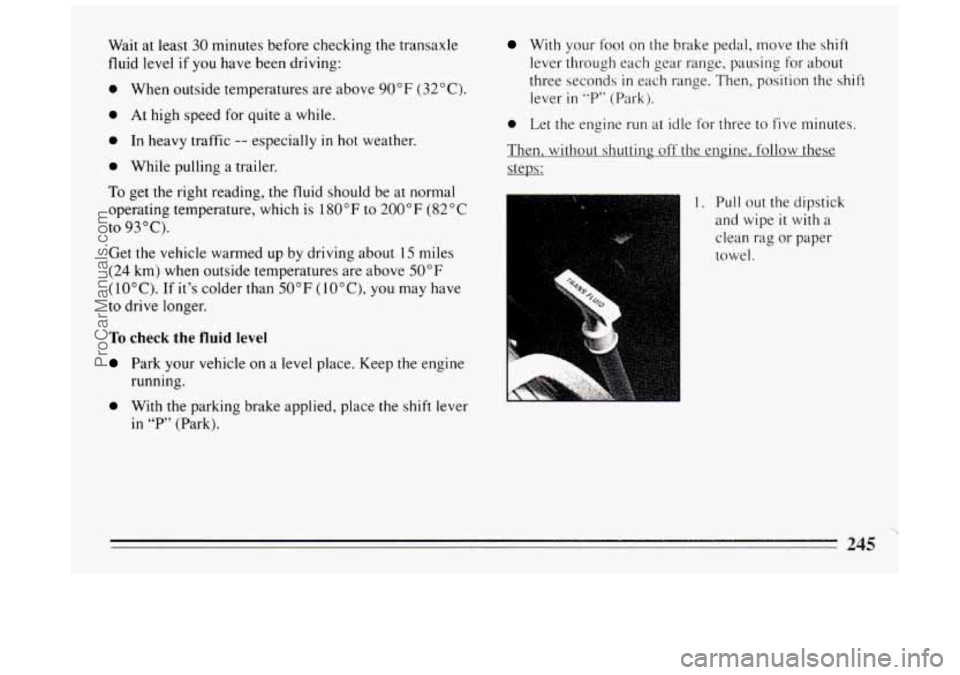
I. Pull out the dipstick
and wipe
it with a
clean rag or paper
towel.
ProCarManuals.com
Page 250 of 324

Adding Coolant
The coolant recovery tank is located at the left of the
engine compartment.
To Check Coolant
When your engine is cold, the coolant level should be at
“FULL COLD’ or a little higher. When your engine is
warm, the level should be up to
“FULL HOT” or a little
higher.
COOLANT
LOW
If this light comes on, it means you’re low on engine
coolant.
To Add Coolant
If you need more coolant, add the proper mix at the
coolant recovery tank.
248
ProCarManuals.com
Page 252 of 324
Power Steering Fluid
How To Check Power Steering Fluid
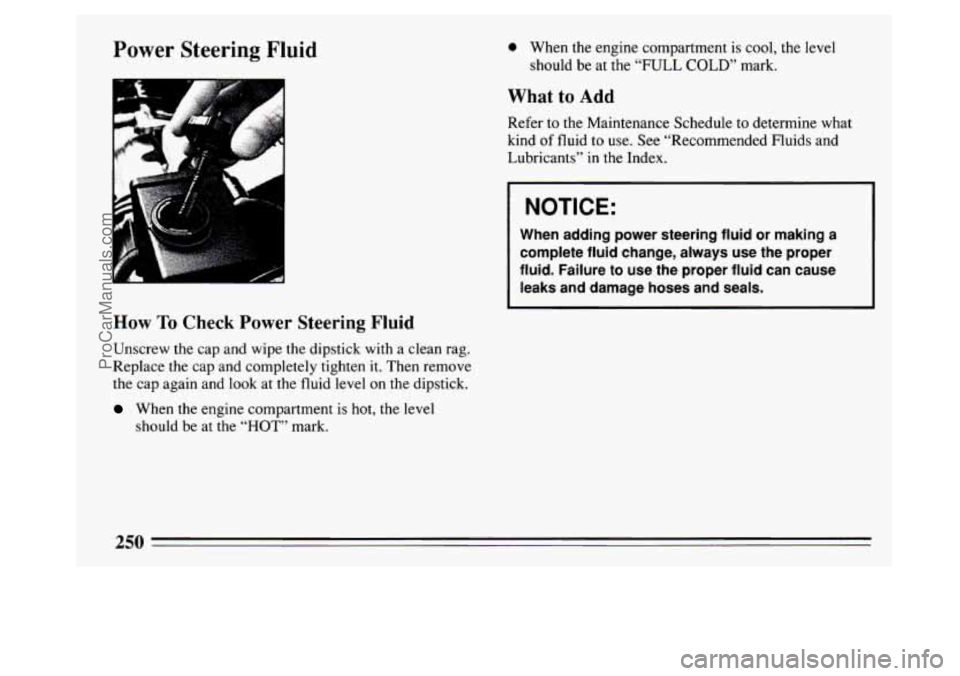
Unscrew the cap and wipe the dipstick with a clean rag.
Replace the cap and completely tighten it. Then remove
the cap again and look at the fluid level
on the dimtick.
When the engine compartment is hot, the level
should be at the
“HOT” mark.
0 When the engine compartment is cool, the level
should be at the
“FULL COLD” mark.
What to Add
Refer to the Maintenance Schedule to determine what
kind
of fluid to use. See “Recommended Fluids and
Lubricants” in the Index.
NOTICE:
When adding power steering fluid or making a
complete fluid change, always use the proper
fluid. Failure to use the proper fluid can cause
leaks and damage hoses and seals.
250
ProCarManuals.com
Page 278 of 324
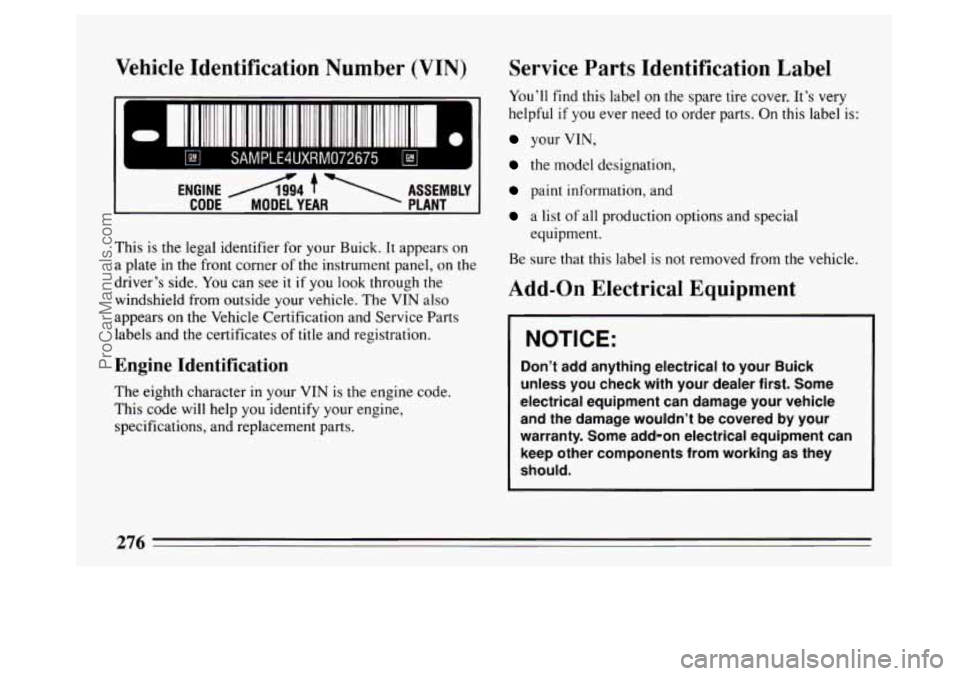
Vehicle Identification Number (VIN)
Cl11!!!1llIl IElll!l I
I= rl
ENGINE A94 7 ASSEMBLY
CODE MODEL YEAR PLANT
This is the legal identifier for your Buick. It appears on
a plate in the front corner
of the instrument panel, on the
driver’s side.
You can see it if you look through the
windshield from outside your vehicle. The VIN also
appears on the Vehicle Certification and Service Parts
labels and
the certificates of title and registration.
Engine Identification
The eighth character in your VIN is the engine code.
This code will help you identify your engine,
specifications, and replacement parts.
Service Parts Identification Label
You’ll find this label on the spare tire cover. It’s very
helpful if you ever need to order parts. On this label is:
your VIN,
the model designation,
paint information, and
a list of all production options and special
equipment.
Be sure that this label
is not removed from the vehicle.
Add-on Electrical Equipment
NOTICE:
Don’t add anything electrical to your Buick
unless you check with your dealer first. Some
electrical equipment can damage your vehicle
and the damage wouldn’t be covered by your
warranty. Some add-on electrical equipment can keep other components from working
as they
should.
276
ProCarManuals.com
Page 286 of 324
I IMPORTANT: I
KEEP ENGINE OIL
AT THE PROPER
LEVEL AND CHANGE AS
RECOMMENDED
11
protection I
Have you purchased the GM Protection Plan? The
Plan supplements your new vehicle warranties. See
your Buick dealer for details.
Introduction
A Word About Maintenance
We at General Motors want to help you keep your
vehicle in good working condition. But we don’t know
exactly how you’ll drive
it. You may drive very short
distances only a few times a week. Or you may drive
long distances all the time
in very hot, dusty weather.
You
may use your vehicle in making deliveries. Or you
may drive
it to work, to do errands or in many other
ways.
Because
of all the different ways people use their GM
vehicles, maintenance needs vary. You may even need
more frequent checks and replacements than you
will
find in the schedules in this part. So please read this part
and note how you drive.
If you have any questions on
how to keep your vehicle in good condition, see your
Buick dealer,
the place many GM owners choose to
have their maintenance work done. Your dealer can be
relied upon to use proper parts and practices.
284
ProCarManuals.com
Page 291 of 324
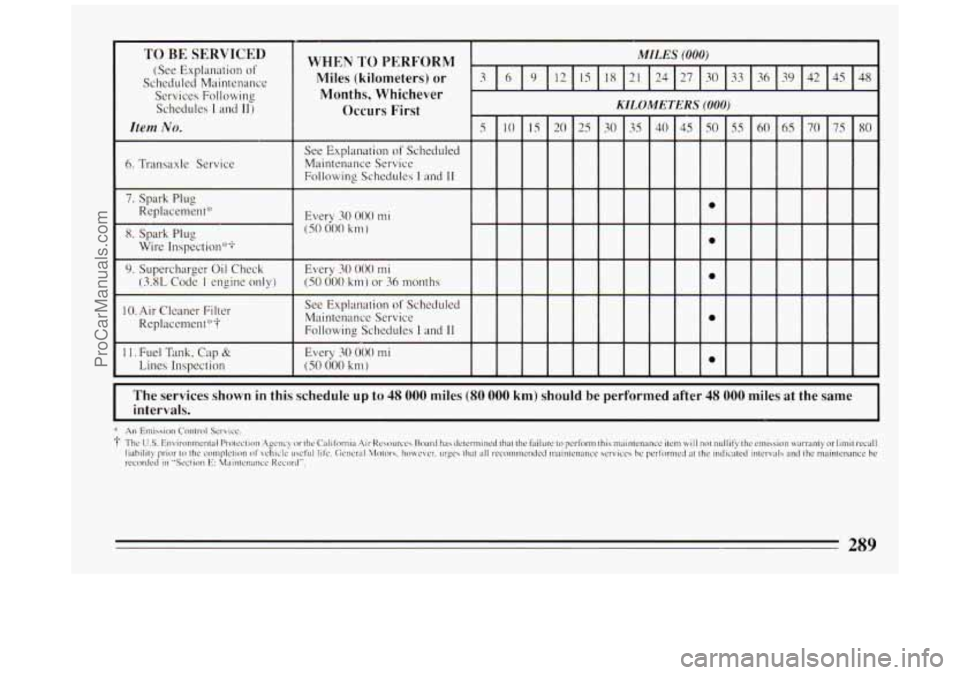
TO BE SERVICED
(See Explanation of
Scheduled Maintenance
Services Following
Schedules
I and 11)
Item No. ~~ ~
~ __
6. Transaxle Service
7. Spark Plug
Replacement”
X. Spark Plug
Wire Inspection*+
9. Supercharger Oil Check
(3.8L Code 1 engine only)
10. Air Cleaner Filter
Replacement*’t
11. Fuel Tank, Cap &
Lines Inspection
WHEN TO PERFORM
Miles (kilometers) or
IS 18 21 24 27 30 33 36 39 42 45 48
Months, Whichever
MILES (000)
Occurs First
See Explanation of Scheduled
Maintenance Service
Following Schedules
I and 11
Every 30 000 mi
(SO 000 km)
tttt
See Explanation of Schedulcd
Maintenance Scrvice
Following Schedules
1 and I1
Every 30 000 mi
(SO 000 km) IIII
KILOMETERS (000) I
The services shown in this schedule up to 48 000 miles (80 000 km) should be performed after 48 000 miles at the same
I
289
ProCarManuals.com
Page 293 of 324
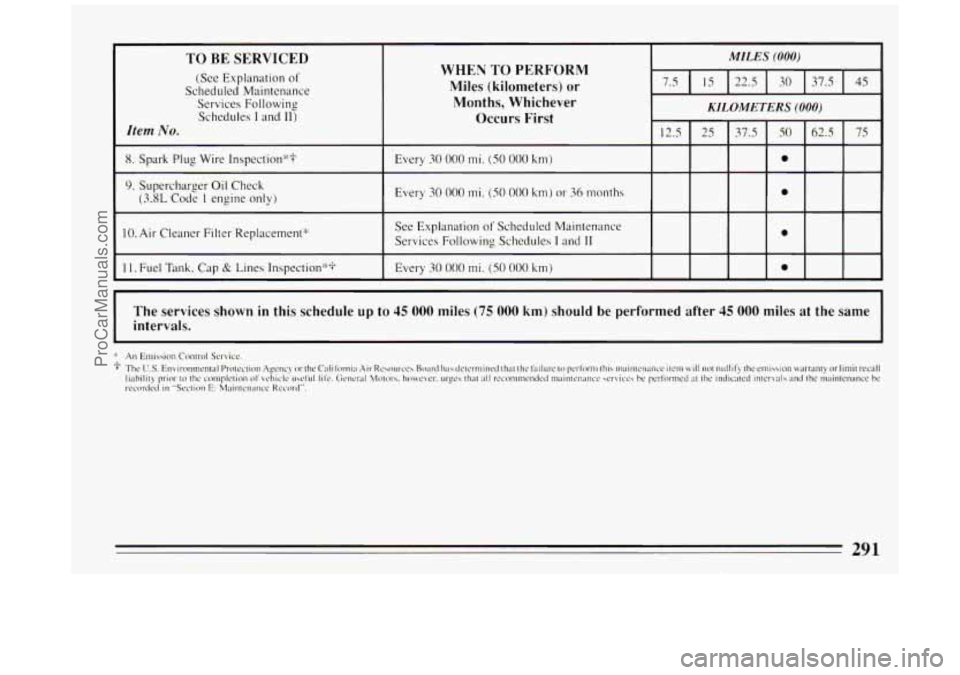
TO BE SERVICED
(See Explanation of
Scheduled Maintenance
Services Following
Schedules
I and 11)
Item No.
8. Spark Plug Wire Inspection*?
9. Supercharger Oil Check
(3.8L Code I engine only)
10. Air Cleaner Filter Replacement"
1 I. Fuel Tank. Cap & Lines Inspection**
WHEN TO PERFORM
Miles (kilometers) or
Months, Whichever
Occurs First
I MILES (000)
22.5 45 37.5 30
KILOMETERS (000)
12.5 I 25 I 37.5 I SO I 62.5 I 75 ~~
Every 30 000 mi. (SO 000 km) e
Every 30 000 mi. (50 000 km) or 36 months I
See Explanation of Scheduled Maintenance
Services Following Schedules
I and I1
Every 30 000 mi. (SO 000 km) e
0
I
The services shown in this schedule up to 45 000 miles (75 000 km) should be performed after 45 000 miles at the same
intervals.
I
291
ProCarManuals.com