ignition BUICK PARK AVENUE 1994 User Guide
[x] Cancel search | Manufacturer: BUICK, Model Year: 1994, Model line: PARK AVENUE, Model: BUICK PARK AVENUE 1994Pages: 324, PDF Size: 17.01 MB
Page 79 of 324
If you set off the alarm by accident, unlock any door
with your
key.
PASS-Key@II
You can also turn off the alarm by using the Keyless
Entry System, if
you have it. The alarm won’t stop if
you try to unlock a door any other way.
How to Test The Alarm
The alarm can be tested by first having the driver’s
window down. Activate the system by locking
the doors
with
the power door lock switch or the Remote Keyless
Entry System. Get out
of the car and close the door and
wait for the SECURITY light to go out. Then reach
in
through the window, unlock the door with the manual
door lock, and open the door. This should set off the
alarm.
If the alarm does not sound when
it should, check to see
if the horn works. The horn fuse may be blown. To
replace the
fuse, see “Fuses and Circuit Breakers” in the
Index.
To reduce the possibility of theft, always activate the
theft deterrent system when leaving your vehicle. Your
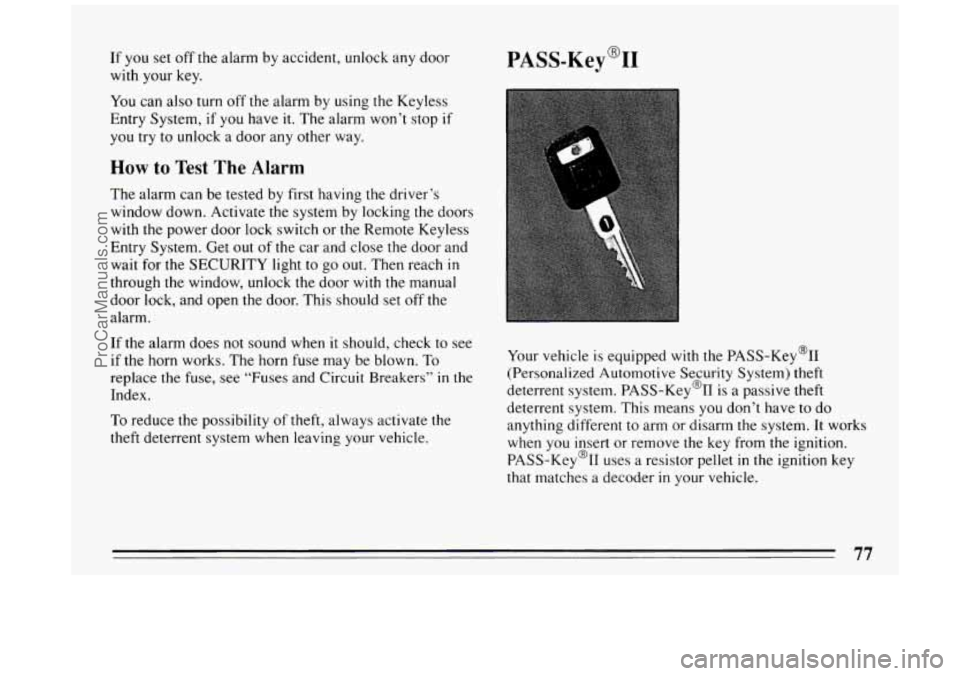
vehicle is equipped with the PASS-Key@II
(Personalized Automotive Security System) theft
deterrent system. PASS-Key%
is a passive theft
deterrent system. This means you don’t have to do
anything different
to arm or disarm the system. It works
when you insert or remove the
key from the ignition.
PASS-Key@II uses a resistor pellet in the ignition key
that matches a decoder
in your vehicle.
77
ProCarManuals.com
Page 80 of 324
When the PASS-Key% system senses that someone is using the wrong key,
it shuts down the vehicle’s starter
and fuel systems. For about three minutes,
the starter
won’t work and
fuel won’t go to the engine. If someone
tries to start your vehicle again or uses another key
during this time, the vehicle will not start. This
discourages someone from randomly trying different
keys with different resistor pellets in an attempt to make
a match.
The ignition key must be clean and dry before it’s
inserted in the ignition or the engine may not start. If the
engine does not start and the “SECURITY’’ light comes
on, the key may be dirty
or wet. Turn the ignition off.
Clean and dry the key. Wait about three minutes and try
again. The security light may remain on during this
time. If
the starter still won’t work, and the key appears
to be clean and dry, wait about three minutes and try the
other ignition key. At this time, you may also want to
check the fuse (see “Fuses and Circuit Breakers”
in the
Index). If
the starter won’t work with the other key, your vehicle needs
service. If your vehicle does start, the first
ignition key may be faulty. See your Buick dealer or a
locksmith who can service the PASS-Key@II.
If you accidentally use a key that has a damaged or
missing resistor pellet, the starter won’t work and the
“SECURITY” light
will flash. But you don’t have to
wait three minutes before trying one of the other ignition
keys.
See your Buick dealer or
a locksmith who can service
the PASS-Key@II to have a new key made.
If you’re ever driving and the “SECURITY” light comes
on and stays on,
you will be able to restart your engine if
you turn it off. Your PASS-Key% system, however, is
not working properly
and must be serviced by your
Buick dealer. Your vehicle is not protected by the
PASS-Key% system.
If you lose or damage a PASS-Key@II ignition key, see
your Buick dealer or a locksmith who can service
PASS-Key@II to have a
new key made.
78
ProCarManuals.com
Page 81 of 324
New Vehicle “Break-In”
NOTICE:
Your modern Buick doesn’t need an elaborate
“break-in.” But
it will perform better in the long
run if you follow these guidelines:
1. Don’t drive at any one speed -- fast or slow
-- for the first 500 miles (804 km). Don’t
make full-throttle starts.
2. Avoid making hard stops for the first 200
miles (322 km) or so. During this time your
new brake linings aren’t yet broken
in. Hard
stops with new linings can mean premature
wear and earlier replacement. Follow this
“breaking-in” guideline every time you get
new brake linings.
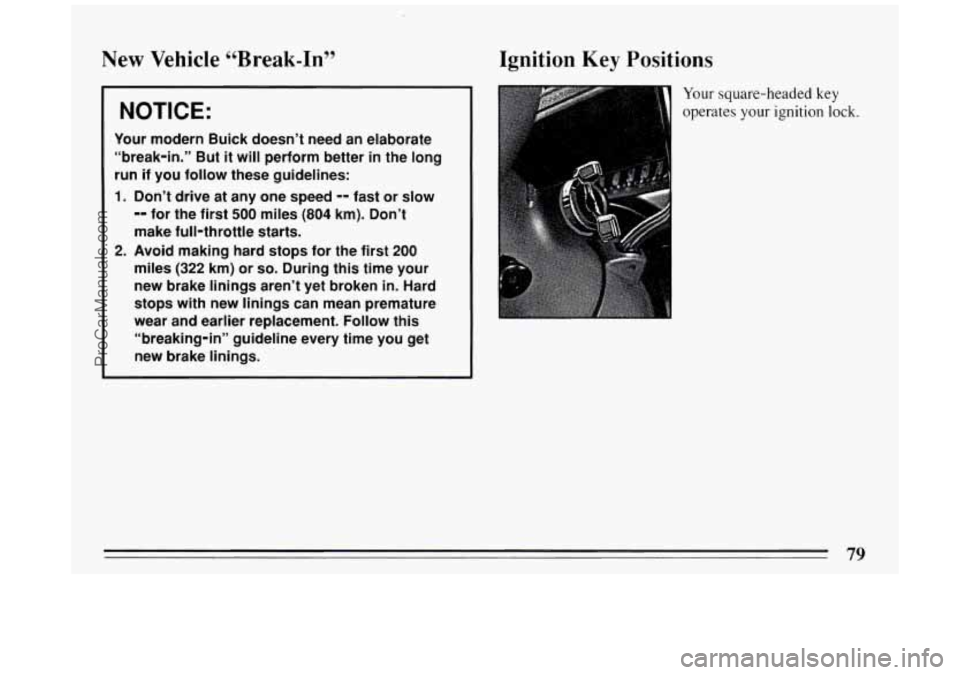
Ignition Key Positions
Your square-headed key
operates your
ignition lock.
79
ProCarManuals.com
Page 82 of 324
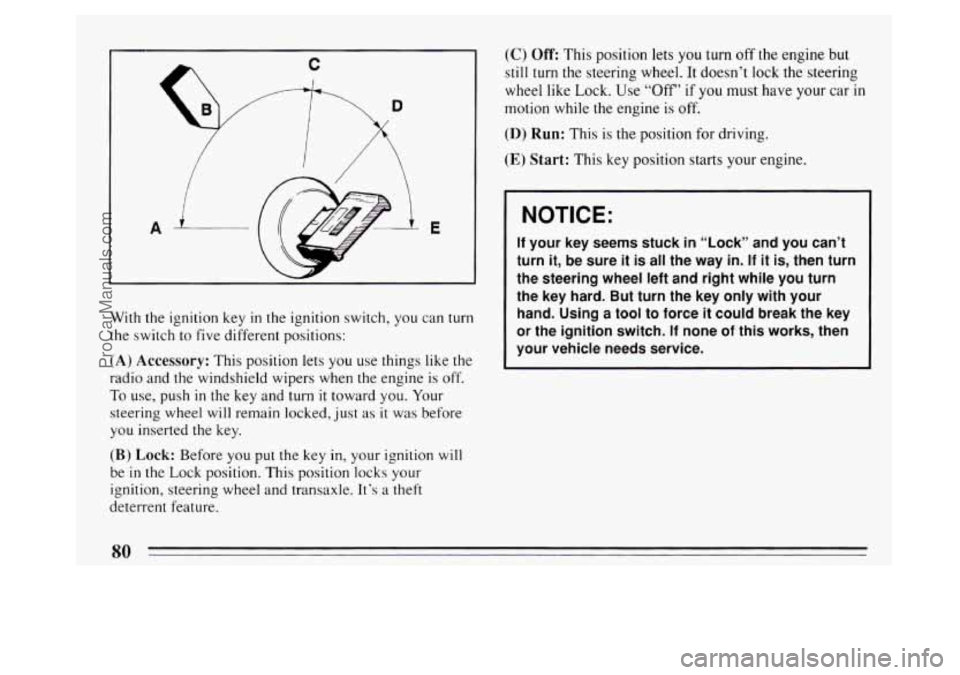
With the ignition key in the ignition switch, you can turn
the switch to five different positions:
(A) Accessory: This position lets you use things like the
radio and the windshield wipers when the engine is off.
To use, push in the key and turn it toward you. Your
steering wheel will remain locked, just as
it was before
you inserted the key.
(B) Lock: Before you put the key in, your ignition will
be
in the Lock position. This position locks your
ignition, steering wheel and transaxle. It’s
a theft
deterrent feature.
(C) Off: This position lets you turn off the engine but
still turn the steering wheel. It doesn’t lock the steering
wheel like Lock.
Use “Off’ if you must have your car in
motion while the engine is off.
(D) Run: This is the position for driving.
(E) Start: This key position starts your engine.
NOTICE:
If your key seems stuck in “Lock” and you can’t
turn
it, be sure it is all the way in. If it is, then turn
the steering wheel left and right while you
turn
the key hard. But turn the key only with your
hand. Using a tool to force
it could break the key
or the ignition switch. If none of this works, then
your vehicle needs service.
80
ProCarManuals.com
Page 83 of 324
Retained Accessory Power (Option)
After the ignition is turned off, and before any door is
opened, the following systems will work for
ten
minutes:
0 Power Windows
0 Radio
Optional Astroroof
Starting Your Engine
Move your shift lever to “P” (Park) or “N” (Neutral).
Your engine won’t start
in any other position -- that’s a
safety feature.
To restart when you’re already moving,
use “N” (Neutral) only.
NOTICE:
Don’t try to shift to “P” (Park) if your Buick is
moving. If you do, you could damage the
transaxle. Shift to
“P” (Park) only when your
vehicle
is stopped.
1. Without pushing the accelerator pedal, turn your
ignition key to “Start.” When the engine starts, let go
of the key. The idle speed will go down as your
engine gets warm.
I NOTICE:
Holding your key in “Start” for longer than 15
seconds at a time will cause your battery to be
drained much sooner.
And the excessive heat
can damage your starter motor.
2. If it doesn’t start right away, hold your key in “Start”
for about three to five seconds at a time
until your
engine starts.
Wait about 15 seconds between each
try to help avoid draining your battery.
ProCarManuals.com
Page 86 of 324
Ensure the shift lever is fully in T’ (Park) range before
starting the engine. Your Buick has a brake-transaxle
shift interlock. You have
to fully apply your regular
brakes
before you can shift from “P” (Park) when the
ignition key
is in the “Run” position. If you cannot shift
out of “P’ (Park), ease pressure on the shift lever - push the
shift lever all the way into
“P’ (Park) as you
maintain brake application. Then move the shift lever
into the gear
you wish. See “Shifting Out of ‘P’ (Park)”
in this part.
R (Reverse)
Use this gear to back up.
NOTICE:
Shifting to “R” (Reverse) while your vehicle is
moving forward could damage your transaxle.
Shift to “R” only after your vehicle is stopped.
I
To rock your vehicle back and forth to get out of snow,
ice or sand without damaging your transaxle, see
“If
You’re Stuck in Sand, Mud, Ice or Snow” in the Index.
0 N (Neutral)
In this position, your engine doesn t connect with the
wheels.
To restart when you’re already moving, use
“N” (Neutral) only. Also, use “N” when your vehicle
is being towed.
84
ProCarManuals.com
Page 89 of 324
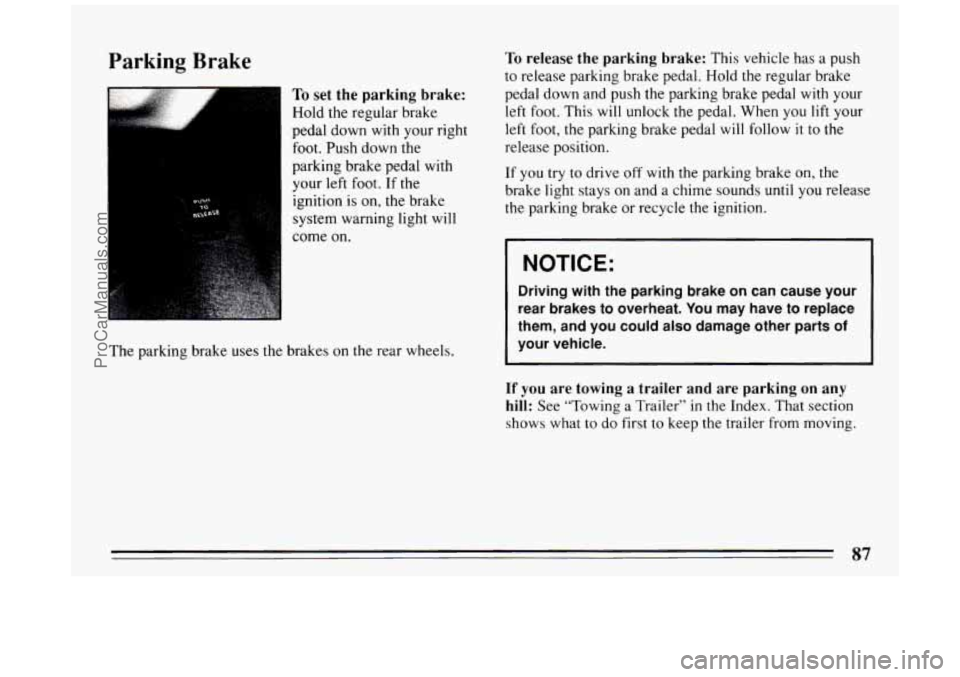
Parking Brake
To set the parking brake:
Hold the regular brake
pedal down with your right
foot. Push down the
parking brake pedal with
your
left foot. If the
ignition is on, the brake
system warning light will
come on.
The parking brake uses
the brakes on the rear wheels.
To release the parking brake: This vehicle has a push
to release parking brake pedal. Hold
the regular brake
pedal down and push the parking brake pedal with your
left foot. This
will unlock the pedal. When you lift your
left
foot, the parking brake pedal will follow it to the
release position.
If
you try to drive off with the parking brake on, the
brake light stays on and a chime sounds until you release
the parking brake or recycle the ignition.
I NOTICE:
Driving with the parking brake on can cause your
rear brakes to overheat.
You may have to replace
them, and you could
also damage other parts of
your vehicle.
If you are towing a trailer and are parking on any
hill:
See “Towing a Trailer” in the Index. That section
shows what to
do first to keep the trailer from moving.
87
ProCarManuals.com
Page 91 of 324
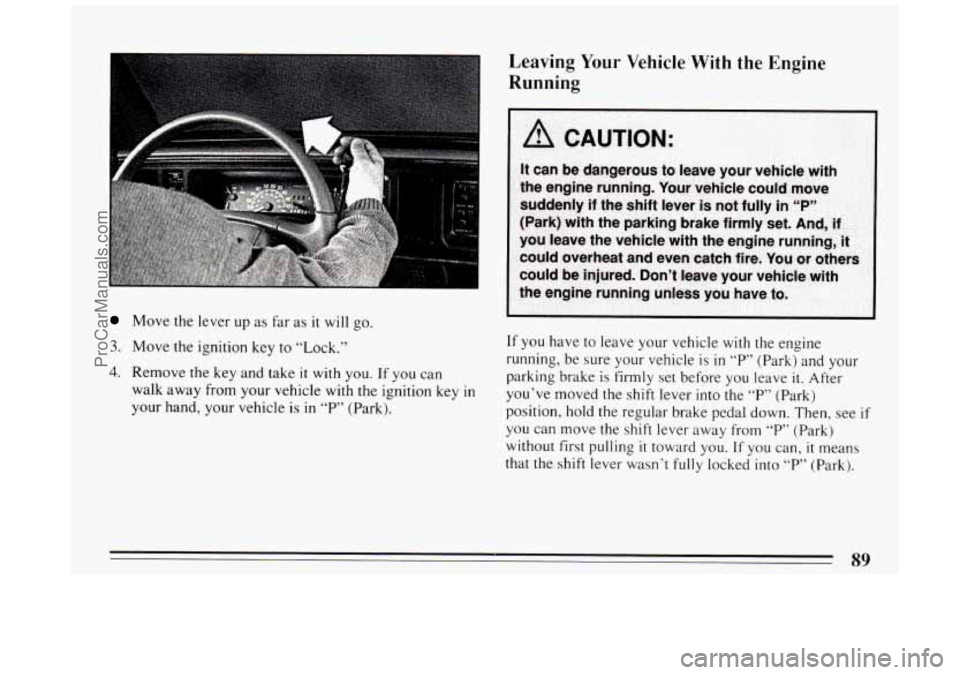
Move the lever up as far as it will go.
3. Move the ignition key to “Lock.”
4. Remove the key and take it with you. If you can
walk away from
your vehicle with the ignition key in
your hand, your vehicle is in “P” (Park).
Leaving Your Vehicle With the Engine
Running
If you have to leave your vehicle with the engine
running, be sure your vehicle
is in “P” (Park) and your
parking brake
is firmly set before you leave it. After
you’ve moved the shift lever into the
“P” (Park)
position, hold the regular brake pedal down. Then, see
if
you can move the shift lever away from “P” (Park)
without first pulling
it toward you. If you can, it means
that the
shift lever wasn’t fully locked into “P” (Park).
89
ProCarManuals.com
Page 92 of 324
Torque Lock
If you are parking on a hill and you don’t shift your
transaxle into
“P’ (Park) properly, the weight of the
vehicle may put too much force on the parking pawl
in
the transaxle. You may find it difficult to pull the shift
lever out of
“P’ (Park). This is called “torque lock.” To
prevent torque lock, set the parking brake and then shift
into “P” (Park) properly before you leave the driver’s
seat.
To find out how, see “Shifting Into ‘P’ (Park)” in
the Index.
When
you are ready to drive, move the shift lever out of
“P” (Park) BEFORE you release the parking brake.
If “torque lock” does occur, you may need
to have
another vehicle push yours
a little uphill to take some of
the pressure from the transaxle,
so you can pull the shift
lever out of “P’ (Park).
Shifting Out of P (Park) 66 99
Your hick has a brake-transaxle shift interlock. You
have
to fully apply your regular brake before you can
shift from
“P’ (Park) when the ignition is in the “Run”
position. See “Automatic Transaxle”
in the Index.
If you cannot shift
out of T“ (Park), ease pressure on
the shift lever
-- push the shift lever all the way into “P”
(Park) as you maintain brake application.
Then move the
shift lever into the gear you want. If
you ever hold the
brake pedal down but still can’t shift out of
“P” (Park),
try this:
1, Turn the key to “Off.” Open and close the driver’s
door
to turn off the Retained Accessory Power
feature,
if you have it.
2. Apply and hold the brake until the end of Step 4.
3. Shift to “N” (Neutral).
4. Start the vehicle and then shift to the drive gear you
5. Have the vehicle fixed as soon as you can.
want.
ProCarManuals.com
Page 105 of 324
To Erase Speed Memory
When you turn off the Cruise Control or the ignition, or
shift into “P” (Park), your Cruise Control set speed
memory is erased.
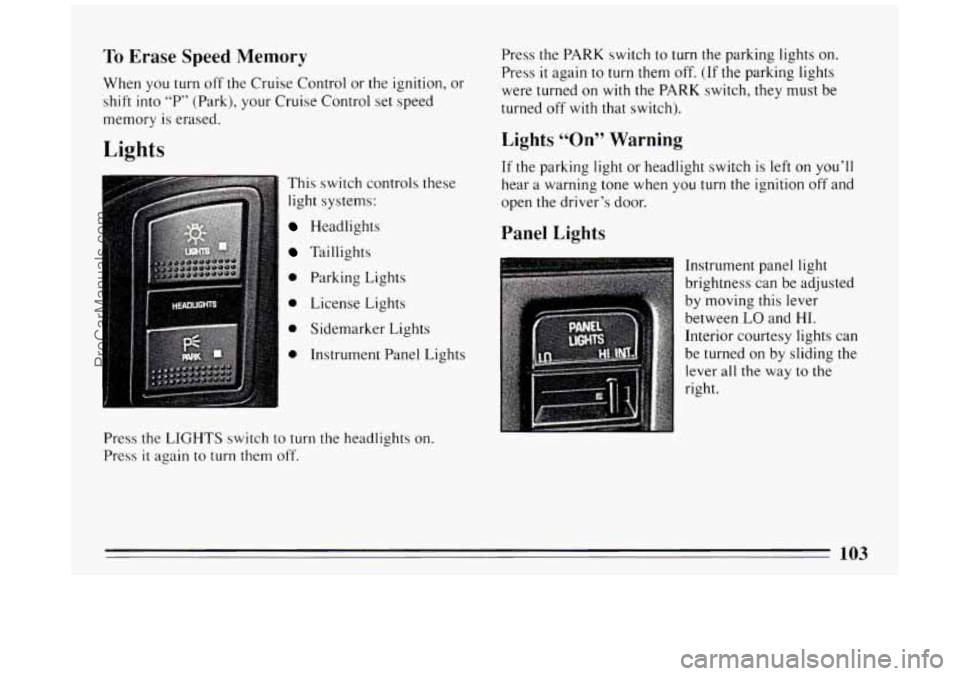
Lights
This switch controls these
light systems:
Headlights
Taillights
0 Parking Lights
0 License Lights
0 Sidemarker Lights
0 Instrument Panel Lights
Press the LIGHTS switch to
turn the headlights on.
Press it again to turn them off. Press the
PARK switch to turn the parking lights
on.
Press it again to turn them off. (If the parking lights
were turned
on with the PARK switch, they must be
turned off with that switch).
Lights “On” Warning
If the parking light or headlight switch is left on you’ll
hear
a warning tone when you turn the ignition off and
open the driver’s door.
Panel Lights
Instrument panel light
brightness can be adjusted
by moving this lever
between
LO and HI.
Interior courtesy lights can
be turned on by sliding the
lever all the way to the
right.
103
ProCarManuals.com