fuel BUICK PARK AVENUE 1994 Owner's Manual
[x] Cancel search | Manufacturer: BUICK, Model Year: 1994, Model line: PARK AVENUE, Model: BUICK PARK AVENUE 1994Pages: 324, PDF Size: 17.01 MB
Page 235 of 324
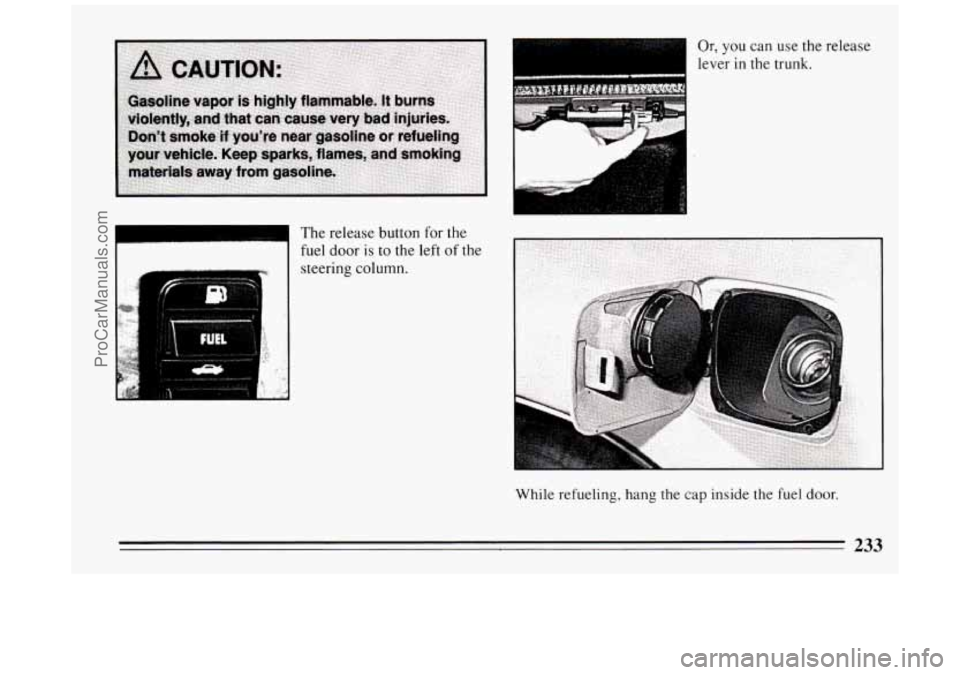
The release button for the
fuel door is to the left of the
steering column.
Or, you can use the release
lever in the
trunk.
While refueling, hang the cap inside the fuel door.
233
ProCarManuals.com
Page 236 of 324
Be careful not to spill gasoline. Clean gasoline from
painted surfaces as soon as possible. See “Cleaning the
Outside
of Your Buick” in the Index.
When
you put the cap back on, turn it to the right until
you hear a clicking noise.
NOTICE:
If you need a new cap, be sure to get the right
type. Your dealer can get one for you.
If you get
the wrong type, it may not fit or have proper
venting, and your fuel tank and emissions
system might be damaged.
Checking Things Under the Hood
Hood Release
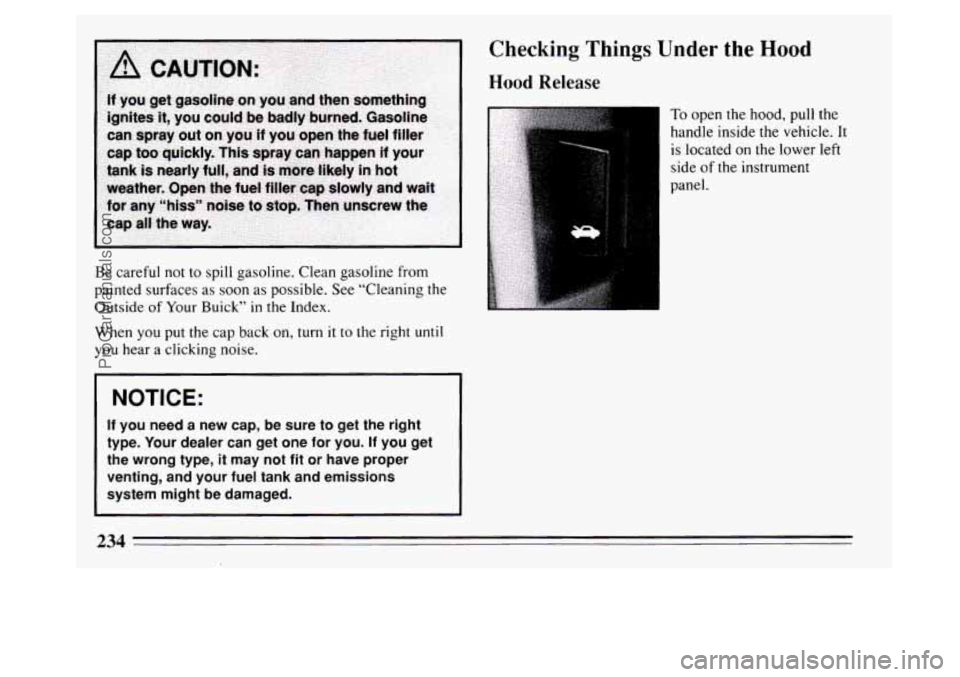
To open the hood, pull the
handle inside the vehicle. It
is located on the lower
left
side of the instrument
panel.
234
ProCarManuals.com
Page 239 of 324
3800 Supercharged (L67) Engine
(Option)
Your Park Avenue Ultra has a 3800 Supercharged
engine. Buick chose supercharging rather than
turbocharging because Buick emphasizes smooth,
refined power.
The Supercharger is a device which is designed to pump
more air into the engine than it would normally use.
This air mixed with fuel, creates increased engine
power. Since
the Supercharger is a pump and is driven
from an engine accessory drive belt, increased pressure
is available at all driving conditions.
The powertrain control module (PCM), works with a
vacuum control to regulate the increased pressure
required during specific driving conditions. When this
increased pressure or boost is not desired, such as during
idling and light throttle cruising, the excess air that the
Supercharger is pumping
is routed through a bypass. All
of these controls, working together provide high
performance character and
fuel efficiency in the 3800
V6 Supercharged Buick engine.
The power steering pump uses a remote reservoir
mounted on the throttle and cruise control cable bracket.
See “Maintenance Schedule’’ in
the Index for when you
should check the fluid.
Engine Accessory Belt
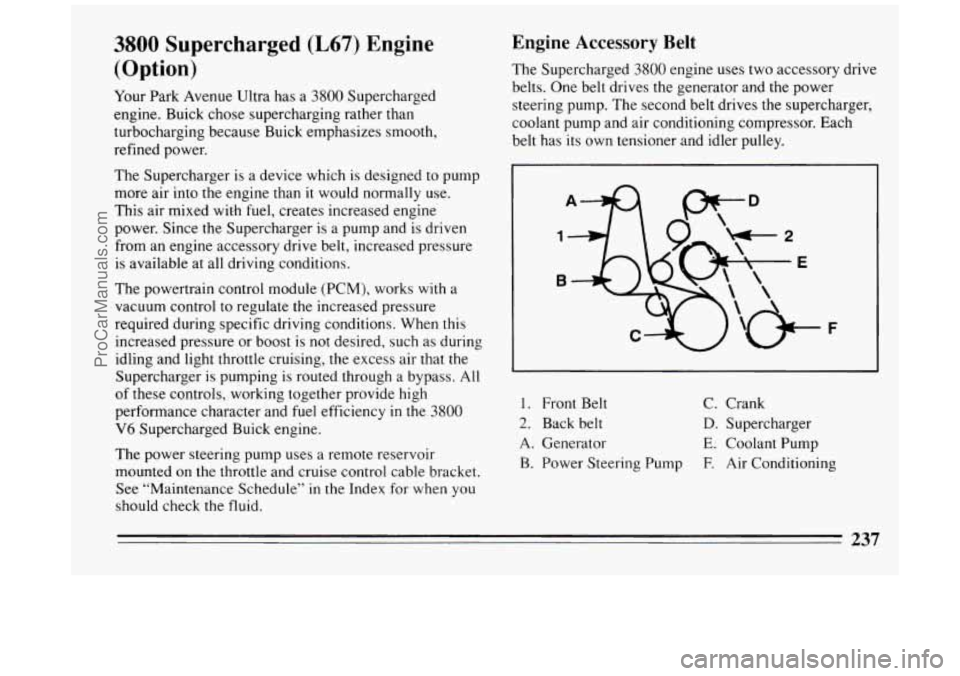
The Supercharged 3800 engine uses two accessory drive
belts. One belt drives the generator and the power
steering pump. The second belt drives the supercharger,
coolant pump and air conditioning compressor. Each
belt has its own tensioner and idler pulley.
1. Front Belt
C. Crank
2. Back belt D. Supercharger
A. Generator
E. Coolant Pump
B. Power Steering Pump E Air Conditioning
237
ProCarManuals.com
Page 241 of 324
It’s a good idea to check your engine oil every time you
get fuel. In order to get an accurate reading, the oil must
be warm and the vehicle must be on level ground.
To Check Engine Oil
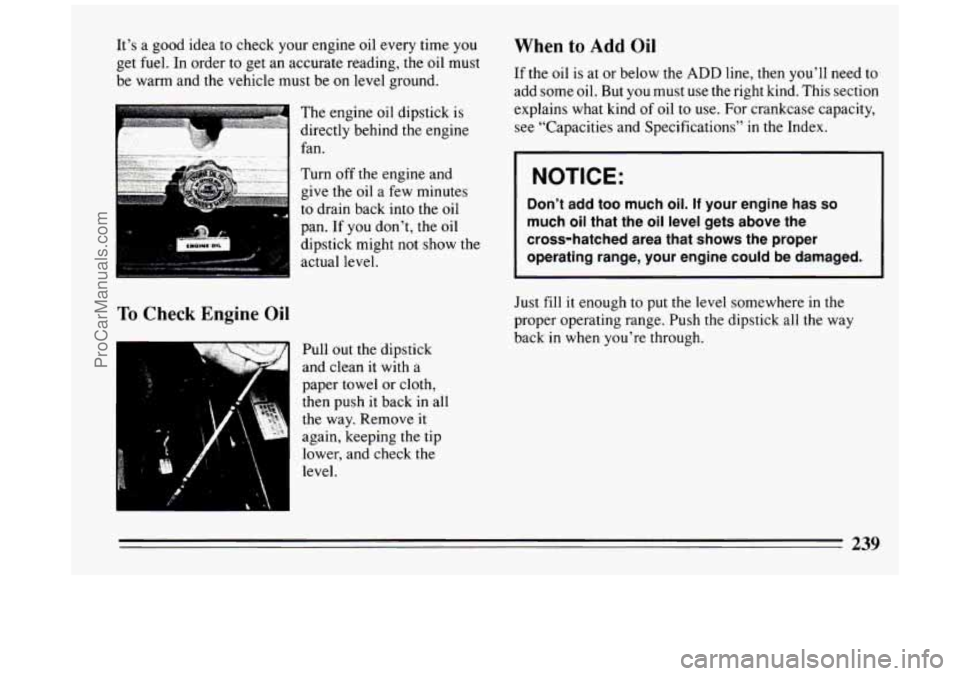
The engine oil dipstick is
directly behind the engine
fan.
Turn off the engine and
give the oil a few minutes
to drain back into
the oil
pan. If you don’t, the oil
dipstick might not show the
actual level.
When to Add Oil
If the oil is at or below the ADD line, then you’ll need to
add some oil. But you must use the right kind. This section
explains what kind
of oil to use. For crankcase capacity,
see “Capacities and Specifications” in the Index.
NOTICE:
Don’t add too much oil. If your engine has so
much oil that the oil level gets above the
cross-hatched area that shows the proper
operating range, your engine could be damaged.
Pull out the dipstick
and clean it with a
paper towel or cloth,
then push it back
in all
the way. Remove
it
again, keeping the tip
lower, and check the
level. Just
fill it enough to put the level somewhere in
the
proper operating range. Push the dipstick all the way
back
in when you’re through.
239
ProCarManuals.com
Page 242 of 324
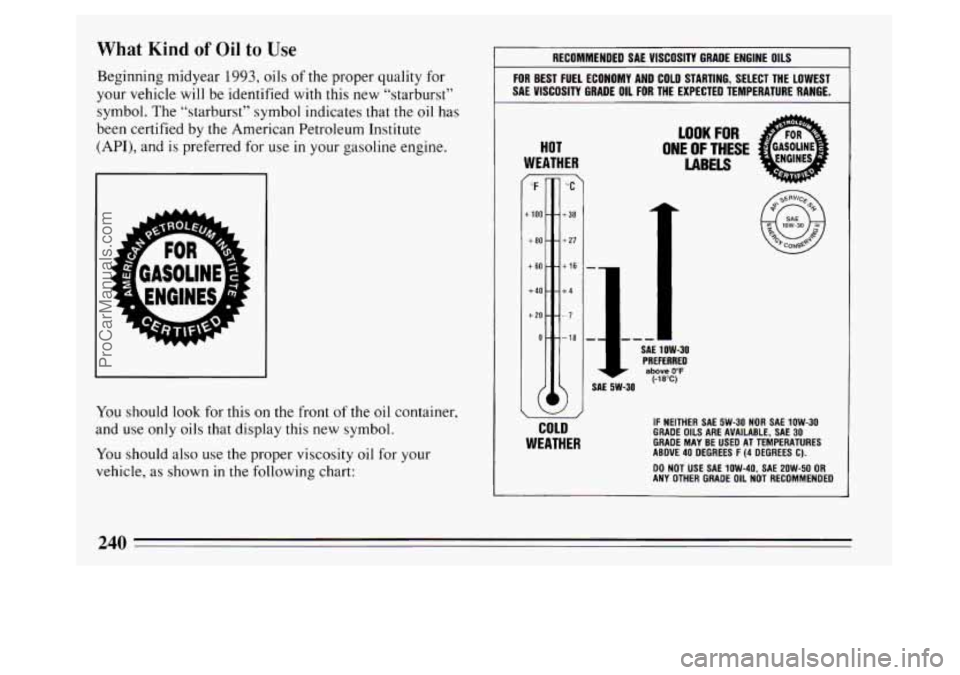
What Kind of Oil to Use
Beginning midyear 1993, oils of the proper quality for
your vehicle
will be identified with this new “starburst”
symbol. The “starburst” symbol indicates that the
oil has
been certified by the American Petroleum Institute
(API), and is preferred for use in your gasoline engine.
You should look for this on the front of the oil container,
and
use only oils that display this new symbol.
You should also use the proper viscosity oil for your
vehicle, as shown
in the following chart:
RECOMMENDED SAE VISCOSITY GRADE ENGINE OILS
FOR BEST FUEL ECONOMY AND COLD STARTING, SELECT THE LOWEST
SAE VISCOSITY GRADE OIL
FOR THE EXPECTED TEMPERATURE RANGE.
HOT
WEATHER
LOOK FOR
ONE OF THESE
LABELS / ‘F %‘ -
+lo0 - - +38
+80--+27
+60--+I6 -
+40--+4
+20 ---7
SAE 1 OW-30 PREFERRED above 0°F (-18°C) SAE 5W-30
a
COLD
WEATHER
IF NEITHER SAE 5W-30 NOR SAE 1OW-30 GRADE OILS ARE AVAILABLE, SAE 30 GRADE MAY BE USED AT TEMPERATURES
ABOVE 40 DEGREES F (4 DEGREES C).
ANY OTHER GRADE OIL NOT RECOMMENDED
DO NOT USE
SAE 1OW-40, SAE 2OW-50 OR
240
ProCarManuals.com
Page 243 of 324

As shown in the chart, SAE 1OW-30 is best for your
.vehicle. However, you can use SAE 5W-30
if it’s going
to be colder than
60°F (16°C) before your next oil
change. When it’s very cold, you should use
SAE
5W-30. These numbers on an oil container show its
viscosity, or thickness. Do not use other viscosity oils,
such as SAE 1OW-40 or SAE 2OW-50.
If you cannot find oils
with the new “starburst” symbol
on the front
of the container, you should look for and
use
oils containing the following three things:
0
0
0
SH or SG
“SH” or “SG” must be on the oil container, either by
itself or combined with other quality designations,
such as “SH/CD,” “SH,SG,CD,”
“SG/CD” etc.
These letters show American Petroleum Institute
(API) levels of quality.
SAE 1OW-30
Energy Conserving I1
Oils
with these words on the container will help you
save fuel. These
three things are usually included
in a doughnut
shaped logo (symbol) on most containers. If you cannot
find oils
with the “starburst” symbol, you should look
for oils
with the doughnut shaped symbol, containing
the three things noted above.
NOTICE:
If you use oils that do not have either the
“starburst” symbol or an
API SH or SG
designation, you can cause engine damage not
covered by your warranty.
GM Goodwrench@ oil (in Canada, GM Engine Oil)
meets all the requirements for your vehicle.
241
ProCarManuals.com
Page 261 of 324
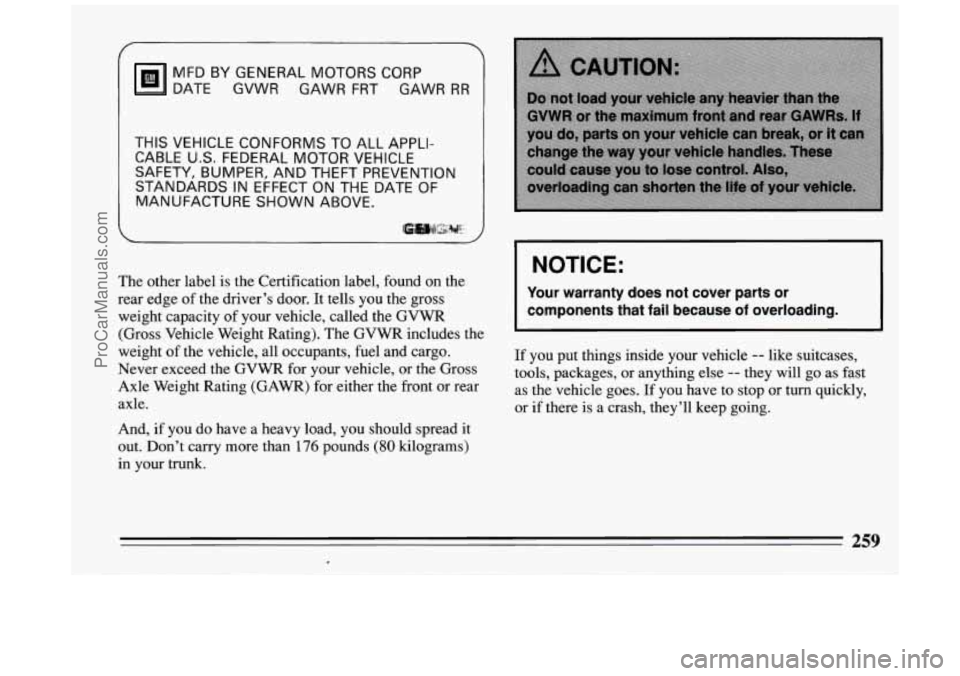
MFD BY GENERAL MOTORS CORP
DATE GVWR GAWR FRT GAWR
RR
THIS VEHICLE CONFORMS TO ALL APPLI-
CABLE
U.S. FEDERAL MOTOR VEHICLE
SAFETY, BUMPER, AND THEFT PREVENTION
STANDARDS
IN EFFECT ON THE DATE OF
MANUFACTURE
SHOWN ABOVE.
The other label is the Certification label, found on the
rear edge of the driver’s door. It tells you the gross
weight capacity of your vehicle, called the GVWR
(Gross Vehicle Weight Rating). The GVWR includes the
weight of the vehicle, all occupants, fuel and cargo.
Never exceed the GVWR for your vehicle, or the Gross
Axle Weight Rating (GAWR) for either the front or rear
axle.
And, if you do have a heavy load, you should spread it
out. Don’t carry more than 176 pounds (80 kilograms)
in your trunk.
I NOTICE:
I
Your warranty does not cover parts or
components that fail because of overloading.
If you put things inside your vehicle -- like suitcases,
tools, packages, or anything else
-- they will go as fast
as the vehicle goes.
If you have to stop or turn quickly,
or
if there is a crash, they’ll keep going.
259
ProCarManuals.com
Page 263 of 324
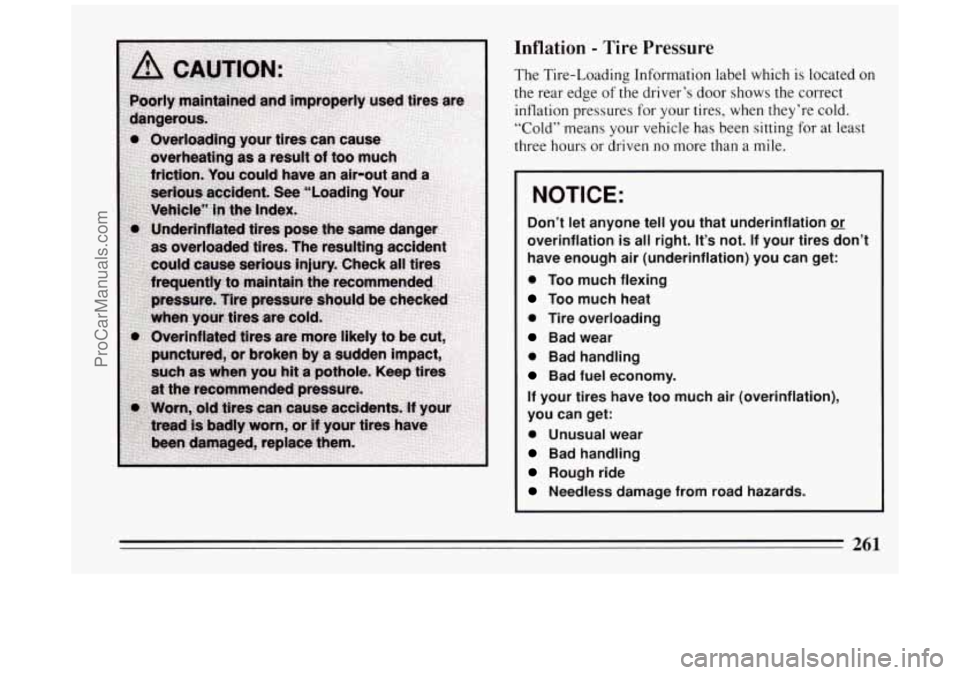
Inflation - Tire Pressure
The Tire-Loading Information label which is located on
the rear edge of the driver’s door shows the correct
inflation pressures for your tires, when they’re
cold.
“Cold” means your vehicle has been sitting for at least
three hours or driven no more than a mile.
NOTICE:
Don’t let anyone tell you that underinflation &r
overinflation is all right. It’s not. If your tires don’t
have enough air (underinflation) you can get:
0 Too much flexing
Too much heat
0 Tire overloading
Bad wear
0 Bad handling
Bad fuel economy.
If your tires have too much air (overinflation),
you can get:
0 Unusual wear
Bad handling
Rough ride
Needless damage from road hazards.
261
ProCarManuals.com
Page 276 of 324
Foreign Material
Calcium chloride and other salts, ice melting agents,
road oil and tar, tree sap, bird droppings, chemica
industrial chimneys, and other foreign matter can
damage your vehicle’s finish if they remain on
pa
surfaces. Use cleaners that are marked safe for pa
surfaces to remove foreign matter.
~~
Finish Damage
.Is from
.inted inted
Any stone chips, fractures or deep scratches
in the finish
should be repaired right away. Bare metal will corrode
quickly and may develop into a major repair expense.
Minor chips and scratches can be repaired with touch-up
materials available from your dealer or other service
outlets. Larger areas of finish damage can be corrected
in your dealer’s body and paint shop.
Underbody Maintenance
Chemicals used for ice and snow removal and dust
control can collect on the underbody. If these are not
removed, accelerated corrosion (rust) can occur on the underbody parts such as fuel lines, frame, floor
pan, and
exhaust system even though they have corrosion
protection.
At least every spring, flush these materials from the
underbody
with plain water. Clean any areas where mud
and other debris can collect. Dirt packed
in closed areas
of the frame should be loosened before being flushed.
Your dealer or an underbody vehicle washing system
can do this for you.
Chemical Paint Spotting
Some weather and atmospheric conditions can create a
chemical fallout. Airborne pollutants can fall upon and
attack painted surfaces on your vehicle. This damage
can take two forms: blotchy, ringlet-shaped
discolorations, and small irregular dark spots etched into
the paint surface.
Although no defect
in the paint job causes this, Buick
will repair, at no charge to the owner, the surfaces of
new vehicles damaged by this fallout condition within
12 months or 12,000 miles (20 000 km) of purchase,
whichever comes first.
274
ProCarManuals.com
Page 284 of 324
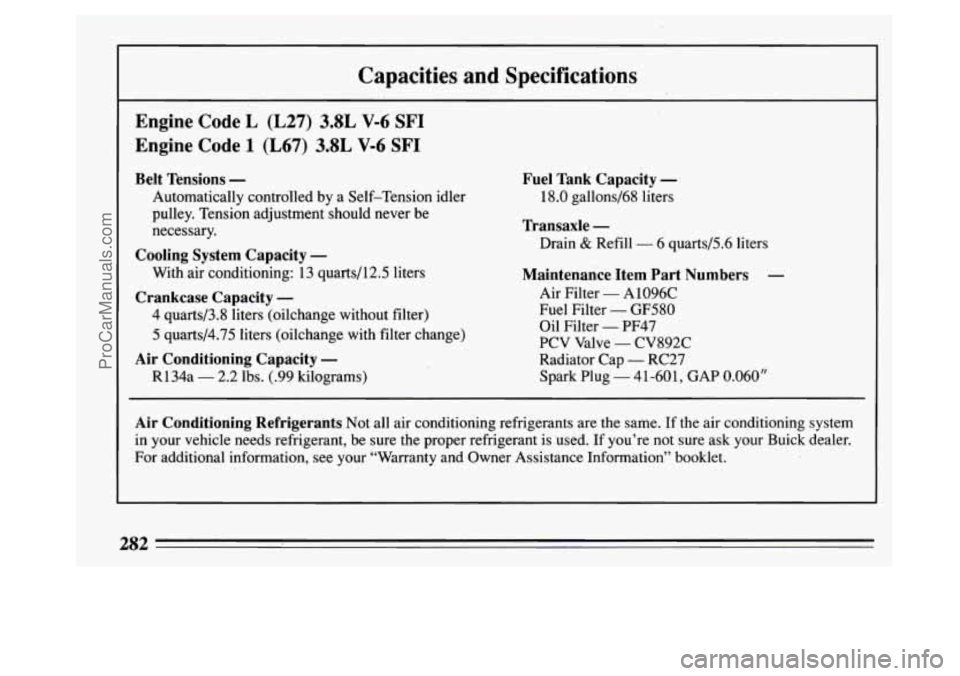
Capacities and Specifications
~~~ ~ ~~~~~
Engine Code L (L27) 3.8L V-6 SF1
Engine Code 1 (L67) 3.8L V-6 SF1
Belt Tensions -
Automatically controlled by a Self-Tension idler
pulley. Tension adjustment should never be
necessary.
Cooling System Capacity -
Crankcase Capacity -
With air conditioning: 13 quarts/l2.5 liters
4 quarts/3.8 liters (oilchange without filter) 5 quarts/4.75 liters (oilchange with filter change)
R134a
- 2.2 lbs. (.99 kilograms)
Air Conditioning Capacity -
Fuel Tank Capacity -
18.0 gallons/68 liters
Transaxle -
Drain & Refill - 6 quarts/5.6 liters
Maintenance Item Part Numbers -
Air Filter - A 1096C
Fuel Filter - GF580
Oil Filter
- PF47
PCV Valve
- CV892C
Radiator Cap
- RC27
Spark Plug
- 41-601, GAP 0.060”
Air Conditioning Refrigerants Not all air conditioning refrigerants are the same. If the air conditioning system
in your vehicle needs refrigerant, be sure the proper refrigerant is used. If you’re not sure ask your Buick dealer.
For additional information, see your “Warranty and Owner Assistance Information” booklet.
ProCarManuals.com