lock BUICK PARK AVENUE 1994 Owner's Manual
[x] Cancel search | Manufacturer: BUICK, Model Year: 1994, Model line: PARK AVENUE, Model: BUICK PARK AVENUE 1994Pages: 324, PDF Size: 17.01 MB
Page 74 of 324
You can match a transmitter to as many different
vehicles as you own, provided they are equipped with
exactly the same model system. (General Motors offers
several different models of these systems on their
vehicles.) Each vehicle can have only two transmitters
matched to it. 3. Use a jumper wire with alligator clips at both ends to
ground (Terminal
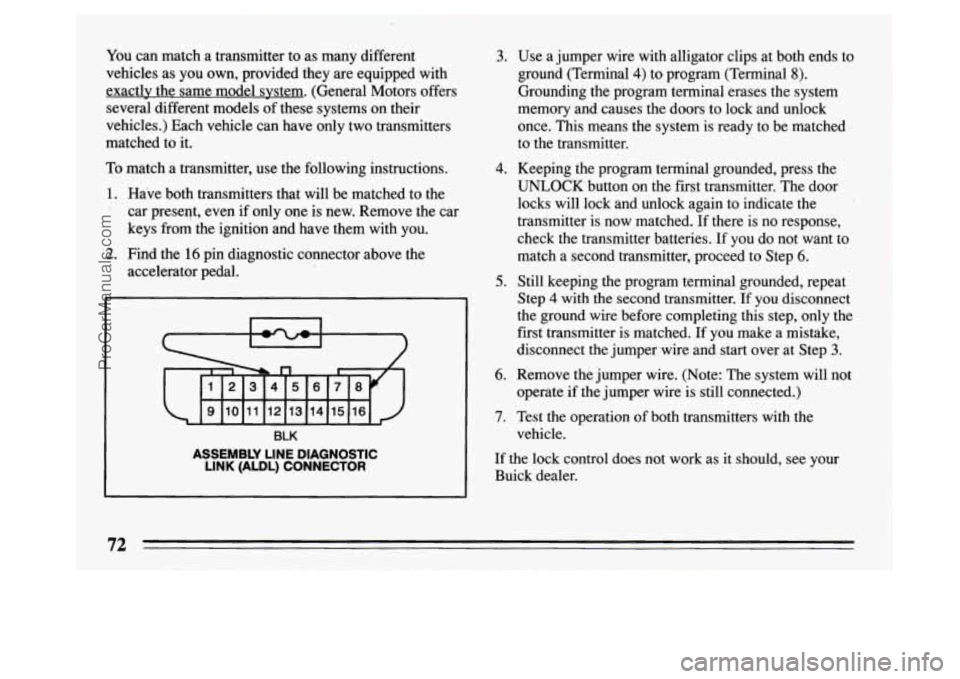
4) to program (Terminal 8).
Grounding the program terminal erases the system
memory and causes the doors to lock and unlock
once. This means the system is ready to be matched
to the transmitter.
To match a transmitter, use the following instructions.
1. Have both transmitters that will be matched to the
'. car present, even if only one is new. Remove the car
keys
from the ignition and have them with you.
2. Find the 16 pin diagnostic connector above the
accelerator pedal.
BLK
ASSEMBLY LINE DIAGNOSTIC LINK (ALDL) CONNECTOR
4. Keeping the program terminal grounded, press the
UNLOCK button on the first transmitter.
The door
locks will lock and unlock again to indicate the
transmitter is now matched.
If there is no response,
check the transmitter batteries.
If you do not want to
match
a second transmitter, proceed to Step 6.
5. Still keeping the program terminal grounded, repeat
Step
4 with the second transmitter. If you disconnect
the ground wire before completing this step, only the
first transmitter is matched. If you make a mistake,
disconnect the jumper wire and start over at Step
3.
6. Remove the jumper wire. (Note: The system will not
operate
if the jumper wire is still connected.)
7. Test the operation of both transmitters with the
vehicle.
If the lock control does not work as it should, see your
Buick dealer.
72
ProCarManuals.com
Page 76 of 324
Rear Door Security Lock
Your Buick is equipped with rear door security locks
that help prevent passengers from opening the rear doors
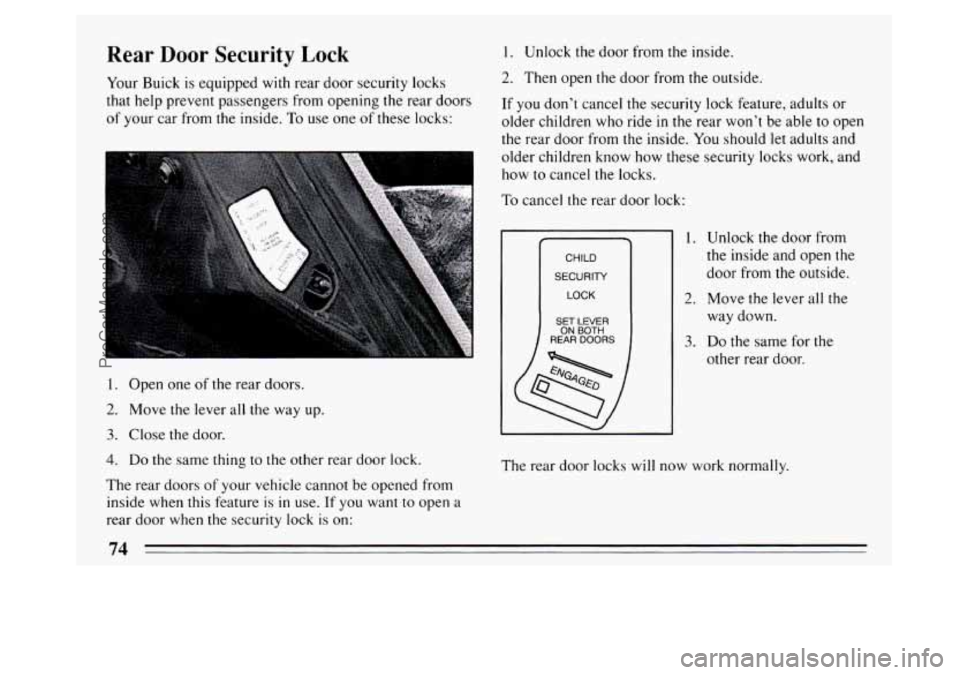
of your car from the inside. To use one of these locks:
1. Open one of the rear doors.
2. Move the lever all the way up.
3. Close the door.
4. Do the same thing to the other rear door lock.
1. Unlock the door from the inside.
2. Then open the door from the outside.
If you don’t cancel
the security lock feature, adults or
older children who ride
in the rear won’t be able to open
the rear door from the inside.
You should let adults and
older children know how these security locks work, and
how to cancel the locks.
To cancel the rear door lock:
CHILD
SECURITY
LOCK
SET LEVER ON BOTH REAR DOORS
1. Unlock the door from
the inside and open the
door from the outside.
2. Move the lever all the
way down.
3. Do the same for the
other rear door.
The rear door locks will now work normally.
The rear doors of your vehicle cannot be opened from
inside when this feature is
in use. If you want to open a
rear door when the security lock
is on:
74
ProCarManuals.com
Page 77 of 324
Illuminated Entry System (Option)
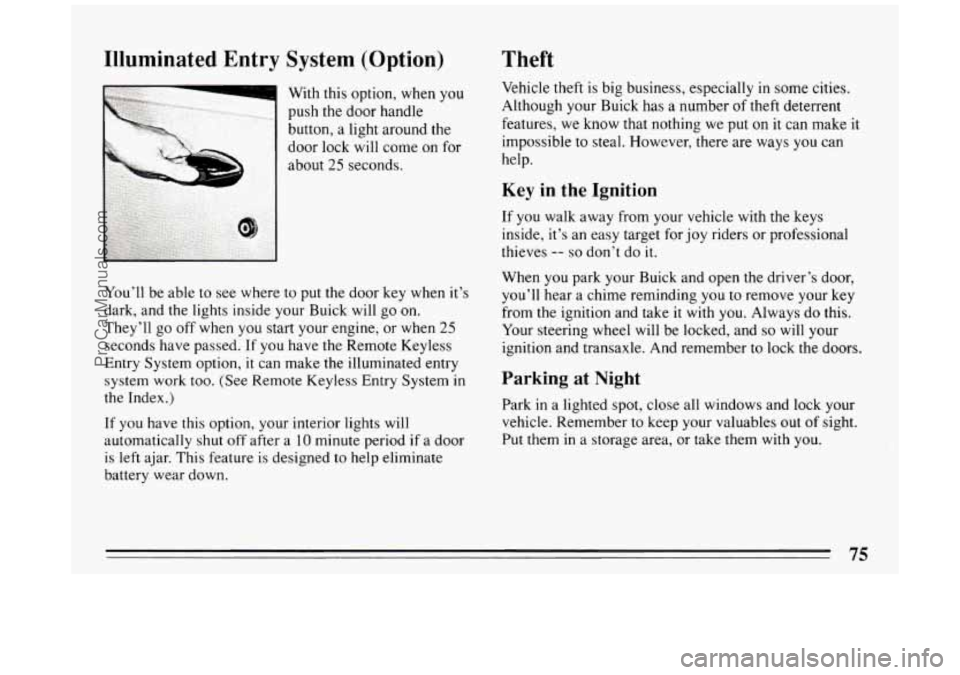
With this option, when you
push the door handle
button,
a light around the
door lock will come on for
about
25 seconds.
You’ll be able to see where to put the door key when it’s
dark, and the lights inside your Buick will go on.
They’ll
go off when you start your engine, or when 25
seconds have passed. If you have the Remote Keyless
Entry System option, it can make the illuminated entry
system work too. (See Remote Keyless Entry System in
the Index.)
If
you have this option, your interior lights will
automatically shut off after a
10 minute period if a door
is left ajar. This feature
is designed to help eliminate
battery wear down.
Theft
Vehicle theft is big business, especially in some cities.
Although your Buick has a number of theft deterrent
features,
we know that nothing we put on it can make it
impossible to steal. However, there are ways you can
help.
Key in the Ignition
If you walk away from your vehicle with the keys
inside, it’s an easy target for joy riders or professional
thieves
-- so don’t do it.
When you park your Buick and open the driver’s door,
you’ll hear a chime reminding you
to remove your key
from the ignition and take
it with you. Always do this.
Your steering wheel will be locked, and
so will your
ignition and transaxle. And remember to lock the doors.
Parking at Night
Park in a lighted spot, close all windows and lock your
vehicle. Remember to keep your valuables
out of sight.
Put them in a storage area, or take them with you.
75
ProCarManuals.com
Page 78 of 324
Parking Lots
If you park in a lot where someone will be watching
your vehicle, it’s best to lock it up and take your keys.
But what
if you have to leave your ignition key? What if
you have to leave something valuable
in your vehicle?
1. Put your valuables in a storage area, like your trunk
or glove box.
2. Lock the glove box.
3. Lock all the doors except the driver’s.
4. Then t&e the door key with you.
Universal Theft Deterrent (Option)
If your Buick has this option, it has a theft deterrent
alarm system. With this system, the “SECURITY” light
will flash as you open the door (if your ignition is
off).
This light reminds you to activate the theft deterrent
system. Here’s how to do it:
1. Open the door.
2. Lock the door with the power door lock switch or
Remote Keyless Entry System. The “SECURITY”
light should come on and stay on.
3. Close all doors. The “SECURITY” light should go
Off.
If a door or the trunk is opened without the key or
Remote Keyless Entry System; the alarm will go
off. It
will also
go off if a door lock or the trunk lock is
damaged. Your vehicle’s lights will flash and the horn
will sound for several minutes, then will go off to save
battery power.
Kemember, the theft deterrent system won’t activate
if
you lock the doors with a key or manual door lock. It
activates only if you use a power door lock switch or
Remote Keyless Entry System. You should also
remember that you can start
your vehicle with the
correct ignition key if the alarm has been set
off. You
must still shut
off the alarm by inserting the key in the
door lock.
Here’s how to avoid setting
off the alarm by accident:
1. If you don’t want to activate the theft deterrent
system, the vehicle should be locked
after the doors
are closed.
2. Always unlock a door with a key, or use the Remote
Keyless Entry System. Unlocking a
door any other
way will set
off the alarm.
ProCarManuals.com
Page 79 of 324
If you set off the alarm by accident, unlock any door
with your
key.
PASS-Key@II
You can also turn off the alarm by using the Keyless
Entry System, if
you have it. The alarm won’t stop if
you try to unlock a door any other way.
How to Test The Alarm
The alarm can be tested by first having the driver’s
window down. Activate the system by locking
the doors
with
the power door lock switch or the Remote Keyless
Entry System. Get out
of the car and close the door and
wait for the SECURITY light to go out. Then reach
in
through the window, unlock the door with the manual
door lock, and open the door. This should set off the
alarm.
If the alarm does not sound when
it should, check to see
if the horn works. The horn fuse may be blown. To
replace the
fuse, see “Fuses and Circuit Breakers” in the
Index.
To reduce the possibility of theft, always activate the
theft deterrent system when leaving your vehicle. Your
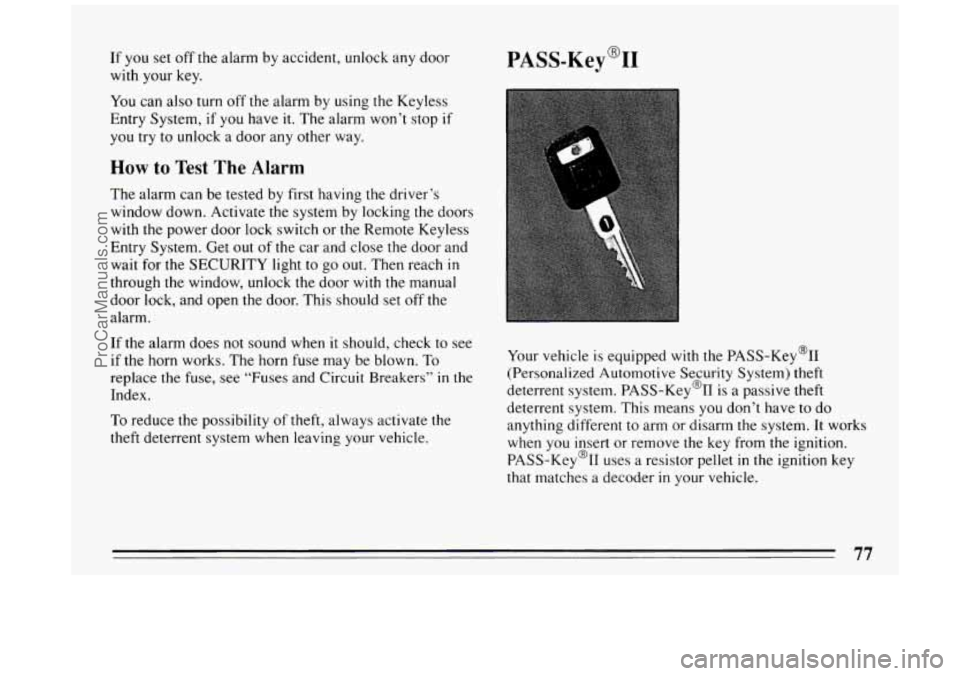
vehicle is equipped with the PASS-Key@II
(Personalized Automotive Security System) theft
deterrent system. PASS-Key%
is a passive theft
deterrent system. This means you don’t have to do
anything different
to arm or disarm the system. It works
when you insert or remove the
key from the ignition.
PASS-Key@II uses a resistor pellet in the ignition key
that matches a decoder
in your vehicle.
77
ProCarManuals.com
Page 80 of 324
When the PASS-Key% system senses that someone is using the wrong key,
it shuts down the vehicle’s starter
and fuel systems. For about three minutes,
the starter
won’t work and
fuel won’t go to the engine. If someone
tries to start your vehicle again or uses another key
during this time, the vehicle will not start. This
discourages someone from randomly trying different
keys with different resistor pellets in an attempt to make
a match.
The ignition key must be clean and dry before it’s
inserted in the ignition or the engine may not start. If the
engine does not start and the “SECURITY’’ light comes
on, the key may be dirty
or wet. Turn the ignition off.
Clean and dry the key. Wait about three minutes and try
again. The security light may remain on during this
time. If
the starter still won’t work, and the key appears
to be clean and dry, wait about three minutes and try the
other ignition key. At this time, you may also want to
check the fuse (see “Fuses and Circuit Breakers”
in the
Index). If
the starter won’t work with the other key, your vehicle needs
service. If your vehicle does start, the first
ignition key may be faulty. See your Buick dealer or a
locksmith who can service the PASS-Key@II.
If you accidentally use a key that has a damaged or
missing resistor pellet, the starter won’t work and the
“SECURITY” light
will flash. But you don’t have to
wait three minutes before trying one of the other ignition
keys.
See your Buick dealer or
a locksmith who can service
the PASS-Key@II to have a new key made.
If you’re ever driving and the “SECURITY” light comes
on and stays on,
you will be able to restart your engine if
you turn it off. Your PASS-Key% system, however, is
not working properly
and must be serviced by your
Buick dealer. Your vehicle is not protected by the
PASS-Key% system.
If you lose or damage a PASS-Key@II ignition key, see
your Buick dealer or a locksmith who can service
PASS-Key@II to have a
new key made.
78
ProCarManuals.com
Page 81 of 324
New Vehicle “Break-In”
NOTICE:
Your modern Buick doesn’t need an elaborate
“break-in.” But
it will perform better in the long
run if you follow these guidelines:
1. Don’t drive at any one speed -- fast or slow
-- for the first 500 miles (804 km). Don’t
make full-throttle starts.
2. Avoid making hard stops for the first 200
miles (322 km) or so. During this time your
new brake linings aren’t yet broken
in. Hard
stops with new linings can mean premature
wear and earlier replacement. Follow this
“breaking-in” guideline every time you get
new brake linings.
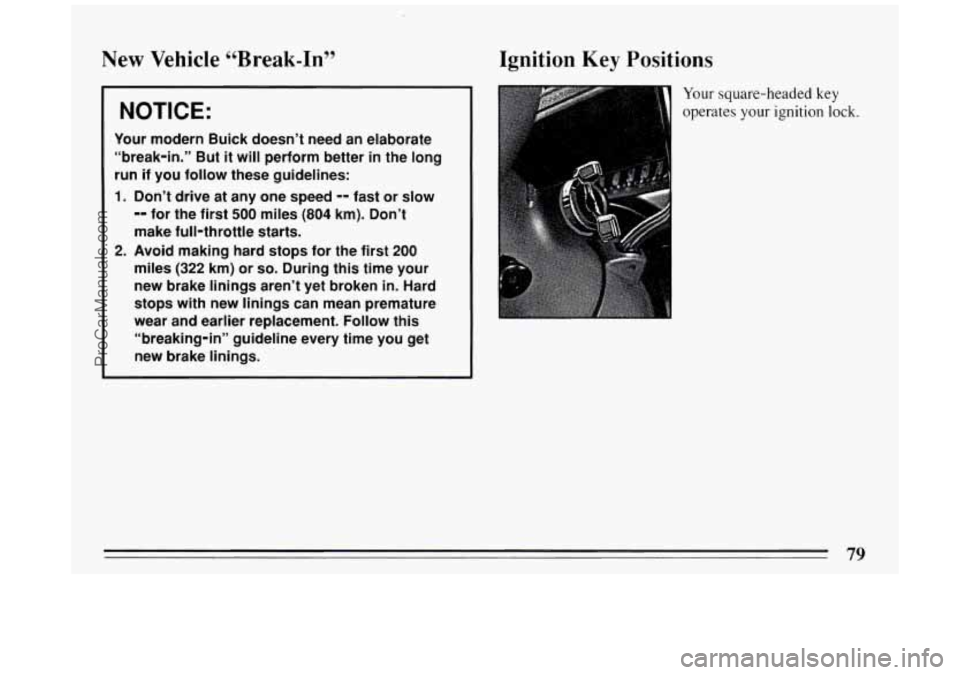
Ignition Key Positions
Your square-headed key
operates your
ignition lock.
79
ProCarManuals.com
Page 82 of 324
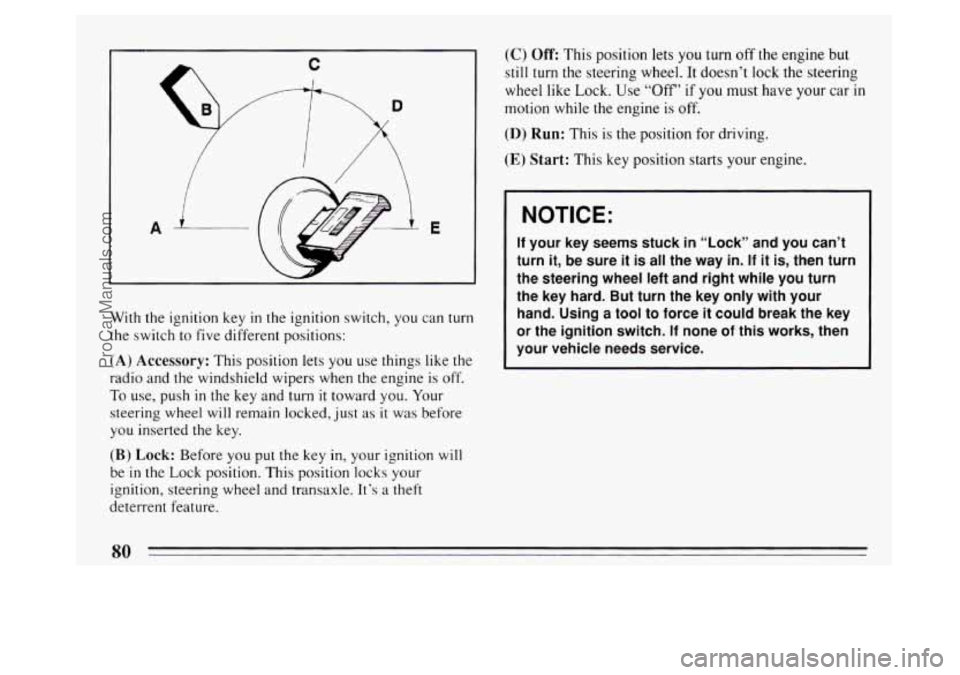
With the ignition key in the ignition switch, you can turn
the switch to five different positions:
(A) Accessory: This position lets you use things like the
radio and the windshield wipers when the engine is off.
To use, push in the key and turn it toward you. Your
steering wheel will remain locked, just as
it was before
you inserted the key.
(B) Lock: Before you put the key in, your ignition will
be
in the Lock position. This position locks your
ignition, steering wheel and transaxle. It’s
a theft
deterrent feature.
(C) Off: This position lets you turn off the engine but
still turn the steering wheel. It doesn’t lock the steering
wheel like Lock.
Use “Off’ if you must have your car in
motion while the engine is off.
(D) Run: This is the position for driving.
(E) Start: This key position starts your engine.
NOTICE:
If your key seems stuck in “Lock” and you can’t
turn
it, be sure it is all the way in. If it is, then turn
the steering wheel left and right while you
turn
the key hard. But turn the key only with your
hand. Using a tool to force
it could break the key
or the ignition switch. If none of this works, then
your vehicle needs service.
80
ProCarManuals.com
Page 84 of 324
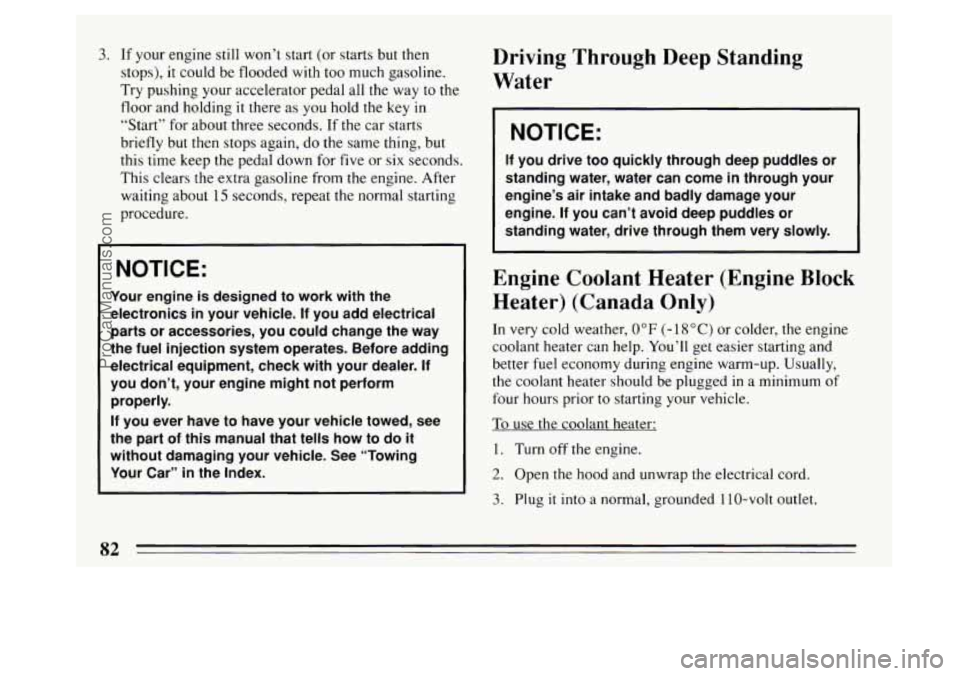
3. If your engine still won’t start (or starts but then
stops),
it could be flooded with too much gasoline.
Try pushing your accelerator pedal all the way to the
floor and holding
it there as you hold the key in
“Start” for about three seconds. If the car starts
briefly but then stops again, do the same thing, but
this time keep the pedal down for five or
six seconds.
This clears the extra gasoline from the engine. After
waiting about
15 seconds, repeat the normal starting
procedure.
NOTICE:
Your engine is designed to work with the
electronics in your vehicle.
If you add electrical
parts or accessories, you could change the way
the fuel injection system operates. Before adding
electrical equipment, check with your dealer.
If
you don’t, your engine might not perform
properly.
If you ever have to have your vehicle towed, see
the part of this manual that tells how to
do it
without damaging your vehicle. See “Towing
Your Car”
in the Index.
Driving Through Deep Standing
Water
I NOTICE:
If you drive too quickly through deep puddles or
standing water, water can come
in through your
engine’s air intake and badly damage your
engine.
If you can’t avoid deep puddles or
standing water, drive through them very slowly.
Engine Coolant Heater (Engine Block
Heater) (Canada Only)
In very cold weather, 0°F (- 18 “C) or colder, the engine
coolant heater can help. You’ll get easier starting and
better fuel economy during engine warm-up. Usually,
the coolant heater should be plugged
in a minimum of
four hours prior to starting your vehicle.
To use the coolant heater:
1. Turn off the engine.
2. Open the hood and unwrap the electrical cord.
3. Plug it into a normal, grounded 1 10-volt outlet.
82
ProCarManuals.com
Page 85 of 324
Automatic Transaxle
NOTICE:
After you’ve used the coolant heater, be sure to
store the cord
as it was before to keep it away
from moving engine parts.
If you don’t, it could
be damaged.
How long should you keep the coolant heater plugged in?
The answer depends on the weather, the kind
of oil you
have, and some other things. Instead
of trying to list
everything here,
we ask that you contact a Buick dealer in
the area where you’ll be parking your vehicle. The dealer
can give you the best advice for that particular area. There are
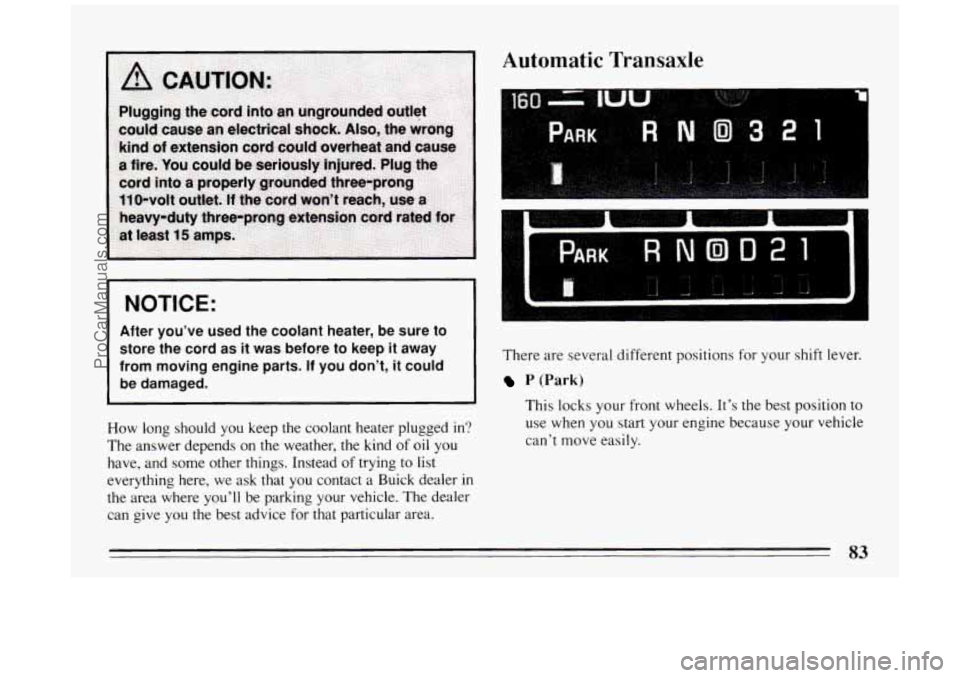
several different positions for your shift lever.
P (Park)
This locks your front wheels. It’s the best position to
use when you start your engine because your vehicle
can’t move easily.
83
ProCarManuals.com