steering BUICK PARK AVENUE 1994 Owner's Manual
[x] Cancel search | Manufacturer: BUICK, Model Year: 1994, Model line: PARK AVENUE, Model: BUICK PARK AVENUE 1994Pages: 324, PDF Size: 17.01 MB
Page 206 of 324
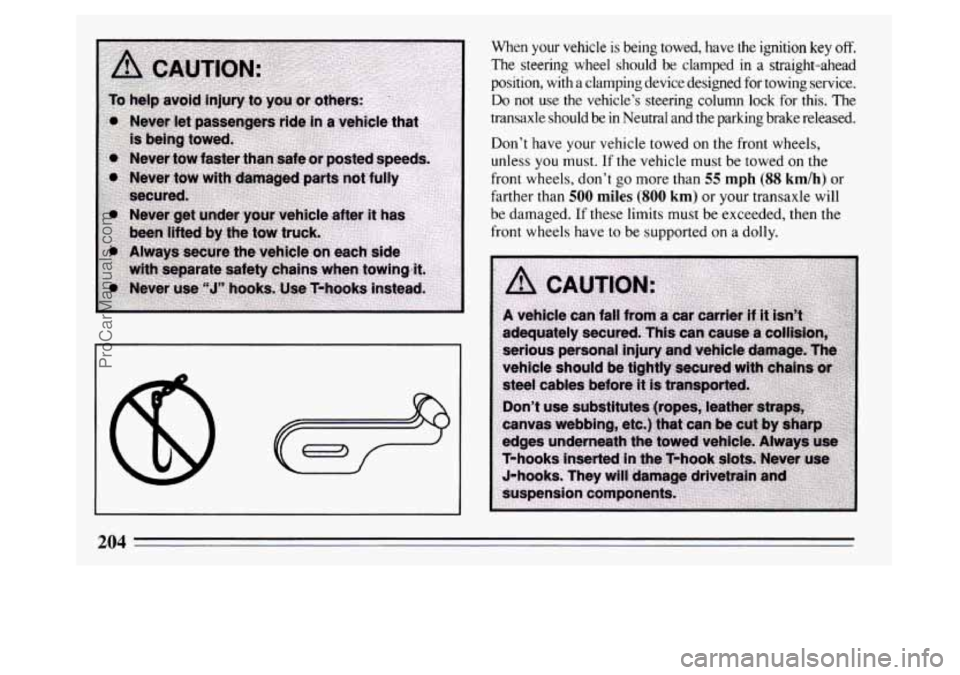
When your vehicle is being towed, have the ignition key off.
The steering wheel should be clamped in a straight-ahead
position, with
a clamping device designed for towing service.
Do not use the vehicle’s steering column lock for this. The
transaxle should be
in Neutral and the parking brake released.
Don’t have your vehicle towed on the front wheels,
unless you must.
If the vehicle must be towed on the
front wheels, don’t go more than
55 mph (88 km/h) or
farther than
500 miles (800 km) or your transaxle will
be damaged. If these limits must be exceeded, then the
front wheels have
to be supported on a dolly.
ProCarManuals.com
Page 216 of 324

8. Then replace the
pressure cap. At
any time during this
procedure
if coolant
begins to
flow out
of the filler neck,
reinstall the
pressure cap. Be
sure the arrows on
pressure cap line up
like this.
If a Tire Goes Flat
It’s unusual for a tire to “blow out” while you’re driving,
especially
if you maintain your tires properly. If air goes
out of
a tire, it’s much more likely to leak out slowly.
But
if you should ever have a “blowout,” here are a few
tips about what to expect and what to do:
If a front tire fails, the flat tire will create
a drag that
pulls the vehicle toward that side. Take your foot
off the
accelerator pedal and grip the steering wheel firmly.
Steer to maintain lane position, then gently brake to a
stop well out of the traffic lane.
A rear blowout, particularly on a curve, acts much like a
skid and may require the same correction you’d use in a
skid. In any rear blowout, remove your foot from the
accelerator pedal. Get the vehicle under control by
steering the way you want the vehicle to
go. It may be
very bumpy and noisy, but you can still steer. Gently
brake to a stop, well
off the road if possible.
If a tire goes flat, the next section shows how to use
your jacking equipment to change
a flat tire safely.
214
ProCarManuals.com
Page 228 of 324
NOTICE:
Spinning your wheels can destroy parts of your
vehicle as well as the tires.
If you spin the wheels
too fast while shifting your transaxle back and
forth, you can destroy your transaxle.
Rocking your vehicle to get it out:
First, turn your steering wheel left and right. That will
clear the area around your front wheels. You should turn
your traction control system off. (See “Traction Control
System” in
the Index.) Then shift back and forth
between
“R” (Reverse) and a forward gear, spinning the
wheels as little as possible. Release the accelerator pedal
while you shift, and press lightly on the accelerator
pedal when the transaxle is in gear. If that doesn’t get
you out after a few tries,
you may need to be towed out.
If
you do need to be towed out, see “Towing Your Car”
in the Index.
226
ProCarManuals.com
Page 229 of 324

Part 6 Service and Appearance Care
Here you will find information about the care of your Buick . This part begins with service and fuel information. and
then
it shows how to check important fluid and lubricant levels . There is also technical information about your
vehicle. and a section devoted to its appearance care
.
Part 6 includes:
Service ........................................................................\
.. 228
Fuel
........................................................................\
..... 229
HoodRelease
..................................................................... 234
Engineoil
....................................................................... \
238
Aircleaner
....................................................................... \
243
Automatic Transaxle Fluid
........................................................... 244
Enginecoolant
.................................................................... 247
PowerSteeringFluid ............................................................... 250
Windshield Washer Fluid
............................................................ 251
Brakes
........................................................................\
... 252
Battery
........................................................................\
.. 255
BulbReplacement
................................................................. 256
Loading Your Vehicle
............................................................... 258
Tires
........................................................................\
.... 260
Appearancecare
.................................................................. 268
Vehicle Identification Number (VIN) .................................................. 276
FusesandCircuitBreakers
........................................................... 277
Capacities and Specifications
......................................................... 282
227
ProCarManuals.com
Page 235 of 324
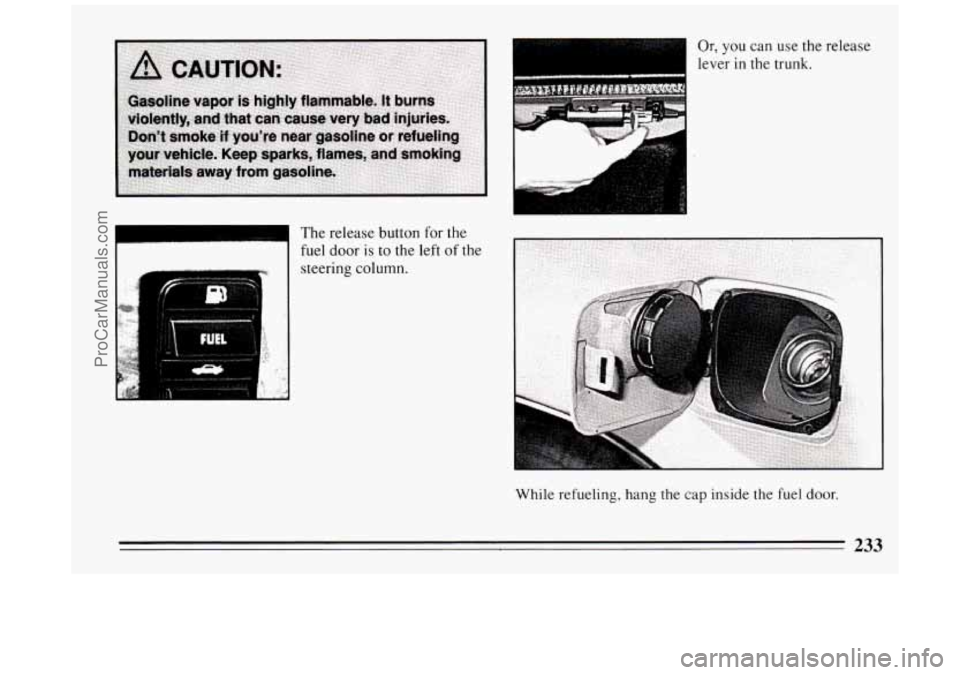
The release button for the
fuel door is to the left of the
steering column.
Or, you can use the release
lever in the
trunk.
While refueling, hang the cap inside the fuel door.
233
ProCarManuals.com
Page 238 of 324
Before closing the hood, be sure all the filler caps are on
properly. Then pull the hood down and close it firmly.
Engine Accessory Belt
A
D
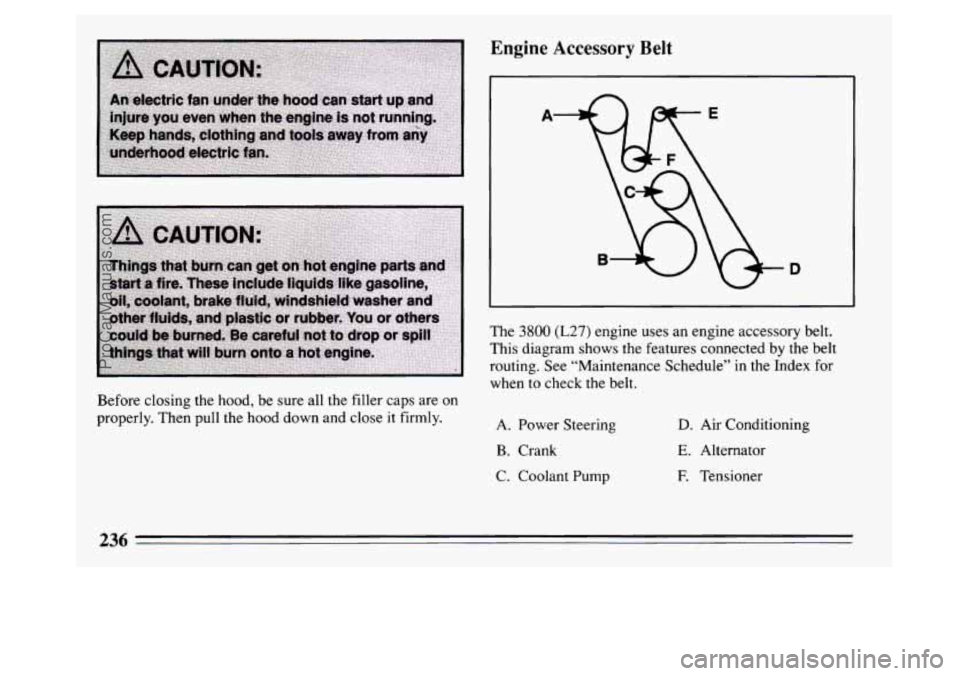
The 3800 (L27) engine uses an engine accessory belt.
This diagram shows the features connected by the belt
routing. See “Maintenance Schedule” in the Index for
when to check
the belt.
A. Power Steering
B. Crank
C. Coolant Pump
D. Air Conditioning
E. Alternator
E Tensioner
236
ProCarManuals.com
Page 239 of 324
3800 Supercharged (L67) Engine
(Option)
Your Park Avenue Ultra has a 3800 Supercharged
engine. Buick chose supercharging rather than
turbocharging because Buick emphasizes smooth,
refined power.
The Supercharger is a device which is designed to pump
more air into the engine than it would normally use.
This air mixed with fuel, creates increased engine
power. Since
the Supercharger is a pump and is driven
from an engine accessory drive belt, increased pressure
is available at all driving conditions.
The powertrain control module (PCM), works with a
vacuum control to regulate the increased pressure
required during specific driving conditions. When this
increased pressure or boost is not desired, such as during
idling and light throttle cruising, the excess air that the
Supercharger is pumping
is routed through a bypass. All
of these controls, working together provide high
performance character and
fuel efficiency in the 3800
V6 Supercharged Buick engine.
The power steering pump uses a remote reservoir
mounted on the throttle and cruise control cable bracket.
See “Maintenance Schedule’’ in
the Index for when you
should check the fluid.
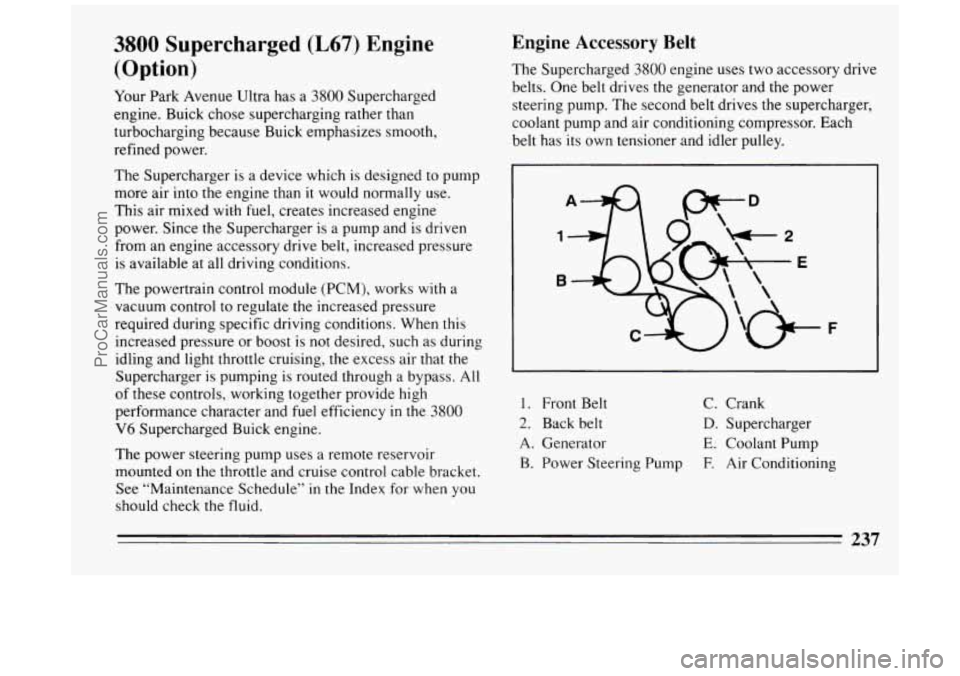
Engine Accessory Belt
The Supercharged 3800 engine uses two accessory drive
belts. One belt drives the generator and the power
steering pump. The second belt drives the supercharger,
coolant pump and air conditioning compressor. Each
belt has its own tensioner and idler pulley.
1. Front Belt
C. Crank
2. Back belt D. Supercharger
A. Generator
E. Coolant Pump
B. Power Steering Pump E Air Conditioning
237
ProCarManuals.com
Page 252 of 324
Power Steering Fluid
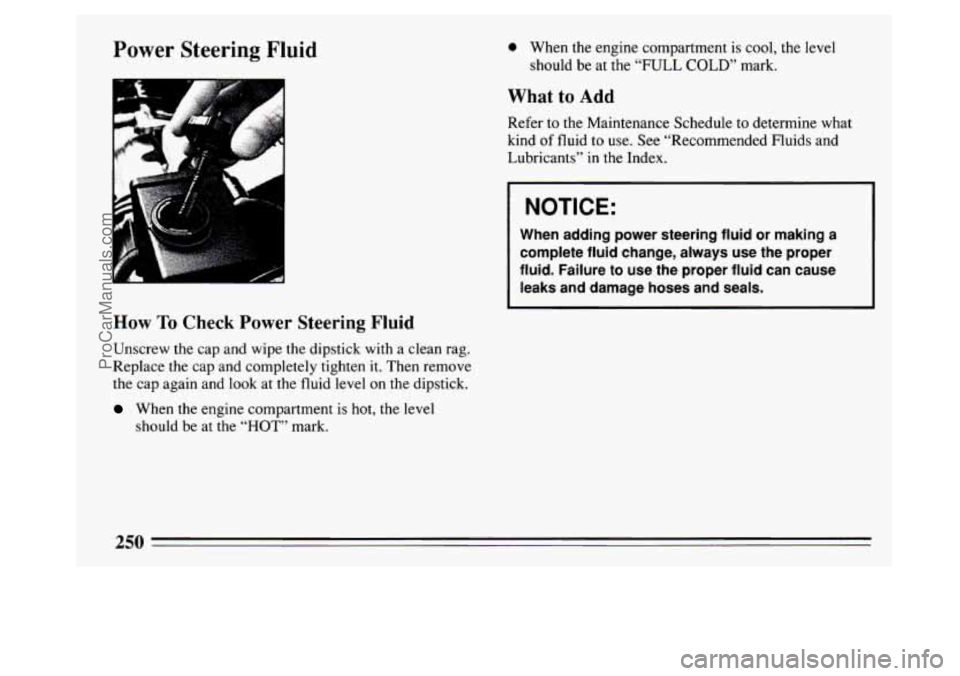
How To Check Power Steering Fluid
Unscrew the cap and wipe the dipstick with a clean rag.
Replace the cap and completely tighten it. Then remove
the cap again and look at the fluid level
on the dimtick.
When the engine compartment is hot, the level
should be at the
“HOT” mark.
0 When the engine compartment is cool, the level
should be at the
“FULL COLD” mark.
What to Add
Refer to the Maintenance Schedule to determine what
kind
of fluid to use. See “Recommended Fluids and
Lubricants” in the Index.
NOTICE:
When adding power steering fluid or making a
complete fluid change, always use the proper
fluid. Failure to use the proper fluid can cause
leaks and damage hoses and seals.
250
ProCarManuals.com
Page 294 of 324
Explanation of Scheduled Maintenance
Services
Following are explanations of the services listed in
Schedule I and Schedule 11.
The proper fluids and lubricants to use are listed
in
Section D. Make sure whoever services your vehicle
uses these. All parts should be replaced and all
necessary repairs done before you or anyone else drives
the vehicle.
NOTE: To determine your engine’s displacement and
code, see “Engine Identification”
in the Index.
1. Engine Oil and Filter Change* -- Always use SH
or SG Energy Conserving I1 oils of proper viscosity.
The
“SH” or “SG” designation may be shown alone
or
in combination with others, such as “SH/CD” or
“SH,
SG, CD,” “SG/CD,” etc. To determine the
preferred viscosity for your vehicle’s engine (e.g., SAE
5W-30 or SAE low-30), see “Engine Oil” in
the Index.
If your vehicle has an Engine Oil Life Monitor, the
monitor will show you when to change the oil. See
“Engine Oil Life Monitor”
in the Index. 2.
Chassis Lubrication -- Lubricate
the transaxle shift
linkage, parking brake cable guides, underbody
contact points and linkage. If your vehicle is
equipped
with grease fittings, lubricate the
suspension and steering linkage.
3. Tire and Wheel Rotation and Inspection -- For
proper wear and maximum tire life, rotate your tires
following the instructions
in this manual. See “Tires,
Inspection
& Rotation” in the Index. Check the tires
for uneven wear or damage. If you see irregular or
premature wear, check the wheel alignment. Check
for damaged wheels also.
4. Engine Accessory Drive Belt(s) Inspection --
Inspect the belt(s) for cracks, fraying, wear and
proper tension. Replace as needed.
5. Cooling System Service* -- Drain, flush and refill
the system
with new or approved recycled coolant
conforming to GM Specification 1825M. Keep
coolant at the proper mixture as specified. See
“Coolant”
in the Index. This provides proper freeze
protection, corrosion inhibitor level and engine
operating temperature.
292
ProCarManuals.com
Page 298 of 324
CHECK OR
SERVICE
Brake-Transmission
Shift Interlock
--
BTSI (Automatic)
WHAT TO DO
I. Before you start, be sure you have
enough room around the vehicle.
It
should be parked on a level surface.
2. Firmly apply the parking brake (see
“Parking Brake”
in the Index if
necessary).
NOTE: Be ready to apply the regular
brake immediately
if the vehicle begins
to move.
3. With the engine off, turn the key to
the
“RUN’ position, but don’t start
the engine. Without applying the
regular brake, try to move the shift lever out of “P” (Park) with normal
effort. If the shift lever moves out of
“P” (Park), your vehicle’s BTSI
needs service.
WHAT TO DO
Steering Column
brake set, try to turn the key to
“LOCK” Lock
While parked, and with the parking
in each shift lever position.
0 The key should turn to “LOCK”
only when the shift lever is
in “P’
0 The key should come out only in
1 “LOCK.”
296
ProCarManuals.com