service BUICK PARK AVENUE 1994 Owner's Guide
[x] Cancel search | Manufacturer: BUICK, Model Year: 1994, Model line: PARK AVENUE, Model: BUICK PARK AVENUE 1994Pages: 324, PDF Size: 17.01 MB
Page 240 of 324
Supercharger Oil
Unless you are technically qualified and have the proper
tools, you should
let your dealer or a qualified service
center perform this maintenance.
When to Check: Check oil level every 30,000 miles
(50,000 km) or every 36 months.
What Kind of Oil to Use: See “Recommended Fluids and
Lubricants”
in the Index. Use only the recommended oil.
How to Check and Add Oil: Check oil only when the
engine is cold. Allow the engine to cool
2 to 3 hours after
running.
1. Remove the wiring harness shield.
2. Clean the area around the oil fill plug before
removing
it.
3. Remove the oil fill plug using a 3/16 allen wrench.
4. The oil level is correct when it just reaches the
bottom
of the threads of the inspection hole.
5. Replace the oil plug with the O-ring in place. Torque
to 10 Nom (88 lb. in.).
6. Replace the wiring harness shield.
Engine Oil
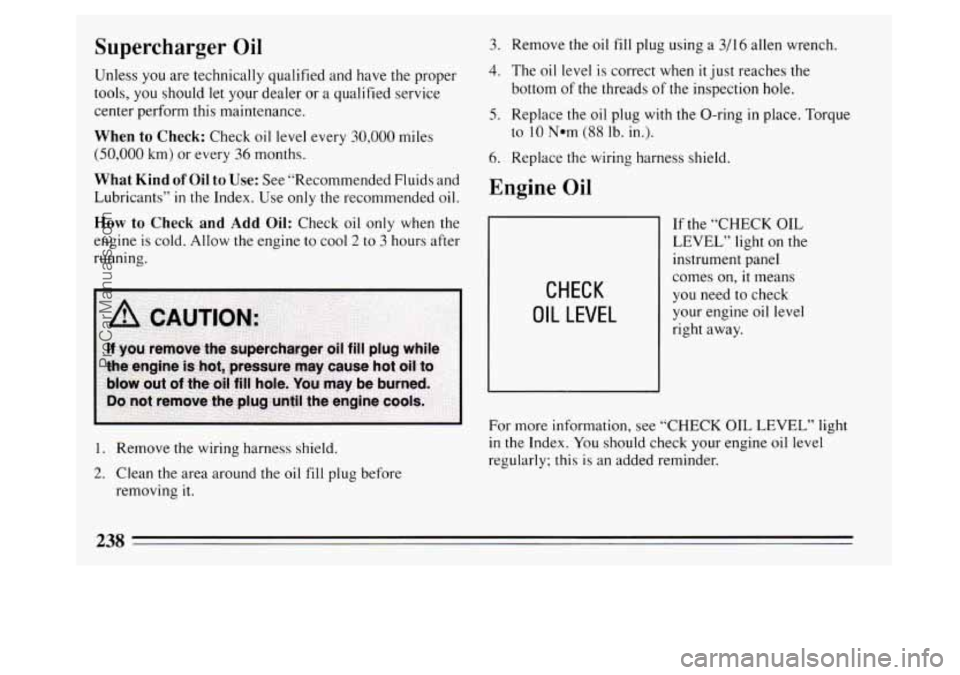
CHECK
OIL LEVEL
If the “CHECK OIL
LEVEL” light on the
instrument panel
comes on,
it means
you need to check
your engine oil level
right away.
For more information, see “CHECK
OIL LEVEL” light
in the Index. You should check your engine oil level
regularly; this is an added reminder.
238
ProCarManuals.com
Page 245 of 324
What to Do with Used Oil
Did you know that used engine oil contains certain
elements
that may be unhealthy for your skin and could
even cause cancer? Don’t let used oil stay on your skin
for very long. Clean your skin and nails with soap and
water, or a good hand cleaner. Wash or properly throw
away clothing or rags containing used engine oil. (See
the manufacturer’s warnings about the use and disposal
of oil products.)
Used oil can be a real threat to the environment. If you
change your own
oil, be sure to drain all free-flowing
oil from the filter before disposal. Don’t ever dispose of
oil by putting it in the trash, pouring
it on the ground,
into sewers, or into streams or bodies of water. Instead,
recycle it by taking
it to a place that collects used oil. If
you have a problem properly disposing of your used oil,
ask your dealer, a service station or a local recycling
center for help.
Air Cleaner
1
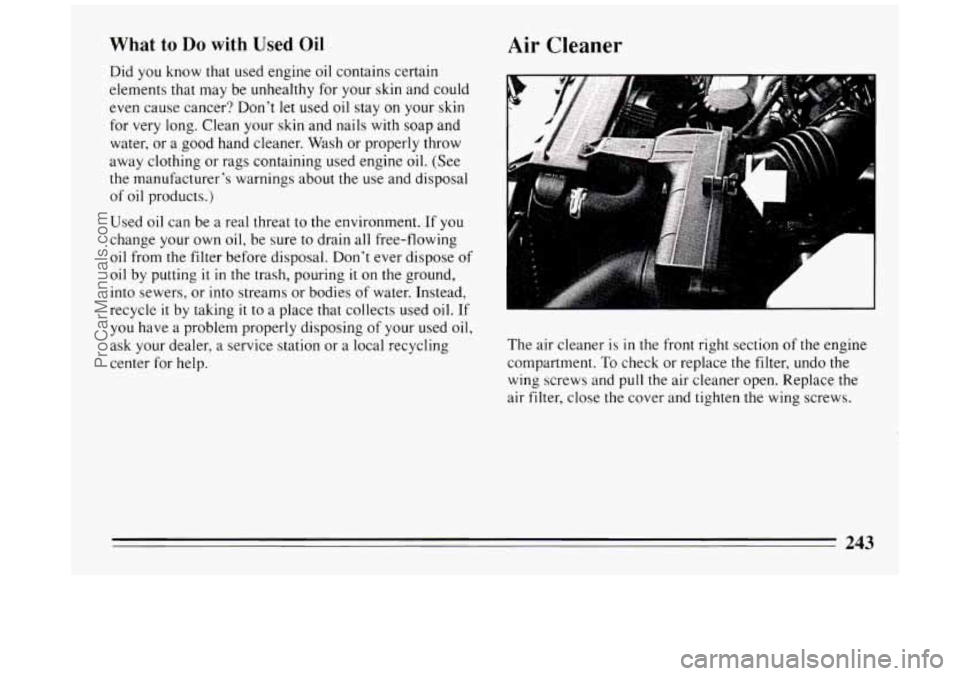
The air cleaner is in the front right section of the engine
compartment.
To check or replace the filter, undo the
wing screws and pull the air cleaner open. Replace the
air filter, close
the cover and tighten the wing screws.
243
ProCarManuals.com
Page 246 of 324

Refer to the Maintenance Schedule to determine when
to replace the air filter.
See “Scheduled Maintenance Services”
in the Index.
NOTICE:
If the air cleaner is off, a backfire can cause a
damaging engine fire. And, dirt can easily get
into your engine, which will damage
it. Always
have the air cleaner
in place when you’re driving.
Automatic Transaxle Fluid
When to- Check and Change
A good time to check your automatic transaxle fluid
level is when the engine oil is changed. Refer
to the
Maintenance Schedule to determine when to change
your fluid. See “Scheduled Maintenance Services’’ in
the Index.
How to Check
Because this operation can be a little difficult, you may
choose
to have this done at a Buick dealership Service
Department.
If you do it yourself, be sure to follow all the
instructions here, or you could get a false reading
on the
dipstick.
NOTICE:
Too much or too little fluid can damage your
transaxle.
Too much can mean that some of the
fluid could come out and fall on hot engine parts
or exhaust system, starting a fire. Be sure
to get
an accurate reading if you check your transaxle
fluid.
244
ProCarManuals.com
Page 264 of 324
When to Check
Check your tires once a month or more.
Don’t forget your compact spare tire. It should be at
60
psi (420 Wa).
How to Check
Use a good quality pocket-type gage to check tire
pressure. Simply looking at the tires will not tell you the
pressure, especially
if you have radial tires -- which
may look properly inflated even if they’re underinflated.
If your tires have valve caps, be sure to put them back
on. They help prevent leaks by keeping out dirt and
moisture.
Tire Inspection and Rotation
To make your tires last longer, have them inspected and
rotated at the mileages recommended
in the
Maintenance Schedule. See “Scheduled Maintenance
Services”
in the Index.
FRONT
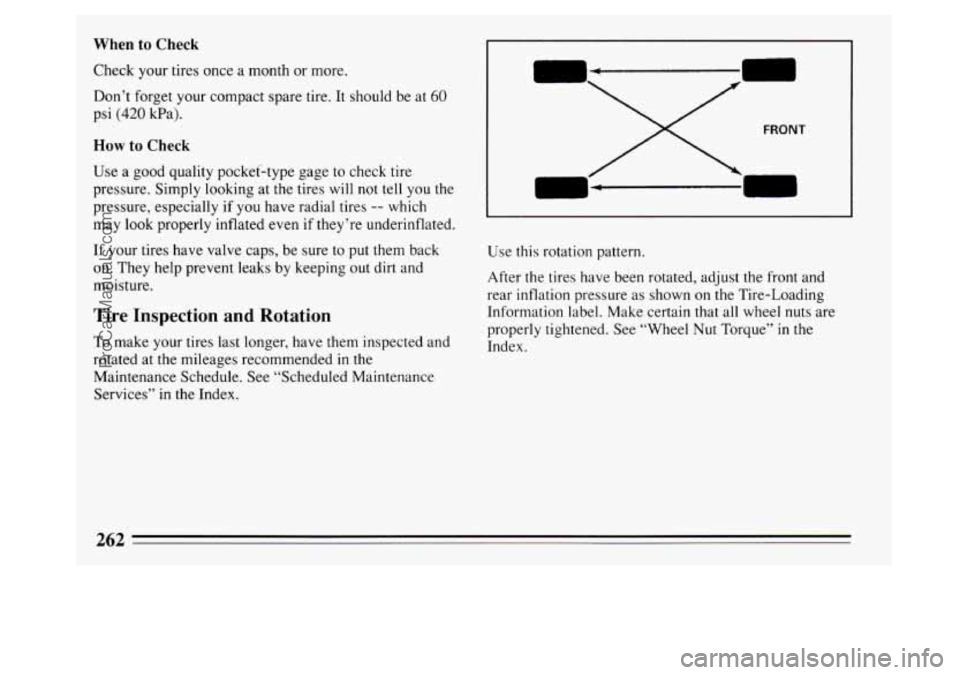
Use this rotation pattern.
After the tires have been rotated, adjust the front and
rear inflation pressure
as shown on the Tire-Loading
Information label. Make certain that all wheel nuts are
properly tightened. See “Wheel Nut Torque” in the
Index.
262
ProCarManuals.com
Page 266 of 324
The tire has a puncture, cut, or other damage that
can’t be repaired well because
of the size or location
of the damage.
Buying New Tires
To find out what kind and size of tires you need, look at
the Tire-Loading Information label.
The tires installed on your vehicle when it was new had
a Tire Performance Criteria Specification (TPC Spec)
number on each tire’s sidewall. When you get new tires,
get ones
with that same TPC Spec number. That way,
your vehicle
will continue to have tires that are designed
to give proper endurance, handling, speed rating,
traction, ride and other things during normal service on
your vehicle. If your tires have an all-season tread
design, the TPC number
will be followed by a “MS”
(for mud and snow).
If you ever replace your tires
with those not having a
TPC Spec number, make sure they are the same size,
load range, speed rating and construction type (bias,
bias-belted or radial) as your original tires.
Uniform Tire Quality Grading
The following information relates to the system
developed by the United States National Highway
Traffic Safety Administration which grades tires by
treadwear, traction and temperature performance.
(This
applies only to vehicles sold in the United States.)
Treadwear
The treadwear grade is a comparative rating based on
the wear rate
of the tire when tested under controlled
conditions on a specified government test course. For
example, a tire graded
150 would wear one and a half
(1 1/2) times as well on the government course as a tire
264
ProCarManuals.com
Page 267 of 324
graded 100. The relative performance of tires depends
upon the actual conditions
of their use, however, and
may depart significantly from the norm due to variations
in driving habits, service practices and differences in
road characteristics and climate.
Traction - A, B, C
The traction grades, from highest to lowest are: A, B,
’ and C. They represent the tire’s ability to stop on wet
pavement as measured under controlled conditions on
specified government test surfaces of asphalt and
concrete.
A tire marked C may have poor traction
performance.
Warning: The traction grade assigned
to this tire is based
on braking (straight-ahead) traction tests and does not
include cornering (turning) traction.
Temperature - A, B, C
The temperature grades are A (the highest), B, and C,
representing the tire’s resistance to the generation of
heat and its ability to dissipate heat
when tested under
controlled conditions on a specified indoor laboratory
test wheel. Sustained high temperature can cause the
material
of the tire to degenerate and reduce tire life, and
excessive temperature can lead to sudden tire failure.
The grade
C corresponds to a level of performance which all passenger car tires must meet under
the
Federal Motor Vehicle Safety Standard No.
109. Grades
B and A represent higher levels of performance on the
laboratory test wheel than the minimum required by law.
Warning: The temperature grade for
this tire is
established for a tire that is properly inflated and not
overloaded. Excessive speed, underinflation, or
excessive loading, either separately or in combination,
can cause heat buildup and possible tire failure.
These grades are molded on the sidewalls
of passenger
car tires.
While the tires available as standard or optional
equipment on General Motors vehicles may vary
with
respect to these grades, all such tires meet General
Motors performance standards and have been approved
for use on General Motors vehicles.
All passenger type
(P Metric) tires must conform to Federal safety
requirements
in addition to these grades.
Wheel Alignment and Tire Balance
The wheels on your vehicle were aligned and balanced
carefully at the factory to give you the longest tire life
and best overall performance.
265
ProCarManuals.com
Page 276 of 324
Foreign Material
Calcium chloride and other salts, ice melting agents,
road oil and tar, tree sap, bird droppings, chemica
industrial chimneys, and other foreign matter can
damage your vehicle’s finish if they remain on
pa
surfaces. Use cleaners that are marked safe for pa
surfaces to remove foreign matter.
~~
Finish Damage
.Is from
.inted inted
Any stone chips, fractures or deep scratches
in the finish
should be repaired right away. Bare metal will corrode
quickly and may develop into a major repair expense.
Minor chips and scratches can be repaired with touch-up
materials available from your dealer or other service
outlets. Larger areas of finish damage can be corrected
in your dealer’s body and paint shop.
Underbody Maintenance
Chemicals used for ice and snow removal and dust
control can collect on the underbody. If these are not
removed, accelerated corrosion (rust) can occur on the underbody parts such as fuel lines, frame, floor
pan, and
exhaust system even though they have corrosion
protection.
At least every spring, flush these materials from the
underbody
with plain water. Clean any areas where mud
and other debris can collect. Dirt packed
in closed areas
of the frame should be loosened before being flushed.
Your dealer or an underbody vehicle washing system
can do this for you.
Chemical Paint Spotting
Some weather and atmospheric conditions can create a
chemical fallout. Airborne pollutants can fall upon and
attack painted surfaces on your vehicle. This damage
can take two forms: blotchy, ringlet-shaped
discolorations, and small irregular dark spots etched into
the paint surface.
Although no defect
in the paint job causes this, Buick
will repair, at no charge to the owner, the surfaces of
new vehicles damaged by this fallout condition within
12 months or 12,000 miles (20 000 km) of purchase,
whichever comes first.
274
ProCarManuals.com
Page 278 of 324
Vehicle Identification Number (VIN)
Cl11!!!1llIl IElll!l I
I= rl
ENGINE A94 7 ASSEMBLY
CODE MODEL YEAR PLANT
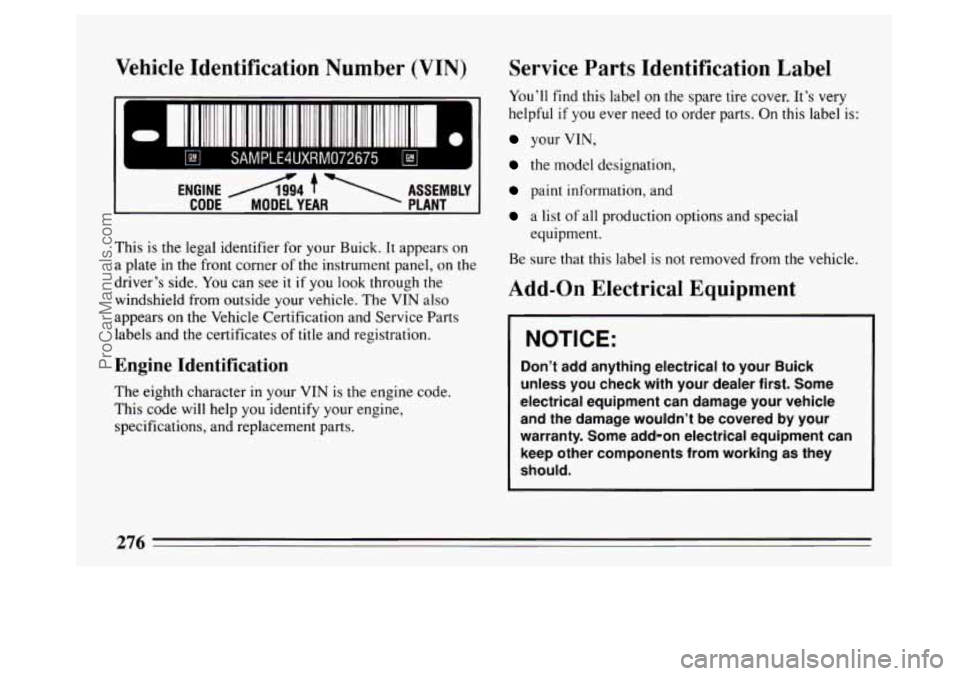
This is the legal identifier for your Buick. It appears on
a plate in the front corner
of the instrument panel, on the
driver’s side.
You can see it if you look through the
windshield from outside your vehicle. The VIN also
appears on the Vehicle Certification and Service Parts
labels and
the certificates of title and registration.
Engine Identification
The eighth character in your VIN is the engine code.
This code will help you identify your engine,
specifications, and replacement parts.
Service Parts Identification Label
You’ll find this label on the spare tire cover. It’s very
helpful if you ever need to order parts. On this label is:
your VIN,
the model designation,
paint information, and
a list of all production options and special
equipment.
Be sure that this label
is not removed from the vehicle.
Add-on Electrical Equipment
NOTICE:
Don’t add anything electrical to your Buick
unless you check with your dealer first. Some
electrical equipment can damage your vehicle
and the damage wouldn’t be covered by your
warranty. Some add-on electrical equipment can keep other components from working
as they
should.
276
ProCarManuals.com
Page 280 of 324
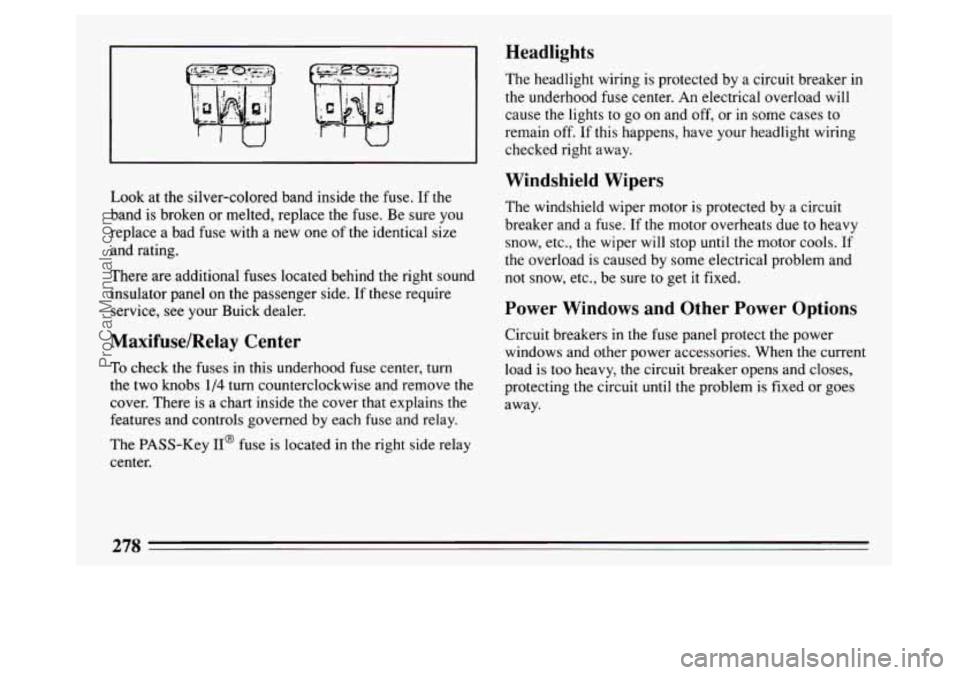
Look at the silver-colored band inside the fuse. If the
band is broken or melted, replace the fuse. Be sure
you
replace a bad fuse with a new one of the identical size
and rating.
There are additional fuses located behind the right sound
insulator panel on the passenger side. If these require
service, see your Buick dealer.
Maxifuse/Relay Center
To check the fuses in this underhood fuse center, turn
the two knobs
1/4 turn counterclockwise and remove the
cover. There is a chart inside the cover that explains the
features and controls governed by each fuse and relay.
The PASS-Key
II@ fuse is located in the right side relay
center.
Headlights
The headlight wiring is protected by a circuit breaker in
the underhood fuse center. An electrical overload will
cause the lights to go on and off, or in some cases to
remain off. If this happens, have your headlight wiring
checked right away.
Windshield Wipers
The windshield wiper motor is protected by a circuit
breaker and a fuse. If
the motor overheats due to heavy
snow, etc., the wiper will
stop until the motor cools. If
the overload is caused by some electrical problem and
not snow, etc., be sure to get it fixed.
Power Windows and Other Power Options
Circuit breakers in the fuse panel protect the power
windows and other power accessories. When the current
load is too heavy, the circuit breaker opens and closes,
protecting the circuit until the problem
is fixed or goes
away.
278
ProCarManuals.com
Page 285 of 324
@) Part 7 Maintenance Schedule
This part covers the maintenance required for your Buick . Your vehicle needs these services to retain its safety.
dependability and emission control performance
.
Part 7 includes:
Introduction ......................................................................
A Word About Maintenance .....................................................
Your Vehicle and the Environment ................................................
How This Part is Organized .....................................................
Section A: Scheduled Maintenance Services .............................................
Using Your Maintenance Schedules ...............................................
Selecting the Right Schedule ....................................................
Schedule1 ...................................................................
Schedule11 ..................................................................
Explanation of Scheduled Maintenance Services .....................................
Section B: Owner Checks and Services .................................................
AtEachFuelFill ..............................................................
AtLeastOnceaMonth .........................................................
AtLeastOnceaYear ..........................................................
Section C: Periodic Maintenance Inspections ............................................
Section D: Recommended Fluids and Lubricants .........................................
Section E: Maintenance Record .......................................................
284
284
285
285
287 287
287
288
290
292
294
294
295 295
298
299
301
283
ProCarManuals.com