air condition BUICK PARK AVENUE 1994 Owners Manual
[x] Cancel search | Manufacturer: BUICK, Model Year: 1994, Model line: PARK AVENUE, Model: BUICK PARK AVENUE 1994Pages: 324, PDF Size: 17.01 MB
Page 133 of 324
@ Part 3 Comfort Controls and Audio Systems
In this part you’ll find out how to operate the comfort control systems and audio systems offered with your Buick .
Be sure to read about the particular system supplied with your vehicle .
Part 3 includes:
Comfort Control System ............................................................ 132
Heater and Defroster
....................................................... 137. 138
Airconditioner
........................................................... 134. 140
Rear Window Defogger
.................................................... 139. 140
Ventilation
................................................................... 141
Steering Wheel Controls
........................................................ 155
Audiosystems
.................................................................... 143
Understanding Radio Reception
.................................................. 143
Radio Controls
....................................................... 144. 147. 151
Settingtheclock
.................................................... 146.149. 152
Tape Player Controls
.................................... ................. 146. 149
CD Player Controls
................................... ..................... 153
Steering Wheel Controls
............................. ....................... 155
Care of Cassette Tape Player and Tapes
............................................ 157
CareofCompactDiscs
......................................................... 158
Antennacare ................................................................ 158
131
ProCarManuals.com
Page 135 of 324
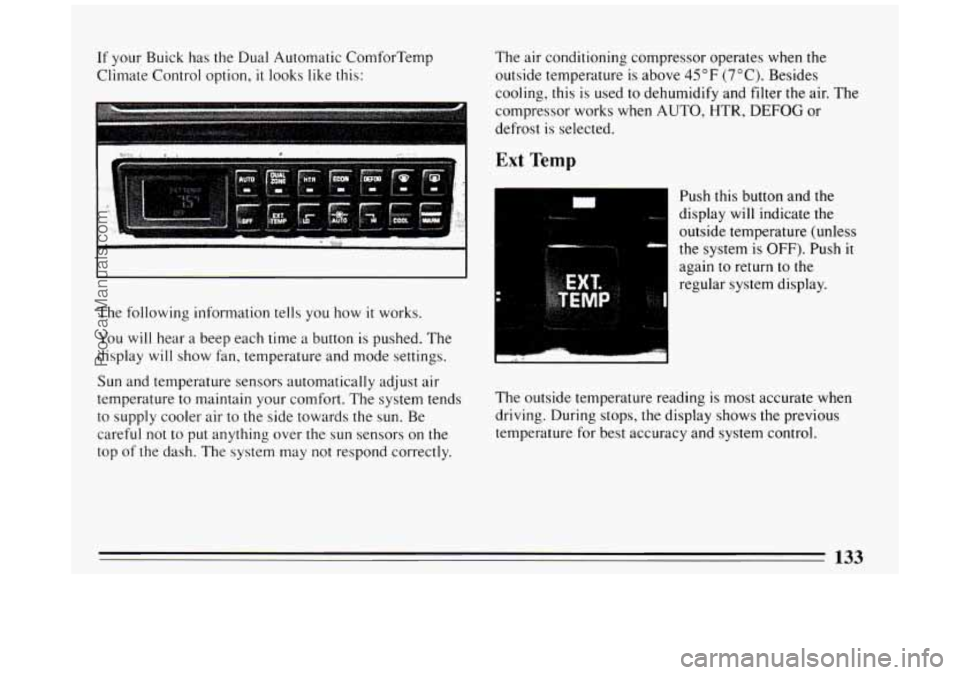
If your Buick has the Dual Automatic ComforTemp
Climate Control option,
it looks like this: The air conditioning compressor operates
when
the
outside temperature is above 45°F (7°C). Besides
cooling, this is used to dehumidify and filter
the air. The
compressor works when AUTO, HTR, DEFOG or
defrost is selected.
The following information
tells you how it works.
You
will hear a beep each time a button is pushed. The
display
will show fan, temperature and mode settings.
Sun and temperature sensors automatically adjust air
temperature to maintain your comfort. The system tends
to supply cooler air to the side towards the sun. Be
careful not to put anything over the sun sensors on the
top
of the dash. The system may not respond correctly.
Ext Temp
Push this button and the
display will indicate the
outside temperature (unless
the system
is OFF). Push it
again to return to the
regular system display.
.. * '' I
The outside temperature reading is most accurate when
driving. During stops, the display shows
the previous
temperature for best accuracy and system control.
133
ProCarManuals.com
Page 139 of 324
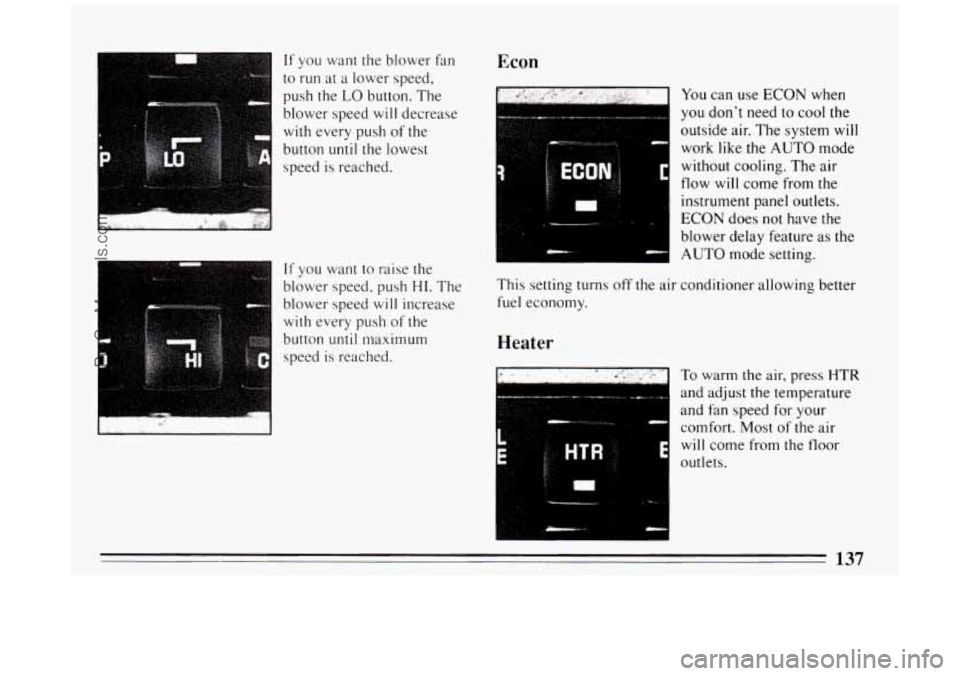
If you want the blower fan
to run at a lower speed,
push the
LO button. The
blower speed
will decrease
with every push of the
button
until the lowest
speed is reached.
If you want to raise the
blower speed, push
HI. The
blower speed
will increase
with every
push of the
button
until maximum
speed
is reached.
Econ
You can use ECON when
you don’t need to cool the
outside air. The system will
work like the AUTO mode
without cooling. The air
flow
will come from the
instrument panel outlets.
ECON does not have the
blower delay feature as
the
AUTO mode setting.
This setting turns off the air conditioner allowing better
fuel economy.
Heater
To warm the air, press mR
and adjust the temperature
and fan speed for your
comfort. Most of the air
will come from the floor
outlets.
137
ProCarManuals.com
Page 142 of 324
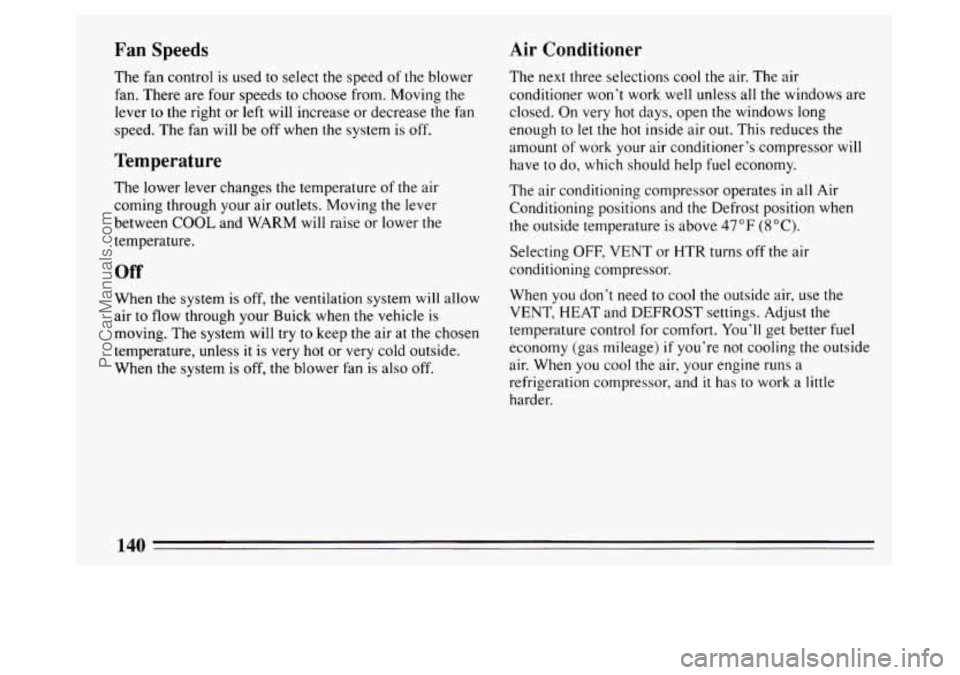
Fan Speeds Air Conditioner
The fan control is used
to select the speed of the blower
fan. There are four speeds to choose from. Moving the
lever to the right or
left will increase or decrease the fan
speed. The fan will be off when the system is
off.
Temperature
The lower lever changes the temperature of the air
coming through your air outlets. Moving the lever
between
COOL and WARM will raise or lower the
temperature.
Off
When the system is off, the ventilation system will allow
air to
flow through your Buick when the vehicle is
moving. The system will try to keep the air at the chosen
temperature, unless
it is very hot or very cold outside.
When the system is off, the blower fan is also off. The
next three selections cool the air. The air
conditioner won’t work well unless all the windows are
closed. On very hot days, open the windows long
enough to let the hot inside air out. This reduces the
amount of work your air conditioner’s compressor
will
have to do, which should help fuel economy.
The air conditioning compressor operates
in all Air
Conditioning positions and
the Defrost position when
the outside temperature
is above 47°F (SOC).
Selecting OFF, VENT or HTR turns off the air
conditioning compressor.
When you don’t need to cool the outside air, use the
VENT, HEAT and DEFROST settings. Adjust the
temperature control for comfort. You’ll get better fuel
economy (gas mileage)
if you’re not cooling the outside
air. When you cool the air, your engine runs a
refrigeration compressor, and
it has to work a little
harder.
140
ProCarManuals.com
Page 143 of 324
Max Vent
This setting provides maximum cooling with the least
amount
of work. MAX recirculates much of the air
inside
your vehicle so it maximizes your air
conditioner’s performance and fuel economy. Air is
directed through
the instrument panel outlets.
Norm
Use NORM for normal cooling on hot days. This setting
cools outside air and directs
it through the instrument
panel outlets.
Bi-Level
This setting is designed for use on sunny days when the
air is only moderately warm or cool. On days like these,
the sun may adequately warm your upper body, but your
lower body may not be warm enough.
The Bi-level setting directs vehicle air
in two ways.
Cool air
is directed toward your upper body through
instrument panel outlets, while slightly warmed air is
directed through the heater outlet at your feet. For
mild outside temperatures when little heating or
cooling is needed, use the VENT setting. Air
will flow
through the instrument panel outlets. ,Use the air outlets
to turn
on, adjust and turn off the air flow. Adjust the
temperature lever to the desired temperature.
Heater
When outside temperatures are cold, pressing the HTR
setting and adjusting the temperature lever
will send
warm air through
the floor outlets and some through the
defroster vents.
Defrost
The DEFROST setting directs most of the air flow
toward the windshield. Use defrost when you want
to
remove fog or ice from the windshield. When it’s 42°F
(6°C) or warmer, you’ll get cooled air.
ProCarManuals.com
Page 210 of 324
If you get the overheat warning with no sign of steam,
try this for a minute or
so:
1. Turn off your air conditioner.
2. Turn on your heater to full hot at the highest fan
speed and open the window as necessary.
3. If you’re in a traffic jam, shift to “N” (Neutral).
If you no longer have the overheat warning, you can
drive. Just to be safe, drive slower for about ten minutes.
If the warning doesn’t come back on, you can drive
normally.
If the warning continues, pull over, stop, and park your
vehicle right away.
If there’s still no sign of steam, you can idle the engine
for two or three minutes while you’re parked, to see
if
the warning stops. But then, if you still have the
warning, TURN OFF THE ENGINE AND GET
EVERYONE OUT OF THE VEHICLE until it cools
down.
You may decide not to lift the hood but to get service
help right away. When you
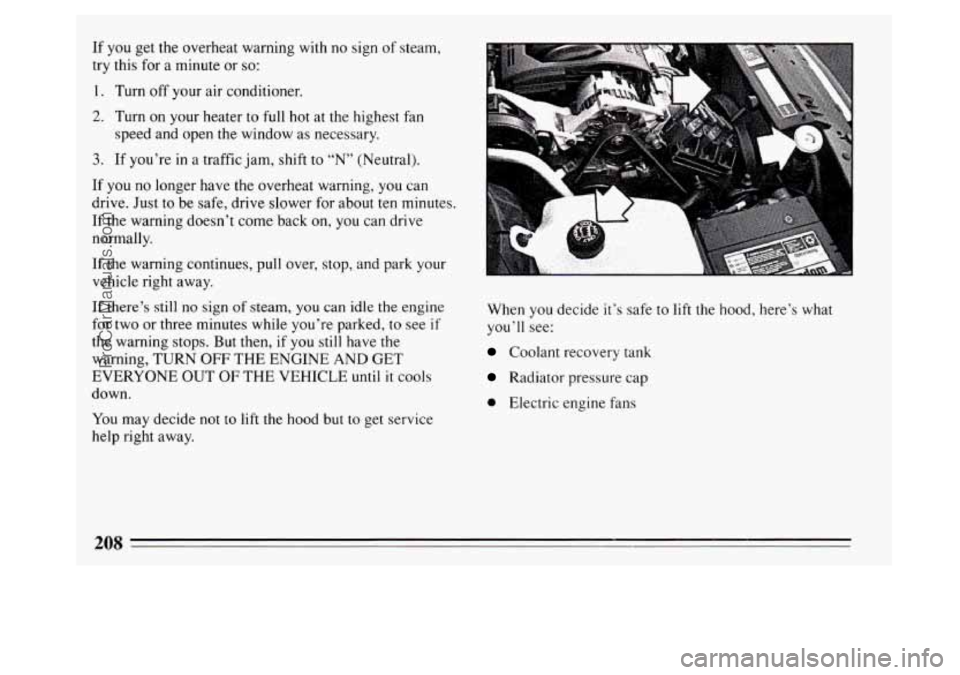
decide it’s safe to lift the hood, here’s what
you’ll see:
Coolant recovery tank
Radiator pressure cap
0 Electric engine fans
208
ProCarManuals.com
Page 238 of 324
Before closing the hood, be sure all the filler caps are on
properly. Then pull the hood down and close it firmly.
Engine Accessory Belt
A
D
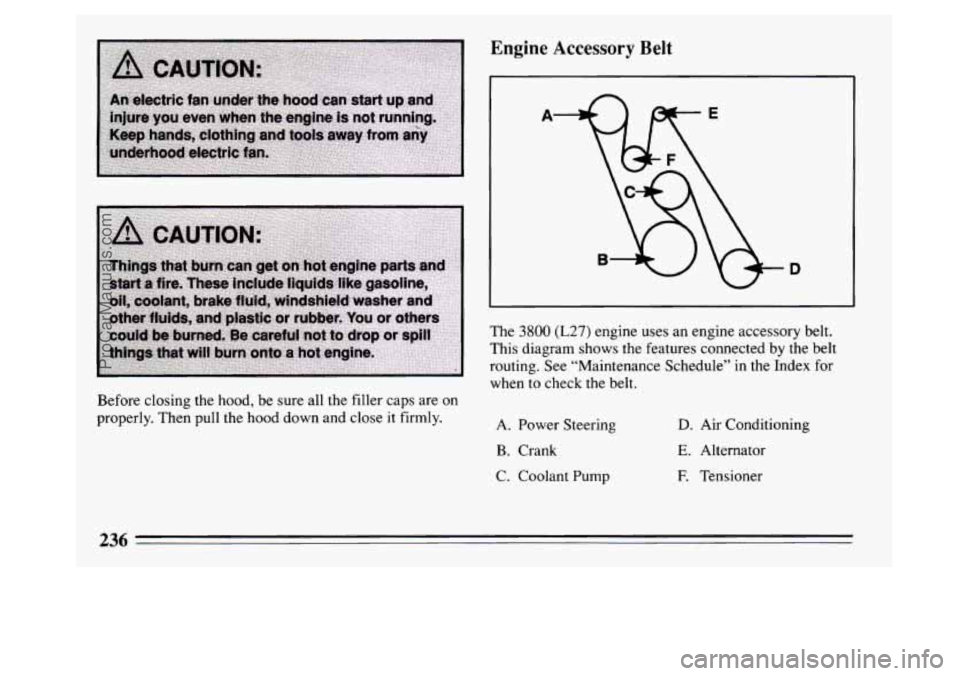
The 3800 (L27) engine uses an engine accessory belt.
This diagram shows the features connected by the belt
routing. See “Maintenance Schedule” in the Index for
when to check
the belt.
A. Power Steering
B. Crank
C. Coolant Pump
D. Air Conditioning
E. Alternator
E Tensioner
236
ProCarManuals.com
Page 239 of 324
3800 Supercharged (L67) Engine
(Option)
Your Park Avenue Ultra has a 3800 Supercharged
engine. Buick chose supercharging rather than
turbocharging because Buick emphasizes smooth,
refined power.
The Supercharger is a device which is designed to pump
more air into the engine than it would normally use.
This air mixed with fuel, creates increased engine
power. Since
the Supercharger is a pump and is driven
from an engine accessory drive belt, increased pressure
is available at all driving conditions.
The powertrain control module (PCM), works with a
vacuum control to regulate the increased pressure
required during specific driving conditions. When this
increased pressure or boost is not desired, such as during
idling and light throttle cruising, the excess air that the
Supercharger is pumping
is routed through a bypass. All
of these controls, working together provide high
performance character and
fuel efficiency in the 3800
V6 Supercharged Buick engine.
The power steering pump uses a remote reservoir
mounted on the throttle and cruise control cable bracket.
See “Maintenance Schedule’’ in
the Index for when you
should check the fluid.
Engine Accessory Belt
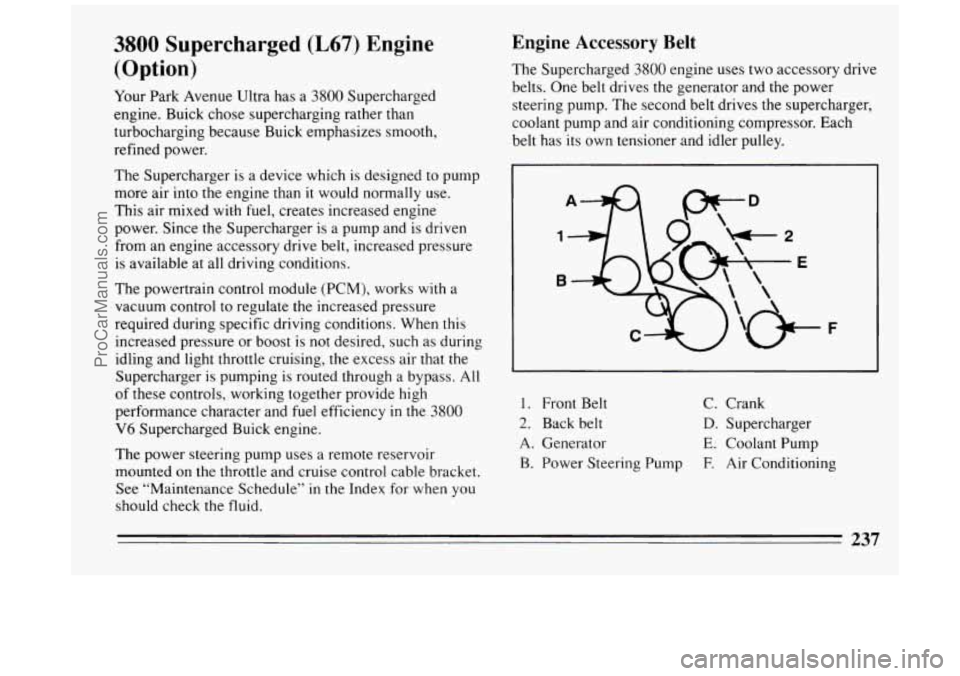
The Supercharged 3800 engine uses two accessory drive
belts. One belt drives the generator and the power
steering pump. The second belt drives the supercharger,
coolant pump and air conditioning compressor. Each
belt has its own tensioner and idler pulley.
1. Front Belt
C. Crank
2. Back belt D. Supercharger
A. Generator
E. Coolant Pump
B. Power Steering Pump E Air Conditioning
237
ProCarManuals.com
Page 256 of 324
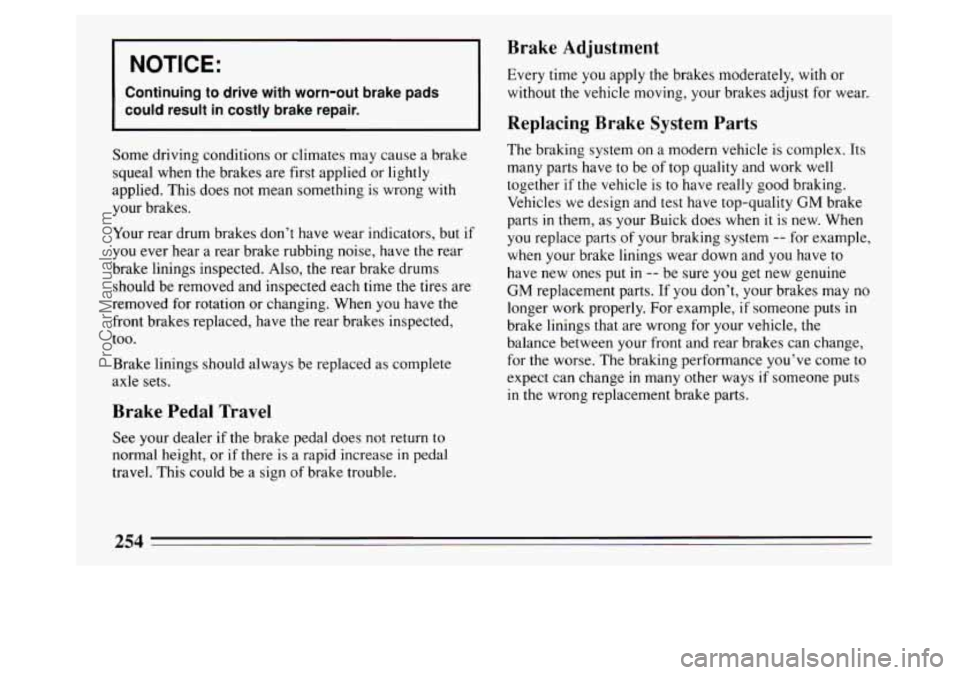
I 1 Brake Adiustment
I NOTICE:
I
Continuing to drive with worn-out brake pads
could result in costly brake repair.
- - __-- - - - -- tJ-----------
I Every time you apply the brakes moderately, with or
Some driving conditions or climates may cause a brake
squeal when the brakes are first applied or
lightly
applied. This does not mean something is wrong with
your brakes.
Your rear drum brakes don’t have wear indicators, but
if
you ever hear a rear brake rubbing noise, have the rear
brake linings inspected. Also, the rear brake drums
should be removed and inspected each time the tires are
removed for rotation or changing. When you have the
front brakes replaced, have the rear brakes inspected,
too.
Brake linings
should always be replaced as complete
axle sets.
Brake Pedal Travel
See your dealer if the brake pedal does not return to
normal height, or if there is a rapid increase
in pedal
travel. This could be a sign
of brake trouble. without the vehicle moving,
your brakes adjust for wear.
Replacing Brake System Parts
The braking system on a modern vehicle is complex. Its
many parts have to be of top quality and work well
together
if the vehicle is to have really good braking.
Vehicles we design and test have top-quality
GM brake
parts
in them, as your Buick does when it is new. When
you replace parts of your braking system
-- for example,
when your brake linings wear down and you have
to
have new ones put in -- be sure you get new genuine
GM replacement parts. If you don’t, your brakes may no
longer work properly. For example,
if someone puts in
brake linings that are wrong for your vehicle, the
balance between your front and rear brakes can change,
for the worse. The braking performance you’ve come to
expect can change
in many other ways if someone puts
in the wrong replacement brake parts.
254
ProCarManuals.com
Page 266 of 324
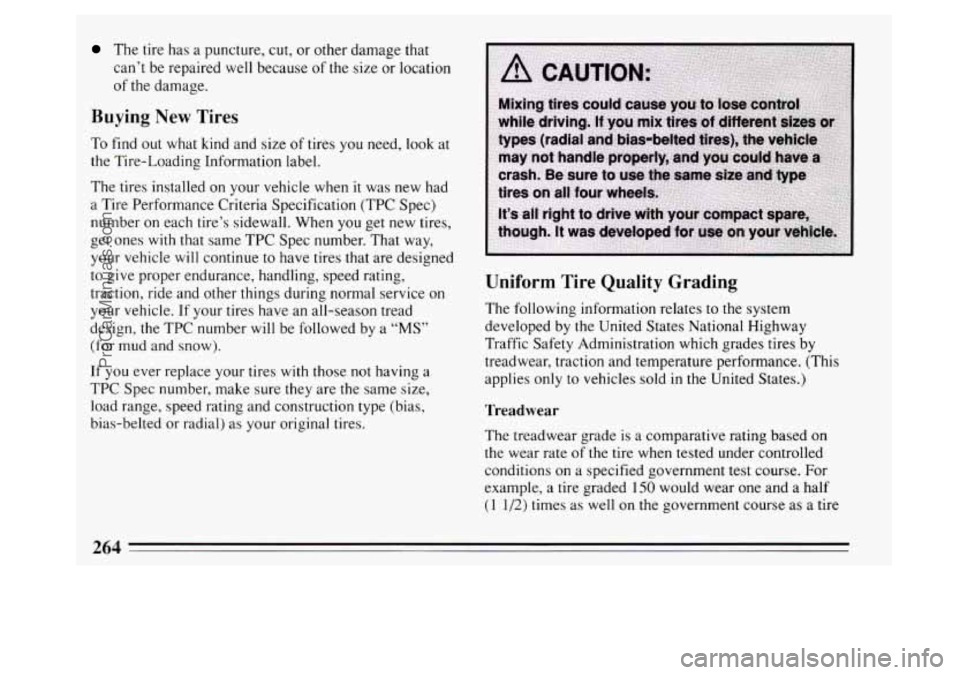
The tire has a puncture, cut, or other damage that
can’t be repaired well because
of the size or location
of the damage.
Buying New Tires
To find out what kind and size of tires you need, look at
the Tire-Loading Information label.
The tires installed on your vehicle when it was new had
a Tire Performance Criteria Specification (TPC Spec)
number on each tire’s sidewall. When you get new tires,
get ones
with that same TPC Spec number. That way,
your vehicle
will continue to have tires that are designed
to give proper endurance, handling, speed rating,
traction, ride and other things during normal service on
your vehicle. If your tires have an all-season tread
design, the TPC number
will be followed by a “MS”
(for mud and snow).
If you ever replace your tires
with those not having a
TPC Spec number, make sure they are the same size,
load range, speed rating and construction type (bias,
bias-belted or radial) as your original tires.
Uniform Tire Quality Grading
The following information relates to the system
developed by the United States National Highway
Traffic Safety Administration which grades tires by
treadwear, traction and temperature performance.
(This
applies only to vehicles sold in the United States.)
Treadwear
The treadwear grade is a comparative rating based on
the wear rate
of the tire when tested under controlled
conditions on a specified government test course. For
example, a tire graded
150 would wear one and a half
(1 1/2) times as well on the government course as a tire
264
ProCarManuals.com