alarm BUICK PARK AVENUE 1994 Owners Manual
[x] Cancel search | Manufacturer: BUICK, Model Year: 1994, Model line: PARK AVENUE, Model: BUICK PARK AVENUE 1994Pages: 324, PDF Size: 17.01 MB
Page 68 of 324
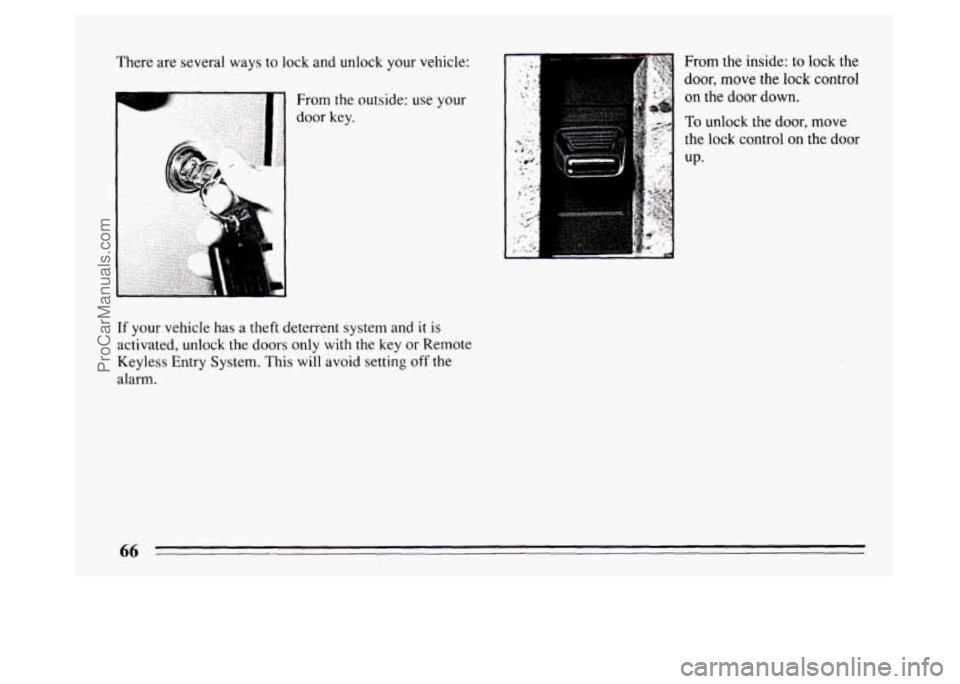
There are several ways to lock and unlock your vehicle:
From the
door key. outside:
use your
If your vehicle has a theft deterrent system and it is
activated, unlock the doors only with the key
or Remote
Keyless Entry System. This will avoid setting
off the
alarm. From
the inside: to lock the
door, move the lock control
on the door down.
To unlock the door, move
the
lock control on the door
66
ProCarManuals.com
Page 78 of 324
Parking Lots
If you park in a lot where someone will be watching
your vehicle, it’s best to lock it up and take your keys.
But what
if you have to leave your ignition key? What if
you have to leave something valuable
in your vehicle?
1. Put your valuables in a storage area, like your trunk
or glove box.
2. Lock the glove box.
3. Lock all the doors except the driver’s.
4. Then t&e the door key with you.
Universal Theft Deterrent (Option)
If your Buick has this option, it has a theft deterrent
alarm system. With this system, the “SECURITY” light
will flash as you open the door (if your ignition is
off).
This light reminds you to activate the theft deterrent
system. Here’s how to do it:
1. Open the door.
2. Lock the door with the power door lock switch or
Remote Keyless Entry System. The “SECURITY”
light should come on and stay on.
3. Close all doors. The “SECURITY” light should go
Off.
If a door or the trunk is opened without the key or
Remote Keyless Entry System; the alarm will go
off. It
will also
go off if a door lock or the trunk lock is
damaged. Your vehicle’s lights will flash and the horn
will sound for several minutes, then will go off to save
battery power.
Kemember, the theft deterrent system won’t activate
if
you lock the doors with a key or manual door lock. It
activates only if you use a power door lock switch or
Remote Keyless Entry System. You should also
remember that you can start
your vehicle with the
correct ignition key if the alarm has been set
off. You
must still shut
off the alarm by inserting the key in the
door lock.
Here’s how to avoid setting
off the alarm by accident:
1. If you don’t want to activate the theft deterrent
system, the vehicle should be locked
after the doors
are closed.
2. Always unlock a door with a key, or use the Remote
Keyless Entry System. Unlocking a
door any other
way will set
off the alarm.
ProCarManuals.com
Page 79 of 324
If you set off the alarm by accident, unlock any door
with your
key.
PASS-Key@II
You can also turn off the alarm by using the Keyless
Entry System, if
you have it. The alarm won’t stop if
you try to unlock a door any other way.
How to Test The Alarm
The alarm can be tested by first having the driver’s
window down. Activate the system by locking
the doors
with
the power door lock switch or the Remote Keyless
Entry System. Get out
of the car and close the door and
wait for the SECURITY light to go out. Then reach
in
through the window, unlock the door with the manual
door lock, and open the door. This should set off the
alarm.
If the alarm does not sound when
it should, check to see
if the horn works. The horn fuse may be blown. To
replace the
fuse, see “Fuses and Circuit Breakers” in the
Index.
To reduce the possibility of theft, always activate the
theft deterrent system when leaving your vehicle. Your
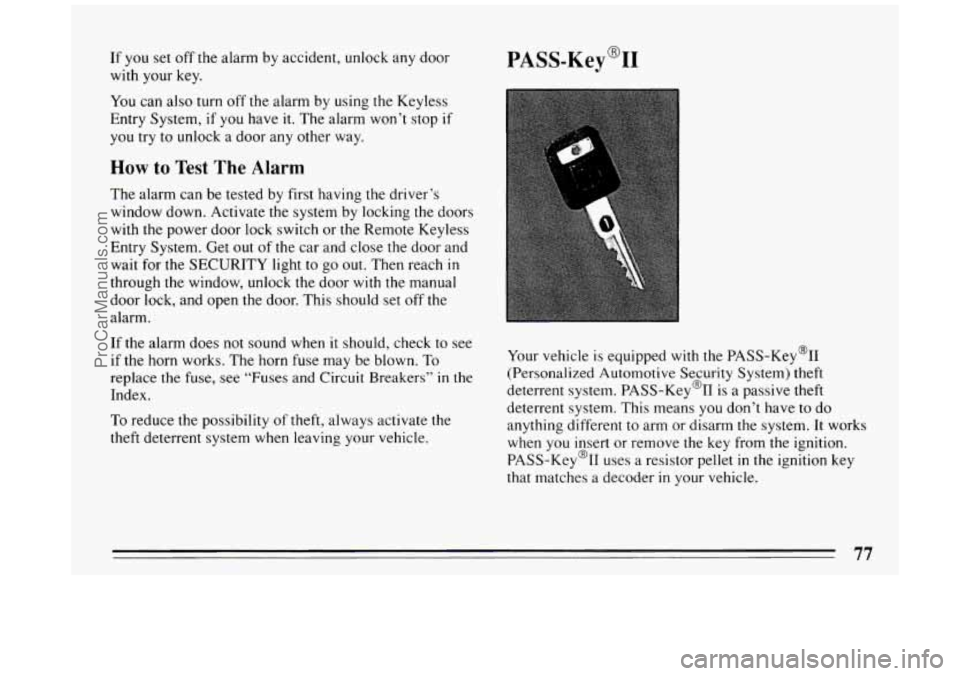
vehicle is equipped with the PASS-Key@II
(Personalized Automotive Security System) theft
deterrent system. PASS-Key%
is a passive theft
deterrent system. This means you don’t have to do
anything different
to arm or disarm the system. It works
when you insert or remove the
key from the ignition.
PASS-Key@II uses a resistor pellet in the ignition key
that matches a decoder
in your vehicle.
77
ProCarManuals.com
Page 122 of 324
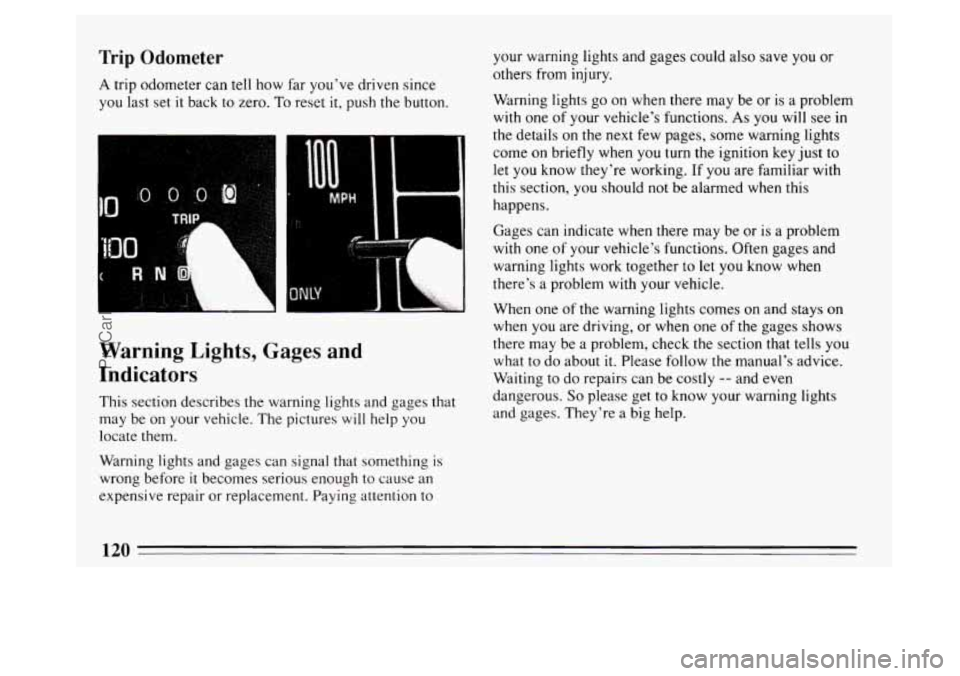
Trip Odometer
A trip odometer can tell how far you've driven since
you last set
it back to zero. To reset it, push the button.
R N ''. 7
I I ......A# L
Warning Lights, Gages and
Indicators
This section describes the warning lights and gages that
may be on your vehicle. The pictures
will help you
locate them.
Warning lights and gages can signal that something is
wrong before
it becomes serious enough to cause an
expensive repair or replacement. Paying attention to your warning lights and gages could
also save you
or
others from injury.
Warning lights
go on when there may be or is a problem
with one of your vehicle's functions. As you will see in
the details on
the next few pages, some warning lights
come on briefly when you
turn the ignition key just to
let you know they're working. If you are familiar with
this section, you
should not be alarmed when this
happens.
Gages can indicate when there may be or is a problem
with one
of your vehicle's functions. Often gages and
warning lights work together to let you know when
there's a problem
with your vehicle.
When one
of the warning lights comes on and stays on
when you are driving, or when one of the gages shows
there may be a problem, check the section that tells
you
what to do about it. Please follow the manual's advice.
Waiting to do repairs can be costly
-- and even
dangerous.
So please get to know your warning lights
and gages. They're a big help.
120
ProCarManuals.com