engine oil BUICK PARK AVENUE 1996 User Guide
[x] Cancel search | Manufacturer: BUICK, Model Year: 1996, Model line: PARK AVENUE, Model: BUICK PARK AVENUE 1996Pages: 388, PDF Size: 20.04 MB
Page 256 of 388
NOTICE:
If you need a new cap, be sure to get the right
type. Your dealer can get one for
you. If you get
the wrong type, it may not fit or have proper
venting, and your fuel tank and emissions system
might be damaged.
Checking Things Under the Hood
I
I
An electric fan under the hood can start up and
injure you even when the engine is not running.
Keep hands, clothing and tools away from
any
underhood electric fan.
I
Things that burn can get on hot engine parts and
start
a fire. These include liquids like gasoline,
oil, coolant, brake fluid, windshield washer and
other fluids, and plastic or rubber.
You or others
could be burned. Be careful not to drop or spill
things that will burn onto
a hot engine.
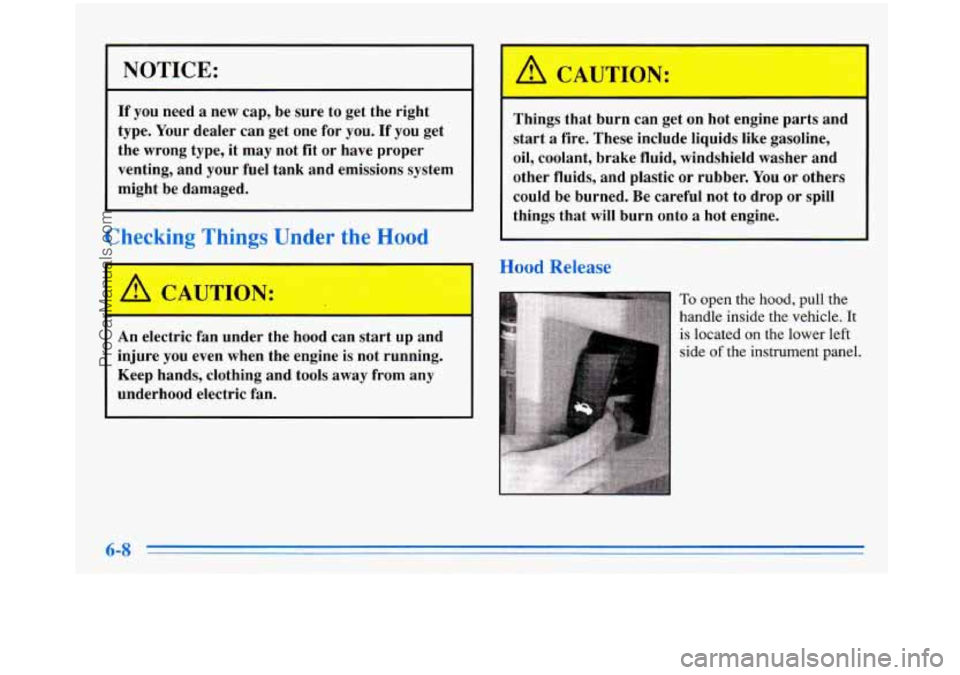
Hood Release
ProCarManuals.com
Page 258 of 388
wv DCIIC~ II [~uut: n) u~gmc (L36)
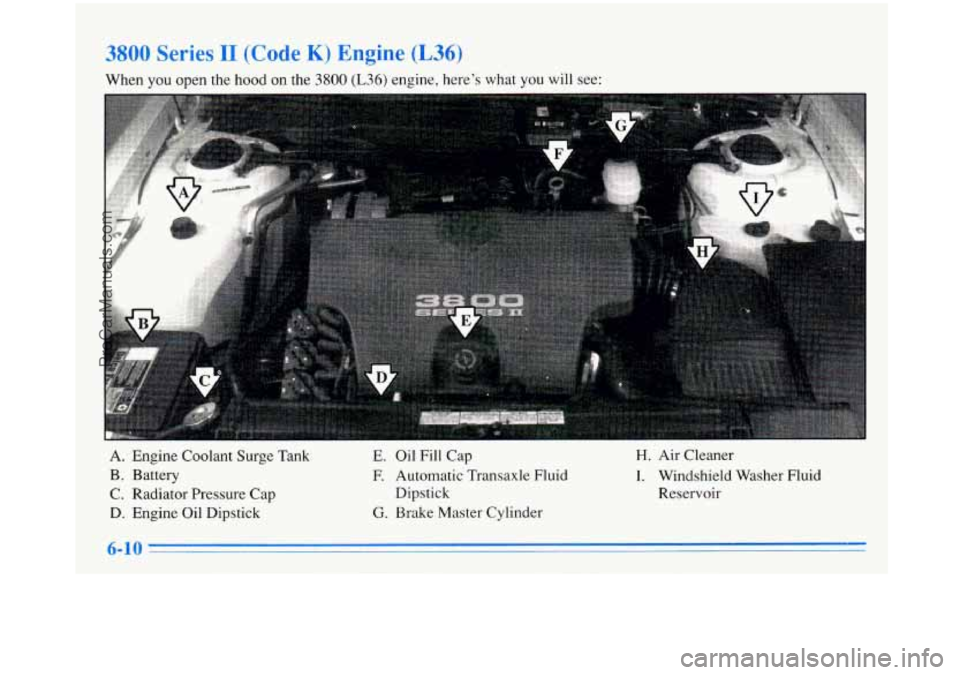
When you open the hood on the 3800 (L36) engine, here’s what you will see:
A. Engine Coolant Surge Tank
B. Battery
C. Radiator Pressure Cap
D. Engine Oil Dipstick E.
Oil
Fill Cap
E Automatic Transaxle Fluid
Dipstick
G. Brake Master Cylinder
.. ,.
H. Air Cleaner
I. Windshield Washer Fluid
Reservoir
ProCarManuals.com
Page 259 of 388
3800 Supercharged (L67) Engine (Option)
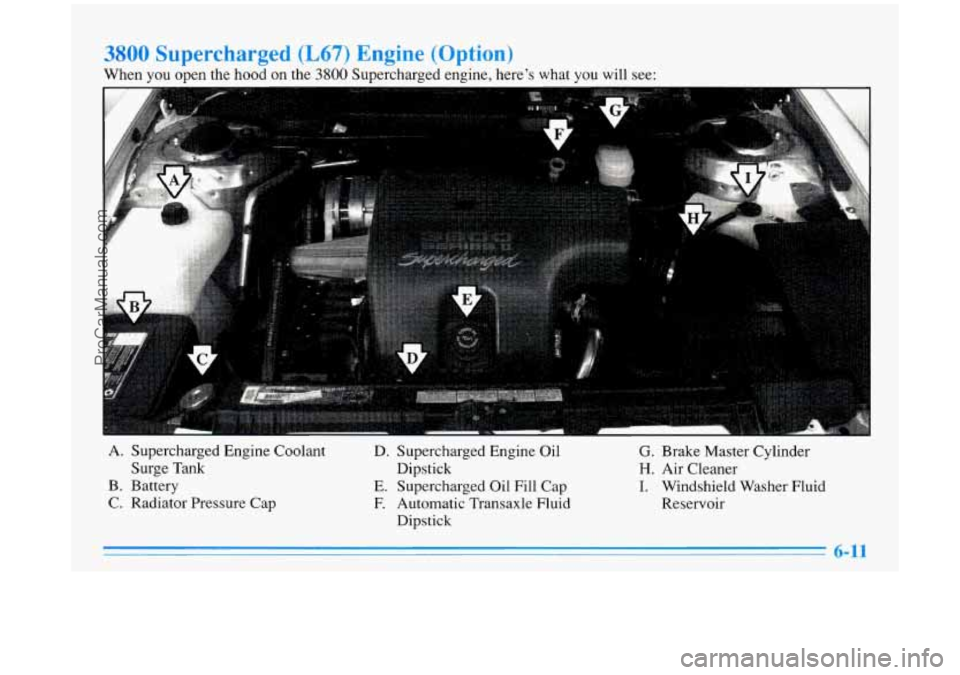
When you open the hood on the 3800 Supercharged engine, here's what you will see:
... . .
A. Supercharged Engine Coolant
B. Battery
C. Radiator Pressure Cap
Surge
Tank D. Supercharged
Engine Oil
E. Supercharged Oil Fill Cap
F. Automatic Transaxle Fluid
Dipstick
Dipstick
-.
G. Brake
Master Cylinder
H. Air Cleaner
I. Windshield Washer Fluid
Reservoir
6-11
ProCarManuals.com
Page 260 of 388
Your Park Avenue Ultra has a 3800 Supercharged
engine. Buick chose supercharging rather than
turbocharging because Buick emphasizes smooth,
refined power.
The supercharger
is a device which is designed to pump
more air into the engine than it would normally use.
This air mixed with fuel creates increased engine power.
Since the supercharger is a pump and is driven from an
engine accessory drive belt, increased pressure is available at all driving conditions.
The Powertrain Control Module (PCM) works with a
vacuum control to regulate the increased pressure
required during specific driving conditions. When this increased pressure or boost is not desired, such as during
idling and light throttle cruising, the excess air that the
supercharger is pumping is routed through a bypass. All
of these controls working together provide high
performance character and fuel efficiency in the
3800 V6 Supercharged Buick engine.
The power steering pump and reservoir are mounted
on the rear (driver’s side)
of the engine block. See
“Maintenance Schedule” in the Index for when you
should check the fluid.
Engine Oil
If the CHECK OIL
LEVEL light on the
instrument panel
comes on, it means
CHECK OIL you need to check
LEVEL your engine oil level
right away.
For more information, see “Check Oil Level Light” in
the Index. You should check your engine oil level
regularly; this is an added reminder.
ProCarManuals.com
Page 261 of 388
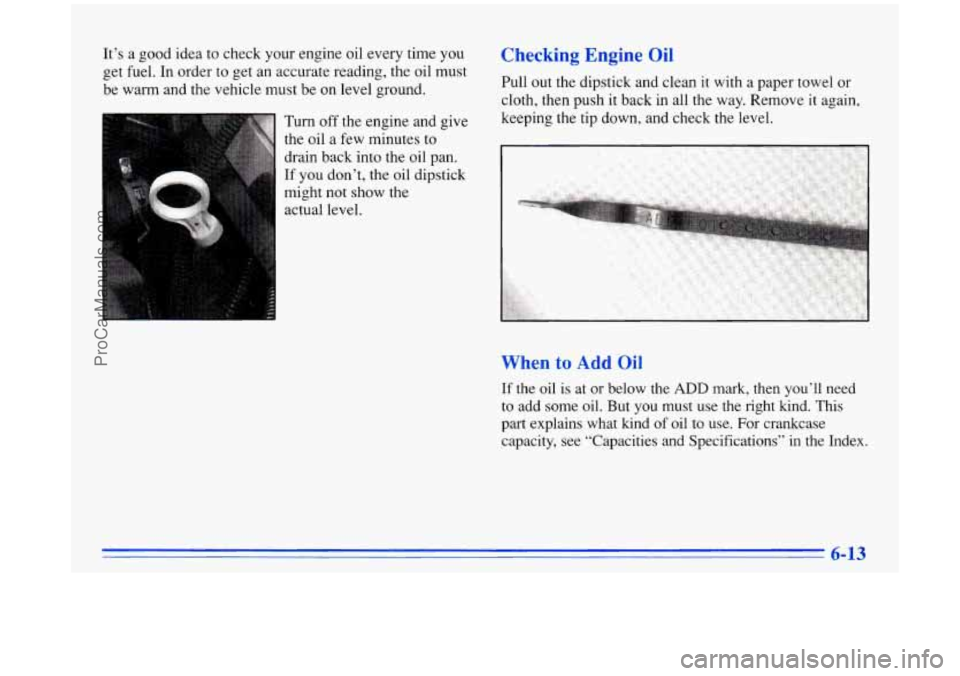
It’s a good idea to check your engine oil every time you
get fuel. In order to get an accurate reading, the oil must
be warm and the vehicle must be on level ground.
Turn off the engine and give
the oil a few minutes to
drain back into the oil pan.
If you don’t, the oil dipstick
might not show the
actual level.
Checking Engine Oil
Pull out the dipstick and clean it with a paper towel or
cloth, then push it back in all the way. Remove it again,
keeping the tip down, and check
the level.
When to Add Oil
If the oil is at or below the ADD mark, then you’ll need
to add some oil. But you must use
the right kind. This
part explains what kind of oil
to use. For crankcase
capacity, see “Capacities and Specifications” in the Index.\
ProCarManuals.com
Page 262 of 388
NOTICE:
I
Don’t add too much oil. If your engine has so
much oil that the oil level gets above the
cross-hatched area that shows the proper operating range, your engine could be damaged.
Add engine oil at the engine oil fill cap next to the
oil dipstick.
Just fill it enough to put the level somewhere in the
proper operating range. Push the dipstick all the way
back in when you’re through.
What Kind of Oil to Use
Oils recommended for your vehicle can be identified by
looking for the “Starburst” symbol. This symbol
indicates that the oil has been certified by the American
Petroleum Institute (API).
Do not use any oil which
does not carry this Starburst symbol.
If you change your
own oil, be sure you
use oil that has the
Starburst symbol on
the front of the oil
container.
If you have
your oil changed
for
you, be sure the oil put
into your engine is
American Petroleum
Institute certified for
gasoline engines.
You should also use the proper viscosity oil for your
vehicle, as shown in the following chart:
ProCarManuals.com
Page 263 of 388
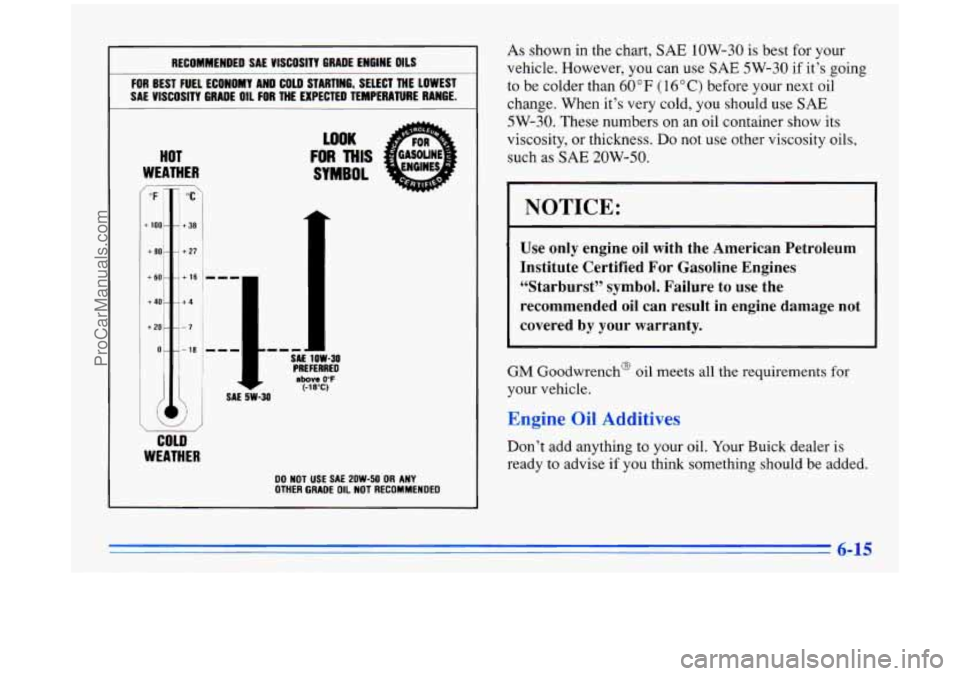
As shown in the chart, SAE 1OW-30 is best for your
vehicle. However, you can use
SAE 5W-30 if it’s going
to be colder than
60°F (1 6°C) before your next oil
change. When it’s very cold, you should use
SAE
5W-30. These numbers on an oil container show its
viscosity, or thickness.
Do not use other viscosity oils,
such as
SAE 20W-50.
RECOMMENDED SAE VISCOSITY GRADE ENGINE OILS
FOR BEST FUEL ECONOMY AND COLD STARTING, SELECT THE LOWEST
SAL VISCOSITY GRADE
OIL FOR THE EXPECTED TEMPERATURE RANGE.
HOT
WEATHER SYMBOL
- OF i
tlOOr
+80-
+ 60-
+40-
+ 20 -
0-
’ I +38 OC
i +27
j
I NOTICE:
6E I 1OW-30
PREFERRED above 0°F (-1nOcl
Use only engine oil with the American Petroleum
Institute Certified For Gasoline Engines
“Starburst” symbol. Failure to use the
recommended oil can result in engine damage not
covered
by your warranty.
+4
-7
- 18 I-
GM Goodwrench@ oil meets all the requirements for
your vehicle.
SAE 5W-30 , -- -,
7n.gine Oil __. W
COLD Don’t add anything to your oil. Your Buick dealer is
ready
to advise if you think something should be added. WEATHER
DO NOT USE SA€ 2OW-50 OR ANY OTHER GRADE OIL NOT RECOMMENDED
0-15
ProCarManuals.com
Page 264 of 388
When to Change Engine Oil
See if any one of these is true for you:
0
Most trips are less than 5 to 10 miles (8 to 16 km).
This is particularly important when outside
temperatures are below freezing.
Most trips include extensive idling (such as frequent
driving in stop-and-go traffic).
Most trips are through dusty areas.
You frequently tow a trailer or use a carrier on top of
your vehicle.
The vehicle is used for delivery service, police, taxi
or other commercial application.
Driving under these conditions causes engine oil to
break down sooner.
If any one of these is true for your
vehicle, then you need to change your oil and filter
every
3,000 miles (5 000 km) or 3 months -- whichever
occurs first. (See “Change Oil Soon” in the Index.)
If none of them is true, change the oil and filter every
7,500 miles (12 500 km) or 12 months -- whichever
occurs first. Driving a vehicle with a fully warmed
engine under highway conditions causes engine oil to
break down slower.
If the optional CHANGE OIL SOON light comes on,
you will need to change your oil sooner than either
mileage specified. Depending upon driving habits, the
CHANGE OJL SOON light may come on as early as
2,000 miles
or less from the last time the oil life monitor
was reset. (See “Oil Life Monitor” in the Index.)
Always
reset the
oil life monitor after every oil change.
What to Do with Used Oil
Did you know that used engine oil contains certain
elements that may be unhealthy for your skin and could
even cause cancer? Don’t let used oil stay on your skin
for very long. Clean your skin and nails with soap and
water, or a good hand cleaner. Wash or properly throw
away clothing or rags containing used engine oil. (See
the manufacturer’s warnings about the use and disposal
of oil products.)
Used oil can be a real threat to the environment.
If you
change your own oil, be sure
to drain all free-flowing oil
from the filter before disposal. Don’t ever dispose of oil
by putting it in the trash, pouring it on
the ground, into
sewers, or into streams or bodies of water. Instead,
recycle it by taking
it to a place that collects used oil. If
you have a problem properly disposing of your used oil,
ask your dealer, a service station or a local recycling
center for help.
ProCarManuals.com
Page 267 of 388
1 Supercharger Oil
Operati--; the engine with the air cleaner off can
cause you or others to be burned. The air cleaner
not only cleans the air, it stops flame if the engine
backfires.
If it isn’t there, and the engine
backfires, you could be burned. Don’t drive with it off, and be careful working on the engine with
the air cleaner
off.
NOTICE:
If the air cleaner is off, a backfire can cause a
damaging engine fire. And, dirt can easily get
into your engine, which will damage it. Always
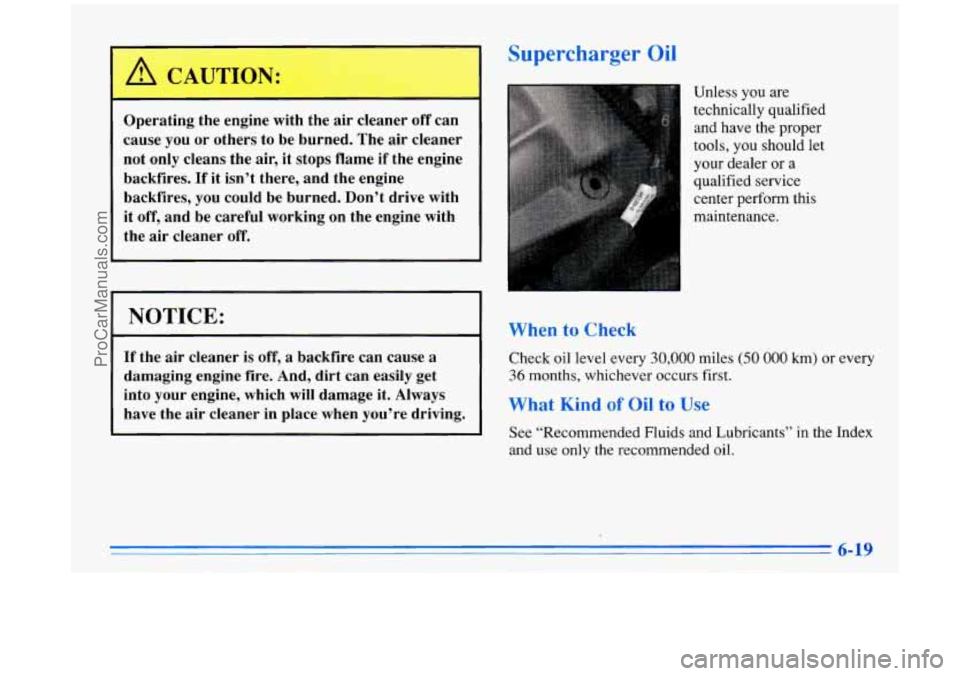
have the air cleaner in place when you’re driving. Unless you
are
technically qualified
and have the proper
tools, you should let
your dealer or a
qualified service
center perform
this
maintenance.
When to Check
Check oil level every 30,000 miles (50 000 km) or every
36 months, whichever occurs first.
What Kind of Oil to Use
See “Recommended Fluids and Lubricants’’ in the Index
and use only the recommended oil.
- 6-19
ProCarManuals.com
Page 268 of 388
How to Check and Add Oil
Check oil only when the engine is cold. Allow the
engine to cool two to three hours after running.
r
I
If you remove the supercharger oil fill plug while
the engine is hot, pressure may cause hot oil to
blow out of the oil fill hole. You may be burned.
Do not remove the plug until the engine cools.
1. Remove the wiring harness shield.
2. Clean the area around the oil fill plug before
removing
it.
3. Remove the oil fill plug using a 3/16 Allen wrench.
4. The oil level is correct when it just reaches the
bottom
of the threads of the inspection hole.
5. Replace the oil plug with the O-ring in place. Torque
to
88 lb-in (10 N-m).
6. Replace wiring harness shield.
Automatic Transaxle Fluid
When to Check and Change
A good time to check your automatic transaxle fluid
level is when the engine oil is changed.
Change both the fluid and filter every
50,000 miles
(83 000 km) if the vehicle is mainly driven under one or
more
of these conditions:
0 In heavy city traffic where the outside temperature
regularly reaches
90 OF (32 O C) or higher.
0 In hilly or mountainous terrain.
0 When doing frequent trailer towing.
Uses such as found in taxi, police or delivery service.
If you do not use your vehicle under any of these
conditions, the fluid and filter do not require changing.
See “Scheduled Maintenance Services” in the
Index.
ProCarManuals.com