engine oil BUICK PARK AVENUE 1996 Owner's Manual
[x] Cancel search | Manufacturer: BUICK, Model Year: 1996, Model line: PARK AVENUE, Model: BUICK PARK AVENUE 1996Pages: 388, PDF Size: 20.04 MB
Page 271 of 388
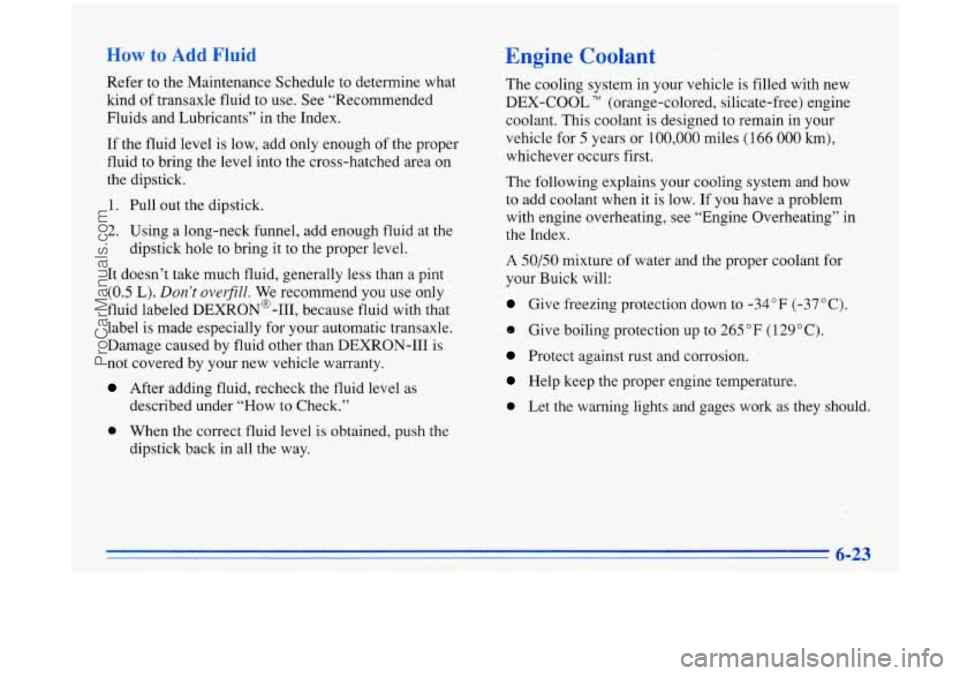
How to Add Fluid
Refer to the Maintenance Schedule to determine what
kind of transaxle fluid to use. See “Recommended
Fluids and Lubricants” in the Index.
If the fluid level is low, add only enough
of the proper
fluid to bring the level into the cross-hatched area on
the dipstick.
1. Pull out the dipstick.
2. Using a long-neck funnel, add enough fluid at the
It doesn’t take much fluid, generally less than a pint
(0.5 L). Don’t ovel-fill. We recommend you use only
fluid labeled DEXRON@-111, because fluid with that
label is made especially for your automatic transaxle.
Damage caused by fluid other than DEXRON-I11 is
not covered by your new vehicle warranty.
dipstick hole to
bring it to the proper level.
After adding fluid, recheck the fluid level as
described under “How to Check.”
0 When the correct fluid level is obtained, push the
dipstick back in all the way.
Engine Coolant
The cooling system in your vehicle is filled with new
DEX-COOL
TM (orange-colored, silicate-free) engine
coolant. This coolant is designed to remain in your
vehicle for
5 years or 100,000 miles (166 000 km),
whichever occurs first.
The following explains your cooling system and how
to add coolant when
it is low. If you have a problem
with engine overheating, see “Engine Overheating” in
the Index.
A 50/50 mixture of water and the proper coolant for
your Buick will:
Give freezing protection down to -34°F (-37°C).
9 Give boiling protection up to 265 OF ( 129 O C).
Protect against rust and corrosion.
Help keep the proper engine temperature.
0 Let the warning lights and gages work as they should.
ProCarManuals.com
Page 273 of 388
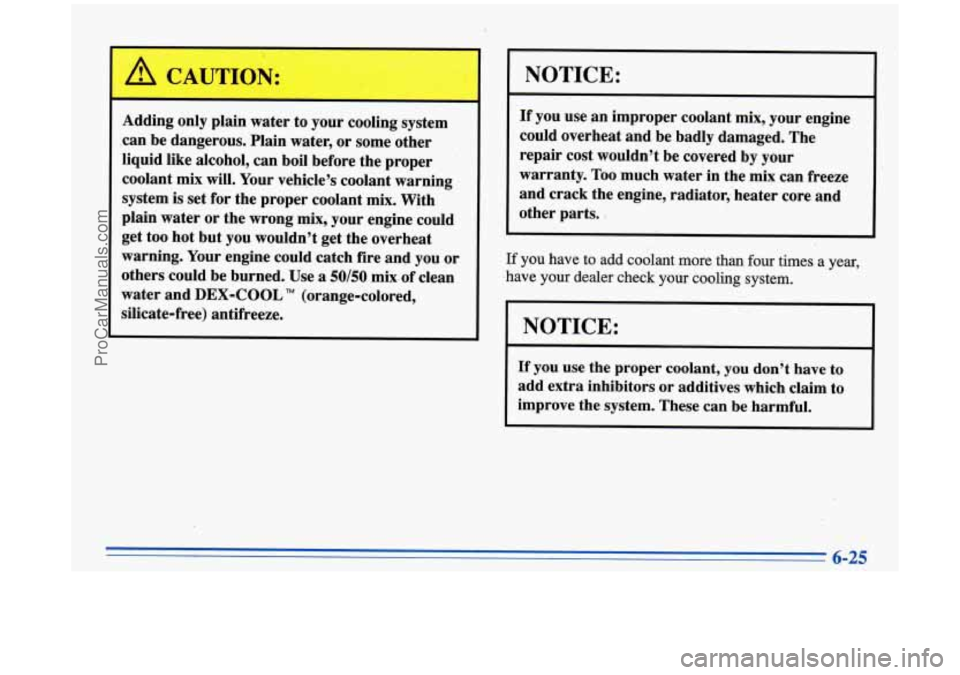
‘ A CAUTICY:
Adding only plain water to your cooling system
,can be dangerous. Plain water, or some other
liquid like alcohol, can boil before the proper
coolant mix will. Your vehi.cle’s coolant warning
system
is set for the proper coolant mix. With
plain water or the wrong mix, your engine could
get too hot but you wouldn’t get the overheat
warning. Your engine could catch fire
and you or
others could be burned. Use a
50150 mix-of clean
water and
DEX-COOL (orange-colored,
silicate-free) antifreeze.
-
NOTICE:
If you use .an improper coolant mix, your engine
could overheat and be badly damaged. The
repair cost wouldn’t be covered
by your
warranty.
Too much water in the mix can freeze
and crack the engine, radiator, heater core and
other parts.
If you have to add coolant more than four times a year,
have your dealer check your cooling system.
~~
NOTICE:
If you use the proper coolant, you don’t have to
add extra inhibitors or additives which claim to
improve the system. These can be harmful.
6-25
ProCarManuals.com
Page 279 of 388
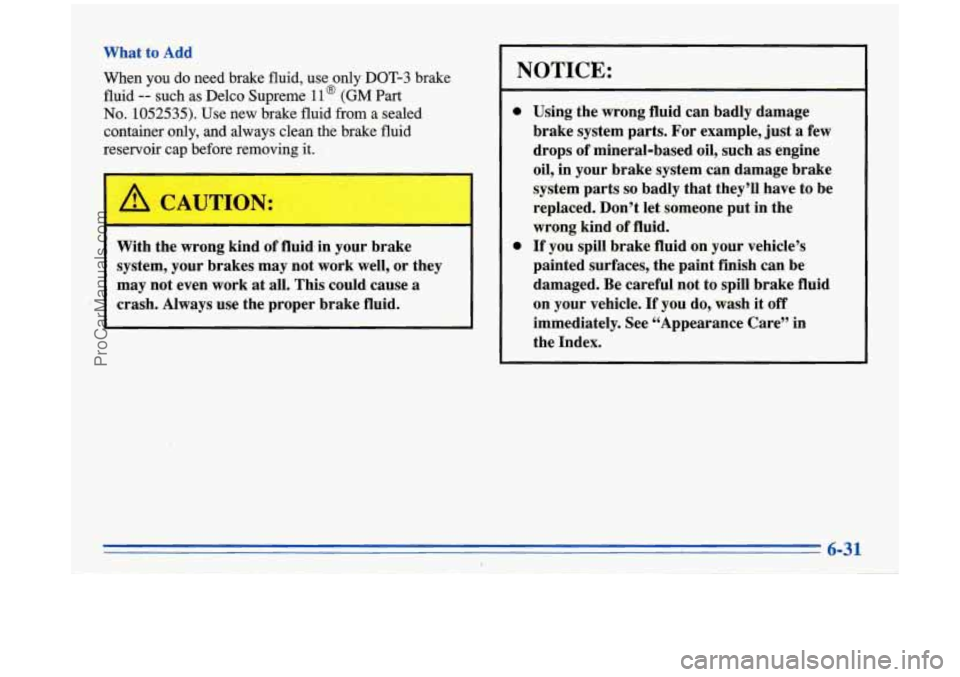
What to Add When you do need brake fluid, use only
DOT-3 brake
fluid
-- such as Delco Supreme 11 @ (GM Part
No. 1052535). Use new brake fluid from a sealed
container only, and always clean
the brake fluid
reservoir cap before removing
it.
A CAU”’3N:
With the wrong kind of‘fluid.in your brake
system, your brakes may not work well, or they
may not even work at all. This could cause
a
crash. Always use the proper brake fluid.
I NOTICE:
0
I
0
Using the wrong fluid can badly damage
brake system parts. For example, just
a few
drops of mineral-based oil, such as engine
oil, in your brake system can damage brake
system parts
so badly that they’ll have to be
replaced. Don’t let someone put in the
wrong kind of fluid.
If you spill brake fluid on your vehicle’s
painted surfaces, the paint finish can be damaged. Be careful not to spill brake fluid
on your vehicle.
If you do, wash it off
immediately. See “Appearance Care” in
the Index.
I 6-31
ProCarManuals.com
Page 312 of 388
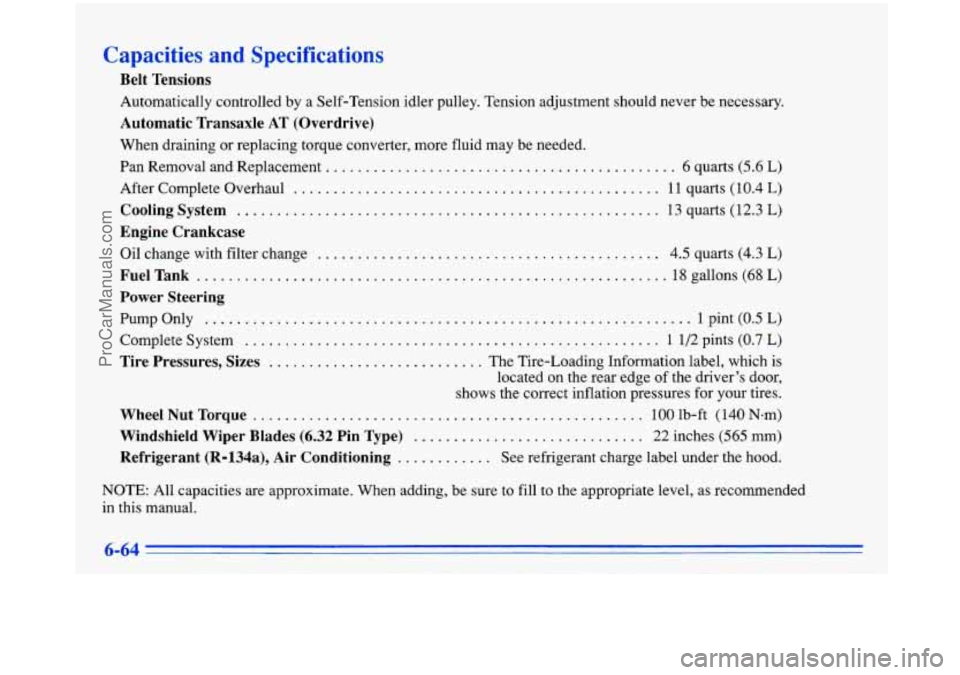
Capacities and Specifications
Belt Tensions
Automatically controlled by a Self-Tension idler pulley. Tension adjustment should never be necessary.
Automatic Transaxle AT (Overdrive)
When draining or replacing torque converter, more fluid may be needed.
Pan Removal and Replacement
............................................ 6 quarts (5.6 L)
After Complete Overhaul .............................................. 11 quarts (1 0.4 L)
Cooling System ..................................................... 13 quarts (12.3 L)
Oil change with filter change ........................................... 4.5 quarts (4.3 L)
Engine Crankcase
FuelTank
........................................................... 18gallons(68L)
Power Steering
Pump Only ............................................................. 1 pint (0.5 L)
Complete System .................................................... 1 1/2 pints (0.7 L)
Tire Pressures, Sizes ........................... The Tire-Loading Information label, which is
located on the rear edge of the driver’s door,
shows the correct inflation pressures for your tires.
Wheel Nut Torque ................................................. 100 lb-ft (140 N-rn)
Windshield Wiper Blades (6.32 Pin Type) ............................. 22 inches (565 mm)
Refrigerant (R=134a), Air Conditioning ............ See refrigerant charge label under the hood.
NOTE: All capacities are approximate. When adding, be sure to fill to the appropriate level, as recommended
in this manual.
6-64
ProCarManuals.com
Page 314 of 388
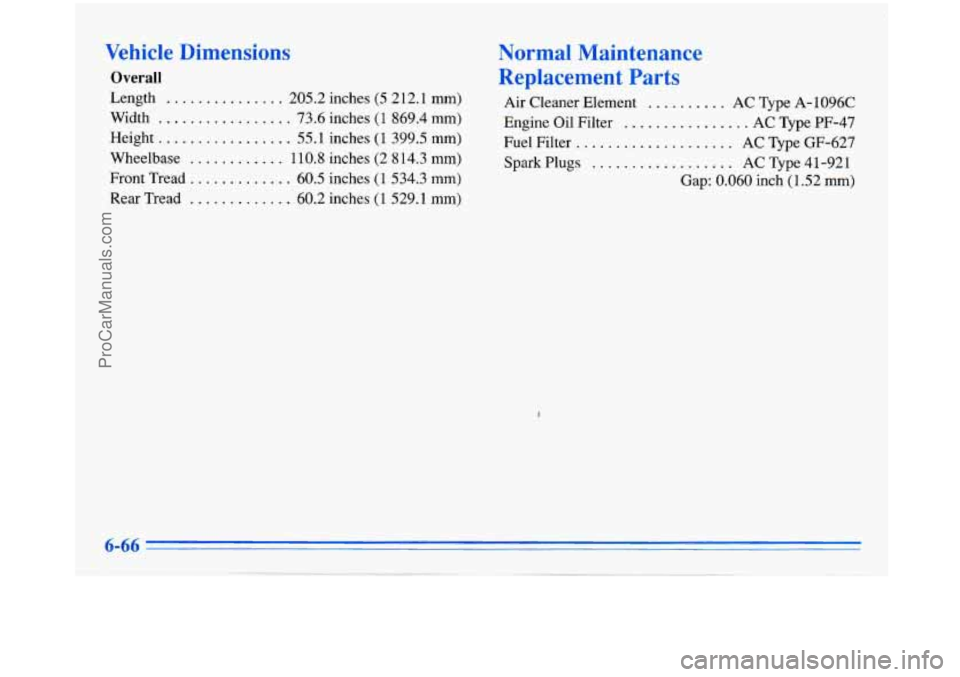
Vehicle Dimensions
Overall
Length ............... 205.2 inches (5 2 12.1 mm)
Width
................. 73.6 inches (1 869.4 mm)
Height
................. 55.1 inches (1 399.5 mm)
Wheelbase
............ 110.8 inches (2 8 14.3 mm)
Front Tread
............. 60.5 inches (1 534.3 mm)
Rear Tread
............. 60.2 inches (1 529.1 mm)
Normal Maintenance
Replacement Parts
Air Cleaner Element .......... AC Type A- 1096C
Engine Oil Filter
................ AC Type PF-47
Fuel Filter
.................... AC Type GF-627
Spark Plugs
.................. AC Type 41-921
Gap:
0.060 inch (1.52 mm)
6-66
ProCarManuals.com
Page 316 of 388
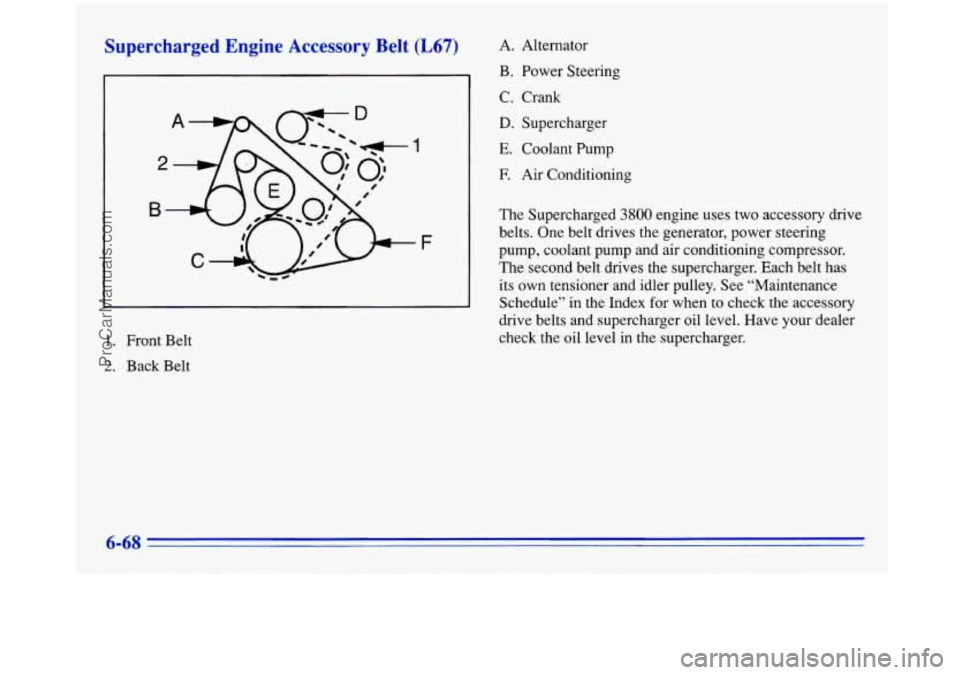
mharged Engine Accessory Belt (L67)
F
1. Front Belt
2. Back Belt A.
B.
C.
D.
E.
E
Alternator
Power Steering
Crank
Supercharger
Coolant Pump
Air Conditioning
The Supercharged
3800 engine uses two accessory drive
belts. One belt drives the generator, power steering
pump, coolant pump and air conditioning compressor.
The second belt drives the supercharger. Each belt has
its own tensioner and idler pulley. See “Maintenance
Schedule” in the Index for when
to check the accessory
drive belts and supercharger oil level. Have your dealer
check the
oil level in the supercharger.
6-68
ProCarManuals.com
Page 319 of 388
Section 7 Maintenance Schedule
~ IMPORTANT: I
KEEP ENGINE OIL
~ AT THE PROPER I
LEVEL AND CHANGE AS
RECOMMENDED
I
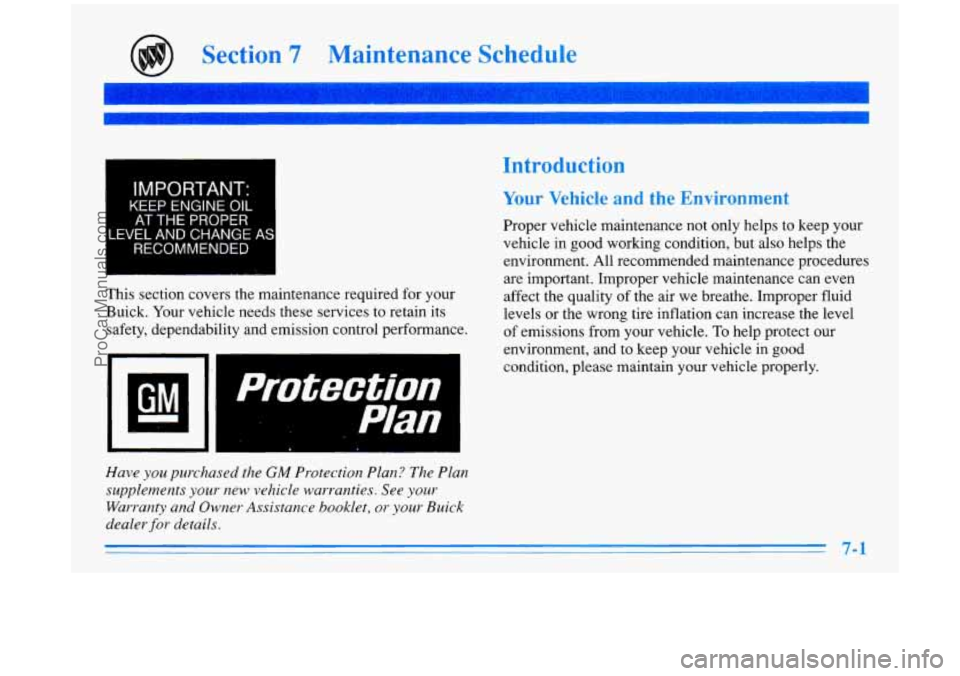
This section covers the maintenance required for your
Buick. Your vehicle needs these services to retain its
safety, dependability and emission control performance.
Protection
Plan
Introduction
Your Vehicle and the Environment
Proper vehicle maintenance not only helps to keep your
vehicle in
good working condition, but also helps the
environment. All recommended maintenance procedures
are important. Improper vehicle maintenance can even
affect the quality
of the air we breathe. Improper fluid
levels or the wrong tire inflation can increase the level
of emissions from your vehicle.
To help protect our
environment, and to keep your vehicle in
good
condition, please maintain your vehicle properly.
Have you purchased the GM Protection Plan? The Plan
supplements your new vehicle warranties. See
your
Warranty and Owner Assistance booklet, or your Buick
dealer
for details.
7-1
ProCarManuals.com
Page 322 of 388
Maintenance Schedule
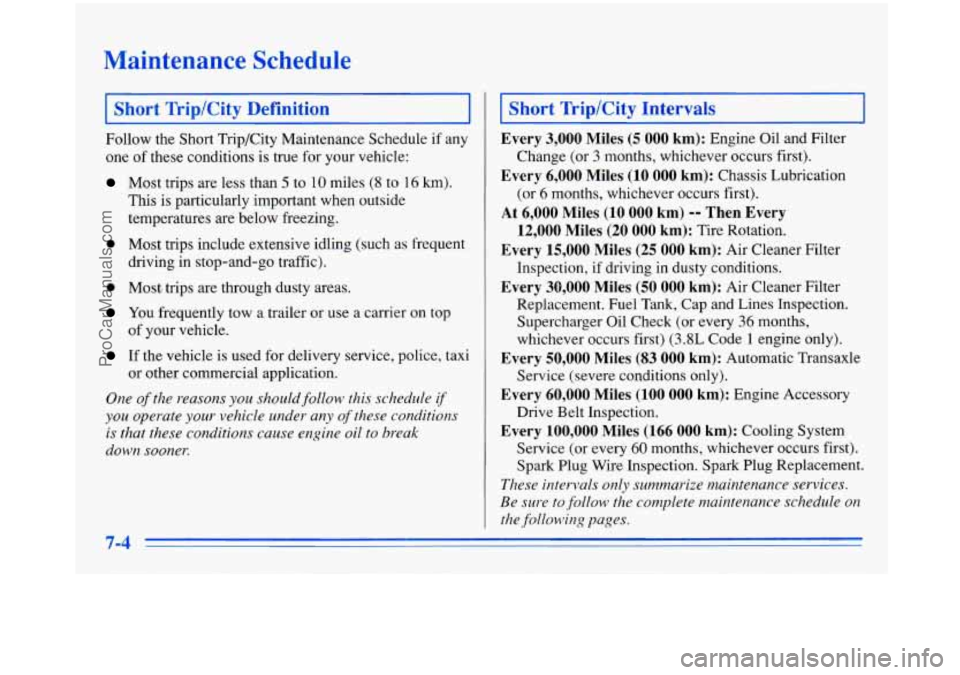
I Short Trip/City Definition
Follow the Short Trip/City Maintenance Schedule if any
one of these conditions is true for your vehicle:
Most trips are less than 5 to 10 miles (8 to 16 km).
This is particularly important when outside
temperatures are below freezing.
0 Most trips include extensive idling (such as frequent
driving in stop-and-go traffic).
0 Most. trips are through dusty areas.
You frequently tow a trailer or use a carrier on top
of your vehicle.
If the vehicle is used for delivery service, police, taxi
or other commercial application.
One of the reasons you should follow this schedule if
you operate your vehicle under any of these conditions
is that these conditions cause engine oil to break
down soonel:
Short Trip/City Intervals
Every 3,000 Miles (5 000 km): Engine Oil and Filter
Change (or
3 months, whichever occurs first).
Every 6,000 Miles (10 000 km): Chassis Lubrication
(or 6 months, whichever occurs first).
At 6,000 Miles (10 000 km) -- Then Every
12,000 Miles (20
000 km): Tire Rotation.
Every 15,000 Miles (25 000 km): Air Cleaner Filter
Inspection, if driving in dusty conditions.
Every 30,000 Miles (50 000 km): Air Cleaner Filter
Replacement. Fuel Tank, Cap and Lines Inspection.
Supercharger Oil Check
(or every 36 months,
whichever occurs first) (3.8L Code
1 engine only).
Every 50,000 Miles (83 000 km): Automatic Transaxle
Service (severe conditions only).
Every 60,000 Miles (100 000 km): Engine Accessory
Drive Belt Inspection.
Every 100,000 Miles (166 000 km): Cooling System
Service (or every
60 months, whichever occurs first).
Spark Plug Wire Inspection. Spark Plug Replacement.
These intervals only summarize maintenance services.
Be sure to.follow the complete m.aintenance schedule on
the
ProCarManuals.com
Page 323 of 388
Maintenance Schedule
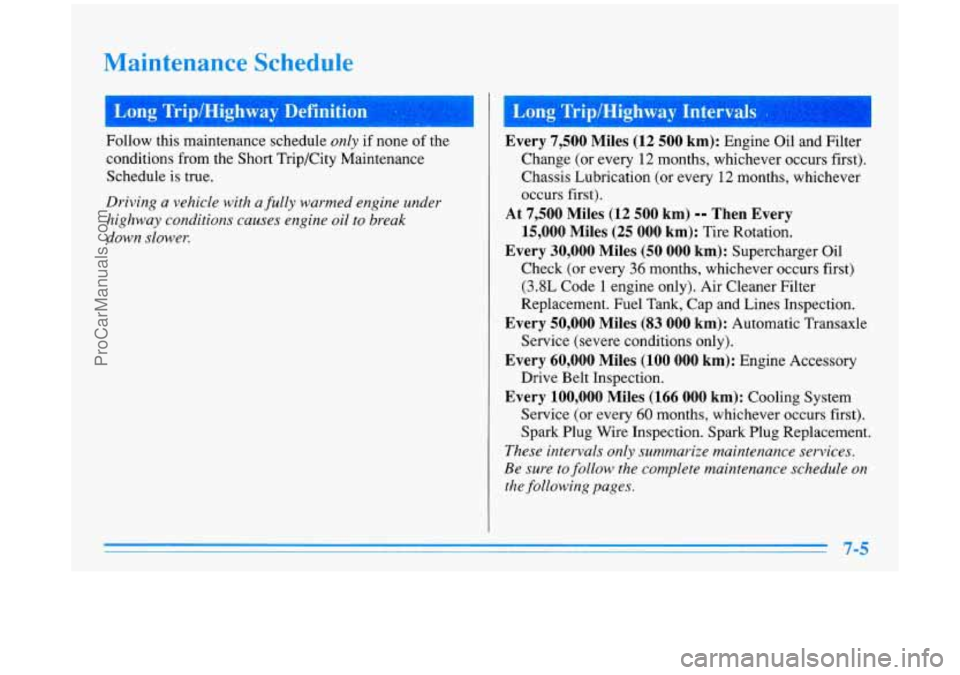
Long Trip/Highway Intervals
Follow this maintenance schedule only if none of th,
conditions from the Short Trip/City Maintenance
Schedule
is true.
Driving a vehicle with a fully warmed engine under
highway conditions causes engine
oil to break
down slower.
dvery 7,500 Miles (12 500 h): Engine Oil and Filter
Change (or every
12 months, whichever occurs first).
Chassis Lubrication (or every
12 months, whichever
occurs first).
At 7,500 Miles (12 500 km) -- Then Every
15,000 Miles (25
000 km): Tire Rotation.
Every 30,000 Miles (50 000 km): Supercharger Oil
Check (or every
36 months, whichever occurs first)
(3.8L Code
1 engine only). Air Cleaner Filter
Replacement. Fuel Tank, Cap and Lines Inspection.
Every 50,000 Miles (83 000 km): Automatic Transaxle
Service (severe conditions only).
Every 60,000 Miles (100 000 km): Engine Accessory
Drive Belt Inspection.
Every 100,000 Miles (166 000 km): Cooling System
Service (or every
60 months, whichever occurs first).
Spark Plug Wire Inspection. Spark Plug Replacement.
These intervals only summarize maintenance services.
Be sure to follow the complete maintenance schedule on
the following pages.
7-5
ProCarManuals.com
Page 324 of 388
I Short Trip/City Maintenance Schedule I
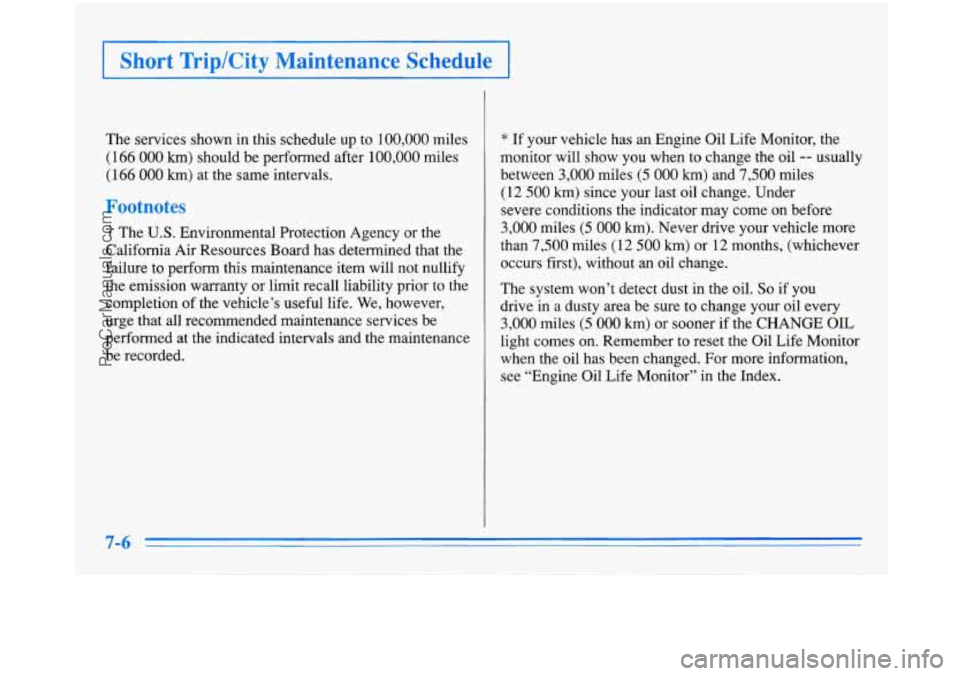
The services shown in this schedule up to 100,000 miles
(166
000 km) should be performed after 100,000 miles
(166
000 km) at the same intervals.
Footnotes
The U.S. Environmental Protection Agency or the
California Air Resources Board has determined that the
failure to perform this maintenance item will not nullify
the emission warranty or limit recall liability prior to the
completion
of the vehicle’s useful life. We, however,
urge that all recommended maintenance services be
performed at the indicated intervals and the maintenance
be recorded.
* If your vehicle has an Engine Oil Life Monitor, the
monitor will show you when
to change the oil -- usually
between
3,000 miles (5 000 km) and 7,500 miles
(1 2 500 km) since your last oil change. Under
severe conditions the indicator may come on before
3,000 miles (5 000 km). Never drive your vehicle more
than
7,500 miles (12 500 km) or 12 months, (whichever
occurs first), without an oil change.
The system won’t detect dust in the oil.
So if you
drive in
a dusty area be sure to change your oil every
3,000 miles (5 000 km) or sooner if the CHANGE OIL
light comes on. Remember to reset the Oil Life Monitor
when the oil has been changed. For more information,
see “Engine Oil Life Monitor” in the Index.
7-6
ProCarManuals.com