lights BUICK PARK AVENUE 1996 User Guide
[x] Cancel search | Manufacturer: BUICK, Model Year: 1996, Model line: PARK AVENUE, Model: BUICK PARK AVENUE 1996Pages: 388, PDF Size: 20.04 MB
Page 126 of 388
Air Bag Readiness Light
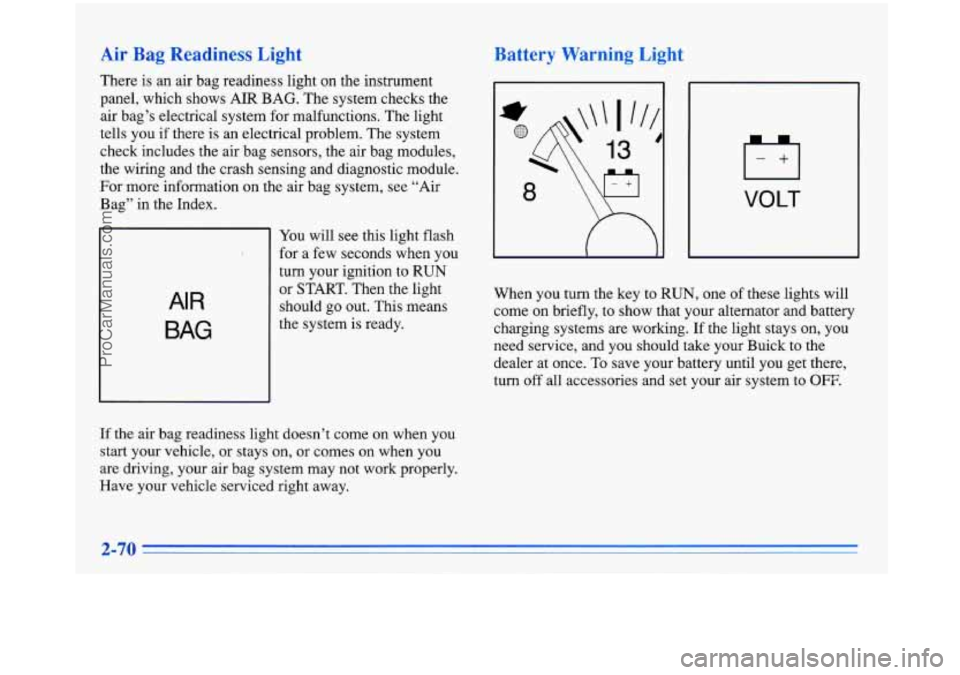
There is an air bag readiness light on the instrument
panel, which shows AIR BAG. The system checks the
air bag’s electrical system for malfunctions. The light
tells you
if there is an electrical problem. The system
check includes the air bag sensors, the air bag modules,
the wiring and the crash sensing and diagnostic module.
For more information on the air bag system, see “Air
Bag” in the Index.
AI R
BAG
You will see this light flash
for a few seconds when you
turn your ignition to
RUN
or START. Then the light
should go out. This means
the system is ready.
If the air bag readiness light doesn’t come on when you
start your vehicle, or stays on, or comes on when
you
are driving, your air bag system may not work properly.
Have your vehicle serviced right away.
Battery Warning Light
VOLT
When you turn the key to RUN, one of these lights will
come on briefly, to show that your alternator and battery
charging systems
are working. If the light stays on, you
need service, and you should take your Buick
to the
dealer at once.
To save your battery until you get there,
turn
off all accessories and set your air system to OFF.
ProCarManuals.com
Page 130 of 388
Engine Coolant Temperature
Warning Light
h -
TEMP
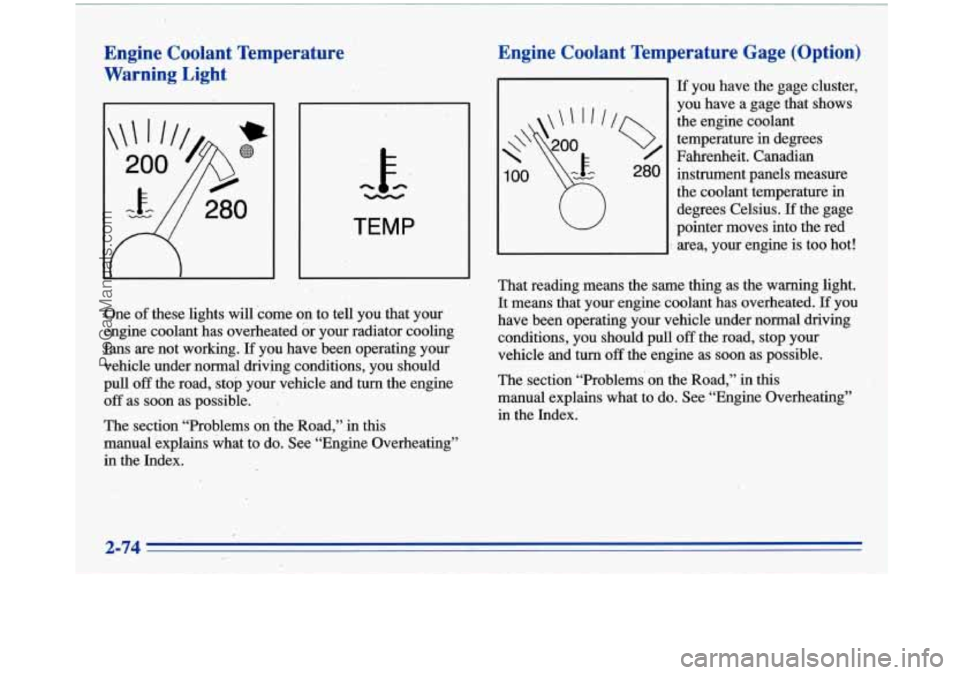
One of these lights will come on to tell you that your
engine coolant has overheated or your radiator cooling
fans are not working.
If you have been operating your
,vehicle under normal driving conditions, you should
pull
off the road, stop your vehicle and turn the engine
off as soon as possible. I
The section “Problems on the Road,” in this
manual explains what to
do. See “Engine Overheating”
in the Index.
Engine Coolant Temperature Gage (Option)
If’ you have the gage cluster,
you have a gage that shows
the engine coolant
temperature
in degrees
Fahrenheit. Canadian
instrument panels measure
the coolant temperature in
degrees Celsius.
-If the gage
pointer moves into the red
area, your engine is too hot!
That reading means ,the same thing as the warning light.
It means that your engine coolant has overheated. If you
have been operating.your vehicle under normal driving
conditions, you should pull
off the road, stop your
vehicle and turn
off the engine as soon as possible.
The section “Problems’ on the Road,” in
this
manual explains what to do. See “Engine Overheating”
in the Index.
2-74
ProCarManuals.com
Page 143 of 388
Dual Automatic ComforTemp
Climate Control (Option)
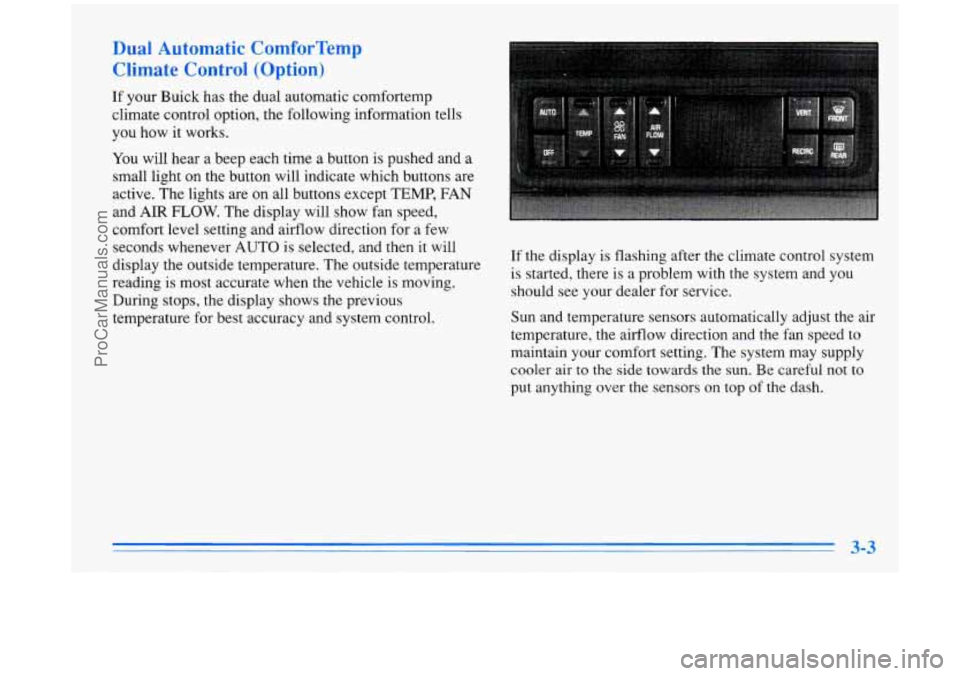
If your Buick has the dual automatic comfortemp
climate control option, the following information tells
you how it works.
You will hear a beep each time a button is pushed and a
small light on the button will indicate which buttons are
active. The lights are on all buttons except TEMP, FAN
and AIR
FLOW. The display will show fan speed,
comfort level setting and airflow direction for a few
seconds whenever AUTO is selected, and then it will
display the outside temperature. The outside temperature
reading is most accurate when the vehicle
is moving.
During stops, the display shows the previous
temperature for best accuracy and system control. If the display
is flashing after the climate control system
is started, there is a problem with the system and you
should see your dealer for service.
Sun and temperature sensors automatically adjust the air
temperature, the airflow direction and the fan speed to
maintain your comfort setting. The system may supply
cooler air to the
side towards the sun. Be careful not to
put anything over the sensors on top of the dash.
ProCarManuals.com
Page 151 of 388
Passenger Control
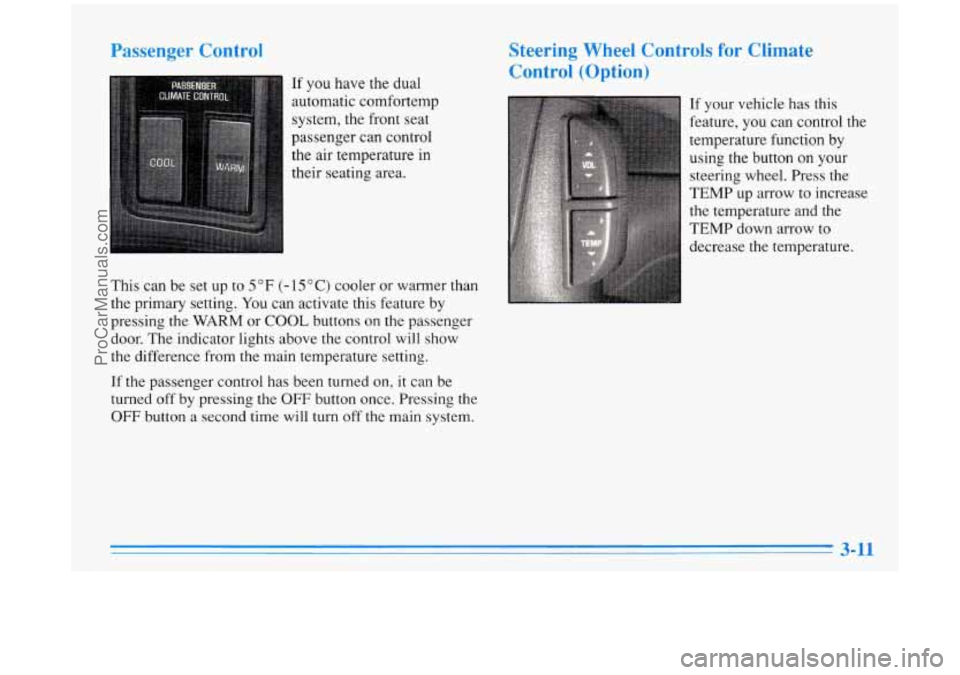
If you have the dual
automatic cornfortemp
system, the front seat
passenger can control
the
air temperature in
their seating area.
This can be set up to
5 OF (- 15 O C) cooler or warmer than
the primary setting.
You can activate this feature by
pressing the
WARM or COOL buttons on the passenger
door. The indicator lights above the control will show
the difference from
the main temperature setting.
If the passenger control has been turned on,
it can be
turned
off by pressing the OFF button once. Pressing the
OFF button a second time will turn off the main system.
Steering Wheel Controls for Climate
Control (Option)
If your vehicle has this
feature, you can control the
temperature function by
using the button
on your
steering wheel. Press the
TEMP up
arrow to increase
the temperature and the
TEMP down arrow to
decrease the temperature.
ProCarManuals.com
Page 189 of 388
Here are some tips on night driving.
0
0
0
0
0
0
0
Drive defensively.
Don’t drink and drive.
Adjust your inside rearview mlrror to reduce the
glare from headlamps behind you.
Since you can’t see as well, you may need to
slow down and keep more space between you and
other vehicles.
Slow down, especially on higher speed roads. Your
headlamps can light up only
so much road ahead.
In remote areas, watch for animals.
If you’re tired, pull off the road in a safe place
and rest.
Night Vision
No one can see as well at night as in the daytime. But as
we get older
these differences increase. A 50-year-old
driver may require at least twice as much light to see the
same thing at night as a 20-year-old.
What you do in the daytime can also affect your night
vision. For example, if you spend the day in bright
sunshine you are wise to wear sunglasses. Your eyes
will
have less trouble adjusting to night. But if you’re driving,
don’t wear sunglasses at night. They may cut
down on glare from headlamps, but they also make a lot
of things invisible.
You can be temporarily blinded by approaching
headlamps. It can take a second or two, or even several
seconds, for your eyes to readjust to the dark. When
you are faced with severe glare (as from a driver who
doesn’t lower the high beams, or a vehicle with
misaimed headlamps), slow down a little. Avoid staring
directly into the approaching headlamps.
Keep your windshield and all the glass on your vehicle
clean
-- inside and out. Glare at night is made much
worse by dirt on the glass. Even the inside of the glass
can build up a film caused by dust. Dirty glass makes
lights dazzle and flash more than clean glass would,.
making the pupils of your eyes contract repeatedly.
Remember that your headlamps light up far less of a
roadway when you are in a turn or curve. Keep your
eyes moving; that way, it’s easier to pick out dimly
lighted objects. Just as your headlamps should be
checked regularly for proper aim,
so should your eyes
be examined regularly. Some drivers suffer from night
blindness
-- the inability to see in dim light -- and
aren’t even aware of it.
1 4-15
ProCarManuals.com
Page 210 of 388
Tbrn Signals When Towing a Trailer
The arrows on your instrument panel will flash
whenever you signal a turn or lane change. Properly
hooked up, the trailer lamps will also flash, telling other
drivers you’re about
to turn, change lanes or stop.
When towing a trailer, the arrows on your instrument
panel will flash for turns even if the bulbs on the trailer
are burned out. Thus, you may think drivers behind you
are seeing your signal when they are not. It’s important
to check occasionally to be sure the trailer bulbs are still
working.
Your vehicle
has bulb warning lights. When you plug a
trailer lighting system into your vehicle’s lighting
system, its bulb warning lights may not let you know if
one of your lamps goes out.
So, when you have a trailer
lighting system plugged in, be sure
to check your
vehicle and trailer lamps from time to time to be sure
they’re all working. Once you disconnect the trailer
lamps, the bulb warning lights again can tell you if one
of your vehicle lamps
is out.
Driving On Grades
Reduce speed and shift to a lower gear before you start
down a long or steep downgrade.
If you don’t shift
down, you might have to use your brakes
so much that
they would get hot and no longer work well.
On a long uphill grade,
shift down to THIRD (3) and
reduce your speed to around
45 mph (70 km/h) to reduce
the possibility of engine and transaxle overheating.
Parking on Hills
You really should not park your vehicle, with a trailer
attached, on a hill.
If something goes wrong, your rig
could start to move. People can be injured, and both
your vehicle and the trailer can
be damaged.
But if you ever have to park your rig on a hill, here’s
how
to do it:
1. Apply your regular brakes, but don’t shift into
PARK (P) yet.
2. Have someone place chocks under the trailer wheels.
3. When the wheel chocks are in place, release the
regular brakes until the chocks absorb the load.
4. Reapply the regular brakes. Then apply your parking
5. Release the regular brakes.
brake, and the shift
to PARK
(P).
4-36
ProCarManuals.com
Page 271 of 388
How to Add Fluid
Refer to the Maintenance Schedule to determine what
kind of transaxle fluid to use. See “Recommended
Fluids and Lubricants” in the Index.
If the fluid level is low, add only enough
of the proper
fluid to bring the level into the cross-hatched area on
the dipstick.
1. Pull out the dipstick.
2. Using a long-neck funnel, add enough fluid at the
It doesn’t take much fluid, generally less than a pint
(0.5 L). Don’t ovel-fill. We recommend you use only
fluid labeled DEXRON@-111, because fluid with that
label is made especially for your automatic transaxle.
Damage caused by fluid other than DEXRON-I11 is
not covered by your new vehicle warranty.
dipstick hole to
bring it to the proper level.
After adding fluid, recheck the fluid level as
described under “How to Check.”
0 When the correct fluid level is obtained, push the
dipstick back in all the way.
Engine Coolant
The cooling system in your vehicle is filled with new
DEX-COOL
TM (orange-colored, silicate-free) engine
coolant. This coolant is designed to remain in your
vehicle for
5 years or 100,000 miles (166 000 km),
whichever occurs first.
The following explains your cooling system and how
to add coolant when
it is low. If you have a problem
with engine overheating, see “Engine Overheating” in
the Index.
A 50/50 mixture of water and the proper coolant for
your Buick will:
Give freezing protection down to -34°F (-37°C).
9 Give boiling protection up to 265 OF ( 129 O C).
Protect against rust and corrosion.
Help keep the proper engine temperature.
0 Let the warning lights and gages work as they should.
ProCarManuals.com
Page 380 of 388
Key Lock Cylinders Service ..................... 7-39
Key Reminder Warning
.......................... 2-21
Keyless Entry System. Remote
Instant Alarm
................................. 2-8
Personal Choice
............................... 2-8
Keys
.......................................... 2-1
Labels Certification
................................. 4-29
Certificationflire
............................. 4-28
Service Parts Identification
..................... 6-56
Tire-Loading Information
...................... 4-28
Vehicle Identification Number
................... 6-56
Lamps
........................................ 2-43
Courtesy
.................................... 2-47
Interior
..................................... 2-46
Monitor System
.............................. 2-45
OnReminder
................................ 2-44
Perimeter Lighting
............................ 2-48
TheaterDimming
............................. 2-47
Leaving
Your Vehicle ............................. 2-7
Leaving Your Vehicle with the Engine Running
....... 2-29
License Plate Holder
............................ 2-63
Light Sensor. Twilight Sentinel
.................... 2-46
Lights Lighter
....................................... 2-61 .
Air Bag Readiness ....................... 1 - 18. 2-70
Anti-Lock Brake System Warning
............ 2-72.4-6
Battery Warning
.............................. 2-70 Brake System Warning
......................... 2-71
ChangeOilSoon
............................. 2-80
CheckEngine
................................ 2-75
DoorAjar
................................... 2-81
Engine Coolant Temperature Warning
............. 2-74
Engine Oil Pressure Light/Gage
................. 2-78
Interior
..................................... 2-46
Low Coolant Warning
......................... 2-75
LowFuel
................................... 2-82
OilLevelCheck
.............................. 2-79
Safety Belt Reminder
...................... 1-6, 2-69
Traction Control System Warning
............ 2-73, 4-8
TrunkAjar .................................. 2-81
Loading Your Vehicle
........................... 4-28
Locks Cylinders
................................... 7-39
Door
........................................ 2-3
FuelDoor
.................................... 6-6
Key Lock Cylinder Service
..................... 7-39
Lockout Protection
............................. 2-7
Memory Door
................................. 2-4
PowerDoor
.................................. 2-4
Rear Door Security
............................. 2-6
Steering Column Lock Check
................... 7-40
Trunk
...................................... 2-13
Window
.................................... 2-33
Low Coolant Warning Light
...................... 2-75
LowFuelLight
................................ 2-82
Lubricants and Fluids
............................ 7-43
Lubrication Service, Body
........................ 7-39
ProCarManuals.com
Page 386 of 388
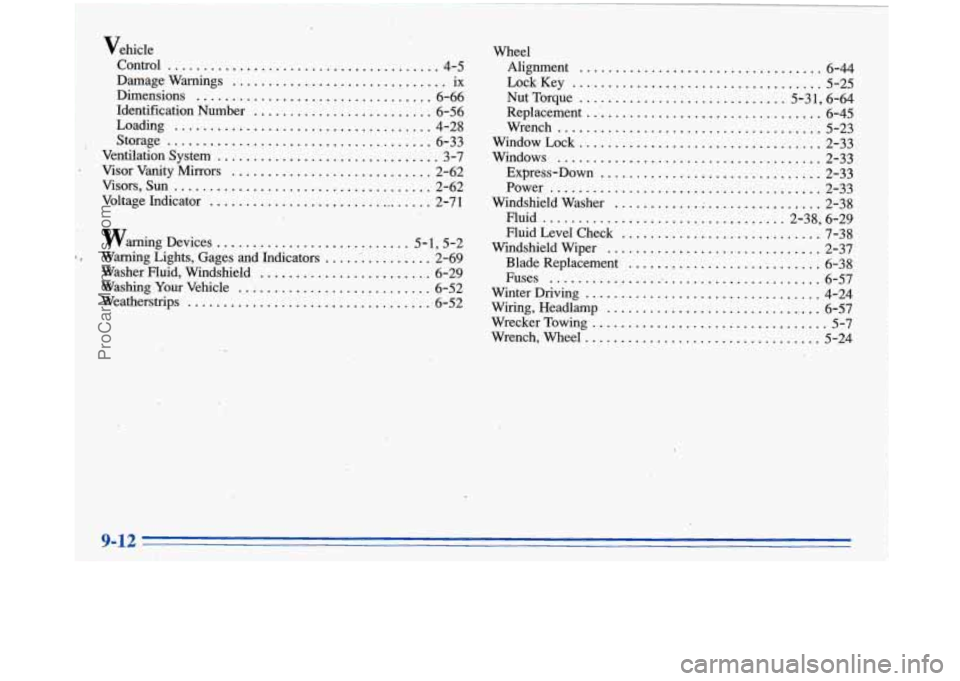
Vehicle Control
...................................... 4-5
Damage Warnings ................................ ix
Dimensions ................................. 6-66
Loading .................................... 4-28
Storage ...................................... 6-33
Identification Number ......................... 6-56
Ventilation System ............................... 3-7
Visor Vanity Mirrors ............................ 2-62
Visors, Sun .................................... 2-62
Voltage Indicator ................................ 2-7 1
warning Devices ........................... 5.1. 5.2
Warning Lights. Gages and Indicators ................ 2-69
Washer Fluid. Windshield ........................ 6-29
Washing Your Vehicle .. : ........................ 6-52
Weatherstrips ................................... 6-52
Wheel
Alignment
.................................. 6-44
LockKey ................................... 5-25
Replacement ............................... : .. 6-45
Nut Torque ............................. 5-31, 6-64
Wrench ..................................... 5-23
Express-Down ............................... 2-33
Fluid ................................... 2-38, 6-29
Fluid Level Check ............................ 7-38
Windshield Wiper ............................... 2-37
Blade Replacement ........................... 6-38
Winter Driving ................................. 4-24
Wiring, Headlamp ............................... 6-57
WindowLock .................................. 2-33
Windows ..................................... 2-33
Power ...................................... 2-33
Windshield Washer ............................. 2-38
Fuses ....................................... 6-57
WreckerTowing ................................. 5-7
Wrench ,Wheel ................................. 5-24
ProCarManuals.com