fuel BUICK PARK AVENUE 1996 Owner's Manual
[x] Cancel search | Manufacturer: BUICK, Model Year: 1996, Model line: PARK AVENUE, Model: BUICK PARK AVENUE 1996Pages: 388, PDF Size: 20.04 MB
Page 256 of 388
NOTICE:
If you need a new cap, be sure to get the right
type. Your dealer can get one for
you. If you get
the wrong type, it may not fit or have proper
venting, and your fuel tank and emissions system
might be damaged.
Checking Things Under the Hood
I
I
An electric fan under the hood can start up and
injure you even when the engine is not running.
Keep hands, clothing and tools away from
any
underhood electric fan.
I
Things that burn can get on hot engine parts and
start
a fire. These include liquids like gasoline,
oil, coolant, brake fluid, windshield washer and
other fluids, and plastic or rubber.
You or others
could be burned. Be careful not to drop or spill
things that will burn onto
a hot engine.
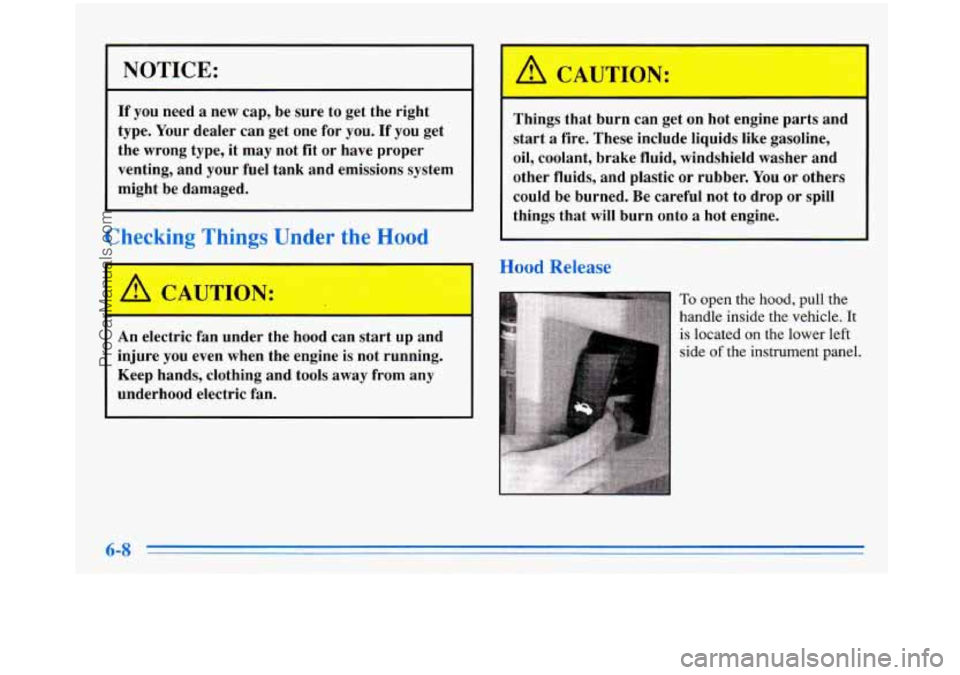
Hood Release
ProCarManuals.com
Page 260 of 388
Your Park Avenue Ultra has a 3800 Supercharged
engine. Buick chose supercharging rather than
turbocharging because Buick emphasizes smooth,
refined power.
The supercharger
is a device which is designed to pump
more air into the engine than it would normally use.
This air mixed with fuel creates increased engine power.
Since the supercharger is a pump and is driven from an
engine accessory drive belt, increased pressure is available at all driving conditions.
The Powertrain Control Module (PCM) works with a
vacuum control to regulate the increased pressure
required during specific driving conditions. When this increased pressure or boost is not desired, such as during
idling and light throttle cruising, the excess air that the
supercharger is pumping is routed through a bypass. All
of these controls working together provide high
performance character and fuel efficiency in the
3800 V6 Supercharged Buick engine.
The power steering pump and reservoir are mounted
on the rear (driver’s side)
of the engine block. See
“Maintenance Schedule” in the Index for when you
should check the fluid.
Engine Oil
If the CHECK OIL
LEVEL light on the
instrument panel
comes on, it means
CHECK OIL you need to check
LEVEL your engine oil level
right away.
For more information, see “Check Oil Level Light” in
the Index. You should check your engine oil level
regularly; this is an added reminder.
ProCarManuals.com
Page 261 of 388
It’s a good idea to check your engine oil every time you
get fuel. In order to get an accurate reading, the oil must
be warm and the vehicle must be on level ground.
Turn off the engine and give
the oil a few minutes to
drain back into the oil pan.
If you don’t, the oil dipstick
might not show the
actual level.
Checking Engine Oil
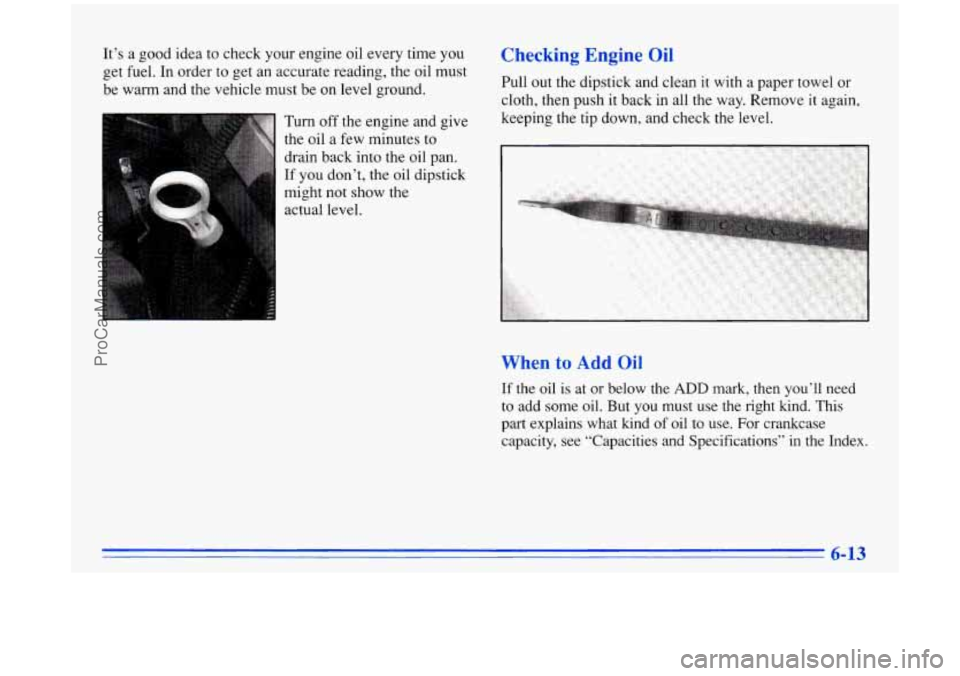
Pull out the dipstick and clean it with a paper towel or
cloth, then push it back in all the way. Remove it again,
keeping the tip down, and check
the level.
When to Add Oil
If the oil is at or below the ADD mark, then you’ll need
to add some oil. But you must use
the right kind. This
part explains what kind of oil
to use. For crankcase
capacity, see “Capacities and Specifications” in the Index.\
ProCarManuals.com
Page 263 of 388
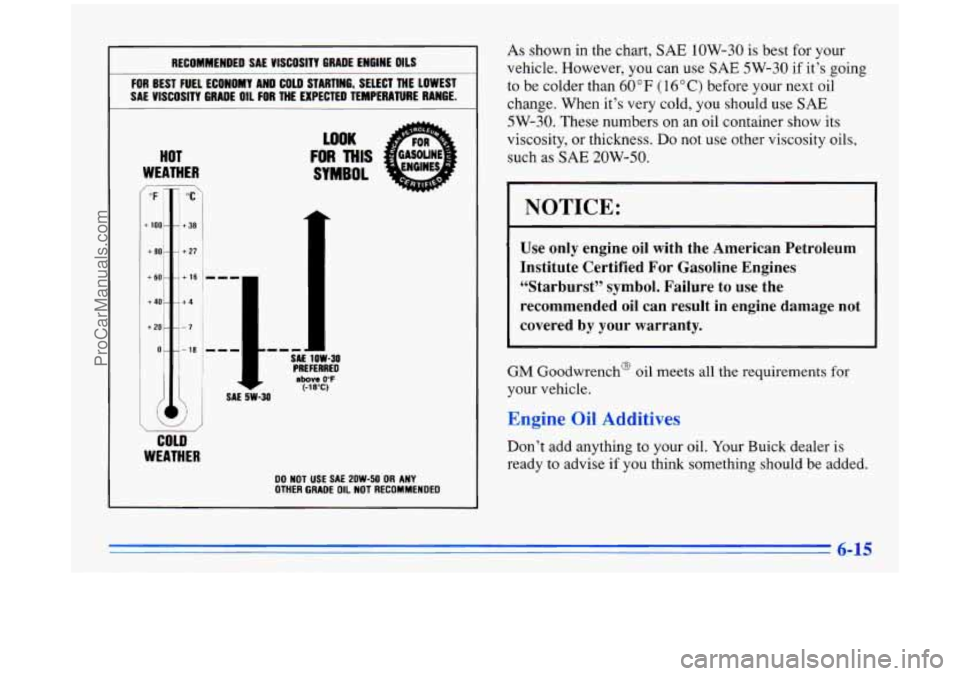
As shown in the chart, SAE 1OW-30 is best for your
vehicle. However, you can use
SAE 5W-30 if it’s going
to be colder than
60°F (1 6°C) before your next oil
change. When it’s very cold, you should use
SAE
5W-30. These numbers on an oil container show its
viscosity, or thickness.
Do not use other viscosity oils,
such as
SAE 20W-50.
RECOMMENDED SAE VISCOSITY GRADE ENGINE OILS
FOR BEST FUEL ECONOMY AND COLD STARTING, SELECT THE LOWEST
SAL VISCOSITY GRADE
OIL FOR THE EXPECTED TEMPERATURE RANGE.
HOT
WEATHER SYMBOL
- OF i
tlOOr
+80-
+ 60-
+40-
+ 20 -
0-
’ I +38 OC
i +27
j
I NOTICE:
6E I 1OW-30
PREFERRED above 0°F (-1nOcl
Use only engine oil with the American Petroleum
Institute Certified For Gasoline Engines
“Starburst” symbol. Failure to use the
recommended oil can result in engine damage not
covered
by your warranty.
+4
-7
- 18 I-
GM Goodwrench@ oil meets all the requirements for
your vehicle.
SAE 5W-30 , -- -,
7n.gine Oil __. W
COLD Don’t add anything to your oil. Your Buick dealer is
ready
to advise if you think something should be added. WEATHER
DO NOT USE SA€ 2OW-50 OR ANY OTHER GRADE OIL NOT RECOMMENDED
0-15
ProCarManuals.com
Page 288 of 388
Inflation -- Tire Pressure
The Tire-Loading Information label, which is located on
the rear edge
of the driver’s door, shows the correct
inflation pressures for your tires when they’re cold.
“Cold” means your vehicle has been sittkg for at least
three hours or driven no more than
1 mile (1.6 km).
.NOTICE:
Don’t let anyone tell you that underinflation or
overinflation is all right. It’s not.
If your tires
don’t have enough air (underinflation), you can
get the following:
0 Too much flexing
0 Too much heat
0 Tire overloading
0 Bad wear
Bad handling
Bad fuel economy.
I
(Continued) NOTICE: (Continued)
If your tires have too much air (overinflation),
you can get the following:
Unusual wear
Bad handling
0 Rough ride
0 Needless damage from road hazards.
When to Check Check your tires once a month or more.
Don’t forget your compact spare tire. It should be
at
60 psi (420 Ea).
How to Check
Use a good quality pocket-type gage to check tire
pressure.
You can’t tell if your tires are properly inflated
simply by looking at them. Radial tires may look
properly inflated even when they’re underinflated.
Be sure to put the valve caps back on the valve stems.
They help prevent leaks by keeping out dik and moisture.
6-40
,
ProCarManuals.com
Page 302 of 388
Finish Damage
Any stone chips, fractures or deep scratches in the finish
should be repaired right away. Bare metal will corrode
quickly and may develop into a major repair expense.
Minor chips and scratches can be repaired with touch-up
materials available from your dealer or other service
outlets. Larger areas
of finish damage can be corrected
in your dealer’s body and paint shop.
Underbody Maintenance
Chemicals used for ice and snow removal and dust control
can collect on the underbody.
If these are not removed,
accelerated corrosion (rust) can occur on
the underbody
parts such as fuel lines, frame, floor pan and exhaust system even though they have corrosion protection.
At least every spring, flush these materials from the
underbody with plain water. Clean any areas where
mud
and other debris can collect. Dirt packed in closed areas
of the frame should be loosened before being flushed.
Your dealer or an underbody car washing system can do
this
for you.
Chemical Paint Spotting
Some weather and atmospheric conditions can create a
chemical fallout. Airborne pollutants can fall upon and
attack painted surfaces on your vehicle.
This damage
can take two forms: blotchy, ringlet-shaped
discolorations, and small irregular dark spots etched into
the paint surface.
Although no defect in the paint job causes this, Buick
will repair, at no charge
to the owner, the surfaces of
new vehicles damaged by this fallout condition within
12 months or 12,000 miles (20 000 km) of purchase,
whichever occurs first.
ProCarManuals.com
Page 310 of 388
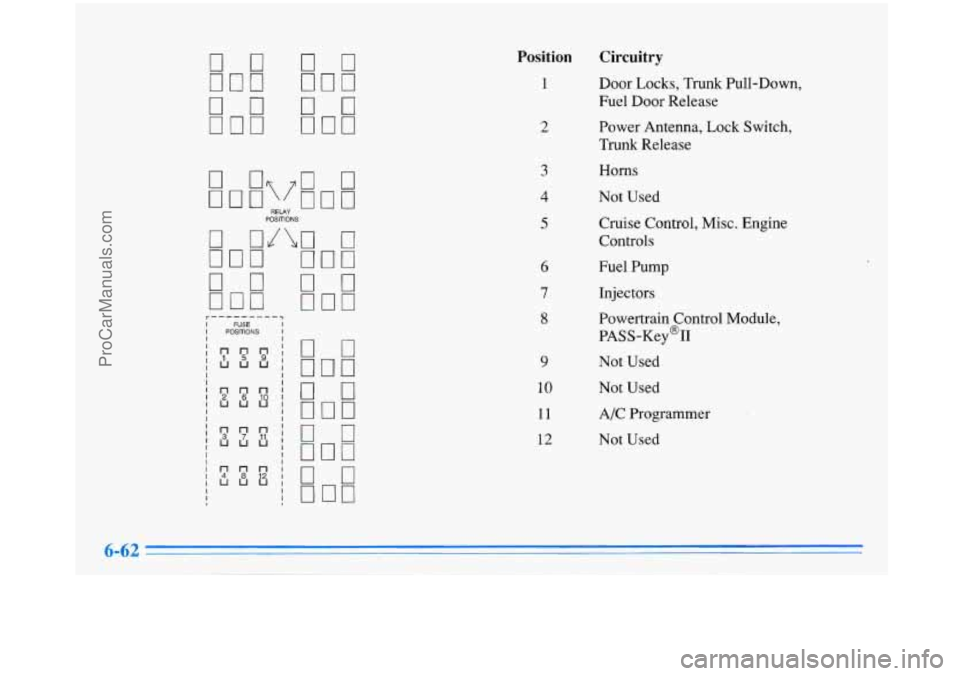
POSl?lONS
r---------? I FUSE I I POSITIONS I
Position Circuitry
1
2
9
10
11
12
Door Locks, Trunk Pull-Down,
Fuel Door Release
Power Antenna, Lock Switch,
Trunk Release
Horns
Not Used Cruise Control, Misc. Engine
Controls
Fuel
F’ump
Injectors
Powertrain Control Module,
PASS-Key@II
Not Used
Not Used
A/C Programmer
Not Used
6-62
ProCarManuals.com
Page 312 of 388
Capacities and Specifications
Belt Tensions
Automatically controlled by a Self-Tension idler pulley. Tension adjustment should never be necessary.
Automatic Transaxle AT (Overdrive)
When draining or replacing torque converter, more fluid may be needed.
Pan Removal and Replacement
............................................ 6 quarts (5.6 L)
After Complete Overhaul .............................................. 11 quarts (1 0.4 L)
Cooling System ..................................................... 13 quarts (12.3 L)
Oil change with filter change ........................................... 4.5 quarts (4.3 L)
Engine Crankcase
FuelTank
........................................................... 18gallons(68L)
Power Steering
Pump Only ............................................................. 1 pint (0.5 L)
Complete System .................................................... 1 1/2 pints (0.7 L)
Tire Pressures, Sizes ........................... The Tire-Loading Information label, which is
located on the rear edge of the driver’s door,
shows the correct inflation pressures for your tires.
Wheel Nut Torque ................................................. 100 lb-ft (140 N-rn)
Windshield Wiper Blades (6.32 Pin Type) ............................. 22 inches (565 mm)
Refrigerant (R=134a), Air Conditioning ............ See refrigerant charge label under the hood.
NOTE: All capacities are approximate. When adding, be sure to fill to the appropriate level, as recommended
in this manual.
6-64
ProCarManuals.com
Page 314 of 388
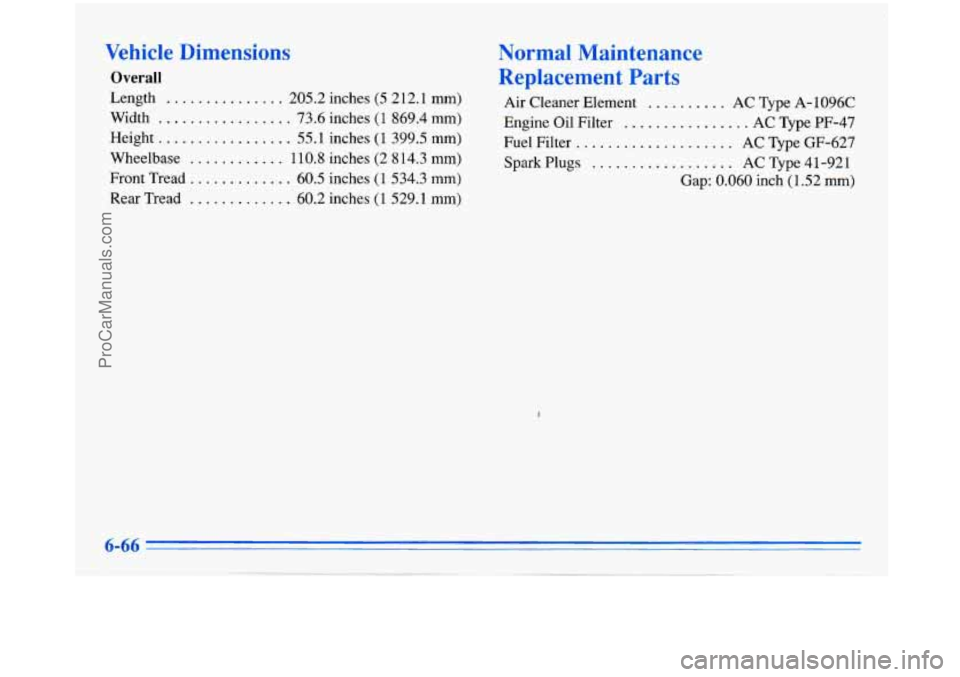
Vehicle Dimensions
Overall
Length ............... 205.2 inches (5 2 12.1 mm)
Width
................. 73.6 inches (1 869.4 mm)
Height
................. 55.1 inches (1 399.5 mm)
Wheelbase
............ 110.8 inches (2 8 14.3 mm)
Front Tread
............. 60.5 inches (1 534.3 mm)
Rear Tread
............. 60.2 inches (1 529.1 mm)
Normal Maintenance
Replacement Parts
Air Cleaner Element .......... AC Type A- 1096C
Engine Oil Filter
................ AC Type PF-47
Fuel Filter
.................... AC Type GF-627
Spark Plugs
.................. AC Type 41-921
Gap:
0.060 inch (1.52 mm)
6-66
ProCarManuals.com
Page 320 of 388
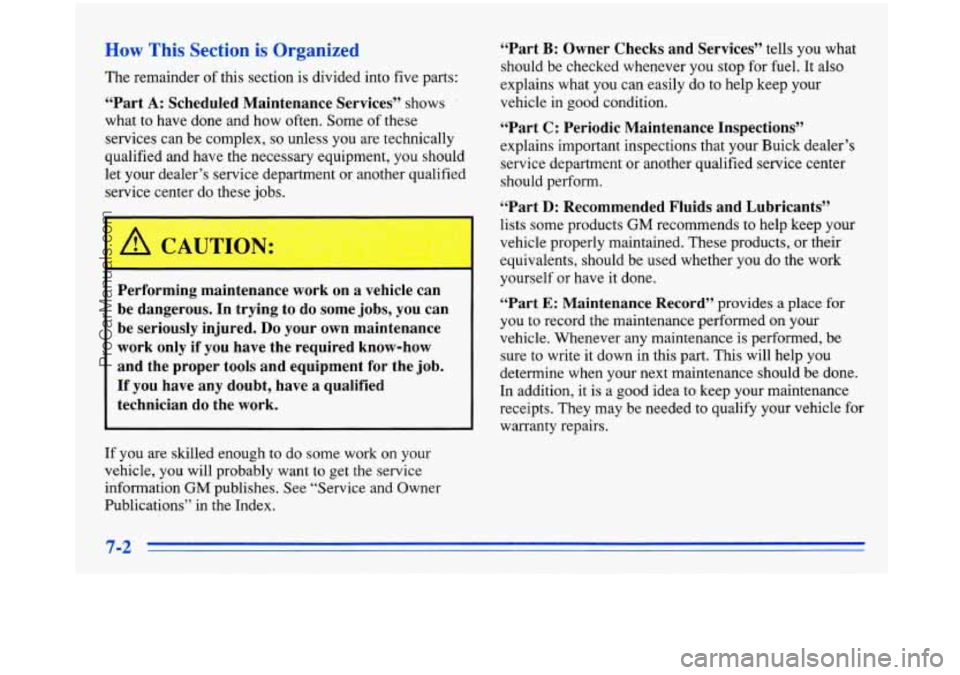
How This Section is Organized
The remainder of this section is divided into five parts:
“Part A: Scheduled Maintenance Services” shows
what to have done and how often. Some of these
services can be complex,
so unless you are technically
qualified and have the necessary equipment, you should
let your dealer’s service department or another qualified
service center
do these jobs.
Performing maintenance work on a vehicle can
be dangerous. In trying to do some jobs, you can
be seriously injured.
Do your own maintenance
work only if you have the required know-how
and the proper tools and equipment for the job.
If you have any doubt, have a qualified
technician do the work.
If you are skilled enough to do some work on your
vehicle, you will probably want to get the service
information
GM publishes. See “Service and Owner
Publications” in the Index. “Part
B: Owner Checks and
Services” tells you what
should be checked whenever you stop for fuel. It also
explains what you can easily do to help keep your
vehicle in good condition.
“Part C: Periodic Maintenance Inspections”
explains important inspections that your Buick dealer’s
service department or another qualified service center
should perform.
“Part
D: Recommended Fluids and Lubricants”
lists some products
GM recommends to help keep your
vehicle properly maintained. These products,
or their
equivalents, should be used whether you do the work
yourself or have it done.
“Part
E: Maintenance Record” provides a place for
you
to record the maintenance performed on your
vehicle. Whenever any maintenance is performed,
be
sure to write it down in this part. This will help you
determine when your next maintenance should
be done.
In addition,
it is a good idea to keep your maintenance
receipts. They may be needed to qualify your vehicle for
warranty repairs.
ProCarManuals.com