wheel BUICK PARK AVENUE 1996 Owner's Guide
[x] Cancel search | Manufacturer: BUICK, Model Year: 1996, Model line: PARK AVENUE, Model: BUICK PARK AVENUE 1996Pages: 388, PDF Size: 20.04 MB
Page 221 of 388
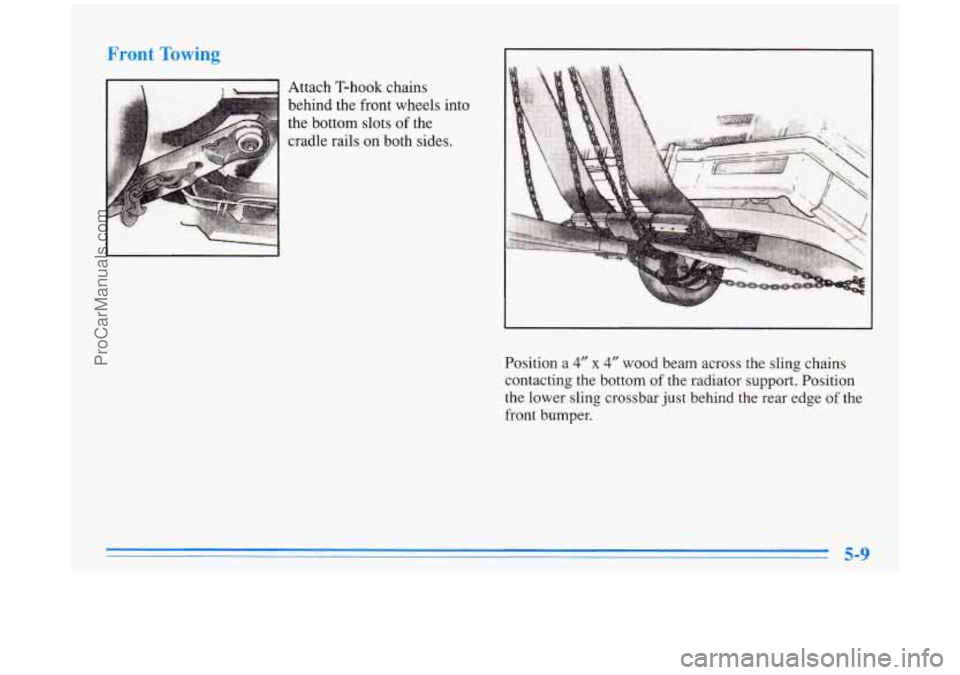
Front Towing
Attach T-hook chains
behind the front wheels into
the bottom slots
of the
cradle rails on both sides.
Position a
4” x 4” wood beam across the sling chains
contacting the bottom of the radiator support. Position
the lower sling crossbar just behind the rear edge of the
front bumper.
ProCarManuals.com
Page 222 of 388
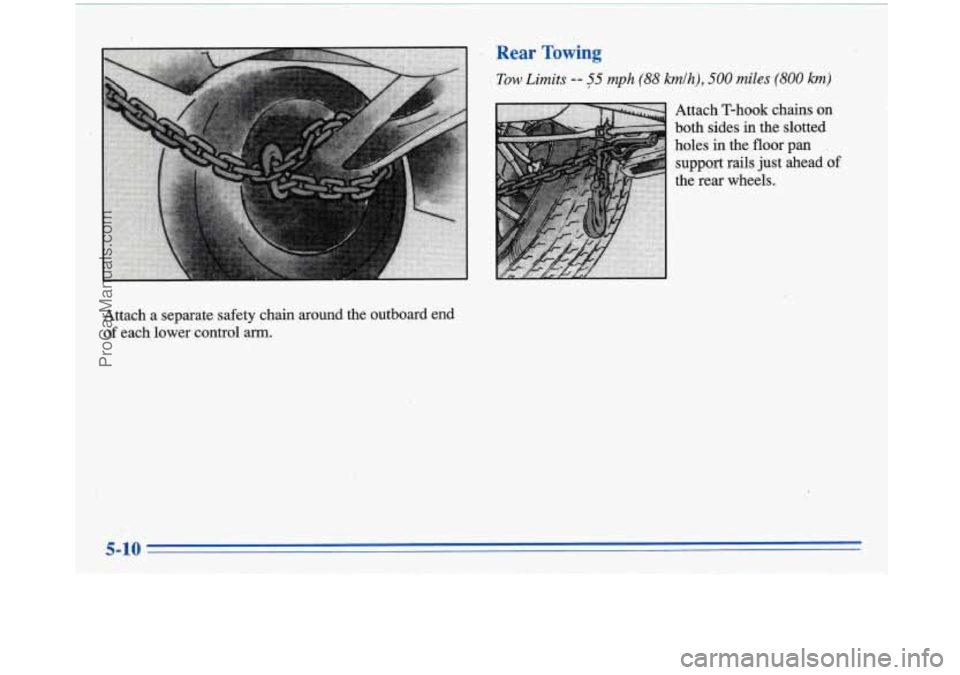
Rear Towing
Tow Limits -- $5 mpht(88 kmlh), 500 miles (800 km)
Attach T-hook chains on
both sides in the slotted
holes
in the floor pan
support rails just ahead of
the rear wheels.
Attach a separate safety chain around the outboard end
of each. lower control arrn.
ProCarManuals.com
Page 234 of 388
If a Tire Goes Flat
It’s unusual for a tire to “blow out” while you’re driving,
especially if
you maintain your tires properly. If air goes
out of a tire, it’s much more likely to leak out slowly.
But
if you should ever have a “blowout,” here are a few
tips about what to expect and what
to do:
If a front tire fails, the flat tire will create a drag that
pulls the vehicle toward that side. Take your foot
off the
accelerator pedal and grip the steering wheel firmly.
Steer to maintain lane position, and then gently brake to
a stop well out of the traffic lane.
A rear blowout, particularly on a curve, acts much like a
skid and may require the same correction you’d
use in a
skid. In any rear blowout, remove your foot from the
accelerator pedal. Get the vehicle under control by
steering the way you want the vehicle to
go. It may be
very bumpy and noisy, but you can still steer. Gently
brake
to a stop -- well off the road if possible.
If a tire goes flat, the next part shows how to use your
jacking equipment to change
a flat tire safely.
Changing a Flat Tire
If a tire goes flat, avoid further tire and wheel damage
by driving slowly to a level place. Turn on your hazard
warning flashers.
Changing
a tire can cause an injury. The vehicle
can slip off the jack and roll over you or other
people.
You and they could be badly injured.
Find
a level place to change your tire. To help
prevent the vehicle from moving:
1. Set the parking brake firmly.
2. Put the shift lever in PARK (P).
3. Turn off the engine.
To be even more certain the vehicle won’t move,
you can put blocks at the front and rear of the
tire farthest away from the one being changed.
That would be the tire
on the other side of the
vehicle,
at the opposite end.
5-22
ProCarManuals.com
Page 236 of 388
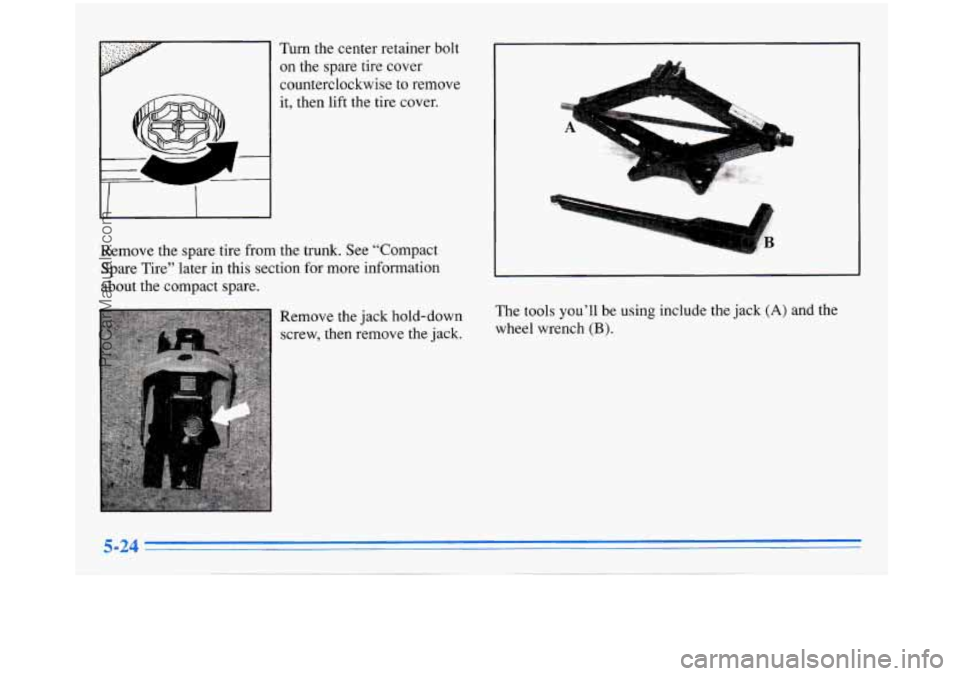
Turn the center retainer bolt on the spare tire cover
counterclockwise to remove
it, then lift the tire cover.
Remove the spare tire from the trunk. See “Compact
Spare Tire” later in this section for more information
about the compact spare.
Remove the jack hold-down
screw, then remove the jack.
1
The tools you’ll be using include the jack (A) and the
wheel wrench
(B).
ProCarManuals.com
Page 237 of 388
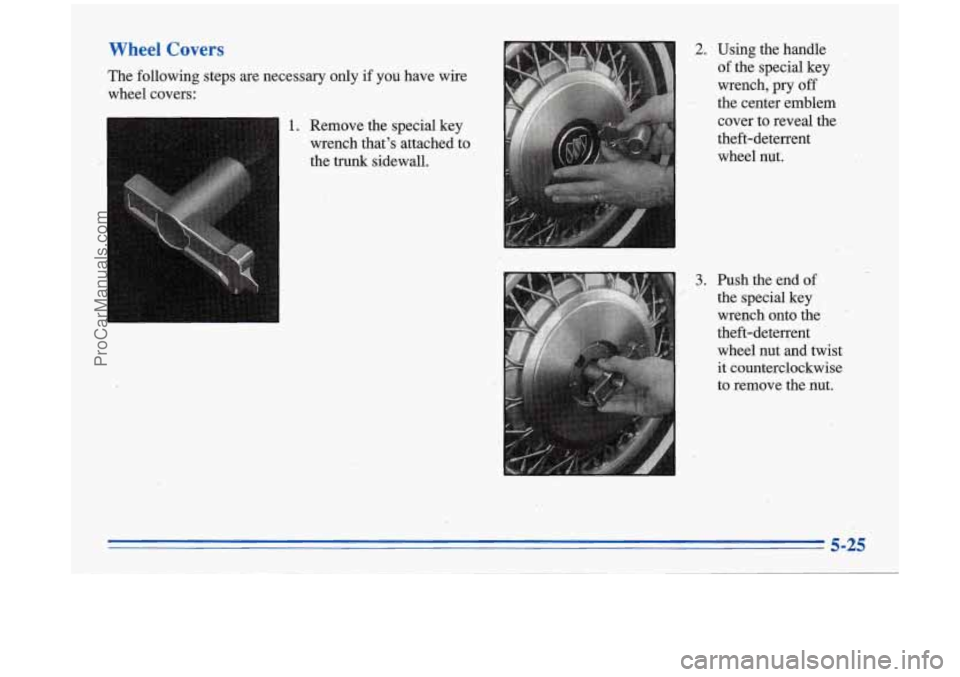
Wheel Covers
The following steps are necessary only if you have wire
wheel covers:
1. Remove the special key
wrench that's attached to
the trunk sidewall.
2. Using the handle
.of the special key
wrench,
pry off
the center emblem
cover to reveal the
theft-deterrent wheel nut.
3. Push the end. of
the special key
wrench onto the
theft-deteq-ent
wheel nut and'twist
it counterclockwise
to remove the nut.
,.
5-25
ProCarManuals.com
Page 238 of 388
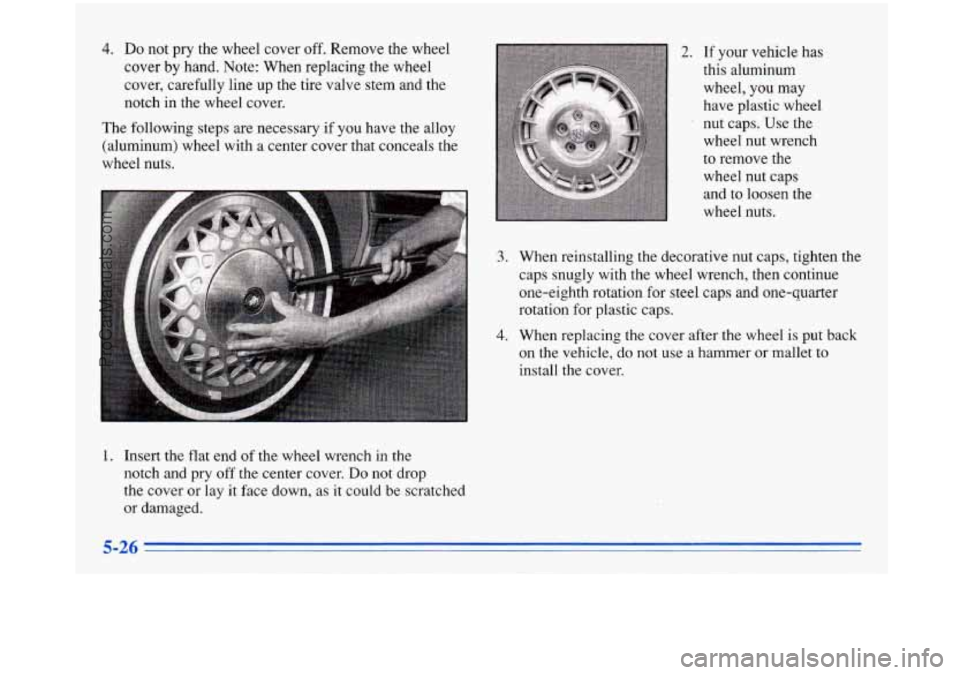
4. Do not pry the wheel cover off. Remove the wheel
cover by hand. Note: When replacing the wheel
cover, carefully line up the tire valve stem and the
notch in the wheel cover.
The following steps are necessary if you have the alloy
(aluminum) wheel with
a center cover that conceals the
wheel nuts.
2. If your vehicle has
this aluminum
wheel,
you may
have plastic wheel
nut caps. Use the wheel nut wrench
to remove the
wheel
nut caps
and
to loosen the
wheel nuts.
3. When reinstalling the decorative nut caps, tighten the
caps snugly with the wheel wrench, then continue
one-eighth rotation for steel caps and one-quarter
rotation for plastic caps.
4. When replacing the cover after the wheel is put back
on the vehicle, do
not use a hammer or mallet to
install the cover.
1. Insert the flat end of the wheel wrench in the
notch and pry
off the center cover. Do not drop
the cover
or lay it face down, as it could be scratched
or damaged.
5-26
ProCarManuals.com
Page 239 of 388
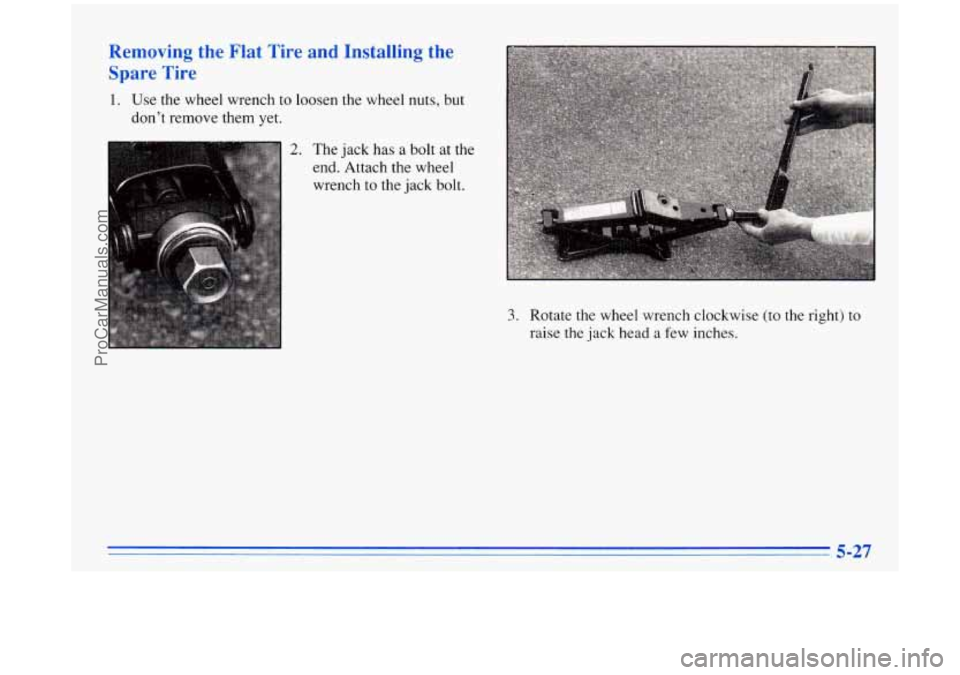
Removing the Flat Tire and Installing the Spare Tire
1. Use the wheel wrench to loosen the wheel nuts, but
don’t remove them yet.
2. The jack has a bolt at the
end. Attach the wheel
wrench to the jack bolt.
3. Rotate the wheel wrench clockwise (to the right) to
raise the jack head a few inches.
ProCarManuals.com
Page 240 of 388
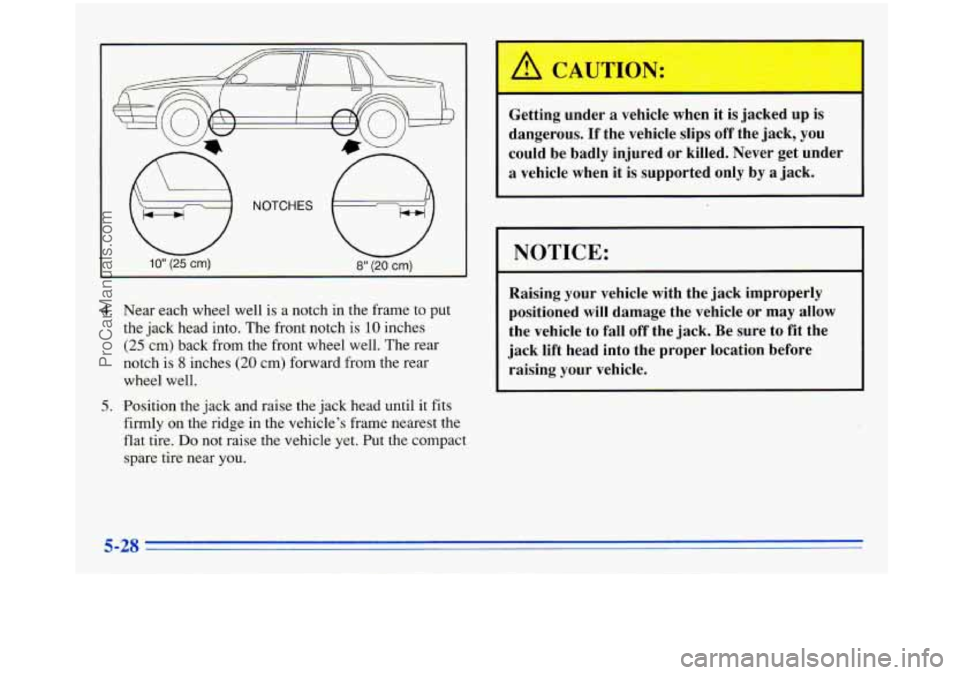
4. Near each wheel well is a notch in the frame to put
the jack head into. The front notch
is 10 inches
(25 cm) back from the front wheel well. The rear
notch is
8 inches (20 cm) forward from the rear
wheel well.
5. .Position the jack and raise the jack head until it fits
firmly on the ridge in the vehicle’s frame nearest the
flat tire.
Do not raise the vehicle yet. Put the compact
spare tire near
you.
Getting under a vehicle when it is jacked up is
dangerous.
If the vehicle slips off the jack, you
could be badly injured
or killed. Never get under
a vehicle when it is supported only by a jack.
_I
NOTICE:
Raising your vehicle with the jack improperly
positioned will damage the vehicle
or may allow
the vehicle to fall off the jack. Be sure to fit the
jack lift head into the proper location before
raising your vehicle.
5-28
ProCarManuals.com
Page 241 of 388
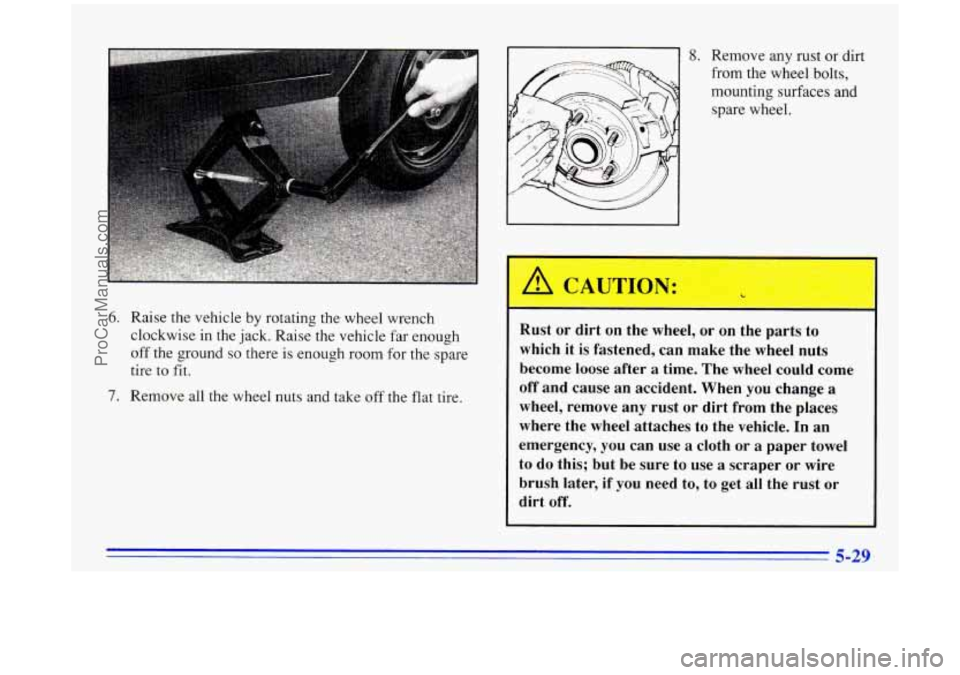
6. Raise the vehicle by rotating the wheel wrench
clockwise in the jack. Raise the vehicle far enough
off the ground
so there is enough room for the spare
tire to fit.
7. Remove all the wheel nuts and take off the flat tire.
8. Remove any rust or dirt
from the wheel bolts,
mounting surfaces and
spare wheel.
~ Rust or dirt on the wheel, or on the parts to
' which it is fastened, can make the wheel nuts
become loose after a time. The wheel could come
off and cause an accident. When
you change a
wheel, remove any rust or dirt from the places
where the wheel attaches to the vehicle. In an
emergency, you can use
a cloth or a paper towel
to do this; but be sure to use
a scraper or wire
brush later, if
you need to, to get all the rust or
dirt off.
ProCarManuals.com
Page 242 of 388
Never use oil or grease on studs or nuts. If you
do, the nuts might come loose. Your wheel could
fall off, causing a serious accident.
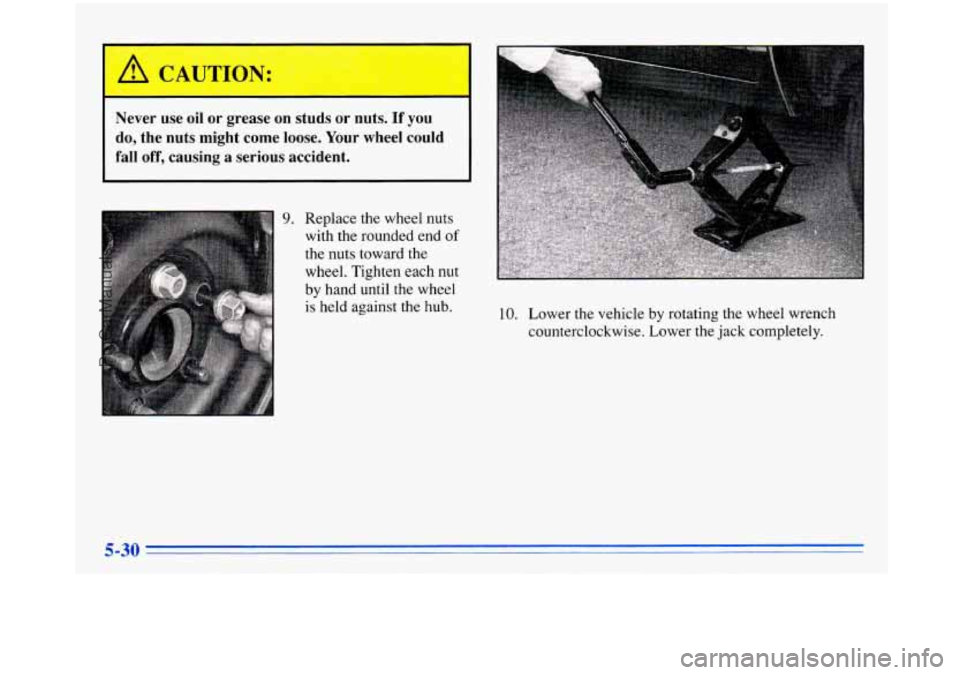
Replace the wheel nuts
with the rounded end
of
the nuts toward the
wheel. Tighten each nut
by hand until the wheel
is held against the hub.
10. Lower the vehicle by rotating the wheel wrench
counterclockwise. Lower the jack completely.
ProCarManuals.com