light BUICK PARK AVENUE 1996 Repair Manual
[x] Cancel search | Manufacturer: BUICK, Model Year: 1996, Model line: PARK AVENUE, Model: BUICK PARK AVENUE 1996Pages: 388, PDF Size: 20.04 MB
Page 198 of 388
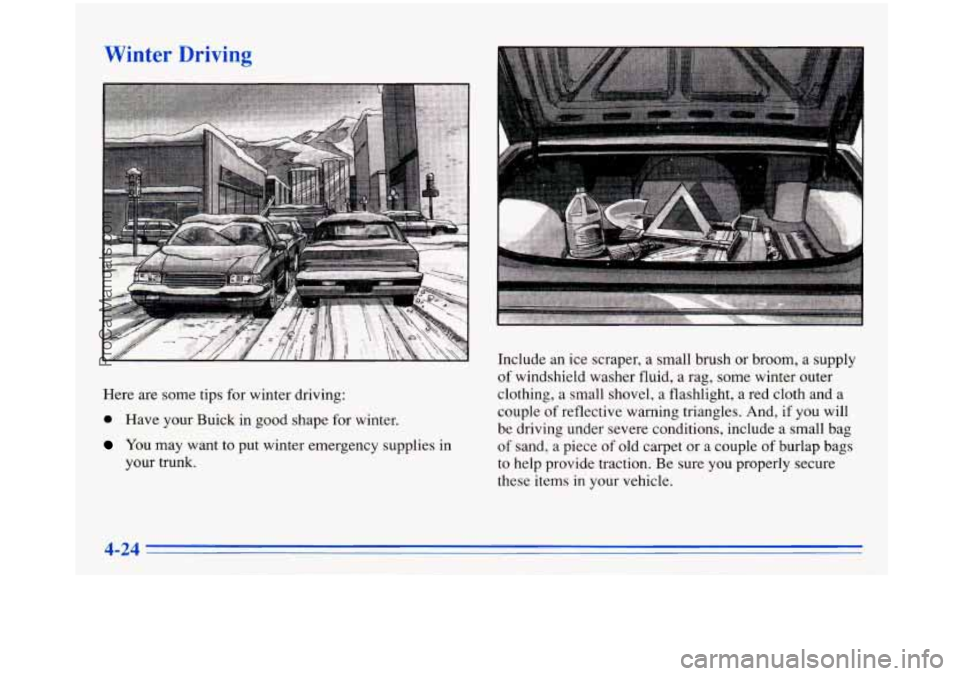
Winter Driving
Here are some tips for winter driving:
@ Have your Buick in good shape for winter,
You may’warlt to put winter emergency supplies in
your
trunk.
Include an ice scraper, a small brush or broom, a supply
of windshield washer fluid, a rag, some winter outer
clothing, a small shovel, a flashlight, a red cloth and a
couple
of reflective warning triangles. And, if you will
be driving under severe conditions, include a small bag
of sand, a piece
of old carpet or a couple of burlap bags
to help provide traction. Be sure you properly secure
these items
in your vehicle.
4-24
_.
ProCarManuals.com
Page 202 of 388
Run your engine only as long as you must. This saves
fuel. When you run the engine, make it go a little faster
than just idle. That is, push the accelerator slightly. This
uses less fuel for the heat that you get and it keeps the
battery charged. You will need a well-charged battery to
restart the vehicle, and possibly for signaling later on
with your headlamps. Let the heater run for awhile.
Then, shut the engine off and close the window almost
all the way to preserve the heat. Start the engine again
and repeat this only when you feel really uncomfortable
from the cold. But do it as little as possible. Preserve the
fuel as long as you can. To help keep warm, you can get
out of the vehicle and do some fairly vigorous exercises
every half hour or
so until help comes.
Loading Your Vehicle
ym OCCUPANTS
VEHICLE CAP. WT.
TIRE-LOADING INFORMATION
7
FRT. CTR. RR. TOTAL LBS. KG
MAX. LOADING & GVWR
SAME AS VEHICLE
CAPACITY WEIGHT XXX COLD TIRE
TIRE
SIZE SPEED PRESSURE
RTG PSI/KPa
FRT.
RR.
SPA.
IF TIRES ARE HOT, ADD 4PSIi28KPa
SEE OWNER'S MANUAL FOR ADDITIONAL
INFORMATION
- ~ ~ __
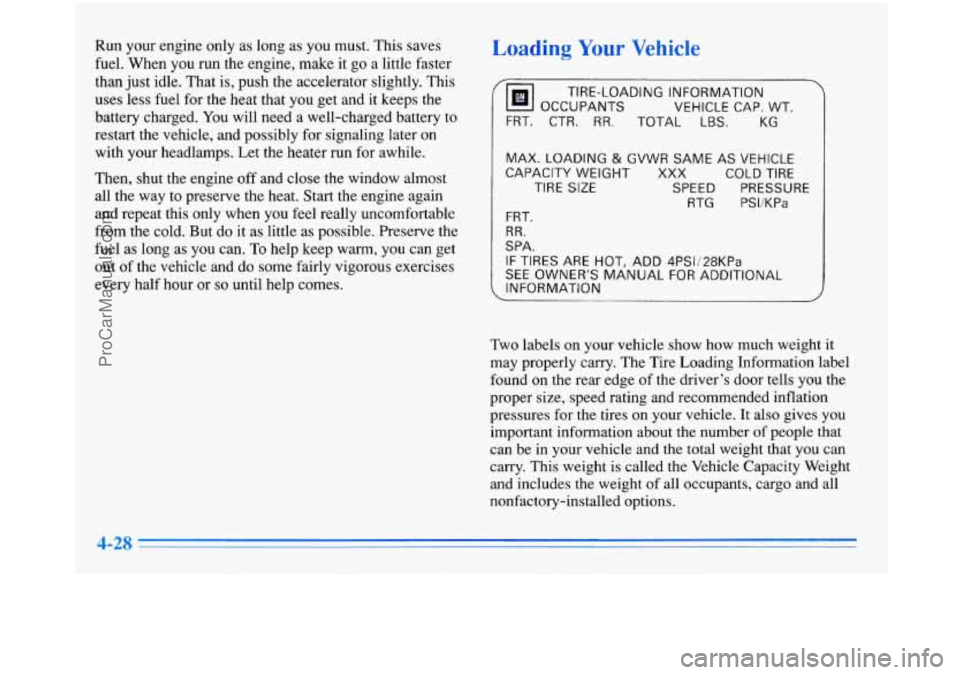
Two labels on your vehicle show how much weight it
may properly carry. The Tire Loading Information label
found on the rear edge
of the driver's door tells you the
proper size, speed rating and recommended inflation
pressures for the tires on your vehicle. It also gives you
important information about the number
of people that
can be in your vehicle and the total weight that you can
carry. This weight is called the Vehicle Capacity Weight
and includes the weight of all occupants, cargo and all
nonfactory-installed options.
4-28
ProCarManuals.com
Page 210 of 388
Tbrn Signals When Towing a Trailer
The arrows on your instrument panel will flash
whenever you signal a turn or lane change. Properly
hooked up, the trailer lamps will also flash, telling other
drivers you’re about
to turn, change lanes or stop.
When towing a trailer, the arrows on your instrument
panel will flash for turns even if the bulbs on the trailer
are burned out. Thus, you may think drivers behind you
are seeing your signal when they are not. It’s important
to check occasionally to be sure the trailer bulbs are still
working.
Your vehicle
has bulb warning lights. When you plug a
trailer lighting system into your vehicle’s lighting
system, its bulb warning lights may not let you know if
one of your lamps goes out.
So, when you have a trailer
lighting system plugged in, be sure
to check your
vehicle and trailer lamps from time to time to be sure
they’re all working. Once you disconnect the trailer
lamps, the bulb warning lights again can tell you if one
of your vehicle lamps
is out.
Driving On Grades
Reduce speed and shift to a lower gear before you start
down a long or steep downgrade.
If you don’t shift
down, you might have to use your brakes
so much that
they would get hot and no longer work well.
On a long uphill grade,
shift down to THIRD (3) and
reduce your speed to around
45 mph (70 km/h) to reduce
the possibility of engine and transaxle overheating.
Parking on Hills
You really should not park your vehicle, with a trailer
attached, on a hill.
If something goes wrong, your rig
could start to move. People can be injured, and both
your vehicle and the trailer can
be damaged.
But if you ever have to park your rig on a hill, here’s
how
to do it:
1. Apply your regular brakes, but don’t shift into
PARK (P) yet.
2. Have someone place chocks under the trailer wheels.
3. When the wheel chocks are in place, release the
regular brakes until the chocks absorb the load.
4. Reapply the regular brakes. Then apply your parking
5. Release the regular brakes.
brake, and the shift
to PARK
(P).
4-36
ProCarManuals.com
Page 216 of 388
..
A CAUTION:
Using a match near a battery can cause battery
gas to explode. People have been hurt doing this,
and some have been blinded. Use
a flashlight if
you need more light. .
Be sure the battery has enough water. You don’t
need to
add water to the Delco Freedom@ battery
installed in every new
GM vehicle. But if a
battery has filler caps,. be sure the rightamount
offluid is there.
If it is low, add water to take care
of that first. If you don’t, explosive gas could
be present.
Battery fluid contains acid that can burn you.
Don’t get it on you.
If you accidentally get it in
your eyes or on your skin, flush the place with
water and get medical help immediately.
I
6. Check that the jumper cables don’t have loose or
missing insulation. If they do, you could get a shock
and the vehicles could. be damaged.
Before you connect the cables, here are some basic
, . ’
things you should know. Positive (+) will ‘go to
positive (+) and negative (-) will go to negative (-)
or a metal .engine part. Don’t connect positive (+) to
negative
(-) or you’ll get a short that would damage
the battery and maybe other
parts, too.
,.
.,
I
Fans or other moving engine parts ean injure you
badly. Keep your hands away from moving parts
once the engines are running.
I
I. 5-4
ProCarManuals.com
Page 224 of 388
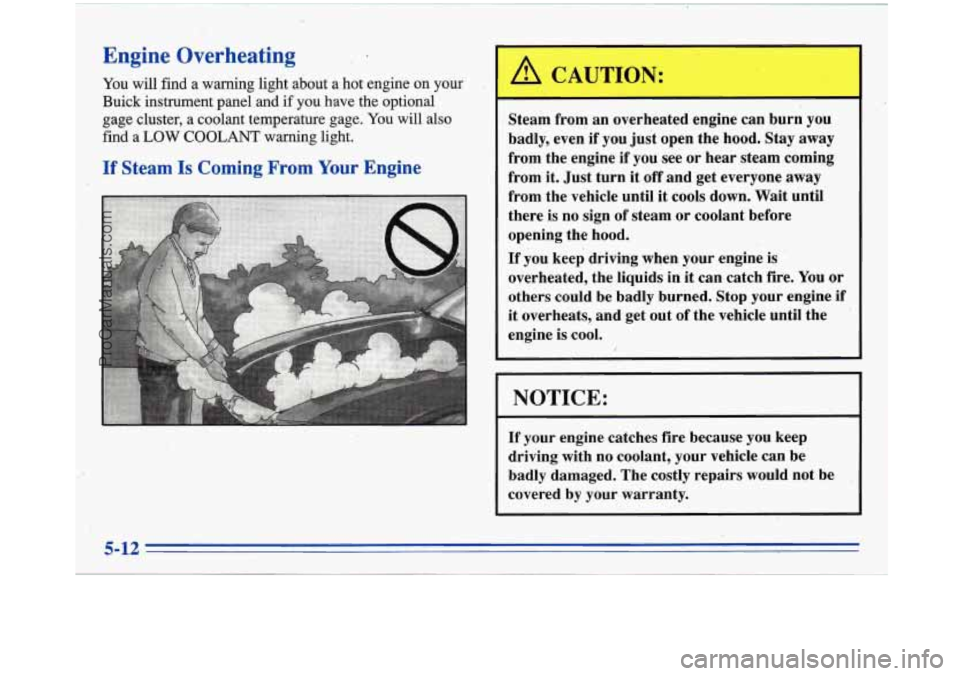
Engine Overheating
You will find a warning light about a hot engine on your
Buick instrument panel and
if you have the optional
gage cluster, a coolant temperature gage. You
will also
find a LOW COOLANT warning light.
If Steam Is Coming From Your Engine
Steam from an overheated engine can burn you
badly, even if you just open the hood. Stay away
from the engine
if you see or hear steam coming
from it. Just turn it off and get everyone away
from the vehicle until it cools down. Wait until
there
is no sign of steam or coolant before
opening the hood.
If you keep driving when your engine is
overheated, the liquids in it can catch fire.
You or
others could be
badly burned. Stop your engine if
it overheats, and get out of the vehicle until the
engine is cool.
,
NOTICE:
If your engine catches fire because you keep
driving with no coolant, your vehicle can be
badly damaged. The costly repairs would not be
covered
by your warranty.
5-12
ProCarManuals.com
Page 247 of 388
If You’re Stuck: In Sand, Mud,
Ice
or Snow
What you don’t want to do when your vehicle is stuck is
to spin your wheels too fast. The method known as
“rocking” can help you get out when you’re stuck, but
you must use caution.
If you let your tires SI at high speed, they can
explode,
and you or others could be injured. And,
the transaxle or other parts
of the vehicle can
overheat. That could cause an engine
compartment fire or other damage. When you’re
stuck, spin the wheels as little as possible. Don’t
spin the wheels above
35 mph (55 km/h) as shown
on the speedometer.
I NOTICE:
Spinning your wheels can destroy parts of your
vehicle as well as the tires.
If you spin the wheels
too fast while shifting your transaxle back and
forth, you can destroy your transaxle.
For information about using tire chains on your vehicle,
see “Tire Chains” in the Index.
Rocking your vehicle
to get it out:
First, turn your steering wheel left and right. That will
clear the area around your front wheels. If your vehicle
has traction control, you should turn the system off. (See
“Traction Control System” in the Index.) Then shift
back and forth between REVERSE (R) and a forward
gear, spinning the wheels
as little as possible. Release
the accelerator pedal while
you shift, and press lightly
on the accelerator pedal when the transaxle is in gear. If
that doesn’t get you out after a few tries, you may need
to be towed out. If you do need to be towed out, see
“Towing Your Vehicle” in the Index.
ProCarManuals.com
Page 260 of 388
Your Park Avenue Ultra has a 3800 Supercharged
engine. Buick chose supercharging rather than
turbocharging because Buick emphasizes smooth,
refined power.
The supercharger
is a device which is designed to pump
more air into the engine than it would normally use.
This air mixed with fuel creates increased engine power.
Since the supercharger is a pump and is driven from an
engine accessory drive belt, increased pressure is available at all driving conditions.
The Powertrain Control Module (PCM) works with a
vacuum control to regulate the increased pressure
required during specific driving conditions. When this increased pressure or boost is not desired, such as during
idling and light throttle cruising, the excess air that the
supercharger is pumping is routed through a bypass. All
of these controls working together provide high
performance character and fuel efficiency in the
3800 V6 Supercharged Buick engine.
The power steering pump and reservoir are mounted
on the rear (driver’s side)
of the engine block. See
“Maintenance Schedule” in the Index for when you
should check the fluid.
Engine Oil
If the CHECK OIL
LEVEL light on the
instrument panel
comes on, it means
CHECK OIL you need to check
LEVEL your engine oil level
right away.
For more information, see “Check Oil Level Light” in
the Index. You should check your engine oil level
regularly; this is an added reminder.
ProCarManuals.com
Page 264 of 388
When to Change Engine Oil
See if any one of these is true for you:
0
Most trips are less than 5 to 10 miles (8 to 16 km).
This is particularly important when outside
temperatures are below freezing.
Most trips include extensive idling (such as frequent
driving in stop-and-go traffic).
Most trips are through dusty areas.
You frequently tow a trailer or use a carrier on top of
your vehicle.
The vehicle is used for delivery service, police, taxi
or other commercial application.
Driving under these conditions causes engine oil to
break down sooner.
If any one of these is true for your
vehicle, then you need to change your oil and filter
every
3,000 miles (5 000 km) or 3 months -- whichever
occurs first. (See “Change Oil Soon” in the Index.)
If none of them is true, change the oil and filter every
7,500 miles (12 500 km) or 12 months -- whichever
occurs first. Driving a vehicle with a fully warmed
engine under highway conditions causes engine oil to
break down slower.
If the optional CHANGE OIL SOON light comes on,
you will need to change your oil sooner than either
mileage specified. Depending upon driving habits, the
CHANGE OJL SOON light may come on as early as
2,000 miles
or less from the last time the oil life monitor
was reset. (See “Oil Life Monitor” in the Index.)
Always
reset the
oil life monitor after every oil change.
What to Do with Used Oil
Did you know that used engine oil contains certain
elements that may be unhealthy for your skin and could
even cause cancer? Don’t let used oil stay on your skin
for very long. Clean your skin and nails with soap and
water, or a good hand cleaner. Wash or properly throw
away clothing or rags containing used engine oil. (See
the manufacturer’s warnings about the use and disposal
of oil products.)
Used oil can be a real threat to the environment.
If you
change your own oil, be sure
to drain all free-flowing oil
from the filter before disposal. Don’t ever dispose of oil
by putting it in the trash, pouring it on
the ground, into
sewers, or into streams or bodies of water. Instead,
recycle it by taking
it to a place that collects used oil. If
you have a problem properly disposing of your used oil,
ask your dealer, a service station or a local recycling
center for help.
ProCarManuals.com
Page 271 of 388
How to Add Fluid
Refer to the Maintenance Schedule to determine what
kind of transaxle fluid to use. See “Recommended
Fluids and Lubricants” in the Index.
If the fluid level is low, add only enough
of the proper
fluid to bring the level into the cross-hatched area on
the dipstick.
1. Pull out the dipstick.
2. Using a long-neck funnel, add enough fluid at the
It doesn’t take much fluid, generally less than a pint
(0.5 L). Don’t ovel-fill. We recommend you use only
fluid labeled DEXRON@-111, because fluid with that
label is made especially for your automatic transaxle.
Damage caused by fluid other than DEXRON-I11 is
not covered by your new vehicle warranty.
dipstick hole to
bring it to the proper level.
After adding fluid, recheck the fluid level as
described under “How to Check.”
0 When the correct fluid level is obtained, push the
dipstick back in all the way.
Engine Coolant
The cooling system in your vehicle is filled with new
DEX-COOL
TM (orange-colored, silicate-free) engine
coolant. This coolant is designed to remain in your
vehicle for
5 years or 100,000 miles (166 000 km),
whichever occurs first.
The following explains your cooling system and how
to add coolant when
it is low. If you have a problem
with engine overheating, see “Engine Overheating” in
the Index.
A 50/50 mixture of water and the proper coolant for
your Buick will:
Give freezing protection down to -34°F (-37°C).
9 Give boiling protection up to 265 OF ( 129 O C).
Protect against rust and corrosion.
Help keep the proper engine temperature.
0 Let the warning lights and gages work as they should.
ProCarManuals.com
Page 274 of 388
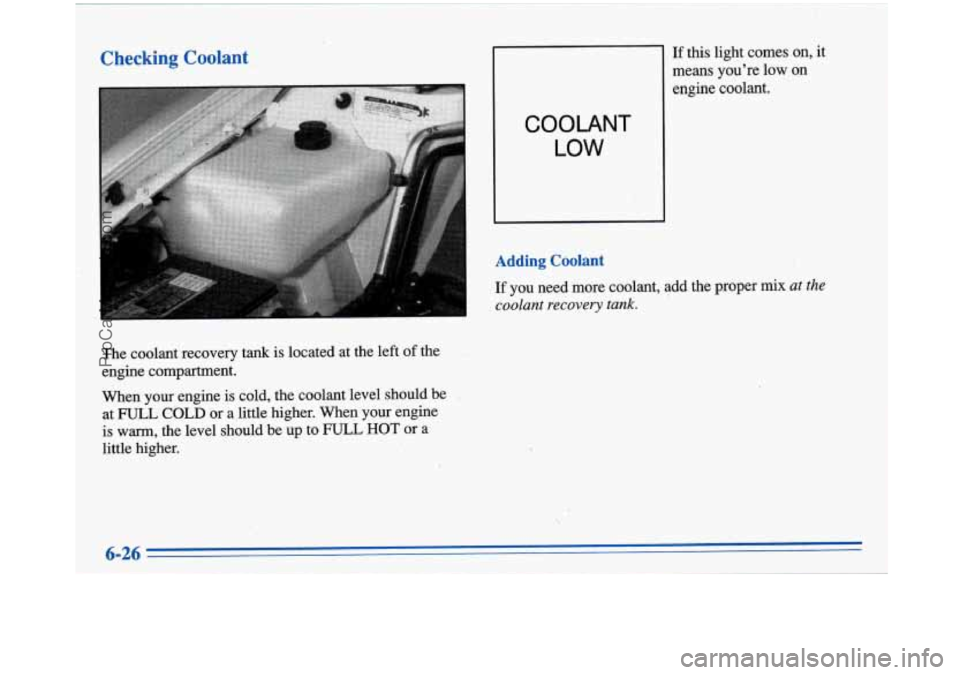
Checking Coolant
The coolant recovery tank is located at the left of the
engine compartment.
When your engine is cold, the coolant 'level should be
at
F'ULL COLD or a little higher. When your engine
is warm, the level should be up to F'ULL HOT or a
little higher.
COOLANT
LOW
- If this light comes on, it
means you're low on
engine coolant.
-
Adding Coolant
If you need more coolant, add the proper mix at the
coolant
recovery tank.
ProCarManuals.com